

News from our lab. We study toxic cyanobacteria, water quality, secondary metabolism and microbial bioinformatics. Posts by lab members. Led by @david_fewer
University of Helsinki
Joined November 2021
- Tweets92
- Following68
- Followers365
- Likes186


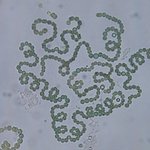


Bacteria can make extracellular polysaccharides that mediate heavy metal removal. This exopolysaccharide-producing cyanobacterium turned a 40-ml liquid culture into a gel. #UHCCCultureCollection
Oldest direct evidence for oxygenic photosynthesis in cyanobacteria fossils from around 1.75 billion years ago

I'm happy and so proud to share our new paper published in Nature, today! #Fossil #FossilThylakoids #Photosynthesis #Cyanobacteria nature.com/articles/s41586-0…
6
810
Our paper describing the isolation of a toxic strain of cyanobacteria from a microbial mat in the Helsinki coast of the Baltic Sea sciencedirect.com/science/ar…


David Fewer retweeted

The cyanobacterium Aetokthonos hydrillicola really is nasty, as we show in the most recent @PNASNews cover story (pnas.org/doi/10.1073/pnas.22…). A thread… 1/

David Fewer retweeted

Campaigners have held a wake on the shores of Lough Neagh to mourn what they say is the death of the largest freshwater lake in Ireland and the UK. The lough is heavily polluted with toxic blue-green algae | rte.ie/b/1405756
Sila's paper on an unusual branched biosynthetic pathway for the production of microbial sunscreens out now in ACS Chemical Biology pubs.acs.org/doi/10.1021/acs…

Our latest paper on the isolation of a toxin-producing cyanobacterium from an algal mat on the Helsinki coast of the Baltic Sea
sciencedirect.com/science/ar…
David Fewer retweeted

Kuuman alkukesän seurauksena sinilevähavaintoja tehtiin runsaasti. Vaikka heinäkuu alkoikin viilenevän kesäsään merkeissä, runsaat sateet voivat lisätä vesistöihin valuvaa ravinnekuormaa ja siten edistää sinileväkukintojen runsastumista.
wwf.fi/uutiset/2023/07/sinil…

David Fewer retweeted

Kaksi kuvaa #Itämeri'stä juuri nyt. Meri on kuuma, @dmidk'n mukaan n. 4 °C yli 1985-2003 keskiarvon. Oikealla @SYKE_EO:ssa tuotettu satelliittikuva eiliseltä, 28.6. #Suomenlahti muistuttaa jo kesää 2018. Heinäkuun sää ratkaisee miten #sinilevä'tilanne kehittyy. @SYKEinfo #ilmasto


Photo of a foliose tripartite lichen (Peltigera) that keeps cyanobacteria (Nostoc) as a nitrogen-fixing partner in black bodies called cephalodia. These cyanobacteria can produce toxins while in symbiosis or grown in pure culture.
doi.org/10.1073/pnas.1200279…


ALT Nostoc sp. UHCC 0360, symbiotic cyanobacterium
1
16
836
David Fewer retweeted

Our alga of the week from the@CCACof is #CCAC 3369 B Spirulina sp.
Class: #Cyanophyceae
Order: Spirulinales
Family: Spirulinaceae
#Algensammlung #algae #microalgae #ude #Cyanobakterien #Blaualgen #cyanobacteria #algaoftheweek

David Fewer retweeted

Domoic acid event along the coast is having a significant effect on the health of marine mammals 💔 via @NYTimes nytimes.com/2023/06/21/us/al…

Xiaodan Ouyang (@XiaodanOuyang) presenting her paper on the direct pathway cloning and expression of radiosumin biosynthetic pathway at the Nordic Natural Products conference today. Well done Xiaodan!
doi.org/10.5281/zenodo.80217…
#ChinaScholarshipCouncil

2
10
850
David Fewer retweeted
Spirulina grows on rocks and boulders in the #BalticSea. These cyanobacteria can adapt their light harvesting apparatus to dim light using different pigments. Photos by Annica Långnabba (Metsähallitus) and @inkeri_vuori
#MicroscopyMonday @VELMUohjelma @NesslingSaatio

ALT Spirulina mat growing on boulders in Baltic Sea Photo © Annica Långnabba (Metsähallistus)


Spirulina grows on rocks and boulders in the #BalticSea. These cyanobacteria can adapt their light harvesting apparatus to dim light using different pigments. Photos by Annica Långnabba (Metsähallitus) and @inkeri_vuori
#MicroscopyMonday @VELMUohjelma @NesslingSaatio
ALT Spirulina mat growing on boulders in Baltic Sea Photo © Annica Långnabba (Metsähallistus)
Congratulations to @XiaodanOuyang on her article in Organic and Biomolecular Chemistry! A big thanks to all co-authors. We report the radiosumin biosynthetic pathway and show that this small molecule is a human trypsin inhibitor.
doi.org/10.1039/D3OB00385J
#Nordaqua #mmtdk
Trichodesmium forms blooms in tropical and subtropical oceans where they are important source of new nitrogen. Sailors have referred to the blooms as sea sawdust since the 1700s. This study in Science resolves how motile filaments form colonies under stress conditions.

The movement of individual gliding filaments of nitrogen-fixing cyanobacteria Trichodesmium and their interactions with other filaments help these nitrogen-fixing cyanobacterium form aggregates in response to stress, a new Science study finds. scim.ag/2OE
A thick mat of Oscillatoria covering rocks from Laajalahti bay on the Helsinki coast. Photosynthetic cyanobacteria can provide a substrate for a rich community of heterotrophic bacteria. Photos by @inkeri_vuori
#BalticSea #MicroscopyMonday


David Fewer retweeted

The amount of water stored in more than half of the largest lakes and reservoirs worldwide is declining, a new Science study finds.
The results underscore the importance of better water management to protect essential ecosystem services. scim.ag/2Jx

Check it out! #CyanoMetDB v02 is now available. This public database includes comprehensive chemoinformatic metadata for 2425 toxins and secondary metabolites from cyanobacteria. Congratulations to @JanssenLilli and contributors for all the handwork!
This Post is from an account that no longer exists. Learn more