

Too much capital is lost in familiar stocks (nostalgia investing). Free weekly: the value traps. Members: the ignored longs. 🤝
For Stock Picker’s 👉
Joined June 2022
- Tweets20.8K
- Following311
- Followers3.3K
- Likes18K






Pinned Tweet
Too much capital is lost in familiar stocks
(nostalgia investing)
🆓 Free weekly: the value traps.
🤝 Members: the ignored longs + frequent updates as long as I cover them.
No crash letter / fear pitch.
Written opinion. You decide.
Stocks only.
👉 financial-engineering.net


Interesting that $KLAR is rumored to be a takeover target.
But the 2–3% move is not much…
$5B market cap is pocket change for deep-pocketed addresses.

this was exactly one year ago.
today, another punch in the gut.
not undeserved — the perpetual-growth story flipped into negative comps. Despite overall sales growth, store expansions are masking that on a store basis, sales are declining…
not good…
conclusion: food is a basic necessity, but the higher-price model is cyclical.

$SFM started to see “some“ consumer weakness.
Butchered by 24-25% 🪓
$CBOE was a Premium idea on my blog in 2024
👉 own the options venue that gets paid either way
Members stayed cool through the summer perps scare that briefly cut the stock 40%.
In total it’s up 63% and has left the S&P + Dow behind
my latest free weekly:
financial-engineering.net/cb…
The original case never needed a panic. It needed volume, a protected franchise, and the patience to ignore noise.
That is still the setup.
Join my free weekly newsletter at financial-engineering.net for the next one.
Members get such ideas first.

tip: in my weekly, you can download my full original report about $CBOE for free!
$CBOE was a Premium idea on my blog in 2024
👉 own the options venue that gets paid either way
Members stayed cool through the summer perps scare that briefly cut the stock 40%.
In total it’s up 63% and has left the S&P + Dow behind
The original case never needed a panic. It needed volume, a protected franchise, and the patience to ignore noise.
That is still the setup.
Join my free weekly newsletter at financial-engineering.net for the next one.
Members get such ideas first.
There's a new version of this post
Who’d have thought ☺️

This is interesting…
Warren Buffett’s Berkshire Hathaway ($BRK) invested $10 BILLION in Alphabet ($GOOGL) at ~$350 in June 2026.
Today, shares trade at just $293.
That’s 17% BELOW Berkshire’s purchase price.
Two of Berkshire’s biggest names saw the opportunity.
If Berkshire liked $GOOGL at $350.
Imagine the opportunity at $293.


Google / Big Tech are pumping earnings by quietly extending depreciation periods on their massive AI infrastructure bets.
Natural stupidity meets artificial intelligence — exactly what I warned about in my second-most clicked piece.
since, it has gotten worse.
$GOOGL $BRK — not sure this will be a great outcome for still-celebrated Berkshire.
how Big Tech AI’s (artificially inflates) earnings:
financial-engineering.net/ar…


On Big Tech’s Capex and the coming D&A tsunami.
the market slowly starts to hate it.
What’s exactly the long thesis for Novo?
$NVO

🚨 BREAKING: reta just beat Ozempic head to head
Lilly's Phase 3 in 1,298 people with type 2 diabetes, 80 weeks:
> reta 12 mg: -47 lbs (21%)
> reta 9 mg: -44 lbs (19.5%)
> Ozempic 2 mg (its highest dose): -21 lbs (9%)
A1C (avg blood sugar) also dropped more: 2.2% vs 1.8%
Lilly plans to file with the FDA in early 2027

ALT Lilly press release on PR Newswire, Oct 28, 2026: Lilly's retatrutide delivered greater A1C reduction and more than double the weight loss of Ozempic's highest approved dose in head-to-head trial. Bullets: A1C lowered 2.2% vs 1.8% with Ozempic 2 mg at 80 weeks; participants lost 44 to 47 lbs (20% to 21%) vs 21 lbs (9%) with Ozempic 2 mg
Alan Gałecki – Financial-Engineering.net retweeted

Zirkuläre finanzielle Abhängigkeiten im KI Sektor 🤖
Aktuelle Marktanalysen zeigen, dass sich die KI-Infrastruktur zu rund 55 % im eigenen Kreislauf finanziert
Beeindruckende Visualisierung von Bloomberg

Meine neuste Analyse für @ThePioneerDe — über die Schweizer ABB 👇
thepioneer.de/originals/othe…

the reported growth was purely pricing driven.
--> volumes were NEGATIVE
Not good…

Reckitt lowered its sales forecast after supply constraints hit sales of its cleaning products in the US and its vitamin brands suffered a setback in China bloomberg.com/news/articles/…

Alan Gałecki – Financial-Engineering.net retweeted

Wie sagte mal der große, leider zu früh von uns gegangene, Philosoph Andreas Brehme:
"Haste Scheiße am Fuß, haste Scheiße am Fuß“


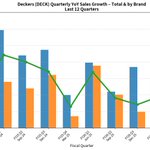
Sales can grow without earnings when margins are under pressure.
Buybacks can fall to save a stock when there are demand and cost issues.
Something to watch.
Interesting

Our cautious stance on footwear wholesale, particularly $DECK and $ONON, has been reinforced by subsequent industry checks and company commentary. Across U.S. and European retailers, we’ve consistently heard the same message: conservative initial orders, limited appetite for replenishment, and increasing promotional pressure. The issue isn’t necessarily collapsing consumer demand, but the willingness of retailers to underwrite another season of inventory risk. We believe $CROX faces a similar challenge, with potentially more severe earnings consequences.
The concern was raised at a recent investor roundtable where CROX was pitched as a short. The argument centered on a saturated Classic Clog franchise, limited incremental distribution opportunities, weak HEYDUDE demand, and an earnings outlook potentially flattered by temporary demand drivers and marketplace dynamics. Our subsequent work has reinforced several of those concerns, although the evidence is more nuanced than simply declaring the Crocs brand broken.
CROX’s own financials illustrate the problem. In Q2, Crocs-brand revenue grew 4.3%, but wholesale declined 5.0%. HEYDUDE revenue declined 5.7%, with wholesale down 17.2% despite DTC growth of 7.2%. For the first half, HEYDUDE wholesale contracted 21.1%, while its gross margin fell 500 basis points to 43.5%. Management continues to emphasize wholesale inventory normalization and a return to growth, but that recovery requires retailers to become more willing to commit capital to a brand whose underlying unit demand remains challenged.
Our third-party data reinforces the distinction between the two franchises. Crocs has demonstrated an ability to offset declining Classic Clog demand through Baya, sandals and newer silhouettes, although recent ex-Amazon sell-through has become volatile. Amazon itself remains deeply negative, while the company’s transition of that business from marketplace DTC to wholesale complicates reported channel comparisons. HEYDUDE offers less evidence of a sustainable consumer recovery: recent observed U.S. units remain down double digits even as dollar trends improve, suggesting that better realized pricing or mix has not translated into renewed volume growth.
We find the wholesale assumptions particularly difficult to reconcile with what we’re hearing from retailers. Management acknowledged on its Q2 call that HEYDUDE’s wholesale contraction reflects an ongoing channel reset, while an analyst specifically questioned the acceleration required to achieve its second-half growth expectations. In an environment where retailers are reluctant to reorder even stronger footwear franchises, we struggle to see why HEYDUDE should benefit from a meaningful replenishment cycle heading into 2027.
The operating implications could be more severe than at DECK. HEYDUDE is already operating with substantially lower gross margins than the Crocs brand, and further wholesale weakness risks magnifying fixed-cost deleverage, promotional pressure and unfavorable channel economics. Cost reductions and buybacks may support EPS, but they do not resolve the underlying demand problem. Importantly, CROX’s Q2 adjusted operating income declined 4.5% despite consolidated revenue growth of 2.6%—a reminder that positive sales growth does not automatically translate into earnings growth.
Which brings us to valuation. Why pay a multiple that is only modestly discounted to more durable footwear franchises for a business with two very different challenges: one banner struggling to establish sustainable growth and another confronting maturity in the product that built the franchise? We can instead evaluate $ONON or $DECK, where the debate is increasingly about the magnitude of growth deceleration rather than whether the existing earnings base is sustainable. Both face wholesale risk, but slowing growth and structural earnings deterioration are not equivalent underwriting propositions.