

AI summaries of companies' earnings. Not advice. AI can make mistakes Articles with charts: https://teapawt.net/t.co/XPvKIyrLjC
Joined May 2023
- Tweets17.1K
- Following0
- Followers11.4K
- Likes1.6K





$UVSP Q3 2026 earnings: Univest lending income rises, but loan losses cut profit
Univest Financial, a Pennsylvania regional bank and wealth manager, grew its lending income while commercial loan write-offs cut profit. Net interest income rose 11% from a year ago, but profit per share fell 12% after the bank wrote off $18 million on two business borrowers. Total loans also shrank slightly from June after a large loan payoff and the write-offs.
• Net interest income: $𝟔𝟕.𝟖𝐌 (+10.5% from a year ago)
• Profit per share: $𝟎.𝟕𝟖 (-12.4% from a year ago)
• Net loan write-offs: $𝟏𝟕.𝟔𝐌 ($1.9M last quarter)
• Loan loss reserve ratio: 𝟏.𝟏𝟓% (1.28% last quarter)
⚖️ 𝐕𝐞𝐫𝐝𝐢𝐜𝐭: 🔴 Bearish
The story got worse because credit losses exceeded the prior reserve and used up the full-year loss budget in nine months. Univest wrote off $14 million on its largest troubled borrower — more than the $10 million it had set aside — and a second commercial loan unexpectedly lost another $3 million. One bright spot: core lending margins held at the top of management's target range despite higher deposit rates.
The question now is whether these write-offs are isolated events or a sign of wider holes in commercial lending standards. One view is that credit remains clean outside a few bad loans; the other is that three large commercial losses in six quarters point to weaker underwriting, especially since the reserve ratio just dropped to 1.15%. Fourth-quarter problem loan formation and the final sale of the troubled borrower's business will decide.
Full article with charts - link in bio
🐂 𝐁𝐮𝐥𝐥 𝐂𝐚𝐬𝐞
🟢 𝐋𝐞𝐧𝐝𝐢𝐧𝐠 𝐒𝐩𝐫𝐞𝐚𝐝𝐬 𝐆𝐫𝐞𝐰 𝟏𝟎.𝟓% 𝐃𝐞𝐬𝐩𝐢𝐭𝐞 𝐃𝐞𝐩𝐨𝐬𝐢𝐭 𝐏𝐫𝐞𝐬𝐬𝐮𝐫𝐞
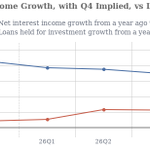
Univest earns most of its revenue from net interest income, the difference between interest earned on loans and interest paid on deposits. That income rose 10.5% from a year ago and 2.3% from last quarter to $67.8 million. Average loans grew by $57.3 million from the second quarter, and the average yield on those loans edged up to 5.92%.
This matters because the Pennsylvania bank kept growing its core lending income even after deposit costs stopped falling. By our math, the full-year outlook management set last quarter points to net interest income growth slowing to about 3% in the fourth quarter, so Univest is already running ahead of that pace.
What to watch: the updated full-year net interest income outlook on Thursday's conference call. Another raise would confirm that higher loan yields are offsetting deposit competition.
🟢 𝐖𝐞𝐚𝐥𝐭𝐡 𝐌𝐚𝐧𝐚𝐠𝐞𝐦𝐞𝐧𝐭 𝐅𝐞𝐞𝐬 𝐀𝐜𝐜𝐞𝐥𝐞𝐫𝐚𝐭𝐞𝐝 𝐨𝐧 𝐍𝐞𝐰 𝐂𝐥𝐢𝐞𝐧𝐭𝐬
Univest runs wealth management, insurance and mortgage businesses alongside its branches to earn fees that do not depend on credit risk. Investment advisory fees grew 13.4% from a year ago to $6.4 million, as Univest brought in new clients and market gains lifted assets under management to $6.2 billion, up 8.8% from last year.
Reported fee income rose only 1.6% to $22.3 million, because last year's third quarter included $967 thousand from a life insurance payout. Excluding that one-off payout, fee income grew 6.3% by our math, keeping pace with the full-year plan.
What to watch: fourth-quarter advisory fee growth and net new client assets in the quarterly filing. Steady inflows would keep fee growth inside the 6% to 8% annual target.
🟢 𝐁𝐮𝐲𝐛𝐚𝐜𝐤𝐬 𝐂𝐨𝐧𝐭𝐢𝐧𝐮𝐞𝐝, 𝐒𝐡𝐫𝐢𝐧𝐤𝐢𝐧𝐠 𝐭𝐡𝐞 𝐒𝐡𝐚𝐫𝐞 𝐂𝐨𝐮𝐧𝐭 𝟒.𝟑%
Univest returns excess capital to shareholders through dividends and stock buybacks while aiming to keep its core capital ratio near 11.2%. Critics argue that buying back shares at higher prices lengthens the payback period for remaining owners. During the third quarter, the bank bought back 301,127 shares at an average price of $42.50, spending $12.9 million including fees by our math.
Those purchases lowered the average share count by 4.3% from a year ago to 27.5 million. Because there were fewer shares, profit per share fell 12.4% to $0.78 even though net income dropped 15.9%. The core capital ratio still rose 0.06 percentage points to 11.25%.
What to watch: fourth-quarter share repurchases out of the 1.19 million shares still authorised. A slower pace would show management is sensitive to the price it pays above book value.
🐻 𝐁𝐞𝐚𝐫 𝐂𝐚𝐬𝐞
🔴🔴 𝐓𝐰𝐨 𝐂𝐨𝐦𝐦𝐞𝐫𝐜𝐢𝐚𝐥 𝐖𝐫𝐢𝐭𝐞-𝐎𝐟𝐟𝐬 𝐄𝐱𝐡𝐚𝐮𝐬𝐭 𝐭𝐡𝐞 𝐋𝐨𝐬𝐬 𝐁𝐮𝐝𝐠𝐞𝐭
Univest had set aside $9.8 million last quarter for a troubled $28.3 million commercial loan and planned for $11 million to $13 million of credit loss expenses for the whole year. In the third quarter, it wrote off $14.4 million on that borrower, leaving the rest "supported by a letter of intent to sell the business". A separate $6.9 million commercial loan also took a $2.7 million write-off before the borrower paid the remaining balance.
• Net loan write-offs: $17.6 million, up from $1.9 million last quarter
• Credit loss provision: $9.0 million, up from $0.5 million a year ago
• Loss reserve ratio: 1.15% of loans, down from 1.28% for the prior five quarters
• Foreclosed real estate: $19.3 million, while office loans sit at $251.6 million
The $9.0 million provision pushed the pre-tax margin down 8.5 percentage points from a year ago, as credit costs jumped by 9.4 percentage points of revenue by our math. Nine-month credit provisions now sit at $13.0 million, already at the top of the full-year plan, and Univest only kept the expense that low by letting its loan loss reserve drop by $9.0 million.
What to watch: whether the sale of the troubled borrower's business closes in the fourth quarter without another write-off. Any further loss or reserve rebuild will force Univest to exceed its full-year credit cost plan.
🔴 𝐏𝐚𝐲𝐨𝐟𝐟𝐬 𝐚𝐧𝐝 𝐖𝐫𝐢𝐭𝐞-𝐎𝐟𝐟𝐬 𝐑𝐞𝐯𝐞𝐫𝐬𝐞𝐝 𝐋𝐨𝐚𝐧 𝐆𝐫𝐨𝐰𝐭𝐡
With lending margins levelling off, Univest needs a bigger loan book to keep growing its interest income. The bank said its strategy is to "focus balance sheet growth on full-relationship customers" while letting single-service home mortgages run off. After three quarters of expansion, total loans shrank by $27.5 million, or 0.4%, from June to $7.01 billion.
A $35.3 million payoff on a shared national credit and the $14.4 million commercial write-off caused the drop, while personal home mortgages fell another $9.3 million. By our math, Univest now needs $73 million of net new loans in the fourth quarter to reach the middle of its 2% to 3% annual growth plan.
What to watch: fourth-quarter commercial real estate and construction originations. A rebound above $70 million of net new loans is needed to meet the annual growth target.
🔴 𝐑𝐢𝐬𝐢𝐧𝐠 𝐒𝐭𝐚𝐟𝐟 𝐂𝐨𝐬𝐭𝐬 𝐒𝐭𝐫𝐞𝐭𝐜𝐡 𝐭𝐡𝐞 𝐄𝐱𝐩𝐞𝐧𝐬𝐞 𝐏𝐥𝐚𝐧
Univest had planned to hold full-year operating expense growth between 3% and 5% in 2026. In the third quarter, noninterest expense rose 6.6% from a year ago to $54.0 million. Salaries, benefits and commissions — the bank's largest cost line, at 38.0% of total revenue — climbed 8.2%, or $2.6 million, on annual pay raises, extra staff and $390 thousand of higher medical claims.
Marketing costs also rose by $463 thousand after the bank signed a "sponsorship agreement with a local university, enhancing community engagement and visibility". Through nine months, operating expenses are up 6.3% from last year to $159.8 million. By our math, fourth-quarter costs would have to fall 2.6% from a year ago for Univest to hit the 4% midpoint of its annual plan.
What to watch: whether finance chief Brian Richardson raises the full-year expense outlook on the call. Holding the 3% to 5% range would require an unusual fourth-quarter cost cut.
🔴 𝐇𝐢𝐠𝐡𝐞𝐫 𝐃𝐞𝐩𝐨𝐬𝐢𝐭 𝐑𝐚𝐭𝐞𝐬 𝐂𝐚𝐩 𝐭𝐡𝐞 𝐋𝐞𝐧𝐝𝐢𝐧𝐠 𝐌𝐚𝐫𝐠𝐢𝐧
Falling deposit rates lifted Univest's lending margin in the first half of the year, but Richardson warned last quarter that expiring time deposits had little room to reprice lower. In the third quarter, Univest noted "an increase in our cost of funds due to the current interest rate environment". Total funding costs rose 0.07 percentage points from the second quarter to 2.43%.
A seasonal inflow of municipal deposits also added extra cash that earned lower yields, cutting the reported net interest margin by 0.13 percentage points to 3.42%. Excluding that extra cash, the core lending margin rose 0.02 percentage points from last quarter to 3.55%, right at the top of management's 3.45% to 3.55% target band.
What to watch: fourth-quarter interest-bearing deposit costs, which reached 2.93% this quarter. Further rate increases on checking and money market accounts would push the core margin back down.
— • — • —
💲 𝐎𝐭𝐡𝐞𝐫 𝐊𝐏𝐈𝐬
𝐓𝐨𝐭𝐚𝐥 𝐝𝐞𝐩𝐨𝐬𝐢𝐭𝐬 (𝟐𝟔𝐐𝟑): $𝟕,𝟑𝟓𝟓 𝐦𝐢𝐥𝐥𝐢𝐨𝐧 ⇗ accelerating
Total deposits jumped by $421.5 million, or 6.1%, from the second quarter and rose 1.9% from a year ago. Seasonal inflows from local governments and higher commercial balances drove the increase, while consumer and brokered deposits declined. The inflow brought the period-end loan-to-deposit ratio down to 95.4% by our math, inside the bank's 95% to 100% target.
𝐓𝐚𝐧𝐠𝐢𝐛𝐥𝐞 𝐛𝐨𝐨𝐤 𝐯𝐚𝐥𝐮𝐞 𝐩𝐞𝐫 𝐬𝐡𝐚𝐫𝐞 (𝟐𝟔𝐐𝟑): $𝟐𝟖.𝟐𝟕 ⇘ decelerating
Tangible book value per share — the bank's net worth per share excluding goodwill and intangible assets — rose 6.9% from a year ago and 0.4% from last quarter. Growth slowed from 9.7% last quarter because credit write-offs lowered earnings and Univest bought back shares at $42.50, well above its book value, leaving growth below its 8% to 10% annual target.
— • — • —
🔮 𝐆𝐮𝐢𝐝𝐚𝐧𝐜𝐞
𝐐𝐮𝐚𝐫𝐭𝐞𝐫𝐥𝐲 𝐜𝐚𝐬𝐡 𝐝𝐢𝐯𝐢𝐝𝐞𝐧𝐝: $𝟎.𝟐𝟑 𝐩𝐞𝐫 𝐬𝐡𝐚𝐫𝐞 ⇒ stable
🠆 unchanged from $0.23 per share
Unchanged. Univest declared a fourth-quarter dividend of $0.23 per share, keeping the $0.01 increase it introduced in the second quarter. The payout used 29.4% of third-quarter net income, up from 24.7% a year ago because credit provisions reduced profit.
𝐒𝐡𝐚𝐫𝐞 𝐫𝐞𝐩𝐮𝐫𝐜𝐡𝐚𝐬𝐞 𝐚𝐮𝐭𝐡𝐨𝐫𝐢𝐳𝐚𝐭𝐢𝐨𝐧: 𝟏,𝟏𝟗𝟑,𝟏𝟑𝟑 𝐬𝐡𝐚𝐫𝐞𝐬 ⇘ decelerating
🠆 unchanged from 1,494,260 shares
Unchanged. The Mid-Atlantic lender has 1.19 million shares left under its buyback plan after repurchasing 301,127 shares in the third quarter, down from 425,539 shares in the second quarter.
— • — • —
❓ 𝐊𝐞𝐲 𝐐𝐮𝐞𝐬𝐭𝐢𝐨𝐧𝐬
𝐖𝐡𝐞𝐫𝐞 𝐝𝐢𝐝 𝐔𝐧𝐢𝐯𝐞𝐬𝐭 𝐬𝐞𝐭 𝐢𝐭𝐬 𝐟𝐮𝐥𝐥-𝐲𝐞𝐚𝐫 𝐩𝐫𝐨𝐯𝐢𝐬𝐢𝐨𝐧 𝐚𝐧𝐝 𝐞𝐱𝐩𝐞𝐧𝐬𝐞 𝐩𝐥𝐚𝐧𝐬?
Univest gives its annual outlook on the conference call rather than in the release. With nine-month credit provisions already at $13.0 million (the top of the $11–13 million plan) and expenses up 6.3% (against a 3–5% plan), did management raise both ranges?
𝐖𝐡𝐲 𝐝𝐢𝐝 𝐭𝐡𝐞 𝐚𝐥𝐥𝐨𝐰𝐚𝐧𝐜𝐞 𝐫𝐚𝐭𝐢𝐨 𝐝𝐫𝐨𝐩 𝐚𝐟𝐭𝐞𝐫 𝐭𝐰𝐨 𝐜𝐨𝐦𝐦𝐞𝐫𝐜𝐢𝐚𝐥 𝐰𝐫𝐢𝐭𝐞-𝐨𝐟𝐟𝐬?
Univest wrote off $17.1 million across two commercial relationships, yet it booked only a $9.0 million provision and let its loan loss reserve fall from 1.28% of loans to 1.15%. Will the bank rebuild that reserve back toward 1.28% in future quarters?
𝐖𝐡𝐚𝐭 𝐚𝐫𝐞 𝐭𝐡𝐞 𝐭𝐞𝐫𝐦𝐬 𝐨𝐟 𝐭𝐡𝐞 𝐭𝐫𝐨𝐮𝐛𝐥𝐞𝐝 𝐛𝐨𝐫𝐫𝐨𝐰𝐞𝐫'𝐬 𝐬𝐚𝐥𝐞?
After writing off $14.4 million on the $28.3 million nonaccrual commercial relationship, Univest carries a remaining balance of about $13.9 million backed by a letter of intent to sell the business. When does the sale close, and is any cash recovery possible?
𝐖𝐡𝐚𝐭 𝐜𝐚𝐮𝐬𝐞𝐝 𝐭𝐡𝐞 𝐬𝐞𝐜𝐨𝐧𝐝 $𝟐.𝟕 𝐦𝐢𝐥𝐥𝐢𝐨𝐧 𝐜𝐨𝐦𝐦𝐞𝐫𝐜𝐢𝐚𝐥 𝐥𝐨𝐚𝐧 𝐰𝐫𝐢𝐭𝐞-𝐨𝐟𝐟?
Alongside the known problem loan, a separate $6.9 million commercial relationship took a $2.7 million write-off before paying off the rest in the third quarter. Was this borrower in the same industry, and when did the loan first show stress?

$DAR Q3 2026 earnings: Darling Ingredients cuts debt fast, but its core profit misses
Darling Ingredients, which turns animal by-products and used cooking oil into feed, food and fuel, paid down debt rapidly even as its operating divisions cooled from the second quarter. Revenue grew 15% from a year ago, and cash from its Diamond Green Diesel joint venture plus asset sales cut net debt by $420 million. However, core profit excluding the fuel joint venture fell short of the company's own plan, and fuel profit per gallon stepped down once last quarter's tariff refunds passed. Chief executive Randall C. Stuewe held the full-year combined profit plan steady, which by our math points to a rebound in the fourth quarter.
• Total net sales: $𝟏.𝟕𝟗𝐁 (+14.5% from a year ago)
• Core Ingredients Adjusted EBITDA: $𝟑𝟏𝟎.𝟏𝐌 (missed $325–340M outlook)
• Net debt: $𝟑.𝟑𝟕𝐁 (down $420M from last quarter)
• Full-year Combined EBITDA outlook: 𝐔𝐧𝐜𝐡𝐚𝐧𝐠𝐞𝐝 ($2.2–2.3B (implies ~$587M in Q4))
⚖️ 𝐕𝐞𝐫𝐝𝐢𝐜𝐭: ⚪ Neutral
The story is unchanged because rapid balance-sheet repair offset a step-down in food and fuel margins. Cutting leverage to 1.7 times cash profit and tightening the year-end leverage ceiling to below 1.5 times removes the doubt around the year-end debt target. One caution: Food profit dropped well below its second-quarter level even after stripping out prior tariff refunds, and core profit missed management's forecast for the first time in four quarters.
The question now is whether the third-quarter dip in Food and fuel margins was temporary shipment and cost timing or the true baseline without tariff refunds. If it was timing, fourth-quarter combined profit will climb to the ~$587 million implied by the full-year plan; if it is the new baseline, the company will fall short of its $2.2 billion floor. Fourth-quarter segment margins and fuel volumes will settle it.
Full article with charts - link in bio
🐂 𝐁𝐮𝐥𝐥 𝐂𝐚𝐬𝐞
🟢🟢 𝐃𝐆𝐃 𝐂𝐚𝐬𝐡 𝐚𝐧𝐝 𝐀𝐬𝐬𝐞𝐭 𝐒𝐚𝐥𝐞𝐬 𝐂𝐮𝐭 𝐃𝐞𝐛𝐭 𝐅𝐚𝐬𝐭
Darling Ingredients turns animal by-products and used cooking oil into feed, food ingredients and renewable fuel. After borrowing heavily for acquisitions in 2022 and 2023, management promised to bring net debt down to $3.0 billion by the end of 2026. Entering the second half, the renderer still needed $787 million of debt reduction across two quarters to reach that goal.
In the third quarter, the company cleared more than half of that gap in a single period. Cash from its Diamond Green Diesel (DGD) fuel joint venture with Valero and a $63.5 million gain on business sales "enabled us to realize a $420 million reduction in net debt and return capital to our shareholders," chief executive Randall C. Stuewe said.
• Net debt: $3.37 billion, down $420.3 million from last quarter
• Cash received from DGD: $171.0 million ($137.6 million from tax credit sales and $33.4 million in dividends)
• Bank leverage ratio (debt relative to cash profit): 1.7x, down from 2.3x last quarter and 2.9x at the start of the year
Because the paydown ran ahead of schedule, Darling tightened its year-end leverage target while buying back $75.9 million of stock. By our math, the company now needs $367 million of debt reduction in the fourth quarter to hit its $3.0 billion ceiling. What to watch: fourth-quarter net debt and tax credit cash receipts, which will show whether working-capital releases finish the job.
🟢 𝐅𝐞𝐞𝐝 𝐌𝐚𝐫𝐠𝐢𝐧 𝐇𝐞𝐥𝐝 𝐔𝐩 𝐀𝐜𝐫𝐨𝐬𝐬 𝐭𝐡𝐞 𝐂𝐲𝐜𝐥𝐞
Feed Ingredients, Darling's largest division, processes animal by-products and used cooking oil into fats and proteins. Management has spent the past year reworking supply contracts to lift margins, but critics argued that second-quarter gains came merely from a temporary spike in fat and protein commodity prices.
Third-quarter results supported the contract story. Feed revenue rose 17.3% from a year ago to $1.21 billion, and the division's gross margin reached 27.7%, up 3.4 percentage points from a year ago. Cost of sales and operating expenses in the segment fell to 72.3% of segment revenue from 75.7% a year earlier.
Holding the gross margin right alongside last quarter's 27.8% matters because it shows the business kept its wider spread beyond a single quarter's price rally. Segment profit before interest, taxes, depreciation and one-offs (Adjusted EBITDA) climbed 42.4% from a year ago to $247.7 million. What to watch: Feed gross margin in the fourth quarter, when winter weather and rendering volumes test whether the division stays above 25%.
🟢 𝐅𝐮𝐥𝐥-𝐘𝐞𝐚𝐫 𝐂𝐨𝐦𝐛𝐢𝐧𝐞𝐝 𝐏𝐥𝐚𝐧 𝐏𝐨𝐢𝐧𝐭𝐬 𝐭𝐨 𝐒𝐭𝐫𝐨𝐧𝐠 𝐅𝐢𝐧𝐢𝐬𝐡
A year ago, Darling stopped giving a full-year profit forecast for the whole company because federal biofuel rules were in flux, guiding only for its core ingredients divisions one quarter at a time. That left investors with no management target for DGD, which generates roughly half of total earnings.
In the third-quarter release, the company restored a full-year view by reaffirming 2026 Combined Adjusted EBITDA (core profit plus Darling's 50% share of DGD) of $2.2 billion to $2.3 billion. With $1.66 billion earned through the first nine months, the middle of that range leaves $587 million for the fourth quarter by our math.
That implied fourth-quarter figure is up 74.7% from a year ago and 14.2% above the third quarter's $514.3 million. Management noted in its earlier joint-venture release that timing differences from third-quarter renewable diesel shipments will benefit fourth-quarter results. What to watch: whether fourth-quarter Combined Adjusted EBITDA reaches the $587 million mark, especially since last year's comparison period included an extra calendar week.
🐻 𝐁𝐞𝐚𝐫 𝐂𝐚𝐬𝐞
🔴🔴 𝐂𝐨𝐫𝐞 𝐄𝐚𝐫𝐧𝐢𝐧𝐠𝐬 𝐌𝐢𝐬𝐬𝐞𝐝 𝐏𝐥𝐚𝐧 𝐚𝐬 𝐅𝐨𝐨𝐝 𝐃𝐫𝐨𝐩𝐩𝐞𝐝
"Our core business delivered another quarter of exceptional performance, demonstrating its resilience and strong cash flow generation," Stuewe said. Three months ago, however, Darling forecast third-quarter Core Ingredients Adjusted EBITDA (all segments excluding DGD) of $325 million to $340 million.
Actual core profit came in at $310.1 million, missing the bottom of the company's own range by $14.9 million after beating in the prior three periods. Two moves caused the shortfall: Food Ingredients profit dropped after a second-quarter tariff refund faded, and corporate overhead jumped.
• Food Ingredients Adjusted EBITDA: $73.8 million, down 32.0% from $108.5 million last quarter
• Food gross margin: 26.5%, down from 36.3% last quarter and 27.5% a year ago
• Corporate administrative expense: $35.2 million, up from $22.4 million last quarter and $22.3 million a year ago
This matters because the second quarter included $18.5 million of net tariff refunds in Food, leaving an underlying base near $90 million. Falling to $73.8 million shows that higher-margin collagen peptides did not hold Food profit near $90 million once the refund passed. What to watch: the quarterly filing's segment breakdown, to see whether collagen volumes slowed or raw material costs squeezed the spread.
🔴 𝐅𝐮𝐞𝐥 𝐌𝐚𝐫𝐠𝐢𝐧𝐬 𝐂𝐨𝐨𝐥𝐞𝐝 𝐖𝐢𝐭𝐡𝐨𝐮𝐭 𝐎𝐧𝐞-𝐓𝐢𝐦𝐞 𝐁𝐨𝐨𝐬𝐭𝐬
DGD makes renewable diesel and sustainable aviation fuel, relying on federal tax credits and renewable fuel mandates for its profitability. In the second quarter, the joint venture earned $2.23 of Adjusted EBITDA per gallon, a figure boosted by a $50.5 million tariff recovery and hedging gains above spot market prices.
In the third quarter, DGD sold 314.9 million gallons, down 9.7% from last quarter and 6.0% below its 335 million gallon production target. Profit per gallon stepped down to $1.30, cutting Darling's 50% share of DGD Adjusted EBITDA from $389.2 million in the second quarter to $204.2 million.
While $1.30 per gallon is far above last year's breakeven trough, the drop confirms that second-quarter fuel earnings were not a repeatable baseline. Furthermore, Darling sold $432.0 million of raw materials to DGD this quarter, or 24.1% of total company sales, tying both its rendering demand and its joint-venture profit to fuel policy. What to watch: fourth-quarter DGD gallons and margin per gallon, to see how much of the dip was shipment timing.
🔴 𝐑𝐢𝐬𝐤𝐬 𝐓𝐡𝐢𝐬 𝐐𝐮𝐚𝐫𝐭𝐞𝐫 𝐃𝐢𝐝𝐧'𝐭 𝐀𝐧𝐬𝐰𝐞𝐫
Several standing operational risks and portfolio milestones had no update in the third-quarter earnings release because Darling publishes volume tables and deal footnotes in its quarterly filing and conference call.
• Raw material tonnage: not in the release; the quarterly filing will show whether the small North American cattle herd kept Feed volumes flat near 3.1 million metric tons.
• CTH casings divestiture: scheduled to close by the end of 2026 for roughly EUR 58 million; not mentioned in the release.
• Tessenderlo collagen joint venture: awaiting regulatory approval to combine collagen operations; no timeline update in the release.
• Remaining tariff recoveries: the release did not state whether any tariff refunds were booked in the third quarter.
• April 2027 debt maturity: no update on whether the $500 million 5.25% notes will be refinanced or paid down with cash.
— • — • —
💲 𝐎𝐭𝐡𝐞𝐫 𝐊𝐏𝐈𝐬
𝐃𝐢𝐥𝐮𝐭𝐞𝐝 𝐬𝐡𝐚𝐫𝐞 𝐜𝐨𝐮𝐧𝐭 (𝟐𝟔𝐐𝟑): 𝟏𝟔𝟎.𝟏 𝐦𝐢𝐥𝐥𝐢𝐨𝐧 ⇄ reversing
Fell by about 493,000 shares from last quarter as Darling repurchased $75.9 million of common stock, bringing nine-month buybacks to $149.4 million. Compared with a year ago, the diluted share count is still up 0.1%, so the buyback programme has just begun to offset employee stock dilution.
𝐒𝐞𝐥𝐥𝐢𝐧𝐠, 𝐠𝐞𝐧𝐞𝐫𝐚𝐥 𝐚𝐧𝐝 𝐚𝐝𝐦𝐢𝐧𝐢𝐬𝐭𝐫𝐚𝐭𝐢𝐯𝐞 𝐞𝐱𝐩𝐞𝐧𝐬𝐞𝐬 (𝟐𝟔𝐐𝟑): $𝟏𝟔𝟔.𝟗 𝐦𝐢𝐥𝐥𝐢𝐨𝐧 ⇗ accelerating
Overhead and administrative costs rose 19.6% from a year ago and 10.6% from last quarter. As a share of revenue, these expenses climbed to 9.3% from 8.9% a year ago and 8.8% in the second quarter, driven by a $12.8 million jump in corporate-level expenses.
𝐆𝐀𝐀𝐏 𝐝𝐢𝐥𝐮𝐭𝐞𝐝 𝐞𝐚𝐫𝐧𝐢𝐧𝐠𝐬 𝐩𝐞𝐫 𝐬𝐡𝐚𝐫𝐞 (𝟐𝟔𝐐𝟑): $𝟏.𝟔𝟕 ⇘ decelerating
Up from $0.12 a year ago as DGD swung from a loss to a $165.6 million equity profit contribution, and down from $2.41 in the second quarter. Pre-tax income of $345.1 million included a $63.5 million gain on the sale of businesses; excluding that gain, pre-tax profit was $281.7 million by our math.
— • — • —
🔮 𝐆𝐮𝐢𝐝𝐚𝐧𝐜𝐞
𝐅𝐘𝟐𝟔 𝐂𝐨𝐦𝐛𝐢𝐧𝐞𝐝 𝐀𝐝𝐣𝐮𝐬𝐭𝐞𝐝 𝐄𝐁𝐈𝐓𝐃𝐀: $𝟐.𝟐–𝟐.𝟑 𝐛𝐢𝐥𝐥𝐢𝐨𝐧 ⇗ accelerating
🠆 unchanged from $2.2–2.3 billion
Unchanged. Darling reaffirmed its full-year target for Combined Adjusted EBITDA (core profit plus half of DGD), which points to 119% growth from 2025 at the $2.25 billion middle of the range. By our math, that leaves about $587 million for the fourth quarter, up 14% from the third quarter and up 75% from last year's 14-week fourth quarter.
𝐅𝐘𝟐𝟔 𝐘𝐞𝐚𝐫-𝐄𝐧𝐝 𝐍𝐞𝐭 𝐃𝐞𝐛𝐭: <= $𝟑.𝟎 𝐛𝐢𝐥𝐥𝐢𝐨𝐧 ⇘ decelerating
🠆 unchanged from <= $3.0 billion
Unchanged. The company still plans to finish 2026 with net debt at or below $3.0 billion. After cutting net debt by $420.3 million in the third quarter to $3.37 billion, Darling needs another $366.7 million of debt reduction in the fourth quarter by our math, a smaller step than it just delivered.
𝐅𝐘𝟐𝟔 𝐘𝐞𝐚𝐫-𝐄𝐧𝐝 𝐁𝐚𝐧𝐤 𝐋𝐞𝐯𝐞𝐫𝐚𝐠𝐞 𝐑𝐚𝐭𝐢𝐨: < 𝟏.𝟓𝐗 ⇘ decelerating
🠅 raised from < 2.0X
Raised. Management tightened its year-end bank covenant leverage target to "ending fiscal year 2026 with net debt at or below $3.0 billion, with a leverage ratio below 1.5X", improving on last quarter's sub-2.0x goal. Because the ratio already reached 1.7x at the end of the third quarter, the new ceiling matches the faster debt paydown.
𝐅𝐘𝟐𝟔 𝐂𝐚𝐩𝐢𝐭𝐚𝐥 𝐄𝐱𝐩𝐞𝐧𝐝𝐢𝐭𝐮𝐫𝐞𝐬: ~$𝟒𝟓𝟎.𝟎 𝐦𝐢𝐥𝐥𝐢𝐨𝐧 ⇘ decelerating
🠆 unchanged from ~$450.0 million
Unchanged. Full-year capital spending stays at roughly $450 million after management lifted it from $400 million last quarter. With $343.5 million spent in the first nine months (including $119.9 million in the third quarter by our math), the plan leaves $106.5 million for the fourth quarter, down 32% from last year's fourth quarter.
— • — • —
❓ 𝐊𝐞𝐲 𝐐𝐮𝐞𝐬𝐭𝐢𝐨𝐧𝐬
𝐖𝐡𝐲 𝐝𝐢𝐝 𝐅𝐨𝐨𝐝 𝐩𝐫𝐨𝐟𝐢𝐭 𝐝𝐫𝐨𝐩 𝐛𝐞𝐥𝐨𝐰 $𝟕𝟒 𝐦𝐢𝐥𝐥𝐢𝐨𝐧?
Even after stripping out $18.5 million of second-quarter tariff refunds, Food Ingredients Adjusted EBITDA fell from roughly $90 million to $73.8 million, and gross margin dropped to 26.5%. Did collagen peptide demand slow, or did higher raw material costs squeeze the spread?
𝐖𝐡𝐲 𝐝𝐢𝐝 𝐃𝐚𝐫𝐥𝐢𝐧𝐠 𝐝𝐫𝐨𝐩 𝐢𝐭𝐬 𝐧𝐞𝐱𝐭-𝐪𝐮𝐚𝐫𝐭𝐞𝐫 𝐜𝐨𝐫𝐞 𝐩𝐫𝐨𝐟𝐢𝐭 𝐭𝐚𝐫𝐠𝐞𝐭?
For the past year, the company gave a specific next-quarter Adjusted EBITDA range for its core ingredients business and a volume target for DGD. After missing both third-quarter targets, the release gave only a full-year combined figure. Will management restore the core target on the call?
𝐖𝐡𝐚𝐭 𝐥𝐢𝐟𝐭𝐞𝐝 𝐜𝐨𝐫𝐩𝐨𝐫𝐚𝐭𝐞 𝐨𝐯𝐞𝐫𝐡𝐞𝐚𝐝 𝐛𝐲 $𝟏𝟑 𝐦𝐢𝐥𝐥𝐢𝐨𝐧?
Corporate selling, general and administrative expense jumped to $35.2 million from $22.4 million last quarter and $22.3 million a year ago. That single increase accounted for most of the core profit miss against the $325 million bottom of the outlook range.
𝐖𝐞𝐫𝐞 𝐚𝐧𝐲 𝐭𝐚𝐫𝐢𝐟𝐟 𝐫𝐞𝐜𝐨𝐯𝐞𝐫𝐢𝐞𝐬 𝐛𝐨𝐨𝐤𝐞𝐝 𝐢𝐧 𝐭𝐡𝐞 𝐭𝐡𝐢𝐫𝐝 𝐪𝐮𝐚𝐫𝐭𝐞𝐫?
Last quarter included roughly $69 million of tariff refunds across DGD and Food, and management said additional claims remained unbooked pending probability thresholds. How much, if any, landed in third-quarter Feed, Food or DGD results?

$MKL Q3 2026 earnings: Markel operating profit rises 14%, but stock losses hit net income
Markel Group's operating businesses grew profit across the board while a stock portfolio drop pushed bottom-line results into a loss. Operating profit excluding stock market swings rose 14% from a year ago to $707 million, led by a 92% insurance combined ratio and a 29% profit rebound in industrial manufacturing. However, $281 million of investment losses left shareholders with a comprehensive loss for the quarter.
• Ongoing insurance premium volume: $𝟐.𝟒𝟖𝐁 (+9.4% from a year ago)
• Operating revenue: $𝟒.𝟏𝟔𝐁 (+5.7% from a year ago)
• Profit excluding stock swings: $𝟕𝟎𝟕𝐌 (+13.9% from a year ago)
• Insurance combined ratio: 𝟗𝟐% (93% a year ago (includes 3-pt exited reinsurance drag))
⚖️ 𝐕𝐞𝐫𝐝𝐢𝐜𝐭: 🟢 Bullish
The story got better because the industrial division ended a four-quarter profit slump with 10% underlying sales growth, and the financial division rebounded cleanly from last quarter's credit charge. In insurance, earned premiums finally turned positive as last year's reinsurance exit faded, while buybacks stepped up to $315 million. One caution: the exited reinsurance book cost three percentage points on the combined ratio, one point worse than last quarter.
The question now is whether the 92% insurance combined ratio came from lower current-year claims or from releasing more reserves set aside in past years. The earnings release gives only the headline ratio, so the quarterly filing's underwriting table and tomorrow's conference call will settle it.
Full article with charts - link in bio
🐂 𝐁𝐮𝐥𝐥 𝐂𝐚𝐬𝐞
🟢🟢 𝐄𝐚𝐫𝐧𝐞𝐝 𝐏𝐫𝐞𝐦𝐢𝐮𝐦𝐬 𝐆𝐫𝐨𝐰 𝐀𝐠𝐚𝐢𝐧 𝐚𝐬 𝐄𝐱𝐢𝐭𝐬 𝐅𝐚𝐝𝐞
Markel Group, the specialty insurer and owner of industrial and financial businesses, reshaped its insurance book over the past year. The company exited its Global Reinsurance division in August 2025 and moved its collector-car partnership with Hagerty to a fee-based fronting arrangement in January 2026. Because insurance policies earn revenue over a year, those exits pushed reported earned premiums down in the first half despite steady new sales.
• Ongoing gross premium volume: $2.48 billion, up 9.4% from a year ago
• Earned premiums: $2.19 billion, up 2.9% after falling 3.5% last quarter
• Underwriting profit: $178.3 million, up 14.6% on a 92% combined ratio
Earned premiums grew again this quarter because Markel has now passed the one-year mark of the reinsurance exit. Ongoing premium volume has grown 9% to 10% in every quarter of 2026, and the combined ratio—claims and expenses as a share of premiums—improved by one percentage point to 92%. However, total insurance profit excluding one-offs dipped 1.8% to $420.9 million because service profits fell by $40.5 million.
What to watch: fourth-quarter earned premium growth. A reading closer to the 9% ongoing written pace would show the old exits have mostly cleared the revenue line.
🟢 𝐈𝐧𝐝𝐮𝐬𝐭𝐫𝐢𝐚𝐥 𝐏𝐫𝐨𝐟𝐢𝐭 𝐑𝐞𝐛𝐨𝐮𝐧𝐝𝐬 𝐀𝐟𝐭𝐞𝐫 𝐅𝐨𝐮𝐫 𝐃𝐨𝐰𝐧 𝐐𝐮𝐚𝐫𝐭𝐞𝐫𝐬
Markel's industrial division makes bakery equipment, building supplies and car-hauling trailers. Profit in this business had fallen from a year ago for four straight quarters as customer demand cooled from post-pandemic highs. Chief executive Tom Gayner said the industrial businesses delivered strong returns this quarter.
Revenue in the industrial segment rose 12.5% from a year ago to $1.18 billion, while sales from businesses it owned a year ago grew 10.4%. Segment profit excluding one-offs rose 29.5% to $131.1 million, lifting the segment profit margin by 1.5 percentage points to 11.1% of revenue. One quarter fades the margin concern rather than ending it, because nine-month industrial profit is still down 2.9% at $255.9 million.
What to watch: fourth-quarter industrial underlying sales and profit. A second quarter of profit growth would confirm the industrial cycle has turned upward.
🟢 𝐒𝐡𝐚𝐫𝐞 𝐁𝐮𝐲𝐛𝐚𝐜𝐤𝐬 𝐀𝐜𝐜𝐞𝐥𝐞𝐫𝐚𝐭𝐞 𝐓𝐨𝐰𝐚𝐫𝐝 𝐅𝐢𝐯𝐞-𝐘𝐞𝐚𝐫 𝐓𝐚𝐫𝐠𝐞𝐭
Gayner said Markel continued to deploy capital "where we believe it creates the most long-term value". After cutting its share count by 10% over the past five years, management previously set a goal to retire another 10% of its shares in under five years.
The company spent $315 million on buybacks in the third quarter, up from $237 million in the second quarter and $134 million in the first. That brought nine-month repurchases to $685 million, nearly double the $344 million spent in the same period last year. By our math, the company retired 159,000 shares in the quarter, reducing the count by 2.9% from a year ago to 12.25 million.
What to watch: nine-month operating cash flow in the quarterly filing. First-half cash flow fell in half, so the filing will show whether current earnings funded this $315 million pace.
🟢 𝐏𝐨𝐬𝐢𝐭𝐢𝐯𝐞𝐬 𝐭𝐡𝐢𝐬 𝐪𝐮𝐚𝐫𝐭𝐞𝐫 𝐝𝐢𝐝𝐧'𝐭 𝐭𝐞𝐬𝐭
Three standing drivers from earlier quarters are not broken out in the summary earnings release and await the quarterly filing or conference call.
• International insurance growth and mix benefit: divisional gross premium volume and combined ratios live in the quarterly filing's segment footnote.
• Insurance expense ratio discipline: the split of the 92% combined ratio between claims and overhead expenses appears in the filing's underwriting table.
• AI underwriting tools: management did not mention the Cortex casualty unit or the Harvey software rollout in the release; any update will come on the call.
🐻 𝐁𝐞𝐚𝐫 𝐂𝐚𝐬𝐞
🔴🔴 𝐒𝐭𝐨𝐜𝐤 𝐏𝐨𝐫𝐭𝐟𝐨𝐥𝐢𝐨 𝐃𝐫𝐨𝐩 𝐏𝐮𝐬𝐡𝐞𝐬 𝐐𝐮𝐚𝐫𝐭𝐞𝐫 𝐈𝐧𝐭𝐨 𝐋𝐨𝐬𝐬
"Our third quarter results demonstrate we continue to do exactly that," Gayner said of Markel's goal to compound value over time. Management emphasizes profit excluding one-offs because accounting rules require the company to run unrealized stock market swings through its income statement.
Those stock market swings cut the other way this quarter. Markel recorded $280.9 million of net investment losses, compared with $432.9 million of gains a year ago and $1.17 billion of gains last quarter. That swing pushed total operating income down 62.1% from a year ago to $383.2 million and left shareholders with a $156.3 million comprehensive loss for the quarter.
What to watch: shareholders' equity and book value per share in the quarterly filing. Those figures will show how much of the second quarter's equity gain was erased by the third-quarter stock drop and the $315 million buyback.
🔴 𝐄𝐱𝐢𝐭𝐞𝐝 𝐑𝐞𝐢𝐧𝐬𝐮𝐫𝐚𝐧𝐜𝐞 𝐔𝐧𝐢𝐭 𝐀𝐝𝐝𝐬 𝐓𝐡𝐫𝐞𝐞 𝐏𝐨𝐢𝐧𝐭𝐬 𝐨𝐟 𝐃𝐫𝐚𝐠
Markel sold the renewal rights to its Global Reinsurance division in August 2025 and placed the remaining policies into run-off. Because multi-year reinsurance contracts take about two years to expire, the exited book still earns premiums and books claims inside the Markel Insurance segment.
The company said its 92% insurance combined ratio included "a three point unfavorable impact from our exited Global Reinsurance division". That drag widened from two percentage points in the second quarter and two percentage points across full-year 2025, even as the division's quarterly gross written premiums shrank to $3.8 million from $166.8 million a year ago. By our math, the ongoing insurance book ran at an 89% combined ratio without it.
What to watch: the Global Reinsurance underwriting loss and reserve development table in the quarterly filing. It will show whether the three-point drag came from old claims worsening or simply from high expenses on a shrinking premium base.
🔴 𝐑𝐢𝐬𝐤𝐬 𝐭𝐡𝐢𝐬 𝐪𝐮𝐚𝐫𝐭𝐞𝐫 𝐝𝐢𝐝𝐧'𝐭 𝐚𝐧𝐬𝐰𝐞𝐫
Five standing concerns from prior quarters cannot be checked from the earnings release alone and require the quarterly filing.
• Fronting credit losses: Financial segment profit rose 30% to $80.1 million, indicating no repeat of last quarter's $205.3 million State National credit charge, but the exact credit allowance and collateral top-ups live in Note 7 of the filing.
• Reserve releases vs current-year claims: the release does not split the 92% combined ratio between prior-year reserve releases and current accident year claims.
• U. S. casualty claims inflation: whether claims are still rising 10% to 12% against 9% price increases will be discussed on the call.
• Middle East conflict losses: the release does not state whether the $76 million of first-half conflict losses grew in the third quarter.
• Softening specialty insurance rates: pricing commentary across property, cyber and marine awaits the filing and call.
— • — • —
💲 𝐎𝐭𝐡𝐞𝐫 𝐊𝐏𝐈𝐬
𝐅𝐢𝐧𝐚𝐧𝐜𝐢𝐚𝐥 𝐬𝐞𝐠𝐦𝐞𝐧𝐭 𝐩𝐫𝐨𝐟𝐢𝐭 𝐞𝐱𝐜𝐥𝐮𝐝𝐢𝐧𝐠 𝐨𝐧𝐞-𝐨𝐟𝐟𝐬 (𝟐𝟔𝐐𝟑): $𝟖𝟎.𝟏 𝐦𝐢𝐥𝐥𝐢𝐨𝐧 ⇄ reversing
Profit in the financial segment—which houses the State National fronting business and the Nephila catastrophe-fund manager—rose 30.4% from a year ago to $80.1 million on revenue up 12.7% to $182.0 million. That reversed last quarter's $148.9 million loss caused by a $205.3 million credit charge, though nine-month segment results remain at a $32.7 million loss.
𝐂𝐨𝐧𝐬𝐮𝐦𝐞𝐫 𝐚𝐧𝐝 𝐎𝐭𝐡𝐞𝐫 𝐩𝐫𝐨𝐟𝐢𝐭 𝐞𝐱𝐜𝐥𝐮𝐝𝐢𝐧𝐠 𝐨𝐧𝐞-𝐨𝐟𝐟𝐬 (𝟐𝟔𝐐𝟑): $𝟑𝟏.𝟐 𝐦𝐢𝐥𝐥𝐢𝐨𝐧 ⇗ accelerating
Operating profit in the consumer and other division—which includes ornamental plants and educational services—jumped 79.7% from a year ago to $31.2 million, even as segment revenue edged up just 1.7% to $296.3 million. Over the first nine months, segment profit is up 27.7% to $193.1 million.
𝐅𝐢𝐯𝐞-𝐲𝐞𝐚𝐫 𝐚𝐯𝐞𝐫𝐚𝐠𝐞 𝐬𝐡𝐚𝐫𝐞𝐡𝐨𝐥𝐝𝐞𝐫𝐬' 𝐞𝐪𝐮𝐢𝐭𝐲 (𝟐𝟔𝐐𝟑): $𝟏𝟓.𝟖𝟏 𝐛𝐢𝐥𝐥𝐢𝐨𝐧 ⇒ stable
Markel tracks five-year rolling averages to smooth out quarterly stock market swings. Five-year average shareholders' equity grew at an 8% compound annual rate to $15.81 billion compared with the prior five-year period, while five-year average debt grew at a 5% annual rate to $4.21 billion.
— • — • —
❓ 𝐊𝐞𝐲 𝐐𝐮𝐞𝐬𝐭𝐢𝐨𝐧𝐬
𝐃𝐢𝐝 𝐜𝐮𝐫𝐫𝐞𝐧𝐭-𝐲𝐞𝐚𝐫 𝐜𝐥𝐚𝐢𝐦𝐬 𝐢𝐦𝐩𝐫𝐨𝐯𝐞 𝐰𝐢𝐭𝐡𝐨𝐮𝐭 𝐫𝐞𝐬𝐞𝐫𝐯𝐞 𝐫𝐞𝐥𝐞𝐚𝐬𝐞𝐬?
The 92% combined ratio improved by one point from a year ago, even with a three-point drag from exited reinsurance. The quarterly filing's underwriting table will show whether current-year claims improved or if prior-year reserve releases carried the number.
𝐃𝐢𝐝 𝐒𝐭𝐚𝐭𝐞 𝐍𝐚𝐭𝐢𝐨𝐧𝐚𝐥 𝐜𝐨𝐥𝐥𝐞𝐜𝐭 𝐢𝐭𝐬 𝐩𝐞𝐧𝐝𝐢𝐧𝐠 𝐜𝐨𝐥𝐥𝐚𝐭𝐞𝐫𝐚𝐥 𝐭𝐨𝐩-𝐮𝐩𝐬?
Financial segment profit rebounded 30% to $80.1 million after last quarter's $205.3 million credit provision. Investors need Note 7 of the filing to see whether the credit allowance stayed at $206.8 million and if other reinsurers posted extra collateral.
𝐖𝐡𝐚𝐭 𝐝𝐫𝐨𝐯𝐞 𝐭𝐡𝐞 𝟏𝟎% 𝐮𝐧𝐝𝐞𝐫𝐥𝐲𝐢𝐧𝐠 𝐬𝐚𝐥𝐞𝐬 𝐣𝐮𝐦𝐩 𝐢𝐧 𝐈𝐧𝐝𝐮𝐬𝐭𝐫𝐢𝐚𝐥?
Industrial underlying sales rose 10.4% and profit jumped 29.5%, ending four straight quarters of declining profit. Management has not yet said whether trailer orders, bakery equipment or building supplies drove the rebound.
𝐖𝐡𝐲 𝐝𝐢𝐝 𝐢𝐧𝐬𝐮𝐫𝐚𝐧𝐜𝐞 𝐬𝐞𝐫𝐯𝐢𝐜𝐞 𝐩𝐫𝐨𝐟𝐢𝐭 𝐝𝐫𝐨𝐩 𝟖𝟐%?
Services and other income inside Markel Insurance fell 81.7% from a year ago to $9.1 million on revenues down 57.6% to $20.1 million, wiping out the 14.6% gain in underwriting profit. The release gives no reason for the drop.

$HIW Q3 2026 earnings: Highwoods fills more office space, but cash growth trails accounting
Highwoods Properties, an owner of Sun Belt office towers, filled empty space and raised its profit outlook while actual cash growth stayed barely positive. Occupancy rose 1.3 percentage points from June to 87%, and accounting rents on re-leased space jumped 29%. Chief executive Ted Klinck raised the full-year funds from operations plan, which by our math points to over $0.90 per share in the fourth quarter excluding land sales.
• Same property cash operating profit: +𝟎.𝟐% (+4.1% on an accounting basis)
• Portfolio occupancy rate: 𝟖𝟕.𝟎% (up 1.3 percentage points from June)
• Accounting rent on re-leased space: +𝟐𝟖.𝟖% (+4.2% on a cash basis)
• Full-year funds from operations outlook: 𝐑𝐚𝐢𝐬𝐞𝐝 𝟐.𝟓¢ (middle of the range: $3.605 per share)
⚖️ 𝐕𝐞𝐫𝐝𝐢𝐜𝐭: 🟢 Bullish
The story got better because signed leases finally turned into move-ins, lifting occupancy to the bottom of the full-year target a quarter early. Property sales and project loans also brought in cash to cover all debt due through 2027. One caution: finance chief Brendan Maiorana said upfront leasing costs and free rent will keep cash flow below normal levels until 2028.
The question now is how fast high accounting rents turn into actual cash after free-rent periods expire. If tenant renovation spending falls toward $115 million a year, cash flow will rise to cover the dividend comfortably; if upfront costs stay high, cash generation will lag. February's 2027 outlook will show the pace.
Full article with charts - link in bio
🐂 𝐁𝐮𝐥𝐥 𝐂𝐚𝐬𝐞
🟢🟢 𝐒𝐢𝐠𝐧𝐞𝐝 𝐋𝐞𝐚𝐬𝐞𝐬 𝐅𝐢𝐧𝐚𝐥𝐥𝐲 𝐋𝐢𝐟𝐭𝐞𝐝 𝐁𝐮𝐢𝐥𝐝𝐢𝐧𝐠 𝐎𝐜𝐜𝐮𝐩𝐚𝐧𝐜𝐲
Highwoods, a real estate trust that owns offices across the southern United States, has signed many leases over the past year that had not yet started. This quarter, tenants moved in and occupancy rose 1.3 percentage points from June to 87.0%. The total leased rate, which includes signed contracts that have not yet started, reached 90.1%.
The 3.1 percentage point gap between leased and occupied space represents about 800,000 square feet of future move-ins, finance chief Brendan Maiorana said. In addition, the company expects to keep about half of the tenants whose leases expire over the next five quarters. Because fewer tenants are leaving and a large backlog is moving in, occupancy should keep rising into 2027.
What to watch: fourth-quarter occupancy against the 87.5% middle of the full-year plan. Reaching that mark would confirm that new move-ins are outpacing tenant departures as planned.
🟢 𝐒𝐮𝐧 𝐁𝐞𝐥𝐭 𝐒𝐜𝐚𝐫𝐜𝐢𝐭𝐲 𝐏𝐮𝐬𝐡𝐞𝐬 𝐑𝐞𝐧𝐭𝐬 𝐔𝐩 𝟐𝟗%
"Office fundamentals are accelerating across our footprint, which drove strong operating and financial performance during the quarter and underpins our positive outlook for the foreseeable future," chief executive Ted Klinck said. Highwoods focuses on what it calls best business districts (BBDs), which are prime city neighborhoods with little new office construction.
• Previously occupied space leased: 1.2 million square feet, including 300,000 square feet to new tenants
• Accounting rent on renewed or replaced leases: up 28.8% compared with the prior contracts
• Cash rent on those same leases: up 4.2%, while Charlotte cash rents jumped 19%
• Average lease length: 7.3 years, up from 6.4 years last quarter
Because builders are constructing almost no rival offices in cities like Nashville and Charlotte, tenants are renewing three to five years early to secure space. Market rents across the portfolio now sit about 7% above the rents current tenants pay, Maiorana said, which gives the landlord room to raise prices as older contracts expire.
What to watch: cash rent increases on re-leased space in the fourth quarter. Holding gains near 4% or better would show that higher asking rents are turning into immediate cash payments.
🟢 𝐏𝐫𝐨𝐩𝐞𝐫𝐭𝐲 𝐒𝐚𝐥𝐞𝐬 𝐚𝐧𝐝 𝐏𝐫𝐨𝐣𝐞𝐜𝐭 𝐋𝐨𝐚𝐧𝐬 𝐂𝐮𝐭 𝐃𝐞𝐛𝐭
Highwoods is selling older properties that require heavy maintenance to focus on newer buildings and cut debt. During the third quarter, the landlord sold nine non-core buildings across Richmond, Atlanta, and Raleigh for $85.2 million. That brought total sales this year to $386 million, nearly $150 million above the original target set in February.
At the same time, the real estate group took out new mortgage loans on two joint-venture towers, 23 Springs in Dallas and Midtown East in Tampa, which returned $99 million of cash to Highwoods. Net debt fell to 6.07 times annualized operating profit (Adjusted EBITDAre), down from 6.36 times a year ago. With $279 million in cash, the trust can pay off its $286 million bond due in March 2027 without borrowing more money.
What to watch: closing of the next $100 million to $250 million of property sales currently under contract. Completing these deals by year-end will fund future projects without adding debt.
🐻 𝐁𝐞𝐚𝐫 𝐂𝐚𝐬𝐞
🔴🔴 𝐅𝐫𝐞𝐞 𝐑𝐞𝐧𝐭 𝐚𝐧𝐝 𝐔𝐩𝐟𝐫𝐨𝐧𝐭 𝐂𝐨𝐬𝐭𝐬 𝐃𝐞𝐥𝐚𝐲 𝐂𝐚𝐬𝐡
While Highwoods highlights a 4.1% rise in accounting profit at properties owned for at least a year, actual cash profit at those same buildings rose just 0.2%. Maiorana noted that "cash flow has been below normalized levels during 2026 as we spend upfront leasing capital to build occupancy before realizing the benefit of higher cash revenues."
When new tenants sign leases, Highwoods gives them initial months of free rent and pays for office renovations and broker commissions. Non-cash straight-line rent, which records revenue during free-rent periods, more than doubled from a year ago to $14.0 million. Meanwhile, upfront leasing capital spending passed $140 million for the first nine months of 2026.
Even worse, management pushed back the timeline for a full cash recovery. Maiorana called 2027 "an okay year from a cash flow perspective, but certainly not back to what we think of as normalized levels," moving the target for normal cash generation to 2028.
What to watch: the 2027 outlook for straight-line rent and leasing capital spending in February. A drop toward $110 million to $120 million in annual leasing capital is needed to improve dividend coverage.
🔴 𝐍𝐞𝐰 𝐂𝐨𝐧𝐬𝐭𝐫𝐮𝐜𝐭𝐢𝐨𝐧 𝐏𝐥𝐚𝐧𝐬 𝐂𝐚𝐫𝐫𝐲 𝐔𝐧𝐝𝐢𝐬𝐜𝐥𝐨𝐬𝐞𝐝 𝐑𝐞𝐭𝐮𝐫𝐧 𝐓𝐚𝐫𝐠𝐞𝐭𝐬
Because Highwoods has not found existing office towers to buy at prices it likes this year, Klinck plans to announce $100 million to $400 million of new construction projects by year-end. Its only current project, 23 Springs in Dallas, is now 95% leased and $19 million away from completion.
However, new office towers take two to four years to build, so they will not produce rental income until at least 2028. For a fourth straight quarter, executives declined to state the exact return on cost they require to start building, saying only that development returns sit well above acquisition yields. Furthermore, Charlotte and Nashville market rents still sit about 20% below the levels needed to justify new multi-tenant construction, Klinck said.
What to watch: project cost, pre-leasing percentage, and targeted yield on any fourth-quarter development announcement. Starting construction without a large pre-leased tenant would add leasing risk while tying up cash for years.
🔴 𝐑𝐢𝐬𝐤𝐬 𝐭𝐡𝐢𝐬 𝐪𝐮𝐚𝐫𝐭𝐞𝐫 𝐝𝐢𝐝𝐧'𝐭 𝐚𝐧𝐬𝐰𝐞𝐫
Two standing capital allocation questions remained open after the third-quarter report and conference call.
• Exiting Pittsburgh: Highwoods plans to sell its PPG Place complex in Pittsburgh, but Klinck said that exit will wait until the company finishes selling the $250 million of properties currently under contract and a few buildings in Atlanta.
• Unused share buyback: The board approved a $250 million share repurchase plan in the first quarter, but Highwoods has not bought back shares and instead agreed to issue 1.06 million new shares through forward sales at $32.24 each.
👓 𝐎𝐭𝐡𝐞𝐫 𝐓𝐡𝐞𝐦𝐞𝐬
𝐓𝐞𝐧𝐚𝐧𝐭𝐬 𝐕𝐢𝐞𝐰 𝐎𝐟𝐟𝐢𝐜𝐞 𝐒𝐩𝐚𝐜𝐞 𝐚𝐬 𝐓𝐚𝐥𝐞𝐧𝐭 𝐓𝐨𝐨𝐥
Despite high interest rates and concerns that artificial intelligence could shrink office staffs, chief operating officer Brian Leary said companies are expanding their office footprints by an average of 13% nationally. When speaking with prospective anchor tenants, Leary noted that "it's really a strategic talent decision as much as it is a capital decision" because employers want their workers together under one roof.
— • — • —
💲 𝐎𝐭𝐡𝐞𝐫 𝐊𝐏𝐈𝐬
𝐑𝐞𝐧𝐭𝐚𝐥 𝐚𝐧𝐝 𝐨𝐭𝐡𝐞𝐫 𝐫𝐞𝐯𝐞𝐧𝐮𝐞𝐬 (𝟐𝟔𝐐𝟑): $𝟐𝟏𝟖.𝟐 𝐦𝐢𝐥𝐥𝐢𝐨𝐧 ⇗ accelerating
Revenue rose 8.1% from a year ago and 0.8% from last quarter, marking the fastest yearly growth in over a year. Buildings bought in Charlotte, Dallas, and Raleigh during 2025 and early 2026 drove the increase, outweighing the loss of rent from $386 million of older properties sold this year. Operating expenses for rental properties stayed steady at 32.8% of revenue.
𝐃𝐞𝐟𝐞𝐫𝐫𝐞𝐝 𝐥𝐞𝐚𝐬𝐢𝐧𝐠 𝐜𝐨𝐬𝐭𝐬, 𝐧𝐞𝐭 (𝟐𝟔𝐐𝟑): $𝟐𝟖𝟎.𝟗 𝐦𝐢𝐥𝐥𝐢𝐨𝐧 ⇗ accelerating
Deferred leasing costs—commissions and tenant incentives paid upfront and expensed over the life of a lease—climbed 15.0% since the end of 2025. The balance rose from $244.3 million in December to $278.2 million in June and $280.9 million in September, showing the heavy cash outlay required to sign 3.2 million square feet of leases this year.
𝐃𝐢𝐥𝐮𝐭𝐞𝐝 𝐬𝐡𝐚𝐫𝐞 𝐜𝐨𝐮𝐧𝐭 (𝟐𝟔𝐐𝟑): 𝟏𝟏𝟐.𝟑 𝐦𝐢𝐥𝐥𝐢𝐨𝐧 ⇒ stable
The average number of diluted shares rose 1.6% from 110.5 million a year ago. In addition, the trust signed forward agreements during the third quarter to sell 1.06 million new shares at $32.24 each for $33.5 million in net proceeds, which will add to the share count once Highwoods settles the contracts.
— • — • —
🔮 𝐆𝐮𝐢𝐝𝐚𝐧𝐜𝐞
𝐅𝐘𝟐𝟔 𝐅𝐮𝐧𝐝𝐬 𝐟𝐫𝐨𝐦 𝐨𝐩𝐞𝐫𝐚𝐭𝐢𝐨𝐧𝐬 (𝐅𝐅𝐎) 𝐩𝐞𝐫 𝐬𝐡𝐚𝐫𝐞: $𝟑.𝟓𝟏–𝟑.𝟕𝟎 ⇗ accelerating
🠅 raised from $3.46–3.70
Raised. Highwoods lifted the bottom of its full-year range by 5 cents, pushing the middle of the range up 2.5 cents to $3.605 per share, or 3.6% growth from last year. This is the second raise this year after holding the plan steady in the first quarter and adding 4 cents in the second. By our math, the outlook leaves about $0.975 for the fourth quarter, or over $0.90 excluding potential land sales.
𝐅𝐘𝟐𝟔 𝐒𝐚𝐦𝐞 𝐩𝐫𝐨𝐩𝐞𝐫𝐭𝐲 𝐜𝐚𝐬𝐡 𝐍𝐎𝐈 𝐠𝐫𝐨𝐰𝐭𝐡: -𝟏.𝟎% 𝐭𝐨 +𝟏.𝟎% ⇗ accelerating
🠆 unchanged from -1.0% to +1.0%
Unchanged. Management kept the full-year cash profit plan for properties owned at least a year at flat at the middle of the range. Because cash profit fell 0.3% across the first nine months, reaching the middle of the full-year range requires fourth-quarter cash profit to grow about 0.9% from a year ago by our math.
𝐅𝐘𝟐𝟔 𝐒𝐚𝐦𝐞 𝐩𝐫𝐨𝐩𝐞𝐫𝐭𝐲 𝐆𝐀𝐀𝐏 𝐍𝐎𝐈 𝐠𝐫𝐨𝐰𝐭𝐡: 𝟏.𝟓%–𝟑.𝟓% ⇗ accelerating
🠅 raised from 1.3%–3.3%
Raised. The company lifted its accounting profit outlook for existing properties by 0.2 percentage points after third-quarter growth reached 4.1%. It is the second raise this year from the original 0.5% to 2.5% forecast. By our math, the 2.5% middle of the range points to about 4.3% growth in the fourth quarter.
𝐅𝐘𝟐𝟔 𝐘𝐞𝐚𝐫-𝐞𝐧𝐝 𝐨𝐜𝐜𝐮𝐩𝐚𝐧𝐜𝐲: 𝟖𝟕.𝟎%–𝟖𝟖.𝟎% ⇗ accelerating
🠆 unchanged from 86.5%–88.5%
Unchanged at the middle of the range. Highwoods narrowed the band by 0.5 percentage points on each side, keeping the midpoint at 87.5%. Because occupancy already reached 87.0% at the end of September, the plan requires another 0.5 percentage points of move-ins during the fourth quarter.
𝐅𝐘𝟐𝟔 𝐍𝐨𝐧-𝐜𝐚𝐬𝐡 𝐫𝐞𝐯𝐞𝐧𝐮𝐞 (𝐬𝐭𝐫𝐚𝐢𝐠𝐡𝐭-𝐥𝐢𝐧𝐞 𝐫𝐞𝐧𝐭𝐚𝐥 𝐢𝐧𝐜𝐨𝐦𝐞): $𝟒𝟎–𝟓𝟎 𝐦𝐢𝐥𝐥𝐢𝐨𝐧 ⇘ decelerating
🠆 unchanged from $40–50 million
Unchanged. The forecast for non-cash accounting rent stays at a $45 million midpoint. With $33.9 million recorded in the first nine months after $14.0 million in the third quarter, the middle of the range leaves about $11.1 million for the fourth quarter by our math.
𝐅𝐘𝟐𝟔 𝐆𝐞𝐧𝐞𝐫𝐚𝐥 𝐚𝐧𝐝 𝐚𝐝𝐦𝐢𝐧𝐢𝐬𝐭𝐫𝐚𝐭𝐢𝐯𝐞 𝐞𝐱𝐩𝐞𝐧𝐬𝐞𝐬: $𝟒𝟐–𝟒𝟒 𝐦𝐢𝐥𝐥𝐢𝐨𝐧 ⇗ accelerating
🠅 raised from $41–43 million
Raised. Corporate overhead costs moved up $1 million at the middle of the range to $43 million, the second $1 million increase this year. Having spent $33.2 million in the first nine months, the outlook implies $9.8 million of fourth-quarter overhead by our math.
𝐅𝐘𝟐𝟔 𝐄𝐬𝐭𝐢𝐦𝐚𝐭𝐞𝐝 𝐥𝐚𝐧𝐝 𝐬𝐚𝐥𝐞 𝐠𝐚𝐢𝐧𝐬 𝐩𝐞𝐫 𝐬𝐡𝐚𝐫𝐞: $𝟎.𝟎𝟒–𝟎.𝟏𝟖 ⇗ accelerating
🠆 unchanged from $0.04–0.18
Unchanged. Highwoods recorded $0.035 per share in the second quarter and none in the third. Maiorana said "We have one possible transaction that could close prior to year-end and result in a large gain" of up to $0.14 per share, though the deal could slip into 2027.
𝐅𝐘𝟐𝟔 𝐂𝐨𝐦𝐩𝐥𝐞𝐭𝐞𝐝 𝐝𝐢𝐬𝐩𝐨𝐬𝐢𝐭𝐢𝐨𝐧𝐬: $𝟑𝟖𝟔 𝐦𝐢𝐥𝐥𝐢𝐨𝐧 ⇗ accelerating
🠅 raised from $375 million
Raised. Completed property sales assumed in the profit outlook rose by $11 million after Highwoods added two Raleigh office buildings to its planned third-quarter sales in Richmond and Atlanta.
𝐅𝐘𝟐𝟔 𝐂𝐨𝐦𝐩𝐥𝐞𝐭𝐞𝐝 𝐚𝐜𝐪𝐮𝐢𝐬𝐢𝐭𝐢𝐨𝐧𝐬 (𝐚𝐭 𝐇𝐢𝐠𝐡𝐰𝐨𝐨𝐝𝐬 𝐬𝐡𝐚𝐫𝐞): $𝟏𝟎𝟖 𝐦𝐢𝐥𝐥𝐢𝐨𝐧 ⇒ stable
🠆 unchanged from $108 million
Unchanged. Completed purchases included in the outlook remain at the $108 million closed in the first quarter across Dallas and Raleigh, as no new acquisitions closed in the second or third quarters.
𝐅𝐘𝟐𝟔 𝐏𝐨𝐭𝐞𝐧𝐭𝐢𝐚𝐥 𝐚𝐝𝐝𝐢𝐭𝐢𝐨𝐧𝐚𝐥 𝐝𝐢𝐬𝐩𝐨𝐬𝐢𝐭𝐢𝐨𝐧𝐬 (𝐧𝐨𝐭 𝐢𝐧 𝐅𝐅𝐎 𝐨𝐮𝐭𝐥𝐨𝐨𝐤): $𝟏𝟎𝟎–𝟐𝟓𝟎 𝐦𝐢𝐥𝐥𝐢𝐨𝐧 ⇒ stable
🠆 unchanged from $100–250 million
Unchanged. Highwoods still expects to sell another $100 million to $250 million of older properties before year-end. Klinck noted that all of these deals are currently under contract at an average yield just below 9.5%.
𝐅𝐘𝟐𝟔 𝐏𝐨𝐭𝐞𝐧𝐭𝐢𝐚𝐥 𝐚𝐜𝐪𝐮𝐢𝐬𝐢𝐭𝐢𝐨𝐧𝐬 (𝐧𝐨𝐭 𝐢𝐧 𝐅𝐅𝐎 𝐨𝐮𝐭𝐥𝐨𝐨𝐤): $𝟎–𝟖𝟓 𝐦𝐢𝐥𝐥𝐢𝐨𝐧 ⇘ decelerating
🠇 cut from $85–250 million
Cut. Management lowered the top end by $165 million and dropped the floor to zero. The $85 million top end represents Highwoods' option to raise its stake in the Bloc83 complex in Raleigh from 10% to 50%, which may happen this year or in 2027.
𝐅𝐘𝟐𝟔 𝐏𝐨𝐭𝐞𝐧𝐭𝐢𝐚𝐥 𝐝𝐞𝐯𝐞𝐥𝐨𝐩𝐦𝐞𝐧𝐭 𝐚𝐧𝐧𝐨𝐮𝐧𝐜𝐞𝐦𝐞𝐧𝐭𝐬 (𝐧𝐨𝐭 𝐢𝐧 𝐅𝐅𝐎 𝐨𝐮𝐭𝐥𝐨𝐨𝐤): $𝟏𝟎𝟎–𝟒𝟎𝟎 𝐦𝐢𝐥𝐥𝐢𝐨𝐧 ⇒ stable
🠆 unchanged from $100–400 million
Unchanged. The company still plans to announce $100 million to $400 million of new construction projects during the fourth quarter, focusing on custom build-to-suit offices or buildings with anchor tenants.
— • — • —
❓ 𝐊𝐞𝐲 𝐐𝐮𝐞𝐬𝐭𝐢𝐨𝐧𝐬
𝐖𝐡𝐲 𝐝𝐞𝐥𝐚𝐲 𝐭𝐡𝐞 𝐜𝐚𝐬𝐡 𝐟𝐥𝐨𝐰 𝐫𝐞𝐜𝐨𝐯𝐞𝐫𝐲 𝐭𝐚𝐫𝐠𝐞𝐭 𝐮𝐧𝐭𝐢𝐥 𝟐𝟎𝟐𝟖?
Finance chief Brendan Maiorana said 2027 cash flow will not return to normal levels, pushing full recovery to 2028. Investors need to know how much free rent and tenant improvement spending will still weigh on cash in 2027.
𝐖𝐡𝐲 𝐬𝐞𝐥𝐥 𝐧𝐞𝐰 𝐬𝐡𝐚𝐫𝐞𝐬 𝐚𝐭 $𝟑𝟐 𝐰𝐡𝐢𝐥𝐞 𝐤𝐞𝐞𝐩𝐢𝐧𝐠 𝐜𝐚𝐬𝐡?
Highwoods holds $279 million in cash and an unused $250 million buyback plan, yet it agreed to issue 1.06 million shares at $32.24. Management did not explain why it raised equity before securing an acquisition or development deal.
𝐖𝐡𝐚𝐭 𝐞𝐱𝐚𝐜𝐭 𝐫𝐞𝐭𝐮𝐫𝐧 𝐨𝐧 𝐜𝐨𝐬𝐭 𝐣𝐮𝐬𝐭𝐢𝐟𝐢𝐞𝐬 𝐧𝐞𝐰 𝐨𝐟𝐟𝐢𝐜𝐞 𝐜𝐨𝐧𝐬𝐭𝐫𝐮𝐜𝐭𝐢𝐨𝐧?
With up to $400 million of new projects planned by year-end and market rents in Charlotte and Nashville still 20% below construction thresholds, investors need the exact yield target Highwoods requires over its 9.5% disposition yields.
𝐇𝐨𝐰 𝐦𝐮𝐜𝐡 𝐝𝐢𝐝 𝐩𝐫𝐨𝐩𝐞𝐫𝐭𝐲 𝐬𝐚𝐥𝐞𝐬 𝐛𝐨𝐨𝐬𝐭 𝐭𝐡𝐞 𝐨𝐜𝐜𝐮𝐩𝐚𝐧𝐜𝐲 𝐫𝐚𝐭𝐞?
Highwoods sold nine buildings totaling 751,000 square feet in the third quarter while portfolio occupancy jumped 1.3 percentage points. Management did not disclose the occupancy rate of those sold buildings or how much their removal lifted the average.

$EVR Q3 2026 earnings: Evercore's revenue sets another record, but its overheads rise faster
Evercore earned more fees than in any previous quarter and paid staff a smaller share of them. Revenue excluding one-offs rose 13% against a year-ago quarter that had itself expanded 42%. Chief executive John Weinberg said the backlog is at record levels, and the firm advised Broadcom on financing $63 billion of AI computing for Anthropic.
• Revenue, excluding one-offs: $𝟭,𝟭𝟳𝟴𝗠 (+13% from a year ago)
• Profit per share, excluding one-offs: $𝟰.𝟮𝟴 (+23% from a year ago)
• Pay as a share of revenue: 𝟲𝟯.𝟬% (65.0% a year ago)
• Full-year outlook for costs outside pay: 𝗨𝗻𝗰𝗵𝗮𝗻𝗴𝗲𝗱 (about 14.2% of revenue; 13.7% so far this year)
⚖️ 𝗩𝗲𝗿𝗱𝗶𝗰𝘁: 🟢 Bullish
The story got better because the summer's two main worries both lost ground. Growth continued through a record comparison, and costs outside pay fell back from their spring high. One caution: those costs still rose 20% from a year ago, and share-sale fees fell by almost half from the spring.
The question now is whether the fourth quarter can match last year's $1.3 billion, its largest ever. One answer says a record backlog and the Warner Bros. Discovery closing in October make it likely. The other says the backlog has never been quantified, so nobody can check. The fourth-quarter numbers will tell.
Full article with charts - link in bio
🐂 𝗕𝘂𝗹𝗹 𝗖𝗮𝘀𝗲
🟢🟢 𝗣𝗮𝘆 𝗧𝗼𝗼𝗸 𝗮 𝗦𝗺𝗮𝗹𝗹𝗲𝗿 𝗦𝗵𝗮𝗿𝗲 𝗼𝗳 𝗥𝗲𝘃𝗲𝗻𝘂𝗲
Evercore's biggest cost is what it pays its bankers, and the share of revenue that goes to pay is the number that decides its profit margin. Finance chief Tim LaLonde reported that share at 63.0% of revenue this quarter, two percentage points below a year ago.
The ratio has fallen every year since 2023, LaLonde told analysts, and the nine-month figure of 63.5% is "our best estimate of the full year". Pay expense grew 9%, well behind revenue, so the firm kept a larger slice of each extra dollar.
• Pay as a share of revenue, full year: 67.6% in 2023, 65.7% in 2024, 64.2% in 2025
• Operating margin excluding one-offs: 22.9%, up 1.1 percentage points from a year ago
The other side is that the costs behind the ratio keep rising. The company named higher base salaries, more amortization of earlier deferred awards, and pay for new hires. The ratio fell because revenue outpaced those costs, not because the firm cut them.
What to watch: the full-year ratio in January against the 63.5% accrued so far. A figure at or below it would mean the year-end bonus pool did not take back this quarter's gains.
🟢 𝗚𝗿𝗼𝘄𝘁𝗵 𝗖𝗮𝗺𝗲 𝗙𝗿𝗼𝗺 𝗠𝗼𝗿𝗲 𝗖𝗹𝗶𝗲𝗻𝘁𝘀, 𝗡𝗼𝘁 𝗕𝗶𝗴𝗴𝗲𝗿 𝗗𝗲𝗮𝗹𝘀
Chief executive John Weinberg said large strategic deals still drive the merger market. The risk for Evercore has been that a few very large fees carry the firm.
This quarter the fee base widened: 324 advisory and underwriting fees, 21% more than a year ago. Fee revenue rose less quickly, so by our math the average fee fell about 5%.
Weinberg tied it to sponsor coverage: "higher year-to-date pitch activity, coupled with a continuously improving win rate". The EMEA advisory business, covering Europe, the Middle East and Africa, set a nine-month record. Sponsor activity "continues to run below historical levels", he said, so there is room to grow.
What to watch: the count of fees of at least $1 million next quarter, against 167 this quarter. A higher count with flat average fees would confirm the broader client base is paying.
🟢 𝗘𝘃𝗲𝗿𝗰𝗼𝗿𝗲 𝗡𝗼𝘄 𝗘𝗮𝗿𝗻𝘀 𝗙𝗲𝗲𝘀 𝗔𝗿𝗿𝗮𝗻𝗴𝗶𝗻𝗴 𝗗𝗮𝘁𝗮-𝗖𝗲𝗻𝘁𝗲𝗿 𝗗𝗲𝗯𝘁
Independent advisers such as Evercore do not lend, so they have had little part in the fees from financing the AI build-out. Chief executive John Weinberg called debt advice "somewhat of a new muscle for us".
This quarter it produced two large mandates: Broadcom on a deal enabling Anthropic to deploy $63 billion of AI computing, and Nexus Data Centers on $15.6 billion of financing for its first data center.
This matters because businesses other than mergers brought in over 40% of revenue in the last four quarters, Weinberg said. He would not size the opportunity but said "that area is going to grow".
What to watch: a dollar figure for debt advisory revenue, never reported so far. Tens of millions a quarter would make financing a third fee source beside mergers and restructuring.
🐻 𝗕𝗲𝗮𝗿 𝗖𝗮𝘀𝗲
🔴🔴 𝗖𝗼𝘀𝘁𝘀 𝗢𝘂𝘁𝘀𝗶𝗱𝗲 𝗣𝗮𝘆 𝗦𝘁𝗶𝗹𝗹 𝗚𝗿𝗼𝘄 𝗙𝗮𝘀𝘁𝗲𝗿 𝗧𝗵𝗮𝗻 𝗥𝗲𝘃𝗲𝗻𝘂𝗲
Finance chief Tim LaLonde presented the quarter's costs outside pay as an improvement: 14.1% of revenue, down 3.4 percentage points from the second quarter. He said the firm had made "the necessary investments in our business" to support its growth.
Measured against a year ago, the picture is the reverse. Non-compensation costs rose 20%, well ahead of revenue growth of 13%. So the ratio climbed almost a full percentage point, with the largest moves in technology and travel.
• Technology and information services: 4.0% of revenue, up 0.4 points, tied by LaLonde to "investments in technology, including AI initiatives"
• Travel: 2.6% of revenue, up 0.4 points on more activity, higher fares and more staff
This cuts against LaLonde's framing because he measures progress from a second quarter he called elevated by seasonal and episodic costs. Against a normal quarter the cost base still grows faster than the business. His only commitment is "a lower growth rate in non-comp expense over the next several years".
What to watch: fourth-quarter non-compensation costs against this quarter's $166 million. A higher figure on flat revenue would show the firm keeps adding cost regardless of what it earns.
🔴 𝗦𝗵𝗮𝗿𝗲-𝗦𝗮𝗹𝗲 𝗙𝗲𝗲𝘀 𝗙𝗲𝗹𝗹 𝗯𝘆 𝗔𝗹𝗺𝗼𝘀𝘁 𝗛𝗮𝗹𝗳 𝗙𝗿𝗼𝗺 𝗦𝗽𝗿𝗶𝗻𝗴
Underwriting, helping companies sell new shares and convertible bonds, had its best quarter ever in the spring. Was that Evercore's own build or a strong listings market?
This quarter the market answered part of it: fees fell 43% from the spring record. The drop came from fewer deals, 12 against 26, as the company cited "an increase in the average fee size".
Fees of $55.6 million were still 27% above a year ago, and chief executive John Weinberg said healthcare listings were strong early in the quarter. But he also pointed to "a slowdown in some of the IPO activity going into the fourth quarter", a market Evercore does not control.
What to watch: fourth-quarter underwriting fees against last year's $43.7 million. Below it, the spring record was the market, not the franchise.
🔴 𝗧𝗵𝗲 𝗙𝗼𝘂𝗿𝘁𝗵 𝗤𝘂𝗮𝗿𝘁𝗲𝗿 𝗙𝗮𝗰𝗲𝘀 𝗮 $𝟭.𝟯 𝗕𝗶𝗹𝗹𝗶𝗼𝗻 𝗖𝗼𝗺𝗽𝗮𝗿𝗶𝘀𝗼𝗻
The last two quarters of 2025 were the largest in Evercore's history, so this half grows from a very high base. The third quarter cleared the first of those comparisons.
The harder comparison is next: last year's fourth quarter brought in $1.3 billion, about 10% above this quarter by our math. Finance chief Tim LaLonde said pull-forwards were "lower than normal", and the Warner Bros. Discovery fee, closed October 6, lands in the fourth quarter.
The record backlog is the main argument that Evercore can match it. But the firm has never put a number on it, and LaLonde would "stay away from predicting timing" of its conversion.
What to watch: fourth-quarter revenue against $1.3 billion. At or above it, Evercore has outgrown the 2025 peak, not just matched it.
🔴 𝗥𝗶𝘀𝗸𝘀 𝗧𝗵𝗶𝘀 𝗤𝘂𝗮𝗿𝘁𝗲𝗿 𝗗𝗶𝗱𝗻'𝘁 𝗔𝗻𝘀𝘄𝗲𝗿
Five standing concerns got no new numbers in the release or on the call, so they stay open until the quarterly filing arrives.
• Unpaid fees: the bad-debt allowance nearly doubled in the first half; the filing's receivables note will show whether it kept growing.
• Employment-tax provision: special charges rose $2.0 million this quarter, mixed with duplicate London office costs; Evercore "will adjust this estimate as appropriate in future periods".
• Robey Warshaw: the deferred payment to the sellers fell due on the first anniversary of the October 2025 closing; the filing will show how it was settled.
• Fund placement: large banks are moving into private capital advice; Evercore reported only "positive trends" and no revenue figure.
• Backlog: again described as record, still without a dollar figure in any period.
👓 𝗢𝘁𝗵𝗲𝗿 𝗧𝗵𝗲𝗺𝗲𝘀
𝗧𝘄𝗼 𝗖𝗼-𝗣𝗿𝗲𝘀𝗶𝗱𝗲𝗻𝘁𝘀 𝗙𝗿𝗼𝗺 𝗝𝗮𝗻𝘂𝗮𝗿𝘆
Evercore named Nigel Dawn and Naveen Nataraj co-presidents from January 1, 2027. Chief executive John Weinberg said the job is to add "additional management capacity and leadership" as the firm grows in scale and global reach, and that both will keep spending significant time with clients. He also said the firm is not looking for another acquisition after Robey Warshaw.
𝗛𝗶𝗴𝗵𝗲𝗿 𝗥𝗮𝘁𝗲𝘀 𝗛𝗮𝘃𝗲 𝗡𝗼𝘁 𝗖𝗵𝗮𝗻𝗴𝗲𝗱 𝗖𝗹𝗶𝗲𝗻𝘁 𝗧𝗮𝗹𝗸𝘀
Chief executive John Weinberg said "dialogues and opportunities are not changing given interest rates at this time", though a faster rise could change that. He pointed to "a maturity wall coming up at 2028 and 2029" for buyout-owned companies, which would feed restructuring work if rates stay high. Industry-wide merger announcements remain healthy, he said, while sponsor and middle-market activity "continues to run below historical levels".
— • — • —
💲 𝗢𝘁𝗵𝗲𝗿 𝗞𝗣𝗜𝘀
𝗜𝗻𝘃𝗲𝘀𝘁𝗺𝗲𝗻𝘁 𝗯𝗮𝗻𝗸𝗶𝗻𝗴 𝘀𝗲𝗻𝗶𝗼𝗿 𝗺𝗮𝗻𝗮𝗴𝗶𝗻𝗴 𝗱𝗶𝗿𝗲𝗰𝘁𝗼𝗿𝘀 (𝟮𝟲𝗤𝟯): 𝟭𝟵𝟭 ⇘ decelerating
Still rising, but more slowly: 191 senior managing directors (SMDs) in investment banking, up 14% from a year ago. The spring count had grown 18%. Four of the 191 have committed but not yet joined, and chief executive John Weinberg said "more than 50 SMDs still ramping", so this bench's cost lands before its revenue. Total staff grew 12%, the fastest pace in this chart's window.
𝗖𝗮𝘀𝗵 𝗮𝗻𝗱 𝗶𝗻𝘃𝗲𝘀𝘁𝗺𝗲𝗻𝘁 𝘀𝗲𝗰𝘂𝗿𝗶𝘁𝗶𝗲𝘀 (𝟯𝟬 𝗦𝗲𝗽𝘁𝗲𝗺𝗯𝗲𝗿 𝟮𝟬𝟮𝟲): $𝟮.𝟴 𝗯𝗶𝗹𝗹𝗶𝗼𝗻 ⇗ accelerating
Cash and securities together reached $2.8 billion, up 14% from a year ago by our math. Debt stayed at $540 million. The balance grew even though Evercore returned $1.0 billion to shareholders in nine months, more than in any previous full year, so the business earns more cash than it pays out.
𝗗𝗶𝗹𝘂𝘁𝗲𝗱 𝘀𝗵𝗮𝗿𝗲 𝗰𝗼𝘂𝗻𝘁, 𝗲𝘅𝗰𝗹𝘂𝗱𝗶𝗻𝗴 𝗼𝗻𝗲-𝗼𝗳𝗳𝘀 (𝟮𝟲𝗤𝟯): 𝟰𝟯.𝟱 𝗺𝗶𝗹𝗹𝗶𝗼𝗻 ⇘ decelerating
Down 2.6% from a year ago, the lowest count in five quarters. Evercore bought back 2.8 million shares over nine months for $886 million. By our math the smaller count added about three percentage points to growth in profit per share.
— • — • —
🔮 𝗚𝘂𝗶𝗱𝗮𝗻𝗰𝗲
𝗙𝗬𝟮𝟬𝟮𝟲 𝗻𝗼𝗻-𝗰𝗼𝗺𝗽𝗲𝗻𝘀𝗮𝘁𝗶𝗼𝗻 𝗰𝗼𝘀𝘁𝘀 𝗮𝘀 𝗮 𝘀𝗵𝗮𝗿𝗲 𝗼𝗳 𝗿𝗲𝘃𝗲𝗻𝘂𝗲, 𝗲𝘅𝗰𝗹𝘂𝗱𝗶𝗻𝗴 𝗼𝗻𝗲-𝗼𝗳𝗳𝘀: 𝗮𝗽𝗽𝗿𝗼𝘅𝗶𝗺𝗮𝘁𝗲𝗹𝘆 𝟭𝟰.𝟮%, 𝗼𝗿 𝗮 𝗹𝗶𝘁𝘁𝗹𝗲 𝗯𝗲𝘁𝘁𝗲𝗿 ⇒ stable
🠆 unchanged from approximately 14.2%
Unchanged. Finance chief Tim LaLonde still aims for last year's 14.2%, "maybe something a little better", and the nine-month figure of 13.7% is already below it. By our math the target leaves room for a fourth-quarter ratio of about 15.5%, assuming revenue matches last year's fourth quarter. The spring quarter ran at 17.5%, so holding the year at 14.2% needed lower second-half costs, and this quarter delivered them.
𝗙𝗬𝟮𝟬𝟮𝟲 𝗽𝗮𝘆 𝗮𝘀 𝗮 𝘀𝗵𝗮𝗿𝗲 𝗼𝗳 𝗿𝗲𝘃𝗲𝗻𝘂𝗲, 𝗲𝘅𝗰𝗹𝘂𝗱𝗶𝗻𝗴 𝗼𝗻𝗲-𝗼𝗳𝗳𝘀: 𝟲𝟯.𝟱% (𝗻𝗶𝗻𝗲-𝗺𝗼𝗻𝘁𝗵 𝗮𝗰𝗰𝗿𝘂𝗮𝗹, 𝘀𝘁𝗮𝘁𝗲𝗱 𝗮𝘀 𝘁𝗵𝗲 𝗯𝗲𝘀𝘁 𝗲𝘀𝘁𝗶𝗺𝗮𝘁𝗲 𝗳𝗼𝗿 𝘁𝗵𝗲 𝗳𝘂𝗹𝗹 𝘆𝗲𝗮𝗿) ⇒ stable
New. LaLonde said the 63.5% accrued through September is the firm's "best estimate of the full year", and he is "hopeful that we can make additional progress". By our math that means the fourth quarter also runs near that level, above the 62.0% of last year's fourth quarter. The ratio has fallen each year since 2023, when it was 67.6%.
𝗤𝟰 𝟮𝟬𝟮𝟲 𝗱𝗶𝘃𝗶𝗱𝗲𝗻𝗱 𝗽𝗲𝗿 𝘀𝗵𝗮𝗿𝗲: $𝟬.𝟴𝟵 ⇒ stable
🠆 unchanged from $0.89
Unchanged. The board declared $0.89 a share, payable December 11, the same as the last two quarters after the 6% increase in the spring. Buybacks remain the larger channel, with $886 million of repurchases over nine months making up most of the $1.0 billion returned.
— • — • —
❓ 𝗞𝗲𝘆 𝗤𝘂𝗲𝘀𝘁𝗶𝗼𝗻𝘀
𝗛𝗼𝘄 𝗹𝗮𝗿𝗴𝗲 𝗶𝘀 𝘁𝗵𝗲 𝗿𝗲𝗰𝗼𝗿𝗱 𝗯𝗮𝗰𝗸𝗹𝗼𝗴 𝗶𝗻 𝗱𝗼𝗹𝗹𝗮𝗿𝘀?
Management has called the backlog record or near record for five quarters without a figure. Any number, or a count of signed engagement letters, would let readers test whether the fourth quarter can match last year's $1.3 billion.
𝗛𝗼𝘄 𝘄𝗮𝘀 𝘁𝗵𝗲 𝗥𝗼𝗯𝗲𝘆 𝗪𝗮𝗿𝘀𝗵𝗮𝘄 𝗮𝗻𝗻𝗶𝘃𝗲𝗿𝘀𝗮𝗿𝘆 𝗽𝗮𝘆𝗺𝗲𝗻𝘁 𝘀𝗲𝘁𝘁𝗹𝗲𝗱?
The deferred payment to the sellers fell due on the first anniversary of the October 2025 closing. Shares would add to the count the buyback is reducing; cash would come out of the $2.8 billion balance.
𝗪𝗵𝗮𝘁 𝗶𝘀 𝘁𝗵𝗲 𝗲𝗺𝗽𝗹𝗼𝘆𝗺𝗲𝗻𝘁-𝘁𝗮𝘅 𝗲𝘅𝗽𝗼𝘀𝘂𝗿𝗲 𝗯𝗲𝘆𝗼𝗻𝗱 𝘁𝗵𝗲 𝗮𝗺𝗼𝘂𝗻𝘁 𝗮𝗰𝗰𝗿𝘂𝗲𝗱?
Special charges rose by $2.0 million this quarter, mixed with duplicate office costs in London. The company says it will keep revising the estimate, so readers need the jurisdiction, the years covered and the maximum reasonably possible loss.
𝗛𝗼𝘄 𝗺𝘂𝗰𝗵 𝗱𝗶𝗱 𝘂𝗻𝗽𝗮𝗶𝗱 𝗳𝗲𝗲𝘀 𝗰𝗼𝘀𝘁 𝘁𝗵𝗶𝘀 𝗾𝘂𝗮𝗿𝘁𝗲𝗿?
The allowance for bad debts nearly doubled in the first half, and the finance chief did not quantify the provision then. Other operating expenses rose 28% again, so the share from unpaid fees matters for the cost story.
𝗪𝗵𝗮𝘁 𝗿𝗲𝘃𝗲𝗻𝘂𝗲 𝗱𝗼 𝗳𝗶𝗻𝗮𝗻𝗰𝗶𝗻𝗴 𝗮𝗱𝘃𝗶𝗰𝗲 𝗮𝗻𝗱 𝗳𝘂𝗻𝗱 𝗽𝗹𝗮𝗰𝗲𝗺𝗲𝗻𝘁 𝗲𝗮𝗿𝗻?
Businesses outside mergers brought in over 40% of revenue, Weinberg said, but no line reports them. A dollar figure for debt advisory and private capital work would show how much growth survives a slower merger market.

$SIFY Q2 2027 earnings: Sify's data center orders jump, but its debt climbs fast
Sify Technologies, an Indian data center and telecom network operator, grew sales quickly while its construction bill climbed higher. Revenue jumped 31% from a year ago as fiber network demand sped up and its digital software unit turned a small operating profit. Finance chief M P Vijay Kumar reported that sold data center capacity waiting to go live rose to 113 megawatts, which the company plans to deliver over the next three quarters.
• Revenue: 𝐈𝐍𝐑 𝟏𝟑,𝟕𝟗𝟖𝐌 (+31% from a year ago)
• Contracted data center backlog: 𝟏𝟏𝟑 𝐌𝐖 (up from 81 MW last quarter)
• Net debt: 𝐈𝐍𝐑 𝟒𝟓,𝟑𝟑𝟏𝐌 (+58% from a year ago)
• Data center delivery plan: 𝟏𝟏𝟑 𝐌𝐖 (to go live over the next 3 quarters)
⚖️ 𝐕𝐞𝐫𝐝𝐢𝐜𝐭: 🟢 Bullish
The story got better because Sify signed 34 megawatts of new data center orders by our math, easing fears that it was building empty facilities. The Digital Services unit also earned money after seven quarters of losses. The bad news: live data center capacity barely moved this quarter, total debt rose by almost a fifth in three months to fund construction, and the planned data center subsidiary listing must happen by January or restart regulatory filings.
The question now is whether Sify can switch on its data center backlog and complete the subsidiary listing before debt costs eat up its cash flow. Either the 113 megawatts come online on schedule alongside a January listing, or commissioning delays and a filing restart force the company to take on more debt. Third-quarter live megawatts and a listing date before January 31 will settle both.
Full article with charts - link in bio
🐂 𝐁𝐮𝐥𝐥 𝐂𝐚𝐬𝐞
🟢🟢 𝐃𝐚𝐭𝐚 𝐂𝐞𝐧𝐭𝐞𝐫 𝐁𝐚𝐜𝐤𝐥𝐨𝐠 𝐉𝐮𝐦𝐩𝐞𝐝 𝐛𝐲 𝟑𝟐 𝐌𝐞𝐠𝐚𝐰𝐚𝐭𝐭𝐬
Sify builds and rents out data centers in India, measuring its capacity in megawatts (MW) of power. Critics worried that the company was building too many facilities without customers after new sales slowed to 5 MW last quarter. This quarter, the Indian infrastructure provider signed a "major capacity deal with a global leader in AI Cloud compute" and expanded contracts with banks and technology firms.
• Contracted backlog awaiting delivery: 113 MW, up from 81 MW last quarter
• Live revenue-generating capacity: 136 MW, up 2 MW from last quarter by our math
• Total committed capacity: 249 MW out of roughly 300 MW under construction
By our math, Sify added 34 MW of new customer commitments in the quarter. That leaves about 51 MW of uncontracted space under construction, down from 85 MW three months ago, which lowers the risk of empty buildings. Finance chief M P Vijay Kumar said "the pricing is getting better, and the returns are also improving" because demand exceeds supply.
What to watch: live operational megawatts in the third quarter. A jump above 160 MW would show that Sify is turning this record order book into paying space.
🟢 𝐍𝐞𝐭𝐰𝐨𝐫𝐤 𝐑𝐞𝐯𝐞𝐧𝐮𝐞 𝐀𝐜𝐜𝐞𝐥𝐞𝐫𝐚𝐭𝐞𝐝 𝐨𝐧 𝐀𝐈 𝐅𝐢𝐛𝐞𝐫 𝐃𝐞𝐦𝐚𝐧𝐝
Sify's network division connects offices, cloud providers and data centers across India. Growth in this unit picked up after a slow start to the year because artificial intelligence requires heavier data links between facilities. The company delivered high-capacity internet to a Chennai facility "built to carry GPU-based AI training and inference workloads" and finished its long-distance fiber route between Hyderabad and Chennai.
Network revenue rose 37.4% from a year ago to INR 5,879 million, up from 8.7% growth last quarter. However, segment operating expenses climbed faster than sales, so the division's profit margin slipped by 2.9 percentage points to 15.6%. Vijay Kumar noted that unit prices naturally fall as customers buy more bandwidth, so revenue will grow slower than data volume.
What to watch: Network Services segment profit margin next quarter. A stabilization near 16% would show that Sify's own long-distance fiber lowers delivery costs enough to offset industry price pressure.
🟢 𝐃𝐢𝐠𝐢𝐭𝐚𝐥 𝐒𝐞𝐫𝐯𝐢𝐜𝐞𝐬 𝐓𝐮𝐫𝐧𝐞𝐝 𝐚 𝐒𝐦𝐚𝐥𝐥 𝐏𝐫𝐨𝐟𝐢𝐭
Digital Services, which manages cloud software and security for corporate customers, has lost money for seven straight quarters while switching from one-off installation projects to recurring subscriptions. Management previously pushed back the timeline for this division to break even several times. This quarter, revenue grew 30.6% from a year ago to INR 2,747 million against an easy comparison, and the unit earned an operating profit of INR 19 million.
That compares with a loss of INR 135 million last quarter and a loss of INR 284 million a year ago. The narrower loss helped Sify post a consolidated net profit of INR 40 million, its second profitable quarter in a row. One quarter of small profit eases the drag on the group, though a sustained recovery requires another quarter of positive earnings.
What to watch: Digital Services segment result in the third quarter. A second positive reading without one-off hardware sales would confirm the turnaround is durable.
🐻 𝐁𝐞𝐚𝐫 𝐂𝐚𝐬𝐞
🔴🔴 𝐃𝐞𝐛𝐭 𝐂𝐥𝐢𝐦𝐛𝐬 𝐚𝐬 𝐈𝐏𝐎 𝐅𝐚𝐜𝐞𝐬 𝐉𝐚𝐧𝐮𝐚𝐫𝐲 𝐃𝐞𝐚𝐝𝐥𝐢𝐧𝐞
"While capacity expansion and capability building have implications for depreciation, interest and manpower costs, we remain focused on ensuring that capital allocation is supported by sound financial planning," Vijay Kumar said. Yet Sify is funding record construction with debt while the planned initial public offering (IPO) of its data center subsidiary, Sify Infinit Spaces, remains unscheduled.
• Quarterly capital spending: INR 8,573 million, or 62.1% of revenue by our math
• Total borrowings: INR 54,681 million, up 18.6% from last quarter and 58.3% from a year ago
• Interest expense on debt and leases: INR 1,142 million, eating up 96.5% of operating profit
Vijay Kumar revealed a hard regulatory cutoff for the subsidiary listing: "There is a timeline available, which is up to the end of January. And beyond that, it is a restart process." With INR 18,572 million of short-term debt against INR 5,868 million of cash, missing the January window would force Sify to rely on more debt or private equity from its sponsor, Kotak.
What to watch: a formal IPO launch date before January 31, 2027. Passing that deadline without listing would trigger a refiling delay and keep interest costs consuming almost all operating profit.
🔴 𝐃𝐚𝐭𝐚 𝐂𝐞𝐧𝐭𝐞𝐫 𝐑𝐞𝐯𝐞𝐧𝐮𝐞 𝐃𝐢𝐩𝐩𝐞𝐝 𝐨𝐧 𝐃𝐞𝐥𝐢𝐯𝐞𝐫𝐲 𝐓𝐢𝐦𝐢𝐧𝐠
Data Center Services is Sify's main profit engine, generating 71% of segment profit this quarter. Last quarter, management said its 81 MW backlog would begin generating revenue at the end of the second quarter. Instead, live capacity rose by just 2 MW to 136 MW, and division revenue fell 2.1% from the first quarter to INR 5,172 million.
Vijay Kumar attributed the sequential dip to lower pass-through electricity charges and the absence of one-time setup fees that boosted the first quarter. Consequently, stripping out lower-margin power revenue helped the division's profit margin rise 1.1 percentage points from last quarter to 44.5%. Still, the big jump in capacity is now slated for the next three quarters rather than starting in the second quarter.
What to watch: Data Center Services revenue in the third quarter. A rise well past the first quarter's INR 5,282 million is required to prove that the 81 MW scheduled for this fiscal year is turning on.
🔴 𝐑𝐢𝐬𝐤𝐬 𝐭𝐡𝐢𝐬 𝐪𝐮𝐚𝐫𝐭𝐞𝐫 𝐝𝐢𝐝𝐧'𝐭 𝐚𝐧𝐬𝐰𝐞𝐫
Two governance and accounting concerns from prior quarters received no new details in the release or on the call.
• Balance sheet restatement: March 2026 shareholder equity remains printed at INR 18,933 million vs INR 24,994 million reported in Q4, and net debt deducts INR 3,482 million of restricted loan deposits; the full annual filing notes are needed to reconcile the convertible bond accounting.
• Parent shareholder dilution: American depositary receipt holders cannot participate directly in the Sify Infinit Spaces IPO; the final prospectus will show how much of the data center unit the parent company retains after the offering and Kotak's conversion.
👓 𝐎𝐭𝐡𝐞𝐫 𝐓𝐡𝐞𝐦𝐞𝐬
𝐈𝐧𝐝𝐢𝐚 𝐀𝐈 𝐃𝐞𝐦𝐚𝐧𝐝 𝐎𝐮𝐭𝐬𝐭𝐫𝐢𝐩𝐬 𝐃𝐚𝐭𝐚 𝐂𝐞𝐧𝐭𝐞𝐫 𝐒𝐮𝐩𝐩𝐥𝐲
Chairman Raju Vegesna said "India is no longer preparing for the digital future—it is actively shaping it" as companies and government agencies adopt artificial intelligence. Vijay Kumar added that "the industry demand is in far excess of the supply which is available" across Indian data centers. To meet long-term demand, Sify holds a land bank across seven cities that can support more than 1 gigawatt of capacity, plus two new edge sites live in Lucknow and Mohali.
— • — • —
💲 𝐎𝐭𝐡𝐞𝐫 𝐊𝐏𝐈𝐬
𝐀𝐝𝐣𝐮𝐬𝐭𝐞𝐝 𝐄𝐁𝐈𝐓𝐃𝐀 (𝟐𝟕𝐐𝟐): 𝐈𝐍𝐑 𝟑,𝟏𝟑𝟏 𝐦𝐢𝐥𝐥𝐢𝐨𝐧 ⇗ accelerating
Earnings before interest, taxes, depreciation and amortization (excluding one-offs) rose 32.6% from a year ago and 4.2% from last quarter. The margin reached 22.7% of revenue, up from 22.4% a year ago, as faster revenue growth absorbed corporate overhead.
𝐎𝐩𝐞𝐫𝐚𝐭𝐢𝐧𝐠 𝐩𝐫𝐨𝐟𝐢𝐭 𝐦𝐚𝐫𝐠𝐢𝐧 (𝟐𝟕𝐐𝟐): 𝟖.𝟔% ⇗ accelerating
Operating profit jumped 67.0% from a year ago to INR 1,184 million, lifting the operating margin by 1.8 percentage points. Direct cost of sales rose 4.0 percentage points of revenue to 63.7%, but Sify offset that by holding selling, general and administrative expenses flat, which fell 4.3 percentage points of revenue to 13.5%.
𝐅𝐢𝐛𝐞𝐫 𝐧𝐞𝐭𝐰𝐨𝐫𝐤 𝐧𝐨𝐝𝐞𝐬 (𝟐𝟕𝐐𝟐): 𝟏,𝟐𝟔𝟒 𝐧𝐨𝐝𝐞𝐬 ⇒ stable
Sify added 26 fiber connection points during the quarter to reach 1,264 across India, up 6% from a year ago. The company also won provisional telecom department clearance for two subsea cable landing stations, including Visakhapatnam.
— • — • —
🔮 𝐆𝐮𝐢𝐝𝐚𝐧𝐜𝐞
𝐅𝐘𝟐𝟕 𝐎𝐩𝐞𝐫𝐚𝐭𝐢𝐨𝐧𝐚𝐥 𝐃𝐚𝐭𝐚 𝐂𝐞𝐧𝐭𝐞𝐫 𝐂𝐚𝐩𝐚𝐜𝐢𝐭𝐲 𝐀𝐝𝐝𝐢𝐭𝐢𝐨𝐧𝐬: 𝟖𝟏 𝐌𝐖 ⇗ accelerating
🠆 unchanged from 81 MW
Unchanged. Finance chief M P Vijay Kumar confirmed that the 81 MW of contracted capacity scheduled for fiscal 2027 remains on track. Because live capacity stood at 129 MW at the end of fiscal 2026 and 136 MW at the end of Q2, the plan leaves 74 MW to be switched on in the second half of the year by our math.
𝐓𝐨𝐭𝐚𝐥 𝐂𝐨𝐧𝐭𝐫𝐚𝐜𝐭𝐞𝐝 𝐃𝐚𝐭𝐚 𝐂𝐞𝐧𝐭𝐞𝐫 𝐁𝐚𝐜𝐤𝐥𝐨𝐠 𝐃𝐞𝐥𝐢𝐯𝐞𝐫𝐲 (𝟐𝟕𝐐𝟑–𝟐𝟖𝐐𝟏): 𝟏𝟏𝟑 𝐌𝐖 ⇗ accelerating
New. Sify has 113 MW of sold capacity waiting to go live, and Vijay Kumar said "We will be delivering this beginning this quarter over the next 3 quarters." Adding 113 MW to the 136 MW already live brings total revenue-generating capacity to 249 MW by the first quarter of fiscal 2028, mostly in Mumbai and Noida.
— • — • —
❓ 𝐊𝐞𝐲 𝐐𝐮𝐞𝐬𝐭𝐢𝐨𝐧𝐬
𝐖𝐡𝐲 𝐡𝐚𝐬𝐧'𝐭 𝐭𝐡𝐞 𝐝𝐚𝐭𝐚 𝐜𝐞𝐧𝐭𝐞𝐫 𝐈𝐏𝐎 𝐥𝐚𝐮𝐧𝐜𝐡𝐞𝐝 𝐲𝐞𝐭?
Vijay Kumar said India's IPO market is strong and regulatory approval expires at the end of January. If market conditions are not the issue, what specific milestone are the bankers waiting for before January?
𝐖𝐡𝐚𝐭 𝐚𝐫𝐞 𝐭𝐡𝐞 𝐭𝐞𝐫𝐦𝐬 𝐨𝐟 𝐭𝐡𝐞 𝐛𝐚𝐜𝐤𝐮𝐩 𝐟𝐮𝐧𝐝𝐢𝐧𝐠 𝐩𝐥𝐚𝐧?
Management confirmed it has financial support if the subsidiary IPO is delayed past January. How much additional debt or convertible equity would Sify draw, and at what interest rate or subsidiary dilution?
𝐇𝐨𝐰 𝐝𝐨𝐞𝐬 𝐭𝐡𝐞 𝐌𝐚𝐫𝐜𝐡 𝟐𝟎𝟐𝟔 𝐞𝐪𝐮𝐢𝐭𝐲 𝐝𝐫𝐨𝐩 𝐫𝐞𝐜𝐨𝐧𝐜𝐢𝐥𝐞?
Reported March 2026 equity fell by INR 6,061 million between the Q4 and Q1 releases without a matching rise in reported borrowings. Where do the reclassified convertible debentures sit on the balance sheet?
𝐖𝐡𝐚𝐭 𝐫𝐞𝐯𝐞𝐧𝐮𝐞 𝐩𝐞𝐫 𝐦𝐞𝐠𝐚𝐰𝐚𝐭𝐭 𝐝𝐨 𝐭𝐡𝐞 𝐧𝐞𝐰 𝐀𝐈 𝐝𝐞𝐚𝐥𝐬 𝐜𝐚𝐫𝐫𝐲?
Sify added 32 MW to its backlog, including a deal with an AI cloud provider. How do the monthly rental rates and power requirements on these new contracts compare with the existing 136 MW fleet?

$DBVT Q3 2026 earnings: DBV files its peanut patch application, but cash runs short
DBV Technologies, a French developer of skin patches for food allergies, filed its lead US drug application while its cash outflow accelerated. Chief executive Daniel Tassé submitted the 4-to-7 peanut patch file at the end of September and raised $50 million in July. Even with that fresh cash, third-quarter cash use reached $57 million by our math and left the company with less than 12 months of funding.
• Cash used in Q3 (by our math): $𝟓𝟔.𝟖𝐌 ($32.7M a year ago)
• Net loss: $𝟔𝟒.𝟓𝐌 ($33.2M a year ago)
• Ending cash: $𝟏𝟔𝟓.𝟕𝐌 (after $50M July stock sale)
• Cash runway outlook: 𝐔𝐧𝐜𝐡𝐚𝐧𝐠𝐞𝐝 (into Q3 2027 (going-concern warning))
⚖️ 𝐕𝐞𝐫𝐝𝐢𝐜𝐭: 🔴 Bearish
The story got worse because rising launch costs absorbed the July funding without extending the cash runway, and a factory regulatory risk surfaced. Management brought back a formal going-concern warning, delayed the toddler filing to 2027, and disclosed an April FDA Warning Letter at its contract manufacturer, Fareva. On the positive side, filing the 4-to-7 application and reopening the stock-sale programme cleared two near-term hurdles.
The question now is whether the FDA accepts the 4-to-7 patch application for Priority Review and clears the Fareva factory on time. A clean acceptance keeps a 2027 launch on track and helps DBV raise more cash, while a filing refusal or factory delay leaves the company short of funds before approval. The fourth-quarter FDA acceptance decision will give the first read.
Full article with charts - link in bio
🐂 𝐁𝐮𝐥𝐥 𝐂𝐚𝐬𝐞
🟢🟢 𝐅𝐃𝐀 𝐀𝐩𝐩𝐥𝐢𝐜𝐚𝐭𝐢𝐨𝐧 𝐅𝐢𝐥𝐞𝐝 𝐟𝐨𝐫 𝐂𝐡𝐢𝐥𝐝𝐫𝐞𝐧 𝐀𝐠𝐞𝐝 𝟒–𝟕
“The third quarter marked a defining step in DBV’s evolution from a clinical-stage company into a commercial organization.” Chief executive Daniel Tassé backed that claim by filing the Biologics License Application (BLA), a formal request for US approval to sell a biological treatment, for the Viaskin Peanut patch in children aged 4 to 7 on September 29.
The French allergy specialist also asked the Food and Drug Administration (FDA) for Priority Review, which shortens the agency's review clock. Submitting the file meets the third-quarter target management set in June after a formatting delay, so the main regulatory catalyst is now in motion.
What to watch: the FDA decision on whether to accept the file and grant Priority Review in the fourth quarter of 2026. A refusal to file would push potential approval and first sales back by several quarters.
concern eased — 𝐍𝐞𝐰 𝐒𝐭𝐨𝐜𝐤 𝐒𝐚𝐥𝐞 𝐑𝐞𝐨𝐩𝐞𝐧𝐬 𝐭𝐡𝐞 𝐅𝐮𝐧𝐝𝐢𝐧𝐠 𝐓𝐚𝐩
DBV relies on an at-the-market (ATM) programme, a setup that lets a company sell new shares incrementally to investors, to fund its operations. That funding route closed in April when the underlying registration filing expired.
In July the patch developer refreshed the $150 million programme and sold $50 million in American Depositary Shares (ADSs), its US-traded stock certificates, to healthcare fund RA Capital Management. This removes the freeze on its fastest funding tool and leaves $100 million of capacity by our math.
What to watch: additional share sales or warrant exercises over the next two quarters. Selling the remaining $100 million capacity would cover less than two quarters of cash use at the current pace.
🐻 𝐁𝐞𝐚𝐫 𝐂𝐚𝐬𝐞
🔴🔴 𝐂𝐚𝐬𝐡 𝐎𝐮𝐭𝐟𝐥𝐨𝐰 𝐀𝐜𝐜𝐞𝐥𝐞𝐫𝐚𝐭𝐞𝐝 𝐚𝐧𝐝 𝐆𝐨𝐢𝐧𝐠-𝐂𝐨𝐧𝐜𝐞𝐫𝐧 𝐃𝐨𝐮𝐛𝐭 𝐑𝐞𝐭𝐮𝐫𝐧𝐞𝐝
DBV is hiring sales, medical and administrative staff to prepare for a US launch while still funding clinical trials. Those preparations lifted total operating expenses 79% from a year ago to $66.3 million, and management now states that “substantial doubt exists about the Company’s ability to continue as a going concern within twelve months”.
• Third-quarter cash outflow: $56.8 million by our math, up from $53.6 million in the second quarter
• Research and development: $47.0 million, up 64%, including $4.7 million of FDA filing fees and $4.5 million of early patch inventory
• Sales, marketing and administrative costs: $19.3 million combined, taking 6.2 percentage points more of total operating expenses than a year ago by our math
• Ending cash: $165.7 million on September 30, even after raising $50 million in July
Despite the $50 million stock sale, the cash runway still ends in the third quarter of 2027. Stretching $165.7 million across four quarters requires average cash use of at most $41.4 million per quarter by our math, a 27% cut from the third-quarter rate. The company says its budgets “incorporate milestone-based spending assumptions”, so commercial hiring only slows if the FDA review stalls.
What to watch: fourth-quarter cash use in the full-year report. A figure above $45 million would leave DBV with less than three quarters of cash before any product approval.
🔴🔴 𝐂𝐨𝐧𝐭𝐫𝐚𝐜𝐭 𝐅𝐚𝐜𝐭𝐨𝐫𝐲 𝐑𝐞𝐜𝐞𝐢𝐯𝐞𝐝 𝐚𝐧 𝐅𝐃𝐀 𝐖𝐚𝐫𝐧𝐢𝐧𝐠 𝐋𝐞𝐭𝐭𝐞𝐫
Fareva Amboise (Fareva) is DBV's contract manufacturer responsible for producing the Viaskin Peanut patch for commercial sale. Before the FDA approves a biological product, the agency conducts a Pre-Approval Inspection (PAI), a factory audit to verify manufacturing quality.
The company disclosed that it is working with its partner on repairs “following the April 2026 FDA Warning Letter to Fareva”. DBV included a target inspection date in its application that “falls after the date by which Fareva expects to complete remediation”.
This matters because the biotechnology firm has no backup patch factory. If Fareva misses its repair schedule or fails the inspection, the FDA can withhold approval of the patch regardless of the clinical trial data.
What to watch: confirmation that Fareva has completed its remediation work ahead of the FDA factory inspection. Any delay in factory repairs would stall the 4-to-7 approval timeline.
🔴 𝐓𝐨𝐝𝐝𝐥𝐞𝐫 𝐀𝐩𝐩𝐥𝐢𝐜𝐚𝐭𝐢𝐨𝐧 𝐏𝐮𝐬𝐡𝐞𝐝 𝐎𝐮𝐭 𝐭𝐨 𝟐𝟎𝟐𝟕
DBV is also developing the Viaskin Peanut patch for toddlers aged 1 to 3, a larger patient group that followed the 4-to-7 programme. Management previously planned to submit that second FDA application in the second half of 2026.
After speaking with regulators, the French drugmaker now expects to submit the toddler application in 2027, including a “potential rolling submission of the 1-through-3 BLA”. The same FDA team will review both age groups and wants to apply lessons from the 4-to-7 file to the toddler submission.
What to watch: the finalized submission schedule once FDA discussions conclude. A late-2027 filing would push toddler commercial sales into 2028 or 2029.
🔴 𝐑𝐢𝐬𝐤𝐬 𝐭𝐡𝐢𝐬 𝐪𝐮𝐚𝐫𝐭𝐞𝐫 𝐝𝐢𝐝𝐧'𝐭 𝐚𝐧𝐬𝐰𝐞𝐫
Three standing concerns received no update in the third-quarter release.
• COMFORT Toddlers safety study results: recruitment closed in the second quarter, and topline safety data are still needed to support the toddler filing.
• Commercial pricing and payer terms: DBV is selecting specialty pharmacies and distributors, and has not shared expected patch pricing or reimbursement terms.
• Euro cost exposure: the press release omitted the cash flow statement, leaving the third-quarter foreign-exchange impact on its euro-heavy cost base unreadable until the quarterly filing.
— • — • —
💲 𝐎𝐭𝐡𝐞𝐫 𝐊𝐏𝐈𝐬
𝐈𝐦𝐩𝐥𝐢𝐞𝐝 𝐰𝐞𝐢𝐠𝐡𝐭𝐞𝐝-𝐚𝐯𝐞𝐫𝐚𝐠𝐞 𝐬𝐡𝐚𝐫𝐞𝐬 (𝟐𝟔𝐐𝟑): 𝟒𝟔𝟏 𝐦𝐢𝐥𝐥𝐢𝐨𝐧 ⇗ accelerating
Up 233% from a year ago by our math. Because DBV issued stock and investors exercised warrants over the past year, net loss per share shrank 42% to $0.14 even though total net loss nearly doubled to $64.5 million.
𝐎𝐩𝐞𝐫𝐚𝐭𝐢𝐧𝐠 𝐢𝐧𝐜𝐨𝐦𝐞 / 𝐫𝐞𝐬𝐞𝐚𝐫𝐜𝐡 𝐭𝐚𝐱 𝐜𝐫𝐞𝐝𝐢𝐭 (𝟐𝟔𝐐𝟑): $𝟏.𝟔 𝐦𝐢𝐥𝐥𝐢𝐨𝐧 ⇘ decelerating
Down 43% from $2.8 million a year ago. DBV has no approved products, so its operating income line consists entirely of French research tax credits, which shrink as spending moves from clinical trials to US launch preparation.
— • — • —
🔮 𝐆𝐮𝐢𝐝𝐚𝐧𝐜𝐞
𝐂𝐚𝐬𝐡 𝐑𝐮𝐧𝐰𝐚𝐲: 𝐈𝐧𝐭𝐨 𝐐𝟑 𝟐𝟎𝟐𝟕 ⇒ stable
🠆 unchanged from Into Q3 2027
Unchanged. Existing cash of $165.7 million still funds the company into the third quarter of 2027, less than 12 months from the October report date. By our math, that plan leaves at most $41.4 million of average quarterly cash use over the next four quarters, down from $56.8 million in Q3. Management has only maintained its runway horizon in past quarters by raising fresh equity.
𝐓𝐨𝐝𝐝𝐥𝐞𝐫 (𝐀𝐠𝐞𝐬 𝟏–𝟑) 𝐁𝐋𝐀 𝐒𝐮𝐛𝐦𝐢𝐬𝐬𝐢𝐨𝐧: 𝟐𝟎𝟐𝟕 ⇘ decelerating
🠇 cut from 2026H2
Pushed out. The company now plans to submit the toddler FDA application in 2027 rather than the second half of 2026. Regulators indicated that starting the toddler review shortly after the 4-to-7 review allows the same FDA team to use overlapping data from the older children's filing.
𝐂𝐡𝐢𝐥𝐝𝐫𝐞𝐧 (𝐀𝐠𝐞𝐬 𝟒–𝟕) 𝐁𝐋𝐀 𝐅𝐢𝐥𝐞 𝐀𝐜𝐜𝐞𝐩𝐭𝐚𝐧𝐜𝐞: 𝟐𝟎𝟐𝟔𝐐𝟒 ⇒ stable
New. Management expects the FDA to decide in the fourth quarter of 2026 whether the 4-to-7 application is complete enough for a full review and whether to grant Priority Review.
— • — • —
❓ 𝐊𝐞𝐲 𝐐𝐮𝐞𝐬𝐭𝐢𝐨𝐧𝐬
𝐖𝐡𝐚𝐭 𝐭𝐫𝐢𝐠𝐠𝐞𝐫𝐞𝐝 𝐭𝐡𝐞 𝐀𝐩𝐫𝐢𝐥 𝐅𝐃𝐀 𝐖𝐚𝐫𝐧𝐢𝐧𝐠 𝐋𝐞𝐭𝐭𝐞𝐫 𝐚𝐭 𝐅𝐚𝐫𝐞𝐯𝐚?
DBV disclosed that its contract manufacturer received a Warning Letter in April 2026. Investors need to know whether the cited deficiencies touch the Viaskin patch lines and when Fareva expects to finish its repairs.
𝐖𝐡𝐲 𝐡𝐚𝐬 𝐃𝐁𝐕 𝐧𝐨𝐭 𝐫𝐞𝐥𝐞𝐚𝐬𝐞𝐝 𝐂𝐎𝐌𝐅𝐎𝐑𝐓 𝐓𝐨𝐝𝐝𝐥𝐞𝐫𝐬 𝐬𝐚𝐟𝐞𝐭𝐲 𝐝𝐚𝐭𝐚?
Recruitment for the toddler supplemental safety study closed in the second quarter of 2026, and the toddler filing was contingent on its readout. The release shifts the filing to 2027 without mentioning the trial results.
𝐇𝐨𝐰 𝐰𝐢𝐥𝐥 𝐜𝐚𝐬𝐡 𝐛𝐮𝐫𝐧 𝐝𝐫𝐨𝐩 𝐭𝐨 $𝟒𝟏 𝐦𝐢𝐥𝐥𝐢𝐨𝐧 𝐩𝐞𝐫 𝐪𝐮𝐚𝐫𝐭𝐞𝐫?
Reaching the third quarter of 2027 on $165.7 million requires a 27% cut in quarterly cash outflow by our math, even as commercial hiring continues. Management has not explained which expenses will fall if the FDA accepts the file.
𝐖𝐡𝐞𝐧 𝐰𝐚𝐬 𝐭𝐡𝐞 𝐖𝐚𝐫𝐧𝐢𝐧𝐠 𝐋𝐞𝐭𝐭𝐞𝐫 𝐤𝐧𝐨𝐰𝐧 𝐫𝐞𝐥𝐚𝐭𝐢𝐯𝐞 𝐭𝐨 𝐞𝐱𝐞𝐜𝐮𝐭𝐢𝐯𝐞 𝐠𝐫𝐚𝐧𝐭𝐬?
The board granted the chief executive performance stock units in May 2026 tied to FDA file acceptance and approval. Investors need to know whether the April Warning Letter at Fareva was known when those awards were set.

$ASTL Q3 2026 earnings: Algoma starts its second electric furnace, but cash burn continues
Algoma Steel Group Inc., a Canadian maker of steel plate and sheet, finished its second electric furnace while burning cash on low single-furnace volume. Third-quarter revenue dropped by half from a year ago as shipments fell 66%, depressed by the January blast-furnace shutdown, 50% US tariffs, and a 12-day power outage. Shifting sales toward thick plate lifted average selling prices 34%, and a $164 million tax refund kept cash balances high.
• Revenue: $𝟐𝟒𝟗.𝟒𝐌 (-52.4% from a year ago)
• Steel shipments: 𝟏𝟒𝟒.𝟓𝐤 𝐭𝐨𝐧𝐬 (-20.4% from last quarter)
• Net selling price per ton: $𝟏,𝟓𝟏𝟎 (+33.7% from a year ago)
• EAF Unit Two outlook: 𝐑𝐚𝐦𝐩𝐢𝐧𝐠 (First steel Oct 9; adding to Q4 volume)
⚖️ 𝐕𝐞𝐫𝐝𝐢𝐜𝐭: ⚪ Neutral
The story is unchanged because completing the second electric furnace offsets a slower reduction in legacy factory overhead. Chief executive Rajat Marwah poured first steel at the second furnace on October 9 and settled the Haverhill coke lawsuit, removing two transition hurdles. One caution: the accounting add-back for unused plant capacity barely budged at $53 million, and by our math operations burned $105 million of cash before tax refunds and insurance, leaving $44 million on the government loan line.
The question now is whether the second furnace can lift volume fast enough to cover fixed factory costs before government loan capacity runs out. Either higher production cuts unit costs and stops the cash drain, or an oversupplied Canadian sheet market forces Algoma to run the new furnace below capacity. Fourth-quarter shipment volume and unit costs will tell.
Full article with charts - link in bio
🐂 𝐁𝐮𝐥𝐥 𝐂𝐚𝐬𝐞
🟢🟢 𝐒𝐞𝐜𝐨𝐧𝐝 𝐄𝐥𝐞𝐜𝐭𝐫𝐢𝐜 𝐅𝐮𝐫𝐧𝐚𝐜𝐞 𝐏𝐨𝐮𝐫𝐬 𝐅𝐢𝐫𝐬𝐭 𝐒𝐭𝐞𝐞𝐥
"Earlier this month, we produced first steel at EAF Unit Two, a major milestone for Algoma," chief executive Rajat Marwah said. An electric arc furnace (EAF) melts scrap steel using electricity rather than coal, and this second unit completes the plant's multi-year rebuild after Algoma shut its blast furnace in January. The new unit poured its first batch of liquid steel on October 9, nine days after the third-quarter target, and turned it into hot-rolled coil.
Completing the second furnace matters because running a steel mill on a single furnace leaves too little volume to cover factory overhead. With only the first furnace operating, shipments dropped 65.5% from a year ago to 144,527 tons, which pushed manufacturing cost per ton up 16.4% to $1,492. Bringing the second unit online lets Algoma increase production toward its 3.7-million-ton annual capacity and spread fixed costs across more tons.
What to watch: fourth-quarter steel shipments and manufacturing cost per ton. A sharp jump in volume from the second furnace, paired with a drop in cost per ton below $1,411, would show that higher output is fixing the mill's unit economics.
🟢 𝐏𝐥𝐚𝐭𝐞 𝐏𝐢𝐯𝐨𝐭 𝐋𝐢𝐟𝐭𝐬 𝐒𝐞𝐥𝐥𝐢𝐧𝐠 𝐏𝐫𝐢𝐜𝐞𝐬 𝐛𝐲 𝐚 𝐓𝐡𝐢𝐫𝐝
Algoma is Canada's only producer of discrete plate, a thick flat steel used in bridges, ships, and military vehicles. To counter a 50% US import tariff, the steelmaker chose to "concentrate production on discrete plate, where it benefits from a pricing premium and a unique market position." It also continued developing Roshel Algoma Defence, its joint venture formed in April to make ballistic steel in Canada.
• Average net selling price: $1,510 per ton, up 33.7% from a year ago and up 11.0% from last quarter
• US share of total shipments: 24%, down from 50% a year ago
• Direct tariff expense: $18.1 million, down from $89.7 million a year ago
Pulling back from the United States cut direct tariff bills by nearly four-fifths, while selling a higher mix of plate pushed realized prices $18 per ton above unit manufacturing costs. That pricing gain cushioned the blow of losing more than half of the mill's total shipment volume during the furnace transition.
What to watch: exact plate shipment tonnage in the third-quarter filing and fourth-quarter report. Sustained growth above the second quarter's 125,000-ton record would prove domestic infrastructure and defence buyers can absorb the new furnace's output.
🐻 𝐁𝐞𝐚𝐫 𝐂𝐚𝐬𝐞
🔴🔴 𝐓𝐚𝐱 𝐑𝐞𝐟𝐮𝐧𝐝𝐬 𝐚𝐧𝐝 𝐋𝐨𝐚𝐧𝐬 𝐌𝐚𝐬𝐤 𝐇𝐞𝐚𝐯𝐲 𝐂𝐚𝐬𝐡 𝐁𝐮𝐫𝐧
Algoma reported $78.6 million of cash generated by operating activities and ended September with $428 million in total liquidity, finance chief Michael Moraca noted. That headline cash generation rested entirely on one-time collections rather than steelmaking profits, and the producer drew another $124.5 million from its government tariff loan facilities (LETL) during the quarter.
• Operating cash flow excluding $163.9 million tax refund and $19.4 million insurance proceeds: -$104.7 million by our math
• Free cash flow excluding tax refund and all insurance proceeds: -$146.8 million by our math
• Remaining government loan capacity: $43.5 million, down from $168.0 million last quarter
• Taxes receivable left on the balance sheet: $50.9 million, down from $217.8 million last quarter
This matters because the two cash cushions that funded the plant transition in 2026 are almost gone. At the third quarter's underlying burn rate, the remaining government loan line and tax receivables cover less than one quarter of losses, so the two electric furnaces must cut cash burn quickly to preserve the $232.5 million credit line and $152.4 million cash balance.
What to watch: fourth-quarter operating cash flow before working-capital swings and one-off collections. A figure that stays deeply negative would mean the second furnace is not ramping fast enough to stop the liquidity drain.
🔴🔴 𝐋𝐞𝐠𝐚𝐜𝐲 𝐎𝐯𝐞𝐫𝐡𝐞𝐚𝐝 𝐂𝐮𝐭 𝐁𝐚𝐫𝐞𝐥𝐲 𝐌𝐨𝐯𝐞𝐝 𝐢𝐧 𝐐𝟑
"Adjusted EBITDA loss of $13.9 million came in line with our previously disclosed guidance," finance chief Michael Moraca said. Adjusted EBITDA is earnings before interest, taxes, depreciation, and one-offs, and Algoma's calculation excludes "capacity utilization" costs—the extra fixed overhead carried from its closed blast-furnace setup. Management previously told investors this legacy charge would fall steadily and vanish by the fourth quarter.
Instead, the capacity utilization add-back barely budged, slipping from $54.7 million in the second quarter to $53.1 million in the third. Without that accounting add-back, the steelmaker's Adjusted EBITDA loss was $67.0 million by our math. On the income statement, cost of sales—the direct cost of making steel and paying tariffs—rose by 8.6 percentage points of revenue from a year ago to 130.9%, while administrative and selling overhead rose 1.0 percentage point to 7.0%.
What to watch: the capacity utilization adjustment in the fourth-quarter earnings release. Any remaining add-back above zero would break management's timetable and show that excess plant overhead is sticking around into 2027.
🔴 𝐂𝐚𝐧𝐚𝐝𝐢𝐚𝐧 𝐒𝐡𝐞𝐞𝐭 𝐆𝐥𝐮𝐭 𝐌𝐞𝐞𝐭𝐬 𝐍𝐞𝐰 𝐅𝐮𝐫𝐧𝐚𝐜𝐞 𝐒𝐮𝐩𝐩𝐥𝐲
The 50% US Section 232 tariff on Canadian steel stayed in place during the third quarter and expanded to cover more downstream steel products. Because Canadian mills cannot profitably ship their usual volumes south, domestic producers are keeping steel at home, while US mills still ship into Canada and overseas producers offer steel at prices Algoma considers "below fair market value."
This domestic glut creates a problem as Algoma turns on its second electric furnace. The first furnace already handles the company's plate orders, and the second unit processed its first steel into hot-rolled coil—the exact sheet product facing the worst oversupply in Canada. Marwah praised a late-October federal and Ontario government support announcement, but until trade barriers or market supply shift, selling extra coil in Canada will pressure prices.
What to watch: average net selling price per ton in the fourth quarter as Unit Two adds coil volume. A drop from the third quarter's $1,510 per ton would show that ramping sheet production is diluting the price gains from plate.
👓 𝐎𝐭𝐡𝐞𝐫 𝐓𝐡𝐞𝐦𝐞𝐬
𝐏𝐨𝐰𝐞𝐫 𝐎𝐮𝐭𝐚𝐠𝐞 𝐓𝐫𝐢𝐠𝐠𝐞𝐫𝐞𝐝 𝐚 𝐍𝐞𝐰 𝐓𝐮𝐫𝐛𝐢𝐧𝐞 𝐏𝐮𝐫𝐜𝐡𝐚𝐬𝐞
An August 17 turbine failure at Algoma's Lake Superior Power plant forced a 12-day pause in electric furnace steelmaking until grid arrangements allowed a restart on August 29. To restore full power on September 30, the company bought a replacement turbine during the quarter, plans to install a leased unit in the fourth quarter as a backup, and is seeking a four-year loan to finance the purchase.
𝐇𝐚𝐯𝐞𝐫𝐡𝐢𝐥𝐥 𝐂𝐨𝐤𝐞 𝐃𝐢𝐬𝐩𝐮𝐭𝐞 𝐒𝐞𝐭𝐭𝐥𝐞𝐝, 𝐎𝐭𝐡𝐞𝐫𝐬 𝐑𝐞𝐦𝐚𝐢𝐧
In October, Algoma settled its legal dispute with Haverhill Coke Company over cancelled coal-era supply contracts "without any admission of liability or wrongdoing by either party." The company recorded $12.3 million in legal settlement and legacy contract expenses in the third quarter, up from $11.2 million last quarter, while other raw-material contract lawsuits from the blast-furnace shutdown remain unresolved.
— • — • —
💲 𝐎𝐭𝐡𝐞𝐫 𝐊𝐏𝐈𝐬
𝐈𝐧𝐯𝐞𝐧𝐭𝐨𝐫𝐢𝐞𝐬 (𝟐𝟔𝐐𝟑): $𝟒𝟏𝟖.𝟏 𝐦𝐢𝐥𝐥𝐢𝐨𝐧 ⇘ decelerating
Stockpiles fell 6.9% from $449.0 million last quarter and are down 26.6% from $569.3 million at the end of 2025. Working down raw materials left over from the closed blast furnace freed up cash during the first nine months of the year, though it also reduces the collateral backing the bank credit line.
𝐓𝐨𝐭𝐚𝐥 𝐝𝐞𝐛𝐭, 𝐧𝐚𝐫𝐫𝐨𝐰 𝐝𝐞𝐟𝐢𝐧𝐢𝐭𝐢𝐨𝐧 (𝟐𝟔𝐐𝟑): $𝟗𝟐𝟔.𝟖 𝐦𝐢𝐥𝐥𝐢𝐨𝐧 ⇗ accelerating
By our math, total debt across bank lines, senior notes, and government loans rose from $917.0 million last quarter and $744.1 million a year ago. The steelmaker used $129.4 million of new government loan cash and its tax refund to pay down $71.6 million of short-term bank debt, lifting unused bank credit to $232.5 million.
𝐂𝐚𝐩𝐢𝐭𝐚𝐥 𝐞𝐱𝐩𝐞𝐧𝐝𝐢𝐭𝐮𝐫𝐞𝐬 (𝟐𝟔𝐐𝟑): $𝟔𝟕.𝟕 𝐦𝐢𝐥𝐥𝐢𝐨𝐧 ⇗ accelerating
Spending on property, plant, and equipment rose from $29.0 million last quarter and $52.4 million a year ago, reaching 27.1% of revenue by our math. Final construction on the second electric furnace and the purchase of a replacement power turbine drove the increase, which was partly offset by $25.6 million of property insurance proceeds.
— • — • —
🔮 𝐆𝐮𝐢𝐝𝐚𝐧𝐜𝐞
𝐄𝐀𝐅 𝐔𝐧𝐢𝐭 𝐓𝐰𝐨 𝐂𝐨𝐧𝐭𝐫𝐢𝐛𝐮𝐭𝐢𝐨𝐧: 𝐂𝐨𝐧𝐭𝐫𝐢𝐛𝐮𝐭𝐢𝐧𝐠 𝐭𝐨 𝐐𝟒 𝟐𝟎𝟐𝟔 𝐩𝐫𝐨𝐝𝐮𝐜𝐭𝐢𝐨𝐧 𝐚𝐧𝐝 𝐬𝐡𝐢𝐩𝐦𝐞𝐧𝐭𝐬 ⇗ accelerating
🠆 unchanged from First steel production expected in Q3 2026
On track after a nine-day slip. The second electric furnace poured its first steel on October 9 and is now ramping up to add shipment volume in the fourth quarter. Management did not issue a numerical fourth-quarter shipment target, leaving its old 1.0 to 1.2 million ton full-year target—which would require 550,000 tons in Q4 by our math—unmentioned.
𝐏𝐨𝐬𝐭-𝐓𝐫𝐚𝐧𝐬𝐟𝐨𝐫𝐦𝐚𝐭𝐢𝐨𝐧 𝐀𝐧𝐧𝐮𝐚𝐥 𝐑𝐚𝐰 𝐒𝐭𝐞𝐞𝐥 𝐂𝐚𝐩𝐚𝐜𝐢𝐭𝐲: ~𝟑.𝟕 𝐦𝐢𝐥𝐥𝐢𝐨𝐧 𝐭𝐨𝐧𝐬 ⇒ stable
🠆 unchanged from ~3.7 million tons
Unchanged. Once both electric furnaces finish ramping up, the plant is designed to produce about 3.7 million tons of raw steel a year and cut carbon emissions by about 70% compared with coal-based steelmaking.
— • — • —
❓ 𝐊𝐞𝐲 𝐐𝐮𝐞𝐬𝐭𝐢𝐨𝐧𝐬
𝐖𝐡𝐚𝐭 𝐰𝐞𝐫𝐞 𝐭𝐡𝐢𝐫𝐝-𝐪𝐮𝐚𝐫𝐭𝐞𝐫 𝐩𝐥𝐚𝐭𝐞 𝐬𝐡𝐢𝐩𝐦𝐞𝐧𝐭 𝐭𝐨𝐧𝐬?
The release states that plate volume grew from a year ago, when the mill shipped 97,000 tons, but omits the exact figure. Investors need the number from the full filing to see if plate topped the second quarter's 125,000-ton record.
𝐖𝐡𝐲 𝐝𝐢𝐝 𝐭𝐡𝐞 𝐮𝐧𝐮𝐬𝐞𝐝-𝐜𝐚𝐩𝐚𝐜𝐢𝐭𝐲 𝐜𝐡𝐚𝐫𝐠𝐞 𝐛𝐚𝐫𝐞𝐥𝐲 𝐟𝐚𝐥𝐥 𝐢𝐧 𝐐𝟑?
Management previously said the capacity utilization adjustment would drop steadily from $54.7 million in Q2 and hit zero in Q4. Instead it was $53.1 million in Q3, raising the question of whether legacy fixed costs will linger into 2027.
𝐖𝐡𝐚𝐭 𝐝𝐢𝐝 𝐭𝐡𝐞 𝐇𝐚𝐯𝐞𝐫𝐡𝐢𝐥𝐥 𝐬𝐞𝐭𝐭𝐥𝐞𝐦𝐞𝐧𝐭 𝐚𝐧𝐝 𝐧𝐞𝐰 𝐭𝐮𝐫𝐛𝐢𝐧𝐞 𝐜𝐨𝐬𝐭?
Algoma settled its coke dispute with Haverhill in October and bought a replacement power turbine during the third quarter, but did not disclose the cash payout for the settlement or the price and loan terms for the turbine.
𝐖𝐡𝐚𝐭 𝐢𝐬 𝐭𝐡𝐞 𝐟𝐨𝐮𝐫𝐭𝐡-𝐪𝐮𝐚𝐫𝐭𝐞𝐫 𝐬𝐡𝐢𝐩𝐦𝐞𝐧𝐭 𝐚𝐧𝐝 𝐄𝐁𝐈𝐓𝐃𝐀 𝐨𝐮𝐭𝐥𝐨𝐨𝐤?
The earnings release gives no numerical outlook for Q4 shipments, unit costs, or earnings. On the call, investors need to know the expected Q4 production rate for Unit Two and whether Q4 break-even EBITDA is still achievable.

$WHD Q3 2026 earnings: Cactus pipe sales hit a record, while wellhead shipments drop
Cactus, a maker of oilfield wellheads and flexible pipe, got a record quarter from its pipe division while its larger wellhead business slowed down. Flexible pipe revenue jumped 20% from last quarter and its order book nearly doubled, lifting the total company backlog to $616 million. That helped offset an 11% sequential drop in wellhead sales and pushed profit margins well above what the company's own plan pointed to. Chief executive Scott Bender expects sales in both divisions to rise slightly in the fourth quarter and announced a new Middle East pipe factory for 2029.
• Spoolable Technologies revenue: $𝟏𝟐𝟔.𝟗𝐌 (+20.2% from last quarter)
• Pressure Control revenue: $𝟑𝟎𝟒.𝟖𝐌 (-11.4% from last quarter)
• Profit per share, excluding one-offs: $𝟎.𝟗𝟔 (+3.2% from last quarter)
• Order backlog: $𝟔𝟏𝟓.𝟔𝐌 (+$159.8M from last quarter)
⚖️ 𝐕𝐞𝐫𝐝𝐢𝐜𝐭: 🟢 Bullish
The story got better because overseas demand for flexible pipe is now strong enough to carry the business and justify a new Middle East plant, while wellhead margins held at 28% as acquisition accounting charges rolled off. One caution: beating the company's margin target says the plan was cautious, and because Cactus combines both divisions into one backlog number, the jump in pipe orders hides how many Middle East wellhead orders actually arrived.
The question now is whether the acquired Middle East wellhead unit is winning enough new contracts to grow after its initial order book runs down. Either the $160 million backlog jump includes major Middle East wellhead awards, or flexible pipe orders did almost all the work while wellhead demand stayed flat. A division backlog split on the conference call or fourth-quarter Middle East revenue will tell.
Full article with charts - link in bio
🐂 𝐁𝐮𝐥𝐥 𝐂𝐚𝐬𝐞
🟢🟢 𝐅𝐥𝐞𝐱𝐢𝐛𝐥𝐞 𝐏𝐢𝐩𝐞 𝐒𝐚𝐥𝐞𝐬 𝐚𝐧𝐝 𝐎𝐫𝐝𝐞𝐫𝐬 𝐇𝐢𝐭 𝐚 𝐑𝐞𝐜𝐨𝐫𝐝
Spoolable Technologies makes flexible pipe that oil and gas producers use to carry fluids from wells. Cactus bought the business in 2023 to sell pipe alongside its wellhead equipment and expand outside North America. Chief executive Scott Bender said the division "meaningfully expanded sales with record international shipments and bookings since the acquisition, while achieving excellent margins."
• Division revenue: $126.9 million, up 20.2% from last quarter and 33.2% from a year ago
• Operating profit margin: 32.8%, up 2.3 percentage points from last quarter
• Profit margin before interest, taxes, depreciation and one-offs: 41.0%, up 1.1 percentage points
• Division order book: nearly doubled during the third quarter
The division beat the company's 15% to 20% sequential growth plan because both US and overseas shipments rose. Higher factory volume lifted margins to the top of the 39% to 41% target range. Bender expects sales to rise slightly in the fourth quarter, because international shipments will outweigh the usual winter slowdown in North America.
What to watch: fourth-quarter division revenue against the slight increase Bender forecast. A gain in a quarter when North American demand normally drops would confirm that overseas orders now drive the division's growth.
🟢 𝐋𝐨𝐰𝐞𝐫 𝐀𝐜𝐜𝐨𝐮𝐧𝐭𝐢𝐧𝐠 𝐂𝐡𝐚𝐫𝐠𝐞𝐬 𝐚𝐧𝐝 𝐂𝐨𝐬𝐭 𝐂𝐮𝐭𝐬 𝐋𝐢𝐟𝐭𝐞𝐝 𝐌𝐚𝐫𝐠𝐢𝐧𝐬
Pressure Control, the main division that sells and rents wellhead equipment, bought a majority stake in Baker Hughes's international wellhead unit at the start of 2026. Management had forecast the division's profit margin before interest, taxes, depreciation and one-offs to drop to between 22% and 24% this quarter as Middle East shipments slowed.
Instead, that margin rose 0.4 percentage points from last quarter to 28.3%, beating the middle of the company's outlook by 5.3 percentage points even as division sales fell 11.4%. Standard operating margin jumped 3.0 percentage points to 20.2%. Cactus attributed the gain to "continued strength in spares and repair margins in the Middle East and lower purchase price accounting-related adjustments".
Those acquisition accounting charges — mainly the write-off of stepped-up inventory value — fell from $20.0 million to $9.4 million, a drop of 2.7 percentage points of division revenue by our math. Because the company has now finished writing off that stepped-up inventory, standard operating profit is much closer to cash profit, though beating a cautious margin target for a second straight quarter is becoming a pattern.
What to watch: fourth-quarter Pressure Control margin on the conference call. A reading near 28% without the help of earlier tariff refunds would show that cost savings from the acquisition are holding.
🐻 𝐁𝐞𝐚𝐫 𝐂𝐚𝐬𝐞
🔴🔴 𝐂𝐨𝐦𝐛𝐢𝐧𝐞𝐝 𝐑𝐞𝐩𝐨𝐫𝐭𝐢𝐧𝐠 𝐇𝐢𝐝𝐞𝐬 𝐭𝐡𝐞 𝐌𝐢𝐝𝐝𝐥𝐞 𝐄𝐚𝐬𝐭 𝐎𝐫𝐝𝐞𝐫 𝐑𝐚𝐭𝐞
"I am also pleased with our order intake in the third quarter as our backlog grew by more than $150 million, nearly doubling in our Spoolable Technologies segment," Bender said. Remaining performance obligations — the backlog of signed customer orders — rose 35.1% from last quarter to $615.6 million, reversing a 15.2% drop in the second quarter.
Cactus still reports only one combined backlog figure, noting that "The majority of this backlog is associated with our Cactus International business, with the balance attributable to Spoolable Technologies". Because the flexible pipe order book nearly doubled after the company booked more than $130 million of international orders in July, flexible pipe drove a large share of the $159.8 million increase.
Meanwhile, Pressure Control revenue fell 11.4% from last quarter on lower Middle East shipments, and Bender expects Middle East activity to stay flat in the fourth quarter. Without a separate backlog number for each division, investors cannot verify whether the acquired Middle East wellhead business has fixed its slow first-half order intake or if pipe orders are masking a weak wellhead book.
What to watch: any division split of the $615.6 million backlog on the call or in the quarterly filing. A flat or shrinking wellhead book would mean Middle East customers are still delaying contract awards.
🔴 𝐖𝐨𝐫𝐤𝐢𝐧𝐠 𝐂𝐚𝐩𝐢𝐭𝐚𝐥 𝐒𝐭𝐢𝐥𝐥 𝐓𝐢𝐞𝐬 𝐔𝐩 𝐎𝐯𝐞𝐫 $𝟗𝟎𝟎 𝐌𝐢𝐥𝐥𝐢𝐨𝐧
When Cactus bought the international wellhead business in January, it took on a large amount of inventory and accounts receivable — money customers owe for work already done, including unbilled revenue. Management said earlier this year that it would speed up customer billing over a couple of quarters to turn those balances into cash.
• Accounts receivable: $506.3 million, down 0.8% from last quarter while total sales fell 4.1%
• Inventories: $401.6 million, up 3.8% from last quarter and up 45.2% since year-end
• Nine-month cash drain from receivables and inventory: $105.9 million
Receivables barely budged even though Pressure Control shipments in the Middle East dropped, and inventory kept climbing. That means the international business is still tying up cash on the balance sheet rather than releasing it as early orders ship.
What to watch: the unbilled revenue figure inside the receivables note of the quarterly filing. Another increase from June's $156.5 million level would show that billing delays in the Middle East remain unresolved.
🔴 𝐑𝐢𝐬𝐤𝐬 𝐭𝐡𝐢𝐬 𝐪𝐮𝐚𝐫𝐭𝐞𝐫 𝐝𝐢𝐝𝐧'𝐭 𝐚𝐧𝐬𝐰𝐞𝐫
Five standing concerns got no new information in the earnings release and await the conference call or the quarterly filing.
• Tariffs and Vietnam sourcing: the release did not say whether Vietnam reached the planned 15% share of US wellhead imports or update the cost of Chinese tariffs.
• Middle East shipping routes: no update on whether Red Sea and Strait of Hormuz vessel delays eased or worsened during the quarter.
• Raw material costs for pipe: no commentary on steel and plastic resin prices, which management previously flagged as a risk to flexible pipe margins.
• SafeLink patent lawsuit: no update on the intellectual property case with Cameron; any change in status will appear in the filing's legal note.
• Long-term cash obligations: Cactus still carries a $272.9 million tax-sharing liability and a $240.9 million partner stake that it may have to buy out starting in 2028.
👓 𝐎𝐭𝐡𝐞𝐫 𝐓𝐡𝐞𝐦𝐞𝐬
𝐀 𝐍𝐞𝐰 𝐌𝐢𝐝𝐝𝐥𝐞 𝐄𝐚𝐬𝐭 𝐅𝐚𝐜𝐭𝐨𝐫𝐲 𝐋𝐢𝐟𝐭𝐬 𝐂𝐚𝐩𝐢𝐭𝐚𝐥 𝐒𝐩𝐞𝐧𝐝𝐢𝐧𝐠
In September, the board approved building a flexible pipe factory in the Middle East. The plant is "expected to commence operations in 2029" and, together with the Texas expansion, will provide "necessary capacity for several years of growth", Bender said. Cactus did not disclose the total cost, but lifted its 2026 capital spending plan to about $65 million to fund long-lead equipment for both projects.
𝐔𝐒 𝐃𝐫𝐢𝐥𝐥𝐢𝐧𝐠 𝐒𝐭𝐚𝐲𝐬 𝐅𝐥𝐚𝐭 𝐚𝐬 𝐎𝐢𝐥 𝐓𝐚𝐢𝐥𝐰𝐢𝐧𝐝𝐬 𝐅𝐚𝐝𝐞
Earlier this year, higher oil prices encouraged private US oil producers to add drilling rigs. That tailwind has now leveled off: Bender said the US land rig count will remain "approximately flat from today's levels through the remainder of the year". Even with flat rig activity, the company expects domestic wellhead sales to rise slightly in the fourth quarter.
— • — • —
💲 𝐎𝐭𝐡𝐞𝐫 𝐊𝐏𝐈𝐬
𝐎𝐩𝐞𝐫𝐚𝐭𝐢𝐧𝐠 𝐜𝐚𝐬𝐡 𝐟𝐥𝐨𝐰 (𝟐𝟔𝐐𝟑): $𝟏𝟖.𝟒 𝐦𝐢𝐥𝐥𝐢𝐨𝐧 ⇘ decelerating
Operating cash flow dropped from $104.6 million last quarter because Cactus paid $91.0 million to Baker Hughes "related to legal entity formation activities" for the January acquisition. Excluding that planned transfer, operations generated $109.4 million of cash and $93.3 million of free cash flow by our math. The payment reduced accounts payable by $108.8 million and left $354.2 million in cash.
𝐂𝐨𝐧𝐭𝐫𝐚𝐜𝐭 𝐥𝐢𝐚𝐛𝐢𝐥𝐢𝐭𝐢𝐞𝐬 (𝟐𝟔𝐐𝟑): $𝟔𝟔.𝟓 𝐦𝐢𝐥𝐥𝐢𝐨𝐧 ⇗ accelerating
Contract liabilities — cash deposits customers pay in advance for orders not yet delivered — rose 28.3% from last quarter. The balance has climbed every quarter since the international acquisition closed, up from $7.7 million at the end of 2025 to $33.6 million in the first quarter and $51.8 million in the second, helping fund the build-up in inventory.
𝐃𝐢𝐥𝐮𝐭𝐞𝐝 𝐬𝐡𝐚𝐫𝐞 𝐜𝐨𝐮𝐧𝐭, 𝐞𝐱𝐜𝐥𝐮𝐝𝐢𝐧𝐠 𝐨𝐧𝐞-𝐨𝐟𝐟𝐬 (𝟐𝟔𝐐𝟑): 𝟖𝟏.𝟏 𝐦𝐢𝐥𝐥𝐢𝐨𝐧 ⇒ stable
The diluted share count assuming all operating units are converted into common stock rose 0.9% from a year ago and 0.3% from last quarter. Cactus did not buy back shares on the open market during the quarter, choosing instead to return $12.0 million to shareholders and unit holders through its $0.15 per share quarterly dividend.
— • — • —
🔮 𝐆𝐮𝐢𝐝𝐚𝐧𝐜𝐞
𝐐𝟒 𝐂𝐨𝐧𝐬𝐨𝐥𝐢𝐝𝐚𝐭𝐞𝐝 𝐫𝐞𝐯𝐞𝐧𝐮𝐞: 𝐌𝐨𝐝𝐞𝐬𝐭𝐥𝐲 𝐢𝐧𝐜𝐫𝐞𝐚𝐬𝐞 𝐯𝐬 𝐐𝟑 ⇄ reversing
New. The plan calls for total sales to rise slightly from the third quarter's $430.9 million level, reversing this quarter's 4.1% sequential drop. Both divisions are expected to contribute to the fourth-quarter gain despite flat US drilling activity.
𝐐𝟒 𝐏𝐫𝐞𝐬𝐬𝐮𝐫𝐞 𝐂𝐨𝐧𝐭𝐫𝐨𝐥 𝐫𝐞𝐯𝐞𝐧𝐮𝐞: 𝐈𝐧𝐜𝐫𝐞𝐚𝐬𝐞 𝐦𝐨𝐝𝐞𝐬𝐭𝐥𝐲 𝐯𝐬 𝐐𝟑 ⇄ reversing
New. The outlook has division sales rebounding slightly from $304.8 million after falling 11.4% in the third quarter. Management expects US customer gains to combine with flat activity in the Middle East.
𝐐𝟒 𝐒𝐩𝐨𝐨𝐥𝐚𝐛𝐥𝐞 𝐓𝐞𝐜𝐡𝐧𝐨𝐥𝐨𝐠𝐢𝐞𝐬 𝐫𝐞𝐯𝐞𝐧𝐮𝐞: 𝐔𝐩 𝐬𝐥𝐢𝐠𝐡𝐭𝐥𝐲 𝐯𝐬 𝐐𝟑 ⇘ decelerating
New. Sales are set to grow slightly from the record $126.9 million third-quarter level. After a 20.2% jump in the third quarter, continued overseas shipments are expected to outweigh the usual fourth-quarter winter slowdown in North America.
𝐅𝐘𝟐𝟔 𝐍𝐞𝐭 𝐜𝐚𝐩𝐢𝐭𝐚𝐥 𝐞𝐱𝐩𝐞𝐧𝐝𝐢𝐭𝐮𝐫𝐞𝐬: ~$𝟔𝟓 𝐦𝐢𝐥𝐥𝐢𝐨𝐧 ⇗ accelerating
🠅 raised from $55–65 million
Raised. Management moved the plan to the top of its prior range, lifting the middle of the target by $5 million. It is the second raise this year: the midpoint stayed at $45 million in the first quarter, rose by $15 million in the second, and added $5 million now. By our math, that leaves $24.3 million for the fourth quarter, up 50.9% from third-quarter spending.
𝐐𝟒 𝐐𝐮𝐚𝐫𝐭𝐞𝐫𝐥𝐲 𝐜𝐚𝐬𝐡 𝐝𝐢𝐯𝐢𝐝𝐞𝐧𝐝: $𝟎.𝟏𝟓 𝐩𝐞𝐫 𝐬𝐡𝐚𝐫𝐞 ⇒ stable
New. The board kept the quarterly payout at $0.15 per Class A share, matching the third-quarter rate after raising it by 7% in July.
— • — • —
❓ 𝐊𝐞𝐲 𝐐𝐮𝐞𝐬𝐭𝐢𝐨𝐧𝐬
𝐇𝐨𝐰 𝐝𝐨𝐞𝐬 𝐭𝐡𝐞 $𝟔𝟏𝟓.𝟔 𝐦𝐢𝐥𝐥𝐢𝐨𝐧 𝐛𝐚𝐜𝐤𝐥𝐨𝐠 𝐬𝐩𝐥𝐢𝐭 𝐛𝐞𝐭𝐰𝐞𝐞𝐧 𝐝𝐢𝐯𝐢𝐬𝐢𝐨𝐧𝐬?
Total backlog rose by $159.8 million and the flexible pipe book nearly doubled, but Cactus combines both divisions into one figure. Investors need the wellhead backlog number to see if Middle East orders actually recovered.
𝐖𝐡𝐚𝐭 𝐰𝐢𝐥𝐥 𝐭𝐡𝐞 𝐧𝐞𝐰 𝐌𝐢𝐝𝐝𝐥𝐞 𝐄𝐚𝐬𝐭 𝐩𝐢𝐩𝐞 𝐟𝐚𝐜𝐭𝐨𝐫𝐲 𝐜𝐨𝐬𝐭?
The board approved building a flexible pipe plant in the Middle East to open in 2029 and ordered long-lead equipment, but the release gives no total budget or annual spending schedule for 2027 and 2028.
𝐃𝐢𝐝 𝐮𝐧𝐛𝐢𝐥𝐥𝐞𝐝 𝐫𝐞𝐜𝐞𝐢𝐯𝐚𝐛𝐥𝐞𝐬 𝐢𝐧 𝐭𝐡𝐞 𝐌𝐢𝐝𝐝𝐥𝐞 𝐄𝐚𝐬𝐭 𝐬𝐭𝐚𝐫𝐭 𝐜𝐨𝐦𝐢𝐧𝐠 𝐝𝐨𝐰𝐧?
Total accounts receivable stayed over $506 million even though Pressure Control sales fell 11.4%. The quarterly filing will show whether the $156.5 million of unbilled revenue from June finally started converting into cash.
𝐃𝐢𝐝 𝐕𝐢𝐞𝐭𝐧𝐚𝐦 𝐫𝐞𝐚𝐜𝐡 𝟏𝟓% 𝐨𝐟 𝐔𝐒 𝐰𝐞𝐥𝐥𝐡𝐞𝐚𝐝 𝐢𝐦𝐩𝐨𝐫𝐭𝐬?
Management previously targeted sourcing 15% of its US Pressure Control imports from Vietnam in the third quarter to reduce Chinese tariff costs, but the release did not mention tariffs or Vietnam.

$VKTX Q2 2026 earnings: Viking advances its obesity trials, but its cash shrinks fast
Viking Therapeutics, a clinical-stage developer of obesity drugs, slowed its quarterly spending while its cash balance kept shrinking at the same pace. Operating expenses fell 19% from the first quarter to $133 million as drug manufacturing bills eased, and chief executive Brian Lian kept all four obesity clinical trials on schedule. Even so, cash and short-term investments dropped by $101 million to $502 million, leaving five quarters of funding at the current pace by our math.
• Cash and short-term investments: $𝟓𝟎𝟐𝐌 (down $101M from last quarter)
• Research and development expenses: $𝟏𝟏𝟓.𝟖𝐌 (down 23% from last quarter)
• Net loss per share: $𝟏.𝟏𝟎 ($0.58 a year ago)
• Cash runway outlook: 𝐔𝐧𝐜𝐡𝐚𝐧𝐠𝐞𝐝 (management projects cash into 2028)
⚖️ 𝐕𝐞𝐫𝐝𝐢𝐜𝐭: ⚪ Neutral
The story is unchanged because lower quarterly expenses did not slow the actual cash drain. Management eased one cost concern by noting that the upcoming Phase 3 trials for its obesity pill will be roughly 75% smaller than its injectable trials. One caution: Lian revealed that the Phase 1 maintenance study compressed the initial dose ramp-up to reach higher doses faster, which could inflate stomach side effects when data arrives this quarter.
The question now is whether quarterly cash burn can drop enough to fund the company into 2028 as finance chief Greg Zante plans. One view is that peak spending on the injectable Phase 3 trials has passed; the other is that starting two oral Phase 3 trials and paying supplier commitments will force a capital raise before the 2027 Phase 3 readouts. The cash flow statement in the upcoming quarterly filing and fourth-quarter spending will settle it.
Full article with charts - link in bio
🐂 𝐁𝐮𝐥𝐥 𝐂𝐚𝐬𝐞
🟢 𝐓𝐫𝐢𝐚𝐥 𝐒𝐩𝐞𝐧𝐝𝐢𝐧𝐠 𝐃𝐫𝐨𝐩𝐩𝐞𝐝 𝐚𝐧𝐝 𝐎𝐫𝐚𝐥 𝐒𝐭𝐮𝐝𝐢𝐞𝐬 𝐂𝐨𝐬𝐭 𝐋𝐞𝐬𝐬
Viking is a biotechnology company developing treatments for obesity, so it has no product sales and its main financial measure is research spending. Finance chief Greg Zante said on the call regarding cash burn, "I think this is really the heaviest usage period." Total operating expenses fell 19.2% from the first quarter to $132.6 million as drug manufacturing bills eased.
The company also gave new detail on the upcoming Phase 3 trials for the pill version of VK2735, its lead weight-loss drug. Chief executive Brian Lian said the two oral studies will be "75% smaller than the VANQUISH study", the 5,500-patient injectable program. Lian added, "It's quite a bit smaller, so the expense will be quite a bit lower as a result."
What to watch: research and development expenses in the third and fourth quarters. A further decline even as the oral Phase 3 trials start in the fourth quarter would confirm that quarterly spending has peaked.
🟢 𝐅𝐨𝐮𝐫 𝐎𝐛𝐞𝐬𝐢𝐭𝐲 𝐂𝐥𝐢𝐧𝐢𝐜𝐚𝐥 𝐏𝐫𝐨𝐠𝐫𝐚𝐦𝐬 𝐀𝐝𝐯𝐚𝐧𝐜𝐞 𝐨𝐧 𝐒𝐜𝐡𝐞𝐝𝐮𝐥𝐞
The drug developer wants to offer patients multiple ways to lose weight and keep it off. Its main drug, VK2735, mimics two gut hormones (GLP-1 and GIP) that regulate appetite and blood sugar. During the quarter, Viking switched patients in its two Phase 3 VANQUISH injectable trials from vials and syringes to auto-injector pens. Lian noted regarding the switch, "Your clinic visits dropped from 4 per month to 1 per month."
Fewer clinic visits make it easier for the 5,500 enrolled patients to stay in the 78-week studies. Meanwhile, the company started a Phase 1 human trial of VK3019, a new obesity drug targeting amylin and calcitonin receptors that control hunger. It also remained on schedule to report Phase 1 maintenance dosing results in the third quarter and start Phase 3 oral trials in the fourth quarter.
What to watch: the Phase 1 maintenance study results later this quarter. Retaining 75% to 80% of initial weight loss on monthly or every-other-week shots would give the company regimens to test in the Phase 3 extension trials.
🐻 𝐁𝐞𝐚𝐫 𝐂𝐚𝐬𝐞
🔴🔴 𝐂𝐚𝐬𝐡 𝐁𝐮𝐫𝐧 𝐎𝐮𝐭𝐩𝐚𝐜𝐞𝐬 𝐭𝐡𝐞 𝟐𝟎𝟐𝟖 𝐑𝐮𝐧𝐰𝐚𝐲 𝐓𝐚𝐫𝐠𝐞𝐭
Zante told analysts on the call, "And our guidance remains intact that we have cash into 2028." That claim clashes with the current pace of cash consumption. Even though operating expenses dropped from the first quarter, Viking's cash and short-term investments still fell by $101.3 million in the second quarter, matching the $102.8 million drop in the first quarter.
• Ending cash and short-term investments: $501.7 million, down from $705.7 million at year-end 2025
• Second-quarter cash decline: $101.3 million by our math
• Runway at current pace: 5.0 quarters by our math, ending in the third quarter of 2027
• Maximum burn to reach 2028: $83.6 million per quarter over the next six quarters by our math
To stretch $501.7 million across the six quarters to reach 2028, quarterly cash use must fall by 17.5% by our math. Yet the company is about to start two Phase 3 oral trials and owes manufacturing prepayments to its supplier CordenPharma between 2026 and 2028.
What to watch: the operating cash flow line in the upcoming second-quarter 10-Q filing. An operating cash outflow near $100 million would show that the funding gap ahead of the 2027 Phase 3 readouts remains open.
🔴 𝐂𝐨𝐦𝐩𝐫𝐞𝐬𝐬𝐞𝐝 𝐃𝐨𝐬𝐢𝐧𝐠 𝐂𝐨𝐮𝐥𝐝 𝐂𝐥𝐨𝐮𝐝 𝐭𝐡𝐞 𝐓𝐡𝐢𝐫𝐝-𝐐𝐮𝐚𝐫𝐭𝐞𝐫 𝐑𝐞𝐚𝐝𝐨𝐮𝐭
In the third quarter, the San Diego company will report data from its 180-patient Phase 1 maintenance study, which tests whether patients can switch from weekly shots of VK2735 to every-other-week or monthly shots. On the call, Lian revealed a design trade-off in the initial 21-week weight-loss phase: "We compressed the titration blocks in that first 21-week treatment period."
Titration is the gradual step-up in drug dose over time to help patients avoid nausea and vomiting. The study also pushed doses up to 20 milligrams and 22.5 milligrams, higher than the 15-milligram top dose in Phase 2. Stepping up doses faster to reach higher levels risks raising stomach side effects during the first 21 weeks, and Lian noted that a period-by-period side-effect breakdown might not be ready for the initial release.
What to watch: whether the third-quarter release separates side-effect rates between the 21-week ramp-up and the 12-week maintenance phase. Combined numbers with high nausea rates would make it hard to judge if monthly maintenance dosing is well tolerated.
🔴 𝐑𝐢𝐬𝐤𝐬 𝐭𝐡𝐢𝐬 𝐪𝐮𝐚𝐫𝐭𝐞𝐫 𝐝𝐢𝐝𝐧'𝐭 𝐚𝐧𝐬𝐰𝐞𝐫
Four standing concerns from prior quarters received no new data or commentary in the second-quarter release and conference call.
• Ligand Pharmaceuticals license dispute: neither the release nor the call mentioned Ligand's April notice purporting to terminate the license for liver drug VK2809 and rare-disease drug VK0214; the 10-Q legal footnote will show its status.
• Cardiovascular outcomes trial: management still has not outlined a heart-outcomes study for VK2735, which rival obesity drugmakers use to secure insurance coverage; any trial announcement would clarify long-term costs.
• Oral drug competition: oral VK2735 starts Phase 3 in the fourth quarter against rival pills already on the market; Phase 3 dose selection in the fourth quarter will show how Viking positions the tablet.
• VANQUISH-2 patient count: the diabetes obesity trial closed at roughly 1,000 patients against an earlier 1,100 target; baseline demographics at upcoming medical conferences will show the final trial size.
👓 𝐎𝐭𝐡𝐞𝐫 𝐓𝐡𝐞𝐦𝐞𝐬
𝐂𝐨𝐦𝐦𝐞𝐫𝐜𝐢𝐚𝐥 𝐚𝐧𝐝 𝐌𝐞𝐝𝐢𝐜𝐚𝐥 𝐋𝐞𝐚𝐝𝐞𝐫𝐬𝐡𝐢𝐩 𝐇𝐢𝐫𝐞𝐬 𝐂𝐨𝐧𝐭𝐢𝐧𝐮𝐞
As its obesity drugs move through late-stage testing, the biotech group is hiring staff for regulatory filings and sales. In the second quarter, Viking appointed Hubert Chen as chief medical officer to oversee clinical trials and regulatory affairs, and after the quarter ended it named former GoodRx executive Dorothy Gemmell to its board. Hiring and consulting drove general and administrative expenses up 16.8% from a year ago to $16.8 million.
— • — • —
💲 𝐎𝐭𝐡𝐞𝐫 𝐊𝐏𝐈𝐬
𝐀𝐜𝐜𝐨𝐮𝐧𝐭𝐬 𝐩𝐚𝐲𝐚𝐛𝐥𝐞 𝐚𝐧𝐝 𝐚𝐜𝐜𝐫𝐮𝐞𝐝 𝐥𝐢𝐚𝐛𝐢𝐥𝐢𝐭𝐢𝐞𝐬 (𝟐𝟔𝐐𝟐): $𝟏𝟎𝟗.𝟓 𝐦𝐢𝐥𝐥𝐢𝐨𝐧 ⇗ accelerating
Unpaid bills and accrued clinical expenses rose to $109.5 million by our math ($69.0 million in accounts payable plus $40.5 million in accrued liabilities), up 43.1% from $76.5 million at the end of 2025. Delaying cash payments to vendors cushioned the second-quarter cash balance, meaning those bills will draw down cash in future quarters.
𝐏𝐫𝐞𝐩𝐚𝐢𝐝 𝐜𝐥𝐢𝐧𝐢𝐜𝐚𝐥 𝐭𝐫𝐢𝐚𝐥 𝐜𝐨𝐬𝐭𝐬 (𝟐𝟔𝐐𝟐): $𝟏𝟓.𝟎 𝐦𝐢𝐥𝐥𝐢𝐨𝐧 ⇗ accelerating
Upfront payments for clinical trials and early-stage studies more than tripled from the first quarter, rising 272.0% from $4.0 million to $15.0 million (and up from $8.1 million at year-end 2025). The jump reflects upfront deposits for the new VK3019 Phase 1 trial and preparations for the fourth-quarter oral Phase 3 studies.
𝐖𝐞𝐢𝐠𝐡𝐭𝐞𝐝-𝐚𝐯𝐞𝐫𝐚𝐠𝐞 𝐝𝐢𝐥𝐮𝐭𝐞𝐝 𝐬𝐡𝐚𝐫𝐞𝐬 (𝟐𝟔𝐐𝟐): 𝟏𝟏𝟔.𝟑 𝐦𝐢𝐥𝐥𝐢𝐨𝐧 ⇗ accelerating
The average share count rose 3.7% from 112.1 million a year ago, and total issued shares reached 116.7 million at quarter end (up from 114.8 million at year-end 2025). Additional paid-in capital increased by $34.7 million from the first quarter by our math, driven by employee stock compensation and ongoing share issuances.
— • — • —
🔮 𝐆𝐮𝐢𝐝𝐚𝐧𝐜𝐞
𝐂𝐚𝐬𝐡 𝐑𝐮𝐧𝐰𝐚𝐲 𝐚𝐧𝐝 𝐐𝐮𝐚𝐫𝐭𝐞𝐫𝐥𝐲 𝐂𝐚𝐬𝐡 𝐔𝐬𝐚𝐠𝐞: 𝐂𝐚𝐬𝐡 𝐢𝐧𝐭𝐨 𝟐𝟎𝟐𝟖 (𝐭𝐚𝐩𝐞𝐫𝐢𝐧𝐠 𝐟𝐫𝐨𝐦 𝐐𝟐) ⇘ decelerating
🠆 unchanged from Cash into 2028; Q2 spend at or below Q1 ($114M cash use / $164.1M OpEx)
Unchanged. Zante reiterated that the $502 million cash balance will fund the company into 2028 and that quarterly cash burn will taper from current levels. By our math, reaching the start of 2028 (six quarters away) requires average quarterly cash burn to drop by 17.5%, from $101.3 million in the second quarter to $83.6 million or less.
𝐕𝐊𝟐𝟕𝟑𝟓 𝐏𝐡𝐚𝐬𝐞 𝟏 𝐌𝐚𝐢𝐧𝐭𝐞𝐧𝐚𝐧𝐜𝐞 𝐒𝐭𝐮𝐝𝐲 𝐑𝐞𝐚𝐝𝐨𝐮𝐭: 𝟑𝐐𝟐𝟔 𝐝𝐚𝐭𝐚 𝐫𝐞𝐥𝐞𝐚𝐬𝐞 ⇒ stable
🠆 unchanged from 3Q26 data release
Unchanged. The clinical-stage group still plans to report results from the subcutaneous maintenance dosing study later in the third quarter of 2026. The oral maintenance cohorts of this study remain scheduled for completion in the first half of 2027.
𝐎𝐫𝐚𝐥 𝐕𝐊𝟐𝟕𝟑𝟓 𝐏𝐡𝐚𝐬𝐞 𝟑 𝐓𝐫𝐢𝐚𝐥 𝐈𝐧𝐢𝐭𝐢𝐚𝐭𝐢𝐨𝐧: 𝟒𝐐𝟐𝟔 𝐢𝐧𝐢𝐭𝐢𝐚𝐭𝐢𝐨𝐧 ⇒ stable
🠆 unchanged from 4Q26 initiation
Unchanged. Management kept its target to start two Phase 3 obesity trials for the daily tablet version of VK2735 in the fourth quarter of 2026, following a one-quarter slip from the third quarter to the fourth quarter announced earlier this year.
— • — • —
❓ 𝐊𝐞𝐲 𝐐𝐮𝐞𝐬𝐭𝐢𝐨𝐧𝐬
𝐖𝐡𝐚𝐭 𝐰𝐚𝐬 𝐨𝐩𝐞𝐫𝐚𝐭𝐢𝐧𝐠 𝐜𝐚𝐬𝐡 𝐛𝐮𝐫𝐧 𝐢𝐧 𝐭𝐡𝐞 𝐬𝐞𝐜𝐨𝐧𝐝 𝐪𝐮𝐚𝐫𝐭𝐞𝐫?
The earnings release omits the cash flow statement. Investors need the 10-Q filing to see whether operating cash outflow stayed below the first quarter's $114.0 million or if equity sales offset a larger burn.
𝐖𝐢𝐥𝐥 𝐭𝐡𝐞 𝐦𝐚𝐢𝐧𝐭𝐞𝐧𝐚𝐧𝐜𝐞 𝐫𝐞𝐚𝐝𝐨𝐮𝐭 𝐬𝐞𝐩𝐚𝐫𝐚𝐭𝐞 𝐫𝐚𝐦𝐩-𝐮𝐩 𝐬𝐢𝐝𝐞 𝐞𝐟𝐟𝐞𝐜𝐭𝐬?
Viking compressed the dose ramp-up in the 21-week induction phase and tested higher doses up to 22.5 milligrams. If the initial data release blends induction and maintenance side effects, high early nausea could obscure the maintenance profile.
𝐖𝐡𝐚𝐭 𝐢𝐬 𝐭𝐡𝐞 𝐬𝐭𝐚𝐭𝐮𝐬 𝐨𝐟 𝐭𝐡𝐞 𝐋𝐢𝐠𝐚𝐧𝐝 𝐥𝐢𝐜𝐞𝐧𝐬𝐞 𝐝𝐢𝐬𝐩𝐮𝐭𝐞?
Ligand notified Viking in April that it was terminating the license for liver drug VK2809 and rare-disease drug VK0214. Management did not mention the dispute on the call, leaving its legal and financial impact unclear.
𝐖𝐡𝐞𝐧 𝐝𝐨 𝐂𝐨𝐫𝐝𝐞𝐧𝐏𝐡𝐚𝐫𝐦𝐚 𝐦𝐚𝐧𝐮𝐟𝐚𝐜𝐭𝐮𝐫𝐢𝐧𝐠 𝐩𝐫𝐞𝐩𝐚𝐲𝐦𝐞𝐧𝐭𝐬 𝐛𝐞𝐠𝐢𝐧?
Viking agreed to make multi-year capacity prepayments to CordenPharma between 2026 and 2028. How those scheduled cash outflows fit inside a tapering quarterly cash burn projection remains unexplained.

We published this analysis of June quarter by mistake today. September quarter is here:
teapawt.net/Finsee_main/status/211…

$VKTX Q3 2026 earnings: Viking's monthly doses kept weight off, but spending hit a record
Viking's obesity drug held its effect at less frequent doses, while the cost of proving it reached a new high. Patients moved from weekly to monthly VK2735 shots kept most of their weight loss, which chief executive Brian Lian called "an impressive maintenance effect". Operating expenses rose 41% from the second quarter; a $575 million stock and note sale paid for it.
• Cash and short-term investments: $𝟵𝟲𝟬𝗠 ($502M at the end of June, after a $575M stock and note sale)
• Operating expenses: $𝟭𝟴𝟳.𝟭𝗠 (+41% from the second quarter)
• Weight loss kept on monthly doses: 𝟴𝟮–𝟵𝟬% (61% for patients moved to placebo)
• Injectable Phase 3 data: 𝗦𝗲𝗰𝗼𝗻𝗱 𝗵𝗮𝗹𝗳 𝗼𝗳 𝟮𝟬𝟮𝟳 (unchanged)
⚖️ 𝗩𝗲𝗿𝗱𝗶𝗰𝘁: 🟢 Bullish
The story got better because the maintenance study answered the main question about dosing flexibility and the oral Phase 3 trials started on time. The bad news: spending did not peak in the second quarter as finance chief Greg Zante suggested. Funding it cost 9% more shares and $250 million of convertible debt.
The question now is whether monthly dosing reaches the label before the injectable data arrive next year. Either the 2027 extension studies carry it into the approval filing, or it needs its own longer trial, as Lian said last year. The extension studies' design will tell.
Full article with charts - link in bio
🐂 𝗕𝘂𝗹𝗹 𝗖𝗮𝘀𝗲
🟢🟢 𝗟𝗲𝘀𝘀 𝗙𝗿𝗲𝗾𝘂𝗲𝗻𝘁 𝗗𝗼𝘀𝗲𝘀 𝗞𝗲𝗽𝘁 𝘁𝗵𝗲 𝗪𝗲𝗶𝗴𝗵𝘁 𝗢𝗳𝗳
Viking's lead drug VK2735 is a weekly injection that copies two gut hormones, GLP-1 and GIP, to curb appetite. The San Diego drug developer wants patients to lose weight on weekly shots and then keep it off on smaller or rarer doses. That matters because most patients stop obesity drugs within a year, the company's presentation says. Chief executive Brian Lian said the study showed "an impressive maintenance effect, excellent tolerability".
In the 180-patient study, patients lost up to about 19% of their body weight after 21 weekly doses. Viking then switched them to every-other-week or monthly shots for a further 12 weeks, or to placebo, and measured how much of the loss they kept.
• Weight loss kept at week 33, every-other-week doses: 83% to 97%
• Weight loss kept at week 33, monthly doses: 82% to 90%
• Weight loss kept, patients moved to placebo: 61%
• Weight loss on continued 17.5 mg weekly dosing: about 22% at week 33, with no plateau
This matters because a drug that holds weight on fewer doses gives Viking a product no rival sells today. It says no other dual or triple agonist comes as both a tablet and an injection, and Lian said the pair will offer "unmatched optionality and flexibility". The placebo arm tests that claim: those patients gave back nearly 40% of their loss by our math, so VK2735 is doing the work.
What to watch: the doses Viking selects for the VANQUISH extension studies, which start in the first quarter of 2027. Monthly or every-other-week arms there would put maintenance dosing on the path to the product label.
concern eased — 𝗦𝗶𝗱𝗲 𝗘𝗳𝗳𝗲𝗰𝘁𝘀 𝗥𝗲𝗽𝗼𝗿𝘁𝗲𝗱 𝗦𝗲𝗽𝗮𝗿𝗮𝘁𝗲𝗹𝘆 𝗳𝗼𝗿 𝗘𝗮𝗰𝗵 𝗦𝘁𝘂𝗱𝘆 𝗣𝗵𝗮𝘀𝗲
On the second-quarter call, chief executive Brian Lian told analysts, "We compressed the titration blocks in that first 21-week treatment period." Faster dose increases usually mean more nausea, so a readout that blended the two phases could have hidden how patients fared on the rarer doses. The October presentation reports the phases separately.
During induction, 40% of treated patients reported mild nausea and 27% vomited. The placebo rate for each was 7%, so the quicker step-ups did cost some comfort early on. After the switch to every-other-week doses, 5% reported mild nausea and 3% vomited. Viking said these patients "did not resensitize to GI adverse events such as nausea or vomiting". Overall adverse events in that phase ran at 38%, below the 52% on placebo.
What to watch: dropouts in the VANQUISH extension studies after patients move to less frequent doses, with results due in 2028. A rate near the 5% seen on monthly doses in this study would confirm the tolerability the smaller trial showed.
🟢 𝗢𝗿𝗮𝗹 𝗣𝗵𝗮𝘀𝗲 𝟯 𝗦𝘁𝗮𝗿𝘁𝗲𝗱 𝗼𝗻 𝗧𝗶𝗺𝗲 𝗪𝗶𝘁𝗵 𝗦𝗺𝗮𝗹𝗹𝗲𝗿 𝗧𝗿𝗶𝗮𝗹𝘀
Viking is also developing VK2735 as a daily tablet, which it wants to be "the first oral dual GLP-1/GIP agonist to reach the market". After one slip from the third quarter to the fourth, the SUNRISE Phase 3 programme began in October, on the revised schedule.
The two SUNRISE studies each target 560 adults for 68 weeks, one in obesity and one in obesity with type 2 diabetes. By our math the oral programme enrols about 80% fewer patients than the injectable VANQUISH trials, so it costs far less to run. Chief executive Brian Lian said on the second-quarter call the oral trials would be "75% smaller than the VANQUISH study".
• VANQUISH-1 and -2 (injection): about 4,500 and 1,000 patients, 78 weeks of dosing, data in the second half of 2027
• SUNRISE-1 and -2 (tablet): 560 patients each, 68 weeks of dosing, data in 2028
• Maintenance Part 2 (injection, then tablet): about 195 patients, results in 2027
• VK3019 (amylin-based drug): single-dose study finishing this quarter, multiple-dose study in the first quarter of 2027
This matters because a daily pill of the same molecule lets a patient start on injections and continue on tablets without changing drugs, which Viking argues lowers the risk of new side effects. But the 2028 readout puts the tablet on the market well after the injection, and the company has not said how many tablets each Phase 3 dose requires.
What to watch: how fast SUNRISE fills its 1,120 places. VANQUISH-1 enrolled its 4,500 patients in about five months. A similar pace would keep the 2028 readout date intact.
🐻 𝗕𝗲𝗮𝗿 𝗖𝗮𝘀𝗲
🔴🔴 𝗦𝗽𝗲𝗻𝗱𝗶𝗻𝗴 𝗛𝗶𝘁 𝗮 𝗥𝗲𝗰𝗼𝗿𝗱 𝗔𝗳𝘁𝗲𝗿 𝗢𝗻𝗲 𝗤𝘂𝗮𝗿𝘁𝗲𝗿'𝘀 𝗗𝗶𝗽
Finance chief Greg Zante said on the second-quarter call, "I think this is really the heaviest usage period." The third quarter proved otherwise. Operating expenses rose 41% from the second quarter to $187.1 million, the most Viking has ever spent in three months. Research and development drove the rise, and the company blamed clinical studies, drug manufacturing, stock-based compensation and salaries.
• Research and development: $166.8 million, up 44% from the second quarter
• Net loss per share: $1.55, against $0.81 a year ago
• Cash used before the financing: about $92 million by our math, down from $101 million in the second quarter
Cash use fell even as spending rose, but only because Viking left more bills unpaid. Accounts payable and accrued costs grew $24 million in the quarter, and stock awards cost nothing in cash. Those bills come due, so the cash figure flatters the spending figure. The budget also has further to climb, because the SUNRISE oral trials began in October and Part 2 of the maintenance study has only just started.
What to watch: fourth-quarter operating expenses. A figure above $187 million would mean the oral trials have added a new layer of cost on top of the injectable programme rather than replacing it.
🔴 𝗩𝗶𝗸𝗶𝗻𝗴 𝗦𝗼𝗹𝗱 𝟭𝟭 𝗠𝗶𝗹𝗹𝗶𝗼𝗻 𝗦𝗵𝗮𝗿𝗲𝘀 𝗮𝗻𝗱 𝗖𝗼𝗻𝘃𝗲𝗿𝘁𝗶𝗯𝗹𝗲 𝗡𝗼𝘁𝗲𝘀
Viking funds itself by selling shares, and in September it sold a lot of them. The company closed concurrent offerings of common stock and convertible senior notes for gross proceeds of about $575 million, or about $550 million after costs. Chief executive Brian Lian said the money provides "the runway to execute multiple Phase 3 trials and build the infrastructure to execute a strong and effective commercial strategy".
• Shares outstanding: 127.5 million, up 9.3% in the quarter
• Convertible notes: $250.7 million, the first borrowing beyond office leases
• Cash and short-term investments: $960 million, up from $502 million at the end of June
The money settles the question of whether Viking would raise cash before the injectable data arrive in the second half of 2027. It did. By our math the new balance covers about ten quarters at the third quarter's rate of cash use, which reaches into early 2029, past both the injectable and the oral readouts. The cost is that existing holders now own about 8.5% less of any future VK2735 sales, before the notes convert into more shares.
What to watch: the conversion price and coupon of the notes in the quarterly filing, and whether fourth-quarter cash use stays near $92 million. A higher figure would shorten those ten quarters by our math and bring the next financing forward.
🔴 𝗥𝗶𝘀𝗸𝘀 𝘁𝗵𝗶𝘀 𝗾𝘂𝗮𝗿𝘁𝗲𝗿 𝗱𝗶𝗱𝗻'𝘁 𝗮𝗻𝘀𝘄𝗲𝗿
Four standing concerns received no new information in the third-quarter release or the October investor presentation, so they carry over unchanged into the next quarter.
• Ligand license dispute over liver drug VK2809 and rare-disease drug VK0214: neither document mentions it, though the presentation still lists both assets with "Partnering discussions ongoing"; the quarterly filing's legal note will show its status.
• Cardiovascular outcomes trial: still no plan for a heart-outcomes study of VK2735, which rival drugmakers use to win insurance coverage; any trial announcement would set its cost and timing.
• Manufacturing prepayments to CordenPharma, due between 2026 and 2028: the release gives no schedule; the filing's commitments note will show how much of the $960 million is already committed.
• Oral drug competition: the SUNRISE doses of 27.5 mg to 55 mg are set, but Viking has not compared the tablet's planned profile with the oral drugs already on sale; the first SUNRISE presentation would do so.
👓 𝗢𝘁𝗵𝗲𝗿 𝗧𝗵𝗲𝗺𝗲𝘀
𝗔𝗱𝗺𝗶𝗻𝗶𝘀𝘁𝗿𝗮𝘁𝗶𝘃𝗲 𝗖𝗼𝘀𝘁𝘀 𝗥𝗶𝘀𝗲 𝗮𝘀 𝗩𝗶𝗸𝗶𝗻𝗴 𝗕𝘂𝗶𝗹𝗱𝘀 𝗮 𝗦𝗮𝗹𝗲𝘀 𝗢𝗿𝗴𝗮𝗻𝗶𝘀𝗮𝘁𝗶𝗼𝗻
General and administrative costs reached $20.3 million, more than double a year ago, on legal and patent work, consultants, stock awards and salaries. Viking said the September financing will support its "growing commercial operations, infrastructure and plans" ahead of a possible VK2735 launch. The company has not said when it will file for approval, so this organisation is a cost without a date.
— • — • —
💲 𝗢𝘁𝗵𝗲𝗿 𝗞𝗣𝗜𝘀
𝗔𝗰𝗰𝗼𝘂𝗻𝘁𝘀 𝗽𝗮𝘆𝗮𝗯𝗹𝗲 𝗮𝗻𝗱 𝗮𝗰𝗰𝗿𝘂𝗲𝗱 𝗹𝗶𝗮𝗯𝗶𝗹𝗶𝘁𝗶𝗲𝘀 (𝟮𝟲𝗤𝟯): $𝟭𝟯𝟯.𝟵 𝗺𝗶𝗹𝗹𝗶𝗼𝗻 ⇗ accelerating
Unpaid bills and accrued trial costs rose again, to $133.9 million by our math from $109.5 million at the end of June. They have grown every quarter for a year and now equal about 72% of a quarter's operating expenses. Those sums will leave the cash balance in coming quarters.
𝗣𝗿𝗲𝗽𝗮𝗶𝗱 𝗰𝗹𝗶𝗻𝗶𝗰𝗮𝗹 𝘁𝗿𝗶𝗮𝗹 𝗰𝗼𝘀𝘁𝘀 (𝟮𝟲𝗤𝟯): $𝟭𝟬.𝟬 𝗺𝗶𝗹𝗹𝗶𝗼𝗻 ⇘ decelerating
Upfront deposits for clinical studies fell by a third from June's $15.0 million as the maintenance study wound down and Viking drew on the prepayments. The balance is still above the $8.1 million at the end of 2025, and the fourth quarter will show whether the SUNRISE start requires fresh deposits.
𝗡𝗲𝘁 𝗶𝗻𝘁𝗲𝗿𝗲𝘀𝘁 𝗶𝗻𝗰𝗼𝗺𝗲 (𝟮𝟲𝗤𝟯): $𝟰.𝟬 𝗺𝗶𝗹𝗹𝗶𝗼𝗻 ⇘ decelerating
Interest earned on cash fell 48% from a year ago to $4.0 million, the fifth straight quarterly decline, because the balance shrank through September before the offering refilled it. A first $88,000 of interest expense on the new convertible notes appeared this quarter, and the fourth quarter will show the full coupon.
— • — • —
🔮 𝗚𝘂𝗶𝗱𝗮𝗻𝗰𝗲
𝗖𝗮𝘀𝗵 𝗮𝗻𝗱 𝗳𝘂𝗻𝗱𝗶𝗻𝗴: $𝟵𝟲𝟬 𝗺𝗶𝗹𝗹𝗶𝗼𝗻; 𝘀𝘂𝗳𝗳𝗶𝗰𝗶𝗲𝗻𝘁 𝗳𝗼𝗿 𝗺𝘂𝗹𝘁𝗶𝗽𝗹𝗲 𝗣𝗵𝗮𝘀𝗲 𝟯 𝘁𝗿𝗶𝗮𝗹𝘀, 𝗲𝗮𝗿𝗹𝗶𝗲𝗿 𝗽𝗿𝗼𝗴𝗿𝗮𝗺𝗺𝗲𝘀 𝗮𝗻𝗱 𝗰𝗼𝗺𝗺𝗲𝗿𝗰𝗶𝗮𝗹 𝗯𝘂𝗶𝗹𝗱-𝗼𝘂𝘁 (𝗻𝗼 𝗱𝗮𝘁𝗲 𝗴𝗶𝘃𝗲𝗻) ⇗ accelerating
🠅 raised from Cash into 2028, with spending tapering in the second half of 2026
Raised. With $960 million in the bank, Viking now says it can fund multiple Phase 3 trials, its earlier programmes and a commercial organisation; three months ago the message was cash into 2028. By our math the balance lasts about ten quarters at the third quarter's cash use, into early 2029. At the full operating-expense rate it would last just over five quarters.
𝗩𝗔𝗡𝗤𝗨𝗜𝗦𝗛 𝗶𝗻𝗷𝗲𝗰𝘁𝗮𝗯𝗹𝗲 𝗣𝗵𝗮𝘀𝗲 𝟯 𝗱𝗮𝘁𝗮: 𝗦𝘁𝘂𝗱𝗶𝗲𝘀 𝗰𝗼𝗺𝗽𝗹𝗲𝘁𝗲𝗱 𝗶𝗻 𝟮𝟬𝟮𝟳; 𝗱𝗮𝘁𝗮 𝗶𝗻 𝘁𝗵𝗲 𝘀𝗲𝗰𝗼𝗻𝗱 𝗵𝗮𝗹𝗳 𝗼𝗳 𝟮𝟬𝟮𝟳 ⇒ stable
🠆 unchanged from 2027
Unchanged. Both injectable Phase 3 studies stay on course to finish in 2027, with data in the second half, after the last patients complete 78 weeks of dosing. The presentation keeps the same date as before, and the release says both studies "continued to advance on track".
𝗩𝗔𝗡𝗤𝗨𝗜𝗦𝗛 𝗲𝘅𝘁𝗲𝗻𝘀𝗶𝗼𝗻 𝘀𝘁𝘂𝗱𝗶𝗲𝘀: 𝗦𝘁𝗮𝗿𝘁 𝗶𝗻 𝟭𝗤𝟮𝟳; 𝗿𝗲𝘀𝘂𝗹𝘁𝘀 𝗶𝗻 𝟮𝟬𝟮𝟴 ⇒ stable
New. Patients finishing the 78-week VANQUISH trials can enrol in extension studies for up to 52 more weeks, starting in the first quarter of 2027, with results in 2028. The VANQUISH-1 extension will include every-other-week and monthly dosing, so it is where the maintenance data first reach a registration-size population.
𝗦𝗨𝗡𝗥𝗜𝗦𝗘 𝗼𝗿𝗮𝗹 𝗣𝗵𝗮𝘀𝗲 𝟯 𝗱𝗮𝘁𝗮: 𝟮𝟬𝟮𝟴 ⇒ stable
New. The oral Phase 3 trials run 68 weeks, so data arrive in 2028, about a year after the injectable results. The gap means the tablet, which Viking describes as a key differentiating feature, cannot be in the first approval filing unless the company waits for it.
𝗠𝗮𝗶𝗻𝘁𝗲𝗻𝗮𝗻𝗰𝗲 𝘀𝘁𝘂𝗱𝘆 𝗣𝗮𝗿𝘁 𝟮 (𝗶𝗻𝗷𝗲𝗰𝘁𝗶𝗼𝗻 𝘁𝗼 𝘁𝗮𝗯𝗹𝗲𝘁) 𝗿𝗲𝘀𝘂𝗹𝘁𝘀: 𝟮𝟬𝟮𝟳 ⇒ stable
🠆 unchanged from First half of 2027
Unchanged, with a wider window. Viking now says results from Part 2, which moves patients from weekly injections to daily tablets, will arrive in 2027; earlier this year it said the first half of 2027. The study enrols about 195 adults, and the oral maintenance doses are the ones that matter for a pill-only regimen.
𝗩𝗞𝟯𝟬𝟭𝟵 𝗮𝗺𝘆𝗹𝗶𝗻-𝗯𝗮𝘀𝗲𝗱 𝗱𝗿𝘂𝗴, 𝗣𝗵𝗮𝘀𝗲 𝟭: 𝗦𝗶𝗻𝗴𝗹𝗲-𝗱𝗼𝘀𝗲 𝘀𝘁𝘂𝗱𝘆 𝗰𝗼𝗺𝗽𝗹𝗲𝘁𝗲 𝗶𝗻 𝟰𝗤𝟮𝟲; 𝗳𝗼𝘂𝗿-𝘄𝗲𝗲𝗸 𝗺𝘂𝗹𝘁𝗶𝗽𝗹𝗲-𝗱𝗼𝘀𝗲 𝘀𝘁𝘂𝗱𝘆 𝘀𝘁𝗮𝗿𝘁𝘀 𝗶𝗻 𝟭𝗤𝟮𝟳 ⇒ stable
🠆 unchanged from Single-dose data later in 2026
Unchanged. The single-dose study of VK3019, Viking's amylin-based obesity drug, finishes this quarter, and a four-week multiple-dose study starts in the first quarter of 2027. Lian had pointed to single-dose data later in 2026, so the timetable holds; the presentation lists the next study simply as 2027.
— • — • —
❓ 𝗞𝗲𝘆 𝗤𝘂𝗲𝘀𝘁𝗶𝗼𝗻𝘀
𝗛𝗼𝘄 𝗺𝗮𝗻𝘆 𝘁𝗮𝗯𝗹𝗲𝘁𝘀 𝘄𝗶𝗹𝗹 𝗲𝗮𝗰𝗵 𝗦𝗨𝗡𝗥𝗜𝗦𝗘 𝗱𝗼𝘀𝗲 𝗿𝗲𝗾𝘂𝗶𝗿𝗲?
Lian targeted no more than two tablets at higher doses after Phase 2 patients disliked taking four. The release lists the Phase 3 doses in milligrams only, so the tablet count that decides convenience remains unknown.
𝗪𝗵𝗮𝘁 𝘄𝗮𝘀 𝗼𝗽𝗲𝗿𝗮𝘁𝗶𝗻𝗴 𝗰𝗮𝘀𝗵 𝗳𝗹𝗼𝘄 𝗶𝗻 𝘁𝗵𝗲 𝘁𝗵𝗶𝗿𝗱 𝗾𝘂𝗮𝗿𝘁𝗲𝗿?
The release omits the cash flow statement. Our $92 million cash-use figure depends on the approximate $550 million net proceeds, so the quarterly filing's operating cash flow line is needed to confirm it.
𝗪𝗵𝗮𝘁 𝗮𝗿𝗲 𝘁𝗵𝗲 𝗰𝗼𝗻𝘃𝗲𝗿𝘁𝗶𝗯𝗹𝗲 𝗻𝗼𝘁𝗲𝘀' 𝗰𝗼𝘂𝗽𝗼𝗻 𝗮𝗻𝗱 𝗰𝗼𝗻𝘃𝗲𝗿𝘀𝗶𝗼𝗻 𝗽𝗿𝗶𝗰𝗲?
The balance sheet shows $250.7 million of notes and a first $88,000 of interest expense, but the release gives no coupon, conversion price or maturity. Those terms set the future dilution and the cash interest cost.
𝗪𝗵𝗶𝗰𝗵 𝗺𝗮𝗶𝗻𝘁𝗲𝗻𝗮𝗻𝗰𝗲 𝗱𝗼𝘀𝗲𝘀 𝗲𝗻𝘁𝗲𝗿 𝘁𝗵𝗲 𝗩𝗔𝗡𝗤𝗨𝗜𝗦𝗛 𝗲𝘅𝘁𝗲𝗻𝘀𝗶𝗼𝗻𝘀?
The 10 mg every-other-week arm kept 97% of weight loss, the best result. Lian said last spring that several arms would be chosen; naming them, and whether 10 mg is one, will show how the data shape the label strategy.
𝗪𝗵𝗲𝗻 𝗱𝗼 𝘁𝗵𝗲 𝗖𝗼𝗿𝗱𝗲𝗻𝗣𝗵𝗮𝗿𝗺𝗮 𝗽𝗿𝗲𝗽𝗮𝘆𝗺𝗲𝗻𝘁𝘀 𝗳𝗮𝗹𝗹 𝗱𝘂𝗲?
Viking committed to multi-year capacity prepayments between 2026 and 2028. Without a schedule, readers cannot tell how much of the $960 million is already committed to manufacturing rather than trials.
$EPAC Q4 2026 earnings: Enerpac sales jump 11%, but fourth-quarter profit still falls
Enerpac Tool Group, the maker of high-pressure hydraulic tools, sold much more gear at year-end while its profit margins shrank. Fourth-quarter sales from businesses owned a year ago jumped 10%, as chief executive Paul Sternlieb pointed to strong Americas tool demand and a rebound in repair services. However, gross margin fell 3 percentage points because of product mix, higher bonus pay and growth spending, so quarterly profit declined.
• Sales from businesses owned a year ago: +𝟏𝟎% (up from +3% last quarter)
• Gross profit margin: 𝟒𝟕.𝟎% (down 3.1 percentage points from a year ago)
• Full-year free cash flow: $𝟏𝟐𝟎𝐌 (beat the $100–110M plan)
• Fiscal 2027 sales outlook: $𝟖𝟐𝟓–𝟖𝟒𝟓𝐌 (+28% at the middle of the range with SFE Group)
⚖️ 𝐕𝐞𝐫𝐝𝐢𝐜𝐭: 🟢 Bullish
The story got better because the service business stopped shrinking and the 2027 plan backs up the fourth-quarter sales jump. Service revenue rose 9% after four quarters of declines, and strong cash flow cut net debt to almost zero right before the SFE Group purchase closed. One caution: fourth-quarter EBITDA margin missed management's 23% to 24% target, and debt costs from the SFE deal will eat up over half of next year's operating profit gain.
The question now is whether Enerpac can turn its larger revenue base into higher profit margins while paying down its acquisition debt. Either SFE Group and the service recovery lift margins back toward 25%, or lower-margin heavy-lifting tools and interest costs keep earnings growth muted. First-quarter gross margin and the post-close debt balance will tell.
Full article with charts - link in bio
🐂 𝐁𝐮𝐥𝐥 𝐂𝐚𝐬𝐞
🟢🟢 𝐓𝐨𝐨𝐥 𝐒𝐚𝐥𝐞𝐬 𝐉𝐮𝐦𝐩𝐞𝐝 𝐚𝐧𝐝 𝟐𝟎𝟐𝟕 𝐊𝐞𝐞𝐩𝐬 𝐆𝐫𝐨𝐰𝐢𝐧𝐠
Enerpac makes high-pressure hydraulic tools and heavy lifting gear in its main Industrial Tools and Services (IT&S) division. Chief executive Paul Sternlieb pointed to "broad-based product strength across the Americas" as the main driver of the fourth quarter. Sales of tools from businesses owned a year ago rose 11%, more than double the 5% pace of the third quarter.
That late-year jump lifted full-year underlying sales growth to 4%, beating the lowered 1% to 2% target management set three months ago. Better still, finance chief Darren Kozik introduced a fiscal 2027 plan for 4% to 6% underlying sales growth, which says the fourth-quarter surge was not just a one-quarter catch-up.
What to watch: regional underlying sales growth on the conference call and in the annual filing. The release named the Americas as the driver, so investors need to see whether Europe and Asia also grew.
🟢 𝐒𝐞𝐫𝐯𝐢𝐜𝐞 𝐒𝐚𝐥𝐞𝐬 𝐆𝐫𝐞𝐰 𝐀𝐟𝐭𝐞𝐫 𝐅𝐨𝐮𝐫 𝐃𝐨𝐰𝐧 𝐐𝐮𝐚𝐫𝐭𝐞𝐫𝐬
Alongside selling equipment, Enerpac runs an on-site industrial maintenance and repair business inside IT&S. That service line shrank for four straight quarters because of weak demand in the United Kingdom and project delays in the Middle East. In the fourth quarter, Sternlieb noted "encouraging trends in our service business" as revenue reached $29.7 million.
Underlying service sales rose 9% from a year ago, reversing an 8% drop in the third quarter and a 26% drop in the first. Even with that rebound, full-year service sales still finished down 12% at $106.2 million, and the industrial group listed lower full-year service volume as a drag on annual profit.
What to watch: first-quarter service revenue against an easy year-ago comparison when sales fell 26%. A second straight quarter of growth will show that the European restructuring and new contracts have fixed the business.
🟢 𝐂𝐚𝐬𝐡 𝐅𝐥𝐨𝐰 𝐓𝐨𝐩𝐩𝐞𝐝 𝐏𝐥𝐚𝐧 𝐚𝐧𝐝 𝐂𝐮𝐭 𝐃𝐞𝐛𝐭
Sternlieb highlighted "robust cash generation" at year-end, and the cash flow statement backed him up. Full-year free cash flow rose 30% to $119.6 million, beating the $100 million to $110 million target by nearly $10 million. By our math, Enerpac generated $59.6 million of free cash flow in the fourth quarter alone, or 32% of sales.
Furthermore, by our math, management paused share buybacks in the fourth quarter, keeping full-year repurchases at the $81.1 million already spent through May. Saving that cash cut net debt from $69.1 million in the third quarter to $7.6 million, or 0.1 times EBITDA excluding one-offs, right before the SFE Group purchase closed.
What to watch: share repurchase spending in the first-quarter filing. Continuing the fourth-quarter pause will show management is putting debt reduction ahead of buybacks after the acquisition.
🟢 𝐒𝐅𝐄 𝐃𝐞𝐚𝐥 𝐋𝐢𝐟𝐭𝐬 𝟐𝟎𝟐𝟕 𝐒𝐚𝐥𝐞𝐬 𝐏𝐥𝐚𝐧 𝟐𝟖%
Enerpac closed its purchase of SFE Group, a maker of pipe-fabrication and orbital-welding equipment, on October 28, 2026. Kozik said the fiscal 2027 outlook "includes approximately 10 months of SFE Group" and sets full-year revenue at $825 million to $845 million. At the middle of the range, total revenue rises 28% from fiscal 2026.
By our math, after stripping out the 4% to 6% underlying growth on Enerpac's existing $652.3 million base, SFE Group and currency add about $150 million of sales in fiscal 2027. That matches the roughly $170 million annual run-rate management cited when it announced the deal in July.
What to watch: SFE Group's standalone revenue and order growth at the November 4 Investor Day. Those figures will show whether SFE is growing in power generation and defense as fast as Enerpac's own heavy-lifting tools.
🐻 𝐁𝐞𝐚𝐫 𝐂𝐚𝐬𝐞
🔴🔴 𝐇𝐢𝐠𝐡𝐞𝐫 𝐒𝐚𝐥𝐞𝐬 𝐅𝐚𝐢𝐥𝐞𝐝 𝐭𝐨 𝐋𝐢𝐟𝐭 𝐐𝐮𝐚𝐫𝐭𝐞𝐫𝐥𝐲 𝐏𝐫𝐨𝐟𝐢𝐭
Sternlieb called the fourth quarter strong, and Kozik said the company is "excited to drive profitable growth" in 2027. However, fourth-quarter profit moved the wrong way even as sales jumped 11%. Net earnings fell 13% to $24.4 million, and EBITDA excluding one-offs dropped 5% to $42.1 million.
• Gross margin: 47.0%, down 3.1 percentage points from 50.1% a year ago
• Cost of making products: 52.9% of sales, up 3.0 percentage points by our math
• Selling and overhead costs: 27.7% of sales (25.5% excluding M&A charges, up 0.6 points)
• EBITDA margin excluding one-offs: 22.6%, below the 23% to 24% target set at Q3
Enerpac said earnings fell "primarily due to mix, higher incentive compensation, and investments for future growth". Because heavy-lifting equipment carries lower margins than standard tools, fast sales growth there diluted the margin and kept full-year EBITDA ($154.3 million) below the $158 million to $168 million plan that started the year.
What to watch: gross margin in the first quarter of fiscal 2027. Another reading near 47% would mean product mix and growth spending are permanently eating into tool profitability.
🔴 𝐃𝐞𝐛𝐭 𝐂𝐨𝐬𝐭𝐬 𝐄𝐚𝐭 𝐇𝐚𝐥𝐟 𝐭𝐡𝐞 𝐏𝐫𝐨𝐟𝐢𝐭 𝐆𝐚𝐢𝐧
Sternlieb said the company has "the financial flexibility to continue executing our disciplined capital allocation strategy" after closing SFE Group. Yet the fiscal 2027 outlook shows the heavy cost of borrowing to buy the business. While EBITDA excluding one-offs rises 30% at the middle of the plan to $200 million, profit per share excluding one-offs rises only 11%, to $2.00–$2.15.
By our math, higher interest expense on the acquisition debt, along with depreciation and taxes on the acquired operations, absorbs more than half of the $45.7 million operating cash profit gain. The press release did not print the post-close debt balance or the interest expense assumption for fiscal 2027.
What to watch: the fiscal 2027 interest expense outlook and pro-forma net debt ratio on the conference call. A leverage ratio above 2.8 times EBITDA would leave little cushion if industrial demand slows.
🔴 𝐑𝐢𝐬𝐤𝐬 𝐭𝐡𝐢𝐬 𝐪𝐮𝐚𝐫𝐭𝐞𝐫 𝐝𝐢𝐝𝐧'𝐭 𝐚𝐧𝐬𝐰𝐞𝐫
Four standing concerns and watch items from prior quarters received no detailed numbers in the fourth-quarter earnings release.
• Middle East conflict drag: listed as a risk, but the release did not state whether deferred refinery work recovered in Q4; the call remarks should clarify.
• European industrial demand: regional sales growth was omitted from the release tables; the annual Form 10-K will show EMEA performance.
• UK North Sea service contract: management previously expected revenue to start in Q4, which the call transcript must confirm.
• Service profit margin: still undisclosed despite the 9% sales rebound; the November 4 Investor Day is the next chance for segment margin detail.
— • — • —
💲 𝐎𝐭𝐡𝐞𝐫 𝐊𝐏𝐈𝐬
𝐂𝐨𝐫𝐭𝐥𝐚𝐧𝐝 𝐁𝐢𝐨𝐦𝐞𝐝𝐢𝐜𝐚𝐥 𝐬𝐚𝐥𝐞𝐬 (𝟐𝟔𝐐𝟒): $𝟔.𝟕 𝐦𝐢𝐥𝐥𝐢𝐨𝐧 ⇘ decelerating
Sales at Cortland Biomedical — Enerpac's smaller division that designs medical textiles and ropes, reported as Other — rose 13% from a year ago in the fourth quarter. Growth slowed from 27%, 27% and 25% in the first three quarters, while its operating profit margin excluding one-offs dipped to 21.0% from 23.0% a year ago.
𝐈𝐧𝐯𝐞𝐧𝐭𝐨𝐫𝐢𝐞𝐬 (𝟐𝟔𝐐𝟒): $𝟕𝟎.𝟕 𝐦𝐢𝐥𝐥𝐢𝐨𝐧 ⇘ decelerating
Stock on hand fell 10.3% from $78.8 million a year ago, even as fourth-quarter revenue grew 10.9%. The toolmaker built inventory to $92.6 million in the second quarter and $85.0 million in the third before shipping it out at year-end, which released cash and helped operating cash flow beat the full-year plan.
𝐃𝐢𝐥𝐮𝐭𝐞𝐝 𝐬𝐡𝐚𝐫𝐞 𝐜𝐨𝐮𝐧𝐭 (𝟐𝟔𝐐𝟒): 𝟓𝟏.𝟓 𝐦𝐢𝐥𝐥𝐢𝐨𝐧 ⇘ decelerating
The average number of diluted shares fell 4.5% from 53.9 million a year ago and stayed roughly flat with the third quarter's 51.6 million. Enerpac spent $81.1 million buying back shares in the first nine months of the year, which lifted full-year profit per share even though total net earnings declined.
— • — • —
🔮 𝐆𝐮𝐢𝐝𝐚𝐧𝐜𝐞
𝐅𝐘𝟐𝟕 𝐍𝐞𝐭 𝐒𝐚𝐥𝐞𝐬: $𝟖𝟐𝟓–𝟖𝟒𝟓 𝐦𝐢𝐥𝐥𝐢𝐨𝐧 ⇗ accelerating
New. The plan calls for revenue to rise 28.0% at the middle of the range from fiscal 2026's $652.3 million. It includes roughly 10 months of SFE Group, which closed on October 28. By our math, after accounting for 5% underlying growth on Enerpac's existing base, SFE Group and currency add about $150 million to the year.
𝐅𝐘𝟐𝟕 𝐒𝐚𝐥𝐞𝐬 𝐠𝐫𝐨𝐰𝐭𝐡 𝐟𝐫𝐨𝐦 𝐛𝐮𝐬𝐢𝐧𝐞𝐬𝐬𝐞𝐬 𝐨𝐰𝐧𝐞𝐝 𝐚 𝐲𝐞𝐚𝐫 𝐚𝐠𝐨: 𝟒–𝟔% ⇘ decelerating
New. The industrial group plans for 5% underlying sales growth at the middle of the range, up from 4% for full-year fiscal 2026 but slower than the 10% pace in the fourth quarter. Management set a 1% to 4% target at the start of fiscal 2026, cut it twice to 1% to 2%, and then finished at 4%.
𝐅𝐘𝟐𝟕 𝐀𝐝𝐣𝐮𝐬𝐭𝐞𝐝 𝐄𝐁𝐈𝐓𝐃𝐀: $𝟏𝟗𝟓–𝟐𝟎𝟓 𝐦𝐢𝐥𝐥𝐢𝐨𝐧 ⇗ accelerating
New. Operating cash profit excluding one-offs rises 29.6% at the $200 million middle of the range, combining Enerpac's $154.3 million base with 10 months of SFE Group. By our math, the middle of the sales and EBITDA ranges points to a 24.0% margin, up from 23.7% in fiscal 2026 and 22.6% in the fourth quarter.
𝐅𝐘𝟐𝟕 𝐀𝐝𝐣𝐮𝐬𝐭𝐞𝐝 𝐃𝐢𝐥𝐮𝐭𝐞𝐝 𝐄𝐏𝐒: $𝟐.𝟎𝟎–𝟐.𝟏𝟓 ⇗ accelerating
New. Profit per share excluding one-offs grows 11.0% at the $2.075 middle of the range, up from $1.87 in fiscal 2026. That is much slower than the 29.6% rise in EBITDA because interest on the SFE Group debt takes a larger cut of earnings.
— • — • —
❓ 𝐊𝐞𝐲 𝐐𝐮𝐞𝐬𝐭𝐢𝐨𝐧𝐬
𝐖𝐡𝐲 𝐝𝐢𝐝 𝐟𝐨𝐮𝐫𝐭𝐡-𝐪𝐮𝐚𝐫𝐭𝐞𝐫 𝐠𝐫𝐨𝐬𝐬 𝐦𝐚𝐫𝐠𝐢𝐧 𝐝𝐫𝐨𝐩 𝐭𝐨 𝟒𝟕.𝟎%?
Sales from businesses owned a year ago rose 10% and high-fixed-cost service revenue rebounded 9%, yet gross margin fell 3.1 percentage points from a year ago. How much of that drop came from heavy-lifting tool mix versus one-time year-end costs?
𝐖𝐡𝐚𝐭 𝐢𝐧𝐭𝐞𝐫𝐞𝐬𝐭 𝐛𝐢𝐥𝐥 𝐬𝐢𝐭𝐬 𝐢𝐧𝐬𝐢𝐝𝐞 𝐭𝐡𝐞 𝟐𝟎𝟐𝟕 𝐞𝐚𝐫𝐧𝐢𝐧𝐠𝐬 𝐩𝐥𝐚𝐧?
The fiscal 2027 plan has EBITDA excluding one-offs rising 30% at the middle of the range, while profit per share rises only 11%. What interest rate and total financing cost does management assume on the SFE Group debt?
𝐃𝐢𝐝𝐄𝐧𝐞𝐫𝐩𝐚𝐜 𝐫𝐞𝐚𝐜𝐡 𝐢𝐭𝐬 𝟏𝟎 𝐧𝐞𝐰 𝐩𝐫𝐨𝐝𝐮𝐜𝐭 𝐥𝐚𝐮𝐧𝐜𝐡𝐞𝐬 𝐠𝐨𝐚𝐥?
Three months ago management said it had launched 8 new products and was on track for 10 in fiscal 2026. The fourth-quarter release gave no update on new launches or the heavy-lifting order backlog.
𝐇𝐨𝐰 𝐝𝐢𝐝 𝐄𝐮𝐫𝐨𝐩𝐞 𝐚𝐧𝐝 𝐭𝐡𝐞 𝐌𝐢𝐝𝐝𝐥𝐞 𝐄𝐚𝐬𝐭 𝐩𝐞𝐫𝐟𝐨𝐫𝐦 𝐢𝐧 𝐐𝟒?
The release credited the Americas for product growth and noted a service rebound, but omitted the regional sales table. Did Middle East refinery work resume, and did the UK North Sea contract start generating revenue?

$THG Q3 2026 earnings: The Hanover's underlying margins widen, but policy sales growth slows
The Hanover, a property and casualty insurer for homes, cars and businesses, earned wider underlying underwriting margins while policy sales slowed across every division. Excluding major storms, claims and operating costs took 85.5% of earned premiums, down nearly 3 percentage points from a year ago and well ahead of what the company's own full-year plan pointed to. Higher storm bills and slower commercial price increases offset part of that gain, but a 13% jump in investment income and share buybacks lifted operating profit per share to $5.15.
• Net premiums written growth: +𝟑.𝟏% (+4.6% last quarter)
• Combined ratio, excluding catastrophes: 𝟖𝟓.𝟓% (2.6 percentage points better than a year ago)
• Operating profit per share, excluding one-offs: $𝟓.𝟏𝟓 (+1.2% from a year ago)
• Full-year underwriting outlook: 𝐔𝐧𝐜𝐡𝐚𝐧𝐠𝐞𝐝 (88–89% combined ratio ex-catastrophes (85.5% through nine months))
⚖️ 𝐕𝐞𝐫𝐝𝐢𝐜𝐭: ⚪ Neutral
The story is unchanged because wider home and auto margins offset a setback in top-line policy growth. Last quarter's pickup in written premiums faded back to 3%, and by our math hitting the full-year sales plan now requires a 9% jump in the fourth quarter. One caution: commercial rate increases cooled again while the insurer kept adding to liability loss reserves.
The question now is whether slower policy growth reflects temporary caution in commercial property or a broader loss of pricing power across the book. If the slowdown is deliberate selectivity, policy counts in home and auto should start growing in the fourth quarter while commercial margins hold; if pricing is driving it, written premiums will stay near 3% and commercial loss ratios will rise. Fourth-quarter policy counts and commercial renewal rates will decide it.
Full article with charts - link in bio
🐂 𝐁𝐮𝐥𝐥 𝐂𝐚𝐬𝐞
🟢🟢 𝐏𝐞𝐫𝐬𝐨𝐧𝐚𝐥 𝐋𝐢𝐧𝐞𝐬 𝐂𝐥𝐚𝐢𝐦𝐬 𝐂𝐨𝐬𝐭𝐬 𝐅𝐚𝐥𝐥 𝟑.𝟖 𝐏𝐨𝐢𝐧𝐭𝐬
The Hanover sells home and auto policies to individuals through its Personal Lines division, its largest segment by sales. Chief executive John C. Roche said "our results reflect excellent underwriting execution and the benefits of our past portfolio actions". In Personal Lines, the current accident year loss ratio excluding catastrophes — claims from this year's policies before major weather events, as a share of earned premiums — fell 3.8 percentage points from a year ago to 56.0%.
The insurer attributed the gain to "the continued benefit of earned pricing outpacing loss trends, as well as benign property claims frequency". Renewal price increases in the division averaged 8.7%, matching last quarter, including average rate increases of 4.9%. That wider margin offset a 4.4-point jump in storm costs and lifted the division's pre-tax operating profit by 2.5% to $103.6 million, making it the group's biggest profit contributor.
What to watch: the Personal Lines current accident year loss ratio excluding catastrophes in the fourth quarter. Holding that figure near 56% during winter weather would show that the 8.7% renewal price increases are still running ahead of repair costs.
🟢 𝐁𝐨𝐧𝐝 𝐏𝐨𝐫𝐭𝐟𝐨𝐥𝐢𝐨 𝐘𝐢𝐞𝐥𝐝𝐬 𝐋𝐢𝐟𝐭 𝐈𝐧𝐯𝐞𝐬𝐭𝐦𝐞𝐧𝐭 𝐈𝐧𝐜𝐨𝐦𝐞 𝟏𝟑%
Insurance companies invest the cash they collect from policyholders before paying out claims. Finance chief Jeffrey M. Farber said net investment income rose 12.7% from a year ago to $131.9 million, driven by "higher earned yields, strong cash flows and increased partnership income". The average pre-tax yield on fixed maturities — the bond portfolio that makes up most of its $11.2 billion in invested assets — rose to 4.58% from 4.33% a year ago.
That bond yield also stepped up by 0.13 percentage points from the second quarter, faster than the 0.03-point gain the quarter before. Because investment income does not depend on weather or claims, this extra $14.9 million of pre-tax cash flow cushioned the company against higher storm losses.
What to watch: the pre-tax earned yield on fixed maturities in the fourth quarter. Another step up from 4.58% would keep investment income growing above the single-digit pace in the full-year plan.
🟢 𝐁𝐮𝐲𝐛𝐚𝐜𝐤𝐬 𝐊𝐞𝐞𝐩 𝐎𝐩𝐞𝐫𝐚𝐭𝐢𝐧𝐠 𝐏𝐫𝐨𝐟𝐢𝐭 𝐏𝐞𝐫 𝐒𝐡𝐚𝐫𝐞 𝐆𝐫𝐨𝐰𝐢𝐧𝐠
The Massachusetts insurer approved a $700 million share buyback programme in May to return excess capital to owners. During the third quarter, the company spent $86 million to buy back about 386,000 shares, stepping up from $55 million in the second quarter. Through October 26, buybacks reached $263 million for the year, leaving $546 million on the authorization.
Those purchases lowered the diluted share count by 2.5% from a year ago to 35.5 million shares. Because each remaining share claims a larger slice of the business, operating profit per share rose 1.2% to $5.15 even though total operating profit slipped 1.3% to $183.1 million.
What to watch: fourth-quarter share repurchases against the $546 million remaining authorization. Buying at the third-quarter pace would trim the share count by another 1% going into next year.
🐻 𝐁𝐞𝐚𝐫 𝐂𝐚𝐬𝐞
🔴🔴 𝐖𝐫𝐢𝐭𝐭𝐞𝐧 𝐏𝐫𝐞𝐦𝐢𝐮𝐦 𝐆𝐫𝐨𝐰𝐭𝐡 𝐒𝐥𝐨𝐰𝐞𝐝 𝐁𝐚𝐜𝐤 𝐭𝐨 𝟑.𝟏%
Net premiums written — the total value of insurance policies sold during the period after reinsurance — is the main gauge of future revenue. Last quarter, policy sales grew 4.6% from a year ago, which management presented as a lasting pickup from the 3.2% pace in the first quarter. Roche said the three business lines "continue to provide avenues for profitable growth across market conditions, while we remain patient where conditions warrant greater selectivity".
• Total net premiums written: $1,792.5 million, up 3.1% from a year ago versus 4.6% last quarter
• Core Commercial (small and mid-sized business policies): up 4.6%, down from 7.2% growth in the second quarter
• Specialty (niche commercial lines): up 3.3%, down from 4.4% last quarter
• Personal Lines (home and auto): up 1.7%, down from 2.6% last quarter
Every division slowed at the same time, which shows that the second-quarter pickup did not hold. In Core Commercial, small business growth dropped from 6.0% to 2.8% and middle-market growth cooled from 9.4% to 6.7%. By our math, reaching the full-year plan of about 5% growth now requires fourth-quarter sales to jump 9.5%, three times this quarter's pace.
What to watch: fourth-quarter net premiums written growth across the three divisions. Another reading near 3% would mean full-year policy sales miss the initial mid-single-digit plan for a second straight year.
🔴 𝐂𝐨𝐦𝐦𝐞𝐫𝐜𝐢𝐚𝐥 𝐏𝐫𝐢𝐜𝐢𝐧𝐠 𝐒𝐥𝐨𝐰𝐬 𝐖𝐡𝐢𝐥𝐞 𝐋𝐢𝐚𝐛𝐢𝐥𝐢𝐭𝐲 𝐂𝐚𝐮𝐭𝐢𝐨𝐧 𝐏𝐞𝐫𝐬𝐢𝐬𝐭𝐬
In Core Commercial, which insures small and mid-sized companies, profitability depends on raising policy prices faster than the cost of legal claims. Renewal price increases in this division slowed to 7.4% from 7.8% in the second quarter and 9.9% a year ago. Pure rate increases — price hikes before changes in coverage exposure — dropped to 6.1% from 7.0% last quarter and 8.7% a year ago.
At the same time, the division's current accident year loss ratio excluding catastrophes stayed elevated at 60.5%, matching a year ago, as the insurer continued to "prudently set loss ratio selections in liability coverages". While the division's expense ratio (overhead and agent commissions as a share of earned premiums) improved by 1.0 percentage point to 32.7%, slower price increases leave less cushion if liability court awards keep rising.
What to watch: Core Commercial average rate increases in the fourth quarter. A drop below 6% while the underlying loss ratio stays above 60% would squeeze commercial margins next year.
🔴 𝐇𝐢𝐠𝐡𝐞𝐫 𝐒𝐭𝐨𝐫𝐦 𝐂𝐥𝐚𝐢𝐦𝐬 𝐚𝐧𝐝 𝐑𝐞𝐬𝐞𝐫𝐯𝐞 𝐑𝐞𝐥𝐞𝐚𝐬𝐞𝐬
The combined ratio measures total claims and operating expenses as a percentage of earned premiums, where a figure below 100% means an underwriting profit. In the third quarter, the overall combined ratio worsened by 1.2 percentage points from a year ago to 92.3%. Losses and loss adjustment expenses (the cost of paying and settling claims) rose 1.6 points to 61.4% of earned premiums, while the expense ratio fell 0.4 points to 30.9%.
Severe weather caused the increase: catastrophe losses more than doubled to $109.7 million, or 6.8 points of the combined ratio, up from $46.2 million (3.0 points) a year ago. That weather bill pushed Core Commercial into an underwriting loss with a 100.5% combined ratio. Meanwhile, Specialty relied on $14.8 million of favorable prior-year reserve releases — money set aside for old claims that was not needed — to cut 4.0 points off its combined ratio, plus a current-year loss ratio that was "favorable to the company's long-term expectations for the segment, driven by lower-than-expected property losses".
What to watch: prior-year reserve development and property losses in Specialty next quarter. If reserve releases return toward last year's 2.8-point rate and property losses normalize, Specialty's combined ratio will rise from 84.0%.
🔴 𝐑𝐢𝐬𝐤𝐬 𝐭𝐡𝐢𝐬 𝐪𝐮𝐚𝐫𝐭𝐞𝐫 𝐝𝐢𝐝𝐧'𝐭 𝐚𝐧𝐬𝐰𝐞𝐫
Four standing items from earlier quarters received either no progress or no new numbers in the third-quarter release.
• Personal Lines customer count: policies in force (the number of active customer policies) "were essentially flat compared to the second quarter of 2026", leaving only the fourth quarter to deliver the promised return to customer growth.
• Full-year expense ratio: operating expenses and commissions took 30.9% of earned premiums in both the third quarter and the first nine months, still 0.6 points above the 30.3% full-year target.
• Five-year financial targets: Farber noted the September Investor Day, but the release gave no updated long-term expense or return targets ahead of incoming chief executive Dick Lavey taking over in January.
• AI and technology rollout: Roche cited investments in AI, but the release gave no numbers on submission volumes or the national workers' compensation rollout; the conference call and quarterly filing may provide detail.
👓 𝐎𝐭𝐡𝐞𝐫 𝐓𝐡𝐞𝐦𝐞𝐬
𝐁𝐨𝐧𝐝 𝐏𝐨𝐫𝐭𝐟𝐨𝐥𝐢𝐨 𝐌𝐚𝐫𝐤𝐬 𝐓𝐫𝐢𝐦 𝐁𝐨𝐨𝐤 𝐕𝐚𝐥𝐮𝐞 𝟓.𝟒%
Rising interest rates during the quarter lowered the market price of The Hanover's bond holdings. Pre-tax net unrealized losses on fixed maturities — paper losses on bonds the insurer still holds — rose to $636.1 million from $259.5 million in June. That pulled book value per share down 5.4% from last quarter to $99.69, though book value excluding those bond marks grew 2.7% to $114.26.
— • — • —
💲 𝐎𝐭𝐡𝐞𝐫 𝐊𝐏𝐈𝐬
𝐔𝐧𝐞𝐚𝐫𝐧𝐞𝐝 𝐩𝐫𝐞𝐦𝐢𝐮𝐦𝐬 (𝟐𝟔𝐐𝟑): $𝟑,𝟔𝟒𝟓.𝟏 𝐦𝐢𝐥𝐥𝐢𝐨𝐧 ⇗ accelerating
Unearned premiums — cash collected for insurance coverage that will be recognized as revenue over the rest of the policy term — rose 3.9% from a year ago and $165.5 million from last quarter, by our math. That reserve matches the 3.9% growth in earned premiums this quarter.
𝐒𝐭𝐚𝐭𝐮𝐭𝐨𝐫𝐲 𝐜𝐚𝐩𝐢𝐭𝐚𝐥 𝐚𝐧𝐝 𝐬𝐮𝐫𝐩𝐥𝐮𝐬 (𝟐𝟔𝐐𝟑): $𝟑.𝟕𝟎 𝐛𝐢𝐥𝐥𝐢𝐨𝐧 ⇗ accelerating
The regulatory capital buffer held inside the operating insurance subsidiaries rose 4.5% from $3.54 billion in June and 13.1% from $3.27 billion a year ago, by our math. Because this regulatory measure ignores temporary bond market swings, its steady rise supports the share buyback programme.
— • — • —
🔮 𝐆𝐮𝐢𝐝𝐚𝐧𝐜𝐞
𝐅𝐘𝟐𝟔 𝐂𝐨𝐦𝐛𝐢𝐧𝐞𝐝 𝐫𝐚𝐭𝐢𝐨, 𝐞𝐱𝐜𝐥𝐮𝐝𝐢𝐧𝐠 𝐜𝐚𝐭𝐚𝐬𝐭𝐫𝐨𝐩𝐡𝐞𝐬: 𝟖𝟖.𝟎–𝟖𝟗.𝟎% ⇒ stable
🠆 unchanged from 88.0–89.0%
Unchanged. The property and casualty insurer did not update its full-year underwriting target in the release, keeping the policy it stated last quarter. With the first nine months at 85.5%, by our math the 88.5% middle of the range implies a 97.5% fourth-quarter ratio, a 12-point jump that current claims trends do not support.
𝐅𝐘𝟐𝟔 𝐍𝐞𝐭 𝐩𝐫𝐞𝐦𝐢𝐮𝐦𝐬 𝐰𝐫𝐢𝐭𝐭𝐞𝐧 𝐠𝐫𝐨𝐰𝐭𝐡: ~𝟓% (𝐦𝐢𝐝-𝐬𝐢𝐧𝐠𝐥𝐞 𝐝𝐢𝐠𝐢𝐭) ⇘ decelerating
🠆 unchanged from ~5% (mid-single digit)
Unchanged. The full-year plan from the start of the year calls for policy sales growth around 5%. After 3.6% growth through the first nine months and 3.1% in the third quarter, by our math hitting 5% for the year requires fourth-quarter sales to rise 9.5% from a year ago.
𝐅𝐘𝟐𝟔 𝐄𝐱𝐩𝐞𝐧𝐬𝐞 𝐫𝐚𝐭𝐢𝐨: 𝟑𝟎.𝟑% ⇒ stable
🠆 unchanged from 30.3%
Unchanged. The full-year plan sets operating expenses and agent commissions at 30.3% of earned premiums. With the first nine months sitting at 30.9%, by our math reaching the full-year target would require a 28.5% ratio in the fourth quarter, well below any recent period.
𝐅𝐘𝟐𝟔 𝐂𝐚𝐭𝐚𝐬𝐭𝐫𝐨𝐩𝐡𝐞 𝐥𝐨𝐬𝐬 𝐫𝐚𝐭𝐢𝐨: 𝟔.𝟓% ⇒ stable
🠆 unchanged from 6.5%
Unchanged. The annual weather assumption remains 6.5% of earned premiums. After a 6.8% weather ratio in the third quarter and 6.3% across the first nine months, by our math the full-year plan leaves a 7.1% allowance for the fourth quarter, against 1.7% recorded a year ago.
— • — • —
❓ 𝐊𝐞𝐲 𝐐𝐮𝐞𝐬𝐭𝐢𝐨𝐧𝐬
𝐖𝐡𝐲 𝐝𝐢𝐝 𝐩𝐨𝐥𝐢𝐜𝐲 𝐬𝐚𝐥𝐞𝐬 𝐬𝐥𝐨𝐰 𝐚𝐜𝐫𝐨𝐬𝐬 𝐚𝐥𝐥 𝐭𝐡𝐫𝐞𝐞 𝐬𝐞𝐠𝐦𝐞𝐧𝐭𝐬?
Net premiums written growth dropped from 4.6% in the second quarter to 3.1% in the third, with small commercial slowing from 6.0% to 2.8%. Investors need to know how much came from walking away from underpriced property accounts versus weaker agent submissions.
𝐖𝐢𝐥𝐥 𝐏𝐞𝐫𝐬𝐨𝐧𝐚𝐥 𝐋𝐢𝐧𝐞𝐬 𝐜𝐮𝐬𝐭𝐨𝐦𝐞𝐫 𝐜𝐨𝐮𝐧𝐭𝐬 𝐠𝐫𝐨𝐰 𝐢𝐧 𝐭𝐡𝐞 𝐟𝐨𝐮𝐫𝐭𝐡 𝐪𝐮𝐚𝐫𝐭𝐞𝐫?
Active policies in Personal Lines stayed flat from the prior quarter for a third straight period, while written premium growth slowed to 1.7%. That leaves one quarter to meet the commitment to grow policy counts before year-end.
𝐖𝐡𝐚𝐭 𝐢𝐬 𝐭𝐡𝐞 𝐜𝐥𝐚𝐢𝐦𝐬 𝐢𝐧𝐟𝐥𝐚𝐭𝐢𝐨𝐧 𝐫𝐚𝐭𝐞 𝐢𝐧 𝐂𝐨𝐫𝐞 𝐂𝐨𝐦𝐦𝐞𝐫𝐜𝐢𝐚𝐥 𝐥𝐢𝐚𝐛𝐢𝐥𝐢𝐭𝐲?
Core Commercial average rate increases fell to 6.1% from 8.7% a year ago, yet the underlying loss ratio stayed at 60.5% due to cautious liability reserve picks. Without the assumed claims inflation rate, readers cannot tell when price increases fall behind claims costs.
𝐖𝐡𝐚𝐭 𝐫𝐞𝐩𝐥𝐚𝐜𝐞𝐬 𝐭𝐡𝐞 𝐞𝐱𝐩𝐞𝐧𝐬𝐞 𝐫𝐚𝐭𝐢𝐨 𝐭𝐚𝐫𝐠𝐞𝐭 𝐚𝐟𝐭𝐞𝐫 𝟐𝟎𝟐𝟔?
The expense ratio sits at 30.9% through nine months against a 30.3% full-year plan, and specific expense outlooks end after this year. Did the September Investor Day establish a new multi-year cost target for incoming chief executive Dick Lavey?

$NEU Q3 2026 earnings: NewMarket's profit rises on rocket chemicals, but core shipments drop
NewMarket's rocket propellant division and a lower tax bill carried third-quarter profit while its core lubricant chemical volumes dropped. Total sales rose 4% to $717 million and earnings per share jumped 27% to $13.50, but by our math half of the profit increase came from an 8-point drop in the tax rate and cuts to research spending. Chief executive Thomas E. Gottwald kept the year-end completion target for the new rocket chemical lines.
• Revenue: $𝟕𝟏𝟔.𝟓𝐌 (+3.8% from a year ago)
• Petroleum additives shipments: -𝟖% (from a year ago (worst in 6 quarters))
• Specialty materials operating profit: $𝟏𝟔.𝟒𝐌 ($6.0M a year ago (includes Calca))
• Rocket capacity expansion plan: 𝐔𝐧𝐜𝐡𝐚𝐧𝐠𝐞𝐝 (completion set for end of 2026)
⚖️ 𝐕𝐞𝐫𝐝𝐢𝐜𝐭: 🔴 Bearish
The story got worse because volume losses in the core petroleum additives business deepened while price surcharges stopped lifting its profit margin. Shipments fell 8% from a year ago on weak lubricant demand, and higher Middle East supply-chain costs pulled the core operating margin down 2 percentage points from last quarter. On the bright side, rocket material sales stayed above $60 million and factory construction stayed on schedule.
The question now is whether the new rocket propellant lines can grow fast enough in 2027 to offset shrinking volumes and fading surcharge cushions in motor oil additives. Either defense demand fills the expanded plants quickly, or rising depreciation meets a weaker core chemical business. Fourth-quarter results, the first with the Calca acquisition in both periods, will show the true baseline.
Full article with charts - link in bio
🐂 𝐁𝐮𝐥𝐥 𝐂𝐚𝐬𝐞
🟢 𝐑𝐨𝐜𝐤𝐞𝐭 𝐏𝐫𝐨𝐩𝐞𝐥𝐥𝐚𝐧𝐭 𝐒𝐚𝐥𝐞𝐬 𝐇𝐞𝐥𝐝 𝐀𝐛𝐨𝐯𝐞 $𝟔𝟎 𝐌𝐢𝐥𝐥𝐢𝐨𝐧
NewMarket's specialty materials division makes chemicals for solid rocket motors and spacecraft thrusters through its AMPAC and Calca subsidiaries. Chief executive Thomas E. Gottwald said third-quarter sales and profit jumped because of "a shift in product shipment mix and the inclusion of the Calca Solutions, LLC business", which the company bought in October 2025.
• Specialty materials revenue: $62.0 million, up 62.4% from a year ago
• Specialty materials operating profit: $16.4 million, up from $6.0 million a year ago
• Trailing four-quarter segment profit: $58.5 million by our math, up from $48.1 million last quarter
This matters because the division held close to last quarter's $67.2 million sales level in a lumpy business, and lifted its operating margin to 26.4%. Because NewMarket bought Calca on October 1, 2025, this was the last quarter where the acquisition flatters the year-over-year comparison.
What to watch: fourth-quarter specialty materials operating profit, when Calca sits in both periods of the comparison. A full-year profit above $60 million would show the acquired propellant business added real earnings rather than just replacing older sales.
🟢 𝐅𝐚𝐜𝐭𝐨𝐫𝐲 𝐒𝐩𝐞𝐧𝐝𝐢𝐧𝐠 𝐀𝐜𝐜𝐞𝐥𝐞𝐫𝐚𝐭𝐞𝐝 𝐁𝐞𝐟𝐨𝐫𝐞 𝐘𝐞𝐚𝐫-𝐄𝐧𝐝 𝐑𝐨𝐜𝐤𝐞𝐭 𝐄𝐱𝐩𝐚𝐧𝐬𝐢𝐨𝐧
NewMarket is building new production lines to increase its ammonium perchlorate rocket oxidizer capacity by more than half and to expand high-purity hydrazine propellant output. Gottwald said the company looks forward to "capacity expansion projects for both ammonium perchlorate and high-purity hydrazine being completed by the end of 2026".
By our math, NewMarket spent $36.7 million on capital expenditures in the third quarter, up from $27.4 million in the second quarter and $24.4 million in the first. Nine-month spending reached $88.5 million, nearly double the $49.6 million spent a year ago, which keeps the construction schedule on track for the fourth quarter.
What to watch: confirmation in the fourth-quarter report that both chemical lines are mechanically complete and operating. An on-time opening sets up 2027 as the first test of how quickly defense and space customers fill the new capacity.
🐻 𝐁𝐞𝐚𝐫 𝐂𝐚𝐬𝐞
🔴🔴 𝐂𝐨𝐫𝐞 𝐋𝐮𝐛𝐫𝐢𝐜𝐚𝐧𝐭 𝐀𝐝𝐝𝐢𝐭𝐢𝐯𝐞 𝐒𝐡𝐢𝐩𝐦𝐞𝐧𝐭𝐬 𝐃𝐫𝐨𝐩𝐩𝐞𝐝 𝟖%
Petroleum additives — chemicals mixed into motor oil and fuel — still bring in 91% of NewMarket's revenue. In the third quarter,Gottwald cited "broader market softness in lubricant additives that resulted in an 8% decline in shipments" compared with a year ago.
That 8% drop is the steepest decline in at least six quarters, worsening from a 3.8% drop in the second quarter and a 7% drop in the first. Notably, Gottwald attributed the nine-month 6% volume drop to "first half effects of our strategic decision to examine and reduce low-margin business and the current quarter market softness". That phrasing indicates the deliberate pruning happened in the first half, so this quarter's 8% drop came from weaker customer demand.
What to watch: fourth-quarter petroleum additives shipment volume growth in the next earnings release. Another drop above 5% would show that underlying customer demand is still shrinking after the low-margin contract exits ended.
🔴🔴 𝐌𝐢𝐝𝐝𝐥𝐞 𝐄𝐚𝐬𝐭 𝐒𝐮𝐫𝐜𝐡𝐚𝐫𝐠𝐞𝐬 𝐍𝐨 𝐋𝐨𝐧𝐠𝐞𝐫 𝐋𝐢𝐟𝐭𝐞𝐝 𝐂𝐨𝐫𝐞 𝐌𝐚𝐫𝐠𝐢𝐧
To counter falling volumes and shipping trouble, NewMarket added "surcharges to offset higher costs incurred due to the supply chain disruptions in the Middle East", Gottwald said. Those extra charges kept core revenue flat at $651.0 million, which implies prices and product mix rose about 9% from a year ago by our math.
In the second quarter, those surcharges pushed petroleum additives operating profit up 6.8% and lifted segment operating margin to 22.1%. This quarter, higher raw material, utility and logistics costs caught up: segment operating profit edged down 0.3% to $130.9 million, and operating margin fell 2.0 percentage points from last quarter to 20.1%. Price increases are now only covering inflation rather than expanding profit.
What to watch: petroleum additives operating margin in the third-quarter 10-Q filing and fourth-quarter release. A drop below 20% would mean input costs are rising faster than the surcharges or that customers are pushing back on price.
🔴 𝐓𝐚𝐱 𝐃𝐫𝐨𝐩 𝐚𝐧𝐝 𝐑𝐞𝐬𝐞𝐚𝐫𝐜𝐡 𝐂𝐮𝐭𝐬 𝐃𝐫𝐨𝐯𝐞 𝐇𝐚𝐥𝐟 𝐭𝐡𝐞 𝐏𝐫𝐨𝐟𝐢𝐭 𝐆𝐚𝐢𝐧
NewMarket reported that net income rose 23.8% to $124.1 million while earnings per share climbed 26.5% to $13.50. Gottwald wrote that the company will "continue to invest in technology to serve our customers" and noted that higher operating profit and a lower tax rate drove the bottom-line gain.
• Effective tax rate: 17.9% of pre-tax profit, down from 26.1% a year ago by our math
• Research, development and testing spending: $30.5 million (4.3% of revenue), down 0.8 percentage points from 5.1% a year ago
• Selling, general and administrative overhead: $48.9 million (6.8% of revenue), up 0.5 percentage points from 6.4% a year ago
Despite the pledge to invest in technology, NewMarket cut research spending by $4.5 million, which supplied more than a third of its $12.3 million operating profit increase. Meanwhile, by our math, the 8.2-point drop in the tax rate added $12.4 million to net income; at last year's tax rate, profit would have risen 11.5% instead of 23.8%.
What to watch: the tax rate reconciliation and segment research spending in the upcoming 10-Q filing. It will show whether the 17.9% tax rate came from a one-time tax credit and whether research cuts stayed in core additives.
🔴 𝐑𝐢𝐬𝐤𝐬 𝐭𝐡𝐢𝐬 𝐪𝐮𝐚𝐫𝐭𝐞𝐫 𝐝𝐢𝐝𝐧'𝐭 𝐚𝐧𝐬𝐰𝐞𝐫
Three standing concerns about the rocket materials build-out and governance received no new information in the earnings release.
• Underlying rocket materials growth: NewMarket still does not split Calca's acquired sales from AMPAC's existing sales; the fourth-quarter report will provide the first clean year-over-year comparison.
• Contracted demand for new capacity: management gives no backlog or customer contract figures for the 50% capacity expansion finishing at year-end; 2027 revenue will be the first test.
• No live questions: the company does not take live analyst questions on its quarterly calls, leaving surcharge mechanics and segment costs untested.
👓 𝐎𝐭𝐡𝐞𝐫 𝐓𝐡𝐞𝐦𝐞𝐬
𝐍𝐞𝐰𝐌𝐚𝐫𝐤𝐞𝐭 𝐏𝐚𝐮𝐬𝐞𝐝 𝐒𝐡𝐚𝐫𝐞 𝐁𝐮𝐲𝐛𝐚𝐜𝐤𝐬 𝐟𝐨𝐫 𝐚 𝐒𝐞𝐜𝐨𝐧𝐝 𝐐𝐮𝐚𝐫𝐭𝐞𝐫
NewMarket reported $126.4 million of share repurchases for the first nine months of 2026, identical to the $126.4 million it reported for the first six months. By our math, the chemical maker bought back zero shares in the third quarter after spending $125.6 million in the first quarter alone, using its third-quarter cash flow to fund $36.7 million of factory projects and trim net debt to 1.0 times EBITDA.
— • — • —
💲 𝐎𝐭𝐡𝐞𝐫 𝐊𝐏𝐈𝐬
𝐈𝐧𝐯𝐞𝐧𝐭𝐨𝐫𝐢𝐞𝐬 𝐚𝐧𝐝 𝐰𝐨𝐫𝐤𝐢𝐧𝐠 𝐜𝐚𝐩𝐢𝐭𝐚𝐥 (𝟐𝟔𝐐𝟑): $𝟓𝟕𝟔.𝟔 𝐦𝐢𝐥𝐥𝐢𝐨𝐧 ⇗ accelerating
Inventories rose 12.6% from a year ago and 10.1% from last quarter, outpacing the 3.8% rise in sales. That stockpiling drove a $77.0 million cash drain from working capital over the first nine months, which by our math held third-quarter operating cash flow to $73.1 million despite $124.1 million in net income.
𝐍𝐞𝐭 𝐝𝐞𝐛𝐭 (𝟐𝟔𝐐𝟑): $𝟕𝟓𝟐.𝟕 𝐦𝐢𝐥𝐥𝐢𝐨𝐧 ⇘ decelerating
Net debt — total debt minus cash — fell $8.5 million from last quarter and $53.1 million since the end of 2025. The chemical group repaid $4.0 million on its credit line during the first nine months alongside a $50.0 million note payment, keeping net debt at 1.0 times trailing four-quarter EBITDA.
𝐒𝐡𝐚𝐫𝐞𝐬 𝐨𝐮𝐭𝐬𝐭𝐚𝐧𝐝𝐢𝐧𝐠 (𝟐𝟔𝐐𝟑): 𝟗.𝟐𝟎 𝐦𝐢𝐥𝐥𝐢𝐨𝐧 ⇒ stable
The share count sits 2.1% lower than a year ago because of the 200,000 shares retired during the first quarter. Because management paused buybacks in the second and third quarters, the share count barely moved over the past six months, adding about 2.2 percentage points to third-quarter per-share profit growth.
— • — • —
🔮 𝐆𝐮𝐢𝐝𝐚𝐧𝐜𝐞
𝐒𝐩𝐞𝐜𝐢𝐚𝐥𝐭𝐲 𝐦𝐚𝐭𝐞𝐫𝐢𝐚𝐥𝐬 𝐜𝐚𝐩𝐚𝐜𝐢𝐭𝐲 𝐞𝐱𝐩𝐚𝐧𝐬𝐢𝐨𝐧: 𝐂𝐨𝐦𝐩𝐥𝐞𝐭𝐞𝐝 𝐛𝐲 𝐞𝐧𝐝 𝐨𝐟 𝟐𝟎𝟐𝟔 ⇒ stable
🠆 unchanged from Towards the end of 2026
Unchanged. The company still plans to finish building its new ammonium perchlorate and high-purity hydrazine propellant lines by the end of 2026. Based on the $100 million to $130 million full-year capital spending plan from last quarter's filing and $88.5 million spent so far, by our math that leaves $11.5 million to $41.5 million of capital spending for the fourth quarter.
𝐒𝐩𝐞𝐜𝐢𝐚𝐥𝐭𝐲 𝐦𝐚𝐭𝐞𝐫𝐢𝐚𝐥𝐬 𝐪𝐮𝐚𝐫𝐭𝐞𝐫𝐥𝐲 𝐫𝐞𝐬𝐮𝐥𝐭𝐬: 𝐎𝐧𝐠𝐨𝐢𝐧𝐠 𝐯𝐚𝐫𝐢𝐚𝐭𝐢𝐨𝐧 𝐞𝐱𝐩𝐞𝐜𝐭𝐞𝐝 ⇘ decelerating
🠆 unchanged from Ongoing variation expected
Unchanged. Management repeats every quarter that rocket material sales and profits will swing from period to period because of the timing of defense and space shipments. After jumping from $12.4 million in the first quarter to $22.3 million in the second, segment operating profit settled at $16.4 million in the third quarter.
— • — • —
❓ 𝐊𝐞𝐲 𝐐𝐮𝐞𝐬𝐭𝐢𝐨𝐧𝐬
𝐖𝐡𝐲 𝐝𝐢𝐝 𝐥𝐮𝐛𝐫𝐢𝐜𝐚𝐧𝐭 𝐬𝐡𝐢𝐩𝐦𝐞𝐧𝐭𝐬 𝐟𝐚𝐥𝐥 𝟖% 𝐚𝐟𝐭𝐞𝐫 𝐜𝐨𝐧𝐭𝐫𝐚𝐜𝐭 𝐩𝐫𝐮𝐧𝐢𝐧𝐠 𝐞𝐧𝐝𝐞𝐝?
Management attributed the nine-month volume drop to first-half low-margin business exits and third-quarter market softness. Investors need to know if the low-margin exits are finished, meaning the entire 8% third-quarter volume drop came from lost customer demand.
𝐇𝐨𝐰 𝐦𝐮𝐜𝐡 𝐝𝐢𝐝 𝐬𝐩𝐞𝐜𝐢𝐚𝐥𝐭𝐲 𝐦𝐚𝐭𝐞𝐫𝐢𝐚𝐥𝐬 𝐠𝐫𝐨𝐰 𝐰𝐢𝐭𝐡𝐨𝐮𝐭 𝐂𝐚𝐥𝐜𝐚?
Calca Solutions added to third-quarter rocket chemical sales but was not in last year's numbers. Without a split between Calca and the older AMPAC business, readers cannot tell if existing rocket oxidizer profit grew or shrank.
𝐖𝐡𝐚𝐭 𝐝𝐫𝐨𝐯𝐞 𝐭𝐡𝐞 𝟏𝟕.𝟗% 𝐭𝐚𝐱 𝐫𝐚𝐭𝐞 𝐢𝐧 𝐭𝐡𝐞 𝐭𝐡𝐢𝐫𝐝 𝐪𝐮𝐚𝐫𝐭𝐞𝐫?
The effective tax rate dropped 8.2 percentage points from a year ago and 3.6 points from the second quarter, providing half of the net income growth. The upcoming 10-Q filing needs to show if this was a one-time tax adjustment.
𝐖𝐡𝐲 𝐢𝐬 𝐢𝐧𝐯𝐞𝐧𝐭𝐨𝐫𝐲 𝐫𝐢𝐬𝐢𝐧𝐠 𝟏𝟑% 𝐰𝐡𝐢𝐥𝐞 𝐬𝐡𝐢𝐩𝐦𝐞𝐧𝐭 𝐯𝐨𝐥𝐮𝐦𝐞𝐬 𝐟𝐚𝐥𝐥 𝟖%?
Inventories climbed $74.4 million since year-end to $576.6 million even as petroleum additive shipments dropped. Management has not explained whether this build-up is higher-cost raw materials from Middle East shipping delays or unsold chemical stock.

$EGO Q3 2026 earnings: Eldorado Gold profit rises, but mine delays cut its outlook
High gold prices lifted Eldorado Gold's profit, but construction delays at its new mines forced deep cuts to its annual plan. The gold and copper miner grew revenue 18% from a year ago to $512 million as realized gold prices Above $4,300 per ounce outweighed lower production at Kisladag. New chief executive Christian Milau acknowledged that ramping up the Skouries mine in Greece took longer and cost more than planned, cutting the company's full-year gold production target while raising unit cost and construction budgets.
• Revenue from mines owned a year ago: +𝟏𝟓.𝟓% (total revenue $511.9M (+17.7% from a year ago))
• All-in sustaining costs per ounce sold: $𝟐,𝟎𝟓𝟎 (+22.1% from a year ago)
• Full-year total gold production outlook: 𝐂𝐮𝐭 𝟏𝟖% (middle of the range: 450,000 oz (down from 547,500 oz))
• Skouries Phase 2 project capital: 𝐑𝐚𝐢𝐬𝐞𝐝 $𝟏𝟏𝟎𝐌 (to $1.425B (plus $130M more in pre-commercial operating costs))
⚖️ 𝐕𝐞𝐫𝐝𝐢𝐜𝐭: 🔴 Bearish
The story got worse because both new growth projects slipped at the same time as the older mines fell short. Skouries and McIlvenna Bay pushed commercial production to late in the fourth quarter and added $263 million in combined capital and pre-commercial costs, while Kisladag and Olympias forced a cut to the operating mines' output plan. The good news: Skouries produced its first concentrate and connected to the power grid in September, and high-grade Ormaque ore lifted Lamaque production by 13%.
The question now is whether this guidance reset clears the deck for 2027 or signals lasting operating problems at the new plants. Either commissioning the last four tailings filters at Skouries in November unlocks steady production, or filtration and thickener bottlenecks drag into next year and consume more cash. Fourth-quarter commercial production declarations at both Skouries and McIlvenna Bay will settle it.
Full article with charts - link in bio
🐂 𝐁𝐮𝐥𝐥 𝐂𝐚𝐬𝐞
🟢🟢 𝐋𝐚𝐦𝐚𝐪𝐮𝐞 𝐂𝐚𝐫𝐫𝐢𝐞𝐬 𝐭𝐡𝐞 𝐎𝐩𝐞𝐫𝐚𝐭𝐢𝐧𝐠 𝐏𝐨𝐫𝐭𝐟𝐨𝐥𝐢𝐨
Lamaque, Eldorado's underground gold complex in Quebec, is the only operating mine beating expectations this year. Earlier in 2026 the company received government permission to mine ore from Ormaque, a nearby deposit with richer gold grades. Feeding that richer rock into the mill lifted both the amount of ore processed and the gold recovered from each tonne.
The Canadian complex produced 52,748 ounces of gold in the third quarter, up 12.7% from a year ago. Segment revenue jumped 49.2% to $239.7 million, and earnings from mine operations rose 62.0% to $168.9 million. Management said "increasing contributions from high-grade Ormaque ore" helped offset production shortfalls at its Turkish and Greek mines.
Because development at Ormaque moved faster than planned, Eldorado shifted those underground tunnel costs from growth capital into sustaining capital starting in July. That accounting shift added to Lamaque's all-in sustaining cost (AISC), a measure of total ongoing production costs, which rose 19.8% to $1,436 per ounce sold. Even so, Lamaque remains the group's lowest-cost producer by a wide margin.
What to watch: fourth-quarter gold grades and tonnes milled at Lamaque in the full-year results. Another quarter above 6 grams of gold per tonne would confirm that Ormaque can keep lifting output into 2027.
🟢 𝐇𝐢𝐠𝐡𝐞𝐫 𝐆𝐨𝐥𝐝 𝐏𝐫𝐢𝐜𝐞𝐬 𝐋𝐢𝐟𝐭 𝐎𝐩𝐞𝐫𝐚𝐭𝐢𝐧𝐠 𝐌𝐚𝐫𝐠𝐢𝐧𝐬
Rising market prices for gold and silver are shielding Eldorado's income statement while it spends heavily to finish two new mines. The miner sold its gold for an average price of $4,326 per ounce in the third quarter, up 22.7% from $3,527 a year ago. Including $9.6 million from the newly acquired McIlvenna Bay mine, total revenue grew 17.7% to $511.9 million.
By our math, revenue from mines owned a year ago still rose 15.5% despite an 8.0% drop in their gold output. Operating profit margin expanded by 3.2 percentage points to 42.5% of revenue. Production costs rose by 1.3 percentage points of revenue to 39.0%, but depreciation and amortization (the non-cash charge for past mine investments) fell by 3.0 points to 11.5% on lower Turkish output.
Leaving out the construction bills at Skouries and McIlvenna Bay, the existing mines generated $98.3 million in free cash flow, up 27.8% from $76.9 million a year ago. What to watch: the average realized gold price and by-product silver sales in the fourth quarter. Holding that cash generation near $100 million a quarter is essential because Skouries loan repayments start on December 31, 2026.
🐻 𝐁𝐞𝐚𝐫 𝐂𝐚𝐬𝐞
🔴🔴 𝐒𝐤𝐨𝐮𝐫𝐢𝐞𝐬 𝐂𝐨𝐬𝐭𝐬 𝐑𝐢𝐬𝐞 𝐚𝐧𝐝 𝟐𝟎𝟐𝟔 𝐎𝐮𝐭𝐩𝐮𝐭 𝐃𝐫𝐨𝐩𝐬
"At Skouries, the ramp-up has taken longer and cost more than we expected, and it is important that we acknowledge that directly," new chief executive Christian Milau said. Skouries is Eldorado's copper-gold mine in northern Greece. On the positive side, the plant produced its first concentrate on September 8 and connected to the national power grid on September 28, allowing workers to remove temporary generators.
Yet the financial and volume toll of the slow start was steep. Only two of the six filter presses that dry out mine waste are running, with the other four due in November. Because throughput is restricted until all filters work, Eldorado cut its 2026 gold outlook for the mine from 60,000–100,000 ounces to 10,000–35,000 ounces, and raised the construction and pre-commercial budgets again.
• 2026 Skouries gold outlook: 10,000–35,000 ounces, down 72% at the middle of the range
• Phase 2 project capital: $1.425 billion, up $110 million ($65 million new costs and $45 million shifted from post-commercial growth capital)
• Accelerated operational capital (pre-commercial operating spend): $390 million, up $130 million ($95 million new costs and $35 million shifted from sustaining capital)
• Potential extra pre-commercial spend: up to $30 million depending on the exact date of commercial production
The company blamed "higher contractor requirements to complete construction and commissioning activities" and "the extended use of temporary generator sets prior to connection to permanent grid power". What to watch: completion of the remaining four tailings filter presses in November 2026 and commercial production in late Q4. Any slip into 2027 will trigger the extra $30 million charge and delay cash inflows.
🔴🔴 𝐔𝐧𝐢𝐭 𝐂𝐨𝐬𝐭𝐬 𝐁𝐫𝐞𝐚𝐤 𝐭𝐡𝐞 𝐎𝐥𝐝 𝐅𝐮𝐥𝐥-𝐘𝐞𝐚𝐫 𝐏𝐥𝐚𝐧
For the first half of 2026, management kept its full-year cost outlook unchanged even though actual costs ran above the top of the target range in both quarters. In the third quarter, the miner finally raised its full-year cost estimates across the board. All-in sustaining costs (AISC), which combine direct mining expenses, royalties, corporate overhead and ongoing mine upkeep, rose 22.1% from a year ago to $2,050 per ounce sold.
Three forces drove the increase. First, Turkiye widened its sliding-scale royalty rates on gold last year, lifting company-wide royalty payments to $31.8 million in the quarter. Second, lower gold output at Kisladag spread fixed plant costs over fewer ounces, pushing Kisladag's AISC up 83.3% to $2,832 per ounce. Third, sustaining capital rose 36.0% to $52.1 million on Lamaque tunnel work and Olympias underground contractors.
What to watch: fourth-quarter AISC per ounce against the revised full-year outlook of $1,975 to $2,125. By our math, hitting the middle of the new full-year range allows fourth-quarter AISC to rise to about $2,265 per ounce, meaning unit costs will stay high into year-end.
🔴 𝐊𝐢𝐬𝐥𝐚𝐝𝐚𝐠 𝐚𝐧𝐝 𝐎𝐥𝐲𝐦𝐩𝐢𝐚𝐬 𝐅𝐨𝐫𝐜𝐞 𝐎𝐩𝐞𝐫𝐚𝐭𝐢𝐧𝐠 𝐂𝐮𝐭𝐬
Eldorado's older mines in Turkiye and Greece are falling behind schedule, forcing a 40,000-ounce cut at the middle of the range for operating-mine gold production this year. At Kisladag, an open-pit heap-leach mine in Turkiye where chemical solution dissolves gold from stacked rock, third-quarter output dropped 38.9% from a year ago to 22,713 ounces.
The company cited lower-grade rock and "slower than planned mining progress during the third quarter, which delayed access to higher-grade material". Because Kisladag's leaching cycle takes about 300 days to extract gold, richer rock stacked now will not lift output until late in the fourth quarter and 2027. At Olympias in Greece, workers had to stockpile ore containing high lead and zinc to keep the processing plant stable.
Olympias also pushed the target throughput for its 650,000-tonne-per-year mill expansion into the first half of 2027, and connecting the new equipment will require a full plant shutdown in the first quarter of 2027. What to watch: how many days the Olympias mill shuts down in the first quarter of 2027, which will show whether next year's output takes another hit.
🔴 𝐌𝐜𝐈𝐥𝐯𝐞𝐧𝐧𝐚 𝐁𝐚𝐲 𝐂𝐨𝐦𝐦𝐞𝐫𝐜𝐢𝐚𝐥 𝐒𝐭𝐚𝐫𝐭 𝐒𝐥𝐢𝐩𝐬 𝐭𝐨 𝐐𝟒
In April 2026 Eldorado issued 64.7 million shares to buy Foran Mining and its McIlvenna Bay copper-zinc-gold-silver mine in Saskatchewan. That share issuance raised Eldorado's diluted share count by 28.4% from a year ago, which is why profit per share excluding one-offs rose only 19.5% to $0.49 even though net profit excluding one-offs climbed 54.3% to $127.0 million.
Last quarter management expected McIlvenna Bay to reach commercial production in the third quarter. Instead, the company pushed commercial production to late in the fourth quarter and raised the project capital budget by $23 million to $975 million. The mill processed 58,832 tonnes of ore in the quarter, producing 1.02 million pounds of copper and 387 ounces of gold, while engineers worked on reagent control and thickener water clarity.
Management also started a study on expanding the mill from 4,900 to 7,000 tonnes per day by 2030 and adding a "dedicated silver‑lead circuit into the flowsheet" by 2028. What to watch: whether McIlvenna Bay declares commercial production before December 31 and brings operating costs down to the targeted $90 to $110 per tonne of ore.
— • — • —
💲 𝐎𝐭𝐡𝐞𝐫 𝐊𝐏𝐈𝐬
𝐂𝐨𝐧𝐬𝐨𝐥𝐢𝐝𝐚𝐭𝐞𝐝 𝐟𝐫𝐞𝐞 𝐜𝐚𝐬𝐡 𝐟𝐥𝐨𝐰 (𝟐𝟔𝐐𝟑): -$𝟏𝟗𝟏.𝟏 𝐦𝐢𝐥𝐥𝐢𝐨𝐧 ⇘ decelerating
Cash outflow widened from negative $87.4 million a year ago as capital spending on property, plant and equipment reached $452.3 million (88.4% of revenue by our math). Operating cash flow also dropped 20.8% to $134.8 million after the company paid $97.6 million in July to settle expiring gold and copper swap contracts.
𝐓𝐨𝐭𝐚𝐥 𝐝𝐞𝐛𝐭 (𝟐𝟔𝐐𝟑): $𝟏,𝟗𝟖𝟓.𝟒 𝐦𝐢𝐥𝐥𝐢𝐨𝐧 ⇗ accelerating
Total debt rose from $1,749.9 million last quarter and $1,275.1 million at the end of 2025. The miner drew $225.0 million on its senior credit facility in the third quarter to fund construction and moved $71.9 million into restricted cash for Skouries loan repayments starting in December. Eldorado bought back zero shares for a second straight quarter.
𝐒𝐤𝐨𝐮𝐫𝐢𝐞𝐬 𝐨𝐫𝐞 𝐬𝐭𝐨𝐜𝐤𝐩𝐢𝐥𝐞 (𝟐𝟔𝐐𝟑): 𝟒.𝟖 𝐦𝐢𝐥𝐥𝐢𝐨𝐧 𝐭𝐨𝐧𝐧𝐞𝐬 ⇗ accelerating
Surface stockpiles of mined rock waiting for the Skouries processing plant grew by 0.9 million tonnes from last quarter, up from 3.9 million tonnes in Q2 and 0.35 million tonnes a year ago. The pile holds an estimated 176,000 ounces of gold and 61 million pounds of copper, giving the mill plenty of feed once the filter presses finish commissioning.
— • — • —
🔮 𝐆𝐮𝐢𝐝𝐚𝐧𝐜𝐞
𝐅𝐘𝟐𝟔 𝐂𝐨𝐧𝐬𝐨𝐥𝐢𝐝𝐚𝐭𝐞𝐝 𝐠𝐨𝐥𝐝 𝐩𝐫𝐨𝐝𝐮𝐜𝐭𝐢𝐨𝐧: 𝟒𝟐𝟓,𝟎𝟎𝟎–𝟒𝟕𝟓,𝟎𝟎𝟎 𝐨𝐳 ⇄ reversing
🠇 cut from 495,000–600,000 oz
Cut. Management lowered the middle of the full-year gold production plan by 97,500 ounces, or 17.8%, pointing to an 8% drop from 2025 output by our math. With 311,325 ounces produced in the first nine months, the new plan leaves about 138,675 ounces for the fourth quarter, up 12.4% from a year ago as Skouries and McIlvenna Bay ramp up.
𝐅𝐘𝟐𝟔 𝐎𝐩𝐞𝐫𝐚𝐭𝐢𝐧𝐠 𝐦𝐢𝐧𝐞𝐬 𝐠𝐨𝐥𝐝 𝐩𝐫𝐨𝐝𝐮𝐜𝐭𝐢𝐨𝐧 (𝐞𝐱-𝐒𝐤𝐨𝐮𝐫𝐢𝐞𝐬 & 𝐌𝐜𝐈𝐥𝐯𝐞𝐧𝐧𝐚 𝐁𝐚𝐲): 𝟒𝟏𝟎,𝟎𝟎𝟎–𝟒𝟑𝟎,𝟎𝟎𝟎 𝐨𝐳 ⇘ decelerating
🠇 cut from 430,000–490,000 oz
Cut. The outlook for existing mines fell by 40,000 ounces at the middle of the range, to a 14.0% decline from 2025 by our math. That leaves about 109,086 ounces for the fourth quarter, down 11.6% from a year ago, as slower mining at Kisladag and the Olympias expansion delay outweigh high-grade ore at Lamaque.
𝐅𝐘𝟐𝟔 𝐒𝐤𝐨𝐮𝐫𝐢𝐞𝐬 𝐠𝐨𝐥𝐝 𝐚𝐧𝐝 𝐜𝐨𝐩𝐩𝐞𝐫 𝐩𝐫𝐨𝐝𝐮𝐜𝐭𝐢𝐨𝐧: 𝟏𝟎,𝟎𝟎𝟎–𝟑𝟓,𝟎𝟎𝟎 𝐨𝐳 𝐀𝐮 / 𝟓–𝟏𝟓𝐌 𝐥𝐛𝐬 𝐂𝐮 ⇘ decelerating
🠇 cut from 60,000–100,000 oz Au / 20–40M lbs Cu
Cut. Skouries gold output was reduced by 57,500 ounces at the middle of the range, and copper was cut by 20 million pounds. It is the second big cut to Skouries' 2026 volume outlook since last year's 135,000–155,000 ounce gold target, driven by commissioning delays on the tailings filter presses.
𝐅𝐘𝟐𝟔 𝐌𝐜𝐈𝐥𝐯𝐞𝐧𝐧𝐚 𝐁𝐚𝐲 𝐩𝐫𝐨𝐝𝐮𝐜𝐭𝐢𝐨𝐧: 𝟓,𝟎𝟎𝟎–𝟏𝟎,𝟎𝟎𝟎 𝐨𝐳 𝐀𝐮 / 𝟓–𝟏𝟎𝐌 𝐥𝐛𝐬 𝐂𝐮 / 𝟑–𝟔𝐤𝐭 𝐙𝐧 / 𝟏𝟎𝟎–𝟐𝟎𝟎𝐤𝐨𝐳 𝐀𝐠 ⇗ accelerating
🠆 unchanged from 5,000–10,000 oz Au / 5–10M lbs Cu / 3–6kt Zn / 100–200koz Ag
Unchanged. The production ranges for the newly acquired Saskatchewan mine held steady despite commercial production moving from the third quarter to late in the fourth quarter. Through September 30, the mine has produced 411 ounces of gold and 1.09 million pounds of copper.
𝐅𝐘𝟐𝟔 𝐀𝐥𝐥-𝐢𝐧 𝐬𝐮𝐬𝐭𝐚𝐢𝐧𝐢𝐧𝐠 𝐜𝐨𝐬𝐭𝐬 (𝐞𝐱-𝐒𝐤𝐨𝐮𝐫𝐢𝐞𝐬 & 𝐌𝐜𝐈𝐥𝐯𝐞𝐧𝐧𝐚 𝐁𝐚𝐲): $𝟏,𝟗𝟕𝟓–$𝟐,𝟏𝟐𝟓 / 𝐨𝐳 𝐬𝐨𝐥𝐝 ⇗ accelerating
🠅 raised from $1,670–$1,870 / oz sold
Raised. Management increased the full-year unit cost forecast by $280 per ounce at the middle of the range, implying a 23.2% jump over 2025 costs by our math. By our math, the new midpoint leaves fourth-quarter AISC near $2,265 per ounce sold, up from $2,050 in the third quarter, on higher sustaining capital and Turkish royalties.
𝐅𝐘𝟐𝟔 𝐓𝐨𝐭𝐚𝐥 𝐜𝐚𝐬𝐡 𝐜𝐨𝐬𝐭𝐬 (𝐞𝐱-𝐒𝐤𝐨𝐮𝐫𝐢𝐞𝐬 & 𝐌𝐜𝐈𝐥𝐯𝐞𝐧𝐧𝐚 𝐁𝐚𝐲): $𝟏,𝟒𝟎𝟎–$𝟏,𝟓𝟎𝟎 / 𝐨𝐳 𝐬𝐨𝐥𝐝 ⇗ accelerating
🠅 raised from $1,220–$1,420 / oz sold
Raised. The direct cash cost outlook moved up $130 per ounce at the middle of the range after running at $1,438 per ounce through the first nine months. Higher gold prices automatically lift royalty payments in Turkiye and Greece, while lower volume at Kisladag raises per-ounce processing costs.
𝐅𝐘𝟐𝟔 𝐒𝐮𝐬𝐭𝐚𝐢𝐧𝐢𝐧𝐠 𝐚𝐧𝐝 𝐠𝐫𝐨𝐰𝐭𝐡 𝐜𝐚𝐩𝐢𝐭𝐚𝐥 (𝐨𝐩𝐞𝐫𝐚𝐭𝐢𝐧𝐠 𝐦𝐢𝐧𝐞𝐬): $𝟏𝟕𝟎–$𝟏𝟗𝟎𝐌 𝐬𝐮𝐬𝐭𝐚𝐢𝐧𝐢𝐧𝐠 / $𝟑𝟗𝟓–$𝟒𝟑𝟎𝐌 𝐠𝐫𝐨𝐰𝐭𝐡 ⇗ accelerating
🠅 raised from $140–$165M sustaining / $375–$405M growth
Raised. Sustaining capital rose $27.5 million at the middle of the range because Ormaque underground development shifted out of growth capital in July and Olympias needed extra filtration maintenance. Growth capital still rose $22.5 million at the middle of the range on Kisladag land purchases, waste stripping and the Olympias mill expansion.
𝐒𝐤𝐨𝐮𝐫𝐢𝐞𝐬 𝐏𝐡𝐚𝐬𝐞 𝟐 𝐩𝐫𝐨𝐣𝐞𝐜𝐭 𝐜𝐚𝐩𝐢𝐭𝐚𝐥 & 𝐚𝐜𝐜𝐞𝐥𝐞𝐫𝐚𝐭𝐞𝐝 𝐨𝐩𝐞𝐫𝐚𝐭𝐢𝐨𝐧𝐚𝐥 𝐜𝐚𝐩𝐢𝐭𝐚𝐥: $𝟏.𝟒𝟐𝟓𝐁 𝐩𝐫𝐨𝐣𝐞𝐜𝐭 / $𝟑𝟗𝟎𝐌 𝐚𝐜𝐜𝐞𝐥𝐞𝐫𝐚𝐭𝐞𝐝 𝐨𝐩𝐞𝐫𝐚𝐭𝐢𝐨𝐧𝐚𝐥 ⇗ accelerating
🠅 raised from $1.315B project / $260M accelerated operational
Raised. Project capital increased by $110 million and pre-commercial operating capital rose by $130 million, with up to $30 million more at risk if commercial production slips. Across the last four updates, the Phase 2 project budget has climbed from $1.06 billion to $1.16 billion, $1.315 billion and now $1.425 billion.
𝐌𝐜𝐈𝐥𝐯𝐞𝐧𝐧𝐚 𝐁𝐚𝐲 𝐩𝐫𝐨𝐣𝐞𝐜𝐭 𝐜𝐚𝐩𝐢𝐭𝐚𝐥 𝐭𝐨 𝐜𝐨𝐦𝐦𝐞𝐫𝐜𝐢𝐚𝐥 𝐩𝐫𝐨𝐝𝐮𝐜𝐭𝐢𝐨𝐧: $𝟗𝟕𝟓 𝐦𝐢𝐥𝐥𝐢𝐨𝐧 ⇗ accelerating
🠅 raised from $952 million (implied)
Raised. Eldorado disclosed a total project capital estimate of $975 million from June 2024 to commercial production, noting an increase of about $23 million from its prior estimate due to the slower ramp-up. Post-commercial capital for the rest of 2026 is set at $15 million for growth and $10 million for sustaining work.
𝐅𝐘𝟐𝟔 𝐃𝐞𝐩𝐫𝐞𝐜𝐢𝐚𝐭𝐢𝐨𝐧 𝐞𝐱𝐩𝐞𝐧𝐬𝐞 (𝐨𝐩𝐞𝐫𝐚𝐭𝐢𝐧𝐠 𝐦𝐢𝐧𝐞𝐬 & 𝐒𝐤𝐨𝐮𝐫𝐢𝐞𝐬): $𝟐𝟐𝟓–$𝟐𝟑𝟓𝐌 𝐨𝐩𝐞𝐫𝐚𝐭𝐢𝐧𝐠 / 𝐒𝐤𝐨𝐮𝐫𝐢𝐞𝐬 𝐧𝐨𝐭 𝐬𝐢𝐠𝐧𝐢𝐟𝐢𝐜𝐚𝐧𝐭 ⇘ decelerating
🠇 cut from $240–$260M operating / $15–$35M Skouries
Cut. Operating mine depreciation fell by $20 million at the middle of the range because lower production reduces per-unit depletion charges. Skouries depreciation dropped from $15–$35 million to near zero for 2026 because depreciation only starts once the mine declares commercial production in late Q4.
— • — • —
❓ 𝐊𝐞𝐲 𝐐𝐮𝐞𝐬𝐭𝐢𝐨𝐧𝐬
𝐇𝐨𝐰 𝐦𝐮𝐜𝐡 𝐝𝐨 𝐭𝐡𝐞 𝐨𝐯𝐞𝐫𝐫𝐮𝐧𝐬 𝐫𝐚𝐢𝐬𝐞 𝐒𝐤𝐨𝐮𝐫𝐢𝐞𝐬' 𝟐𝟎𝟐𝟕 𝐮𝐧𝐢𝐭 𝐜𝐨𝐬𝐭𝐬?
Phase 2 project capital and pre-commercial operating costs at Skouries rose by a combined $240 million this quarter, with another $30 million possible. Management has not said whether higher contractor headcount and operating expenses will carry over into 2027 all-in sustaining costs.
𝐇𝐨𝐰 𝐥𝐨𝐧𝐠 𝐰𝐢𝐥𝐥 𝐭𝐡𝐞 𝐎𝐥𝐲𝐦𝐩𝐢𝐚𝐬 𝐩𝐥𝐚𝐧𝐭 𝐬𝐡𝐮𝐭 𝐝𝐨𝐰𝐧 𝐢𝐧 𝐐𝟏?
Connecting the new 650,000-tonne mill equipment at Olympias requires a full plant shutdown in the first quarter of 2027. Knowing the exact duration of that outage is necessary to judge first-quarter gold and base metal production.
𝐖𝐡𝐞𝐧 𝐰𝐢𝐥𝐥 𝐄𝐥𝐝𝐨𝐫𝐚𝐝𝐨 𝐩𝐮𝐛𝐥𝐢𝐬𝐡 𝟐𝟎𝟐𝟕 𝐜𝐨𝐬𝐭𝐬 𝐟𝐨𝐫 𝐌𝐜𝐈𝐥𝐯𝐞𝐧𝐧𝐚 𝐁𝐚𝐲?
Commercial production at McIlvenna Bay slipped to late in the fourth quarter, and the project budget rose by $23 million. Investors still lack 2027 guidance for all-in sustaining costs and sustaining capital at the Saskatchewan mine.
𝐖𝐢𝐥𝐥 𝐜𝐫𝐞𝐝𝐢𝐭 𝐥𝐢𝐧𝐞 𝐫𝐞𝐩𝐚𝐲𝐦𝐞𝐧𝐭𝐬 𝐝𝐞𝐥𝐚𝐲 𝐬𝐡𝐚𝐫𝐞 𝐛𝐮𝐲𝐛𝐚𝐜𝐤𝐬 𝐢𝐧 𝟐𝟎𝟐𝟕?
Eldorado drew $325 million on its senior credit facility this year and begins repaying the Skouries project loan on December 31, 2026. New chief executive Christian Milau has not specified how much debt he wants to pay down before restarting share repurchases.

$GRBK Q3 2026 earnings: Green Brick home orders edge up, but discounts cut profit
Green Brick Partners, a homebuilder focused on Texas and the Southeast, sold slightly more homes by offering bigger discounts while its profit shrank. Total revenue fell 9% from a year ago as lower average selling prices outweighed a 3% increase in both home deliveries and new orders. Co-chief executive Jim Brickman said buyer incentives on new orders rose to 11%, which pulled homebuilding gross margin down to 28%.
• Total revenue: $𝟒𝟒𝟖𝐌 (-8.8% from a year ago)
• Homebuilding gross margin: 𝟐𝟖.𝟎% (32.1% a year ago (-4.1 percentage points))
• Net new home orders: 𝟗𝟐𝟔 𝐡𝐨𝐦𝐞𝐬 (+3.1% from a year ago; incentives at 11%)
• Profit per share: $𝟏.𝟑𝟓 (-23.7% from a year ago)
⚖️ 𝐕𝐞𝐫𝐝𝐢𝐜𝐭: 🔴 Bearish
The story got worse because last quarter's order rebound faded and cost more in discounts than before. Second-quarter orders did not turn into higher third-quarter closings, while heavy land spending pushed net homebuilding debt up from 6.1% to 9.6% of capital. One bright spot: the in-house mortgage unit grew operating profit 69% from a year ago and buybacks picked up.
The question now is whether Green Brick's self-developed Texas land lots can hold gross margin near 28% while 11% order discounts flow through future closings. Either self-developed lots absorb the rate buydowns, or rising inventory and Texas concentration squeeze margins and cash flow further. Fourth-quarter gross margin and the filing's land spending numbers will tell.
Full article with charts - link in bio
🐂 𝐁𝐮𝐥𝐥 𝐂𝐚𝐬𝐞
🟢 𝐈𝐧-𝐇𝐨𝐮𝐬𝐞 𝐌𝐨𝐫𝐭𝐠𝐚𝐠𝐞 𝐏𝐫𝐨𝐟𝐢𝐭 𝐆𝐫𝐞𝐰 𝐅𝐫𝐨𝐦 𝐋𝐚𝐬𝐭 𝐘𝐞𝐚𝐫
Green Brick's financial services arm provides mortgages, title services and insurance to its homebuyers. Co-chief executive Jed Dolson said "Green Brick Mortgage continued to increase its capture in our core Texas markets", meaning a larger share of buyers used the builder's own lender.
Segment revenue rose 51.9% from a year ago to $11.2 million as loan originations grew 42.2% to 499 loans. Operating profit in the unit climbed 68.9% to $5.6 million, and nine-month profit nearly doubled to $15.6 million.
That growth matters because mortgage income helps offset a 24.0% drop in overall company net income. Still, sequential momentum stalled, as loan volume slipped 4.2% by our math from 521 loans in the second quarter. The earnings release also omitted the exact buyer capture rate and gave no update on the planned rollout to Atlanta.
What to watch: the mortgage capture rate and Atlanta rollout status in the third-quarter filing. A capture rate stuck near the second quarter's 66% would leave the unit short of its 70% year-end target.
🟢 𝐁𝐮𝐲𝐛𝐚𝐜𝐤𝐬 𝐏𝐢𝐜𝐤𝐞𝐝 𝐔𝐩 𝐚𝐧𝐝 𝐁𝐨𝐨𝐤 𝐕𝐚𝐥𝐮𝐞 𝐑𝐨𝐬𝐞
Green Brick slowed its stock buybacks in the first half of 2026 to pay for land, spending $16.6 million across the first two quarters combined. In the third quarter, the Dallas-Fort Worth homebuilder stepped up its repurchases again while also paying off maturing debt.
The builder bought back 264,215 shares for about $17.9 million, nearly matching its entire first-half total. It also retired $50 million of 4.00% senior notes that came due in August 2026, and book value per share (stockholders' equity divided by shares) rose 14% from a year ago to $46.10.
What to watch: fourth-quarter share repurchases against credit line borrowings. Another step-up in buybacks while credit lines remain drawn would mean the company is funding stock purchases with debt.
🐻 𝐁𝐞𝐚𝐫 𝐂𝐚𝐬𝐞
🔴🔴 𝐇𝐢𝐠𝐡𝐞𝐫 𝐁𝐮𝐲𝐞𝐫 𝐃𝐢𝐬𝐜𝐨𝐮𝐧𝐭𝐬 𝐏𝐮𝐥𝐥𝐞𝐝 𝐆𝐫𝐨𝐬𝐬 𝐌𝐚𝐫𝐠𝐢𝐧 𝐃𝐨𝐰𝐧
To keep homes selling when mortgage rates are high, Green Brick offers buyer incentives such as price discounts and mortgage-rate buydowns, where the builder pays upfront to lower a buyer's monthly rate. Co-chief executive Jim Brickman said the results show the ability of its operators to "balance price, pace and profitability as market conditions evolve".
The numbers show profitability giving way to sales pace. Incentives on new orders jumped to a level "elevated at 11%", up from 9.0% in the second quarter and 8.9% a year ago, while homebuilding gross margin fell to 28.0%.
• Homebuilding gross margin: 28.0%, down 4.1 percentage points from 32.1% a year ago and down 1.8 points from the second quarter
• Cost of residential units: 72.0% of residential revenue, up 4.1 percentage points from a year ago by our math
• Sales pace per community: 8.5 orders for the quarter (2.8 per month), down from 10.0 in the second quarter
Because accounting rules deduct closing-cost incentives directly from revenue, those 11% discounts shrink the top line while land and construction costs stay fixed. Even with bigger discounts, monthly sales per community still slowed, cutting third-quarter profit per share by 23.7% to $1.35.
What to watch: fourth-quarter homebuilding gross margin as the third quarter's 11% order incentives turn into home closings. A drop below 28.0% would show that rate buydowns are eroding profit faster than self-developed land lots can protect it.
🔴🔴 𝐒𝐞𝐜𝐨𝐧𝐝-𝐐𝐮𝐚𝐫𝐭𝐞𝐫 𝐎𝐫𝐝𝐞𝐫 𝐑𝐞𝐛𝐨𝐮𝐧𝐝 𝐅𝐚𝐝𝐞𝐝 𝐚𝐧𝐝 𝐃𝐞𝐥𝐢𝐯𝐞𝐫𝐢𝐞𝐬 𝐃𝐫𝐨𝐩𝐩𝐞𝐝
Last quarter, net new home orders jumped 18.8% from a year earlier to 1,079 homes, raising hopes that a big wave of speculatively built homes (houses started before a buyer signs a contract) would lift third-quarter closings. In the third quarter, Brickman said, "We continue to respond to deteriorating market conditions to maintain sales pace."
Order growth cooled to 3.1% from a year ago at 926 homes, and the dollar value of those new orders fell 1.1% to $428.9 million. Worse, the second quarter's order surge did not turn into a third-quarter delivery surge: home deliveries fell 6.6% from the second quarter by our math to 978 units, up 2.6% from a year ago.
Active selling communities also dipped from 106 in June to 104 at the end of September, running against management's earlier plan to grow community count toward year-end. With deliveries exceeding new orders by 52 homes by our math, the builder is working through its order book without getting a volume boost.
What to watch: fourth-quarter net new orders and ending community count. A decline in orders or a community count stuck at 104 would confirm that the second-quarter order jump was a one-off spike driven by discounts.
🔴 𝐋𝐨𝐰𝐞𝐫 𝐇𝐨𝐦𝐞 𝐏𝐫𝐢𝐜𝐞𝐬 𝐒𝐡𝐫𝐢𝐧𝐤 𝐑𝐞𝐯𝐞𝐧𝐮𝐞 𝐚𝐧𝐝 𝐁𝐚𝐜𝐤𝐥𝐨𝐠
Trophy Signature Homes, Green Brick's entry-level builder in Texas, sells smaller, lower-priced houses than the group's other brands. Both co-chief executives credited Trophy for keeping buyer demand steady, which is the bull case for the brand, but its larger share of sales and heavier buyer discounts are pulling average home prices down.
• Average price of delivered homes: $446,700, down 12.1% from $508,100 a year ago
• Average price of new home orders: $463,200, down 4.1% from $483,100 a year ago
• Backlog (homes under contract but not yet closed): 629 homes worth $379.3 million, down 6.8% in units and 17.0% in dollar value from a year ago
Because the average delivered price fell 12.1% while unit deliveries rose 2.6%, residential units revenue dropped 9.7% to $437.0 million. Even though the average price of homes in backlog remains higher at $603,100, that figure is down 10.9% from a year ago, so the price drag on revenue has not ended.
What to watch: the gap between the average price of new orders and delivered homes next quarter. Order prices at $463,200 sit slightly above delivered prices at $446,700, so holding that level would slow the revenue decline.
🔴 𝐋𝐚𝐧𝐝 𝐒𝐩𝐞𝐧𝐝𝐢𝐧𝐠 𝐏𝐮𝐬𝐡𝐞𝐝 𝐃𝐞𝐛𝐭 𝐔𝐩
Green Brick buys and develops its own land lots rather than relying on third-party developers, a strategy bulls view as a long-term cost advantage as Brickman vowed to "continue to invest through the current down-cycle". Yet heavy land spending during an earnings drop is now absorbing cash, raising debt and deepening the builder's reliance on Texas.
• Real estate inventory: $2.34 billion, up 11.4% ($239.3 million) since year-end 2025 by our math
• Owned lots: 40,869, up 11.4% from a year ago; Texas holds 92.5% of all 51,435 lots owned and under contract by our math
• Net homebuilding debt (debt minus cash): $214.4 million, or 9.6% of capital, up from $127.8 million (6.1%) in the second quarter
• Quarter-end liquidity (cash plus available credit): $325 million, down 29.6% from $461.6 million in the second quarter by our math
To fund inventory growth, retire $50 million of notes and buy back stock, the company drew $103.1 million on its credit lines after having no net borrowings in June. Meanwhile, owned lots in the Southeast (Atlanta and Florida) fell 8.9% since year-end to 2,155, leaving even more capital tied to a single state.
What to watch: operating cash flow and year-to-date land spending in the third-quarter filing. Those figures will show how much of the $850 million full-year land budget remains for the fourth quarter.
— • — • —
💲 𝐎𝐭𝐡𝐞𝐫 𝐊𝐏𝐈𝐬
𝐒𝐞𝐥𝐥𝐢𝐧𝐠, 𝐠𝐞𝐧𝐞𝐫𝐚𝐥 𝐚𝐧𝐝 𝐚𝐝𝐦𝐢𝐧𝐢𝐬𝐭𝐫𝐚𝐭𝐢𝐯𝐞 𝐞𝐱𝐩𝐞𝐧𝐬𝐞𝐬 (𝟐𝟔𝐐𝟑): $𝟓𝟏.𝟖 𝐦𝐢𝐥𝐥𝐢𝐨𝐧 ⇘ decelerating
Overhead and selling costs fell 6.3% from $55.2 million a year ago and dropped from $54.4 million in the second quarter. However, because homebuilding revenue shrank faster, overhead rose to 11.8% of residential units revenue by our math, up 0.4 percentage points from 11.4% a year ago and up from 11.3% in the second quarter.
𝐂𝐮𝐬𝐭𝐨𝐦𝐞𝐫 𝐚𝐧𝐝 𝐛𝐮𝐢𝐥𝐝𝐞𝐫 𝐝𝐞𝐩𝐨𝐬𝐢𝐭𝐬 (𝟐𝟔𝐐𝟑): $𝟐𝟖.𝟎 𝐦𝐢𝐥𝐥𝐢𝐨𝐧 ⇗ accelerating
Upfront cash deposits from homebuyers and lot buyers rose 5.9% from $26.4 million in the second quarter and 8.8% from $25.7 million at year-end 2025 by our math, though they remain 20.5% below the $35.2 million held a year ago. Higher sequential deposits alongside 28.6% refundable lot contracts help limit balance-sheet risk if demand weakens further.
𝐃𝐢𝐥𝐮𝐭𝐞𝐝 𝐬𝐡𝐚𝐫𝐞 𝐜𝐨𝐮𝐧𝐭 (𝟐𝟔𝐐𝟑): 𝟒𝟑.𝟐𝟎 𝐦𝐢𝐥𝐥𝐢𝐨𝐧 ⇘ decelerating
Weighted average diluted shares fell 1.0% from 43.63 million a year ago by our math and edged down from 43.28 million in the second quarter. The lower share count reflects $34.5 million of stock buybacks across the first nine months of 2026 by our math, which cushioned diluted profit per share by 0.3 percentage points compared to net income.
— • — • —
🔮 𝐆𝐮𝐢𝐝𝐚𝐧𝐜𝐞
𝐅𝐨𝐫𝐰𝐚𝐫𝐝 𝐎𝐮𝐭𝐥𝐨𝐨𝐤 𝐃𝐢𝐬𝐜𝐥𝐨𝐬𝐮𝐫𝐞: 𝐍𝐨𝐭 𝐩𝐫𝐨𝐯𝐢𝐝𝐞𝐝 𝐢𝐧 𝐫𝐞𝐥𝐞𝐚𝐬𝐞 ⇒ stable
🠆 unchanged from FY26 land acquisitions ~$400M; land development ~$450M; mortgage capture >70%
Unchanged. Green Brick does not issue quarterly revenue, profit or margin targets in its earnings releases, and co-chief executive Jim Brickman reiterated that the company will "continue to invest through the current down-cycle". Earlier 2026 targets for $400 million in land acquisitions, $450 million in land development and a 70% mortgage capture rate are normally updated on the conference call.
— • — • —
❓ 𝐊𝐞𝐲 𝐐𝐮𝐞𝐬𝐭𝐢𝐨𝐧𝐬
𝐖𝐡𝐲 𝐝𝐢𝐝 𝐬𝐞𝐜𝐨𝐧𝐝-𝐪𝐮𝐚𝐫𝐭𝐞𝐫 𝐨𝐫𝐝𝐞𝐫𝐬 𝐧𝐨𝐭 𝐥𝐢𝐟𝐭 𝐭𝐡𝐢𝐫𝐝-𝐪𝐮𝐚𝐫𝐭𝐞𝐫 𝐝𝐞𝐥𝐢𝐯𝐞𝐫𝐢𝐞𝐬?
Second-quarter net new orders reached 1,079 units, yet third-quarter deliveries fell sequentially from 1,047 to 978 homes while homes under construction held steady at 2,181. Did construction cycle times lengthen, or did fewer buyers close on speculatively built homes within the quarter?
𝐖𝐡𝐚𝐭 𝐰𝐞𝐫𝐞 𝐒𝐨𝐮𝐭𝐡𝐞𝐚𝐬𝐭 𝐫𝐞𝐯𝐞𝐧𝐮𝐞 𝐚𝐧𝐝 𝐩𝐫𝐨𝐟𝐢𝐭 𝐢𝐧 𝐭𝐡𝐞 𝐭𝐡𝐢𝐫𝐝 𝐪𝐮𝐚𝐫𝐭𝐞𝐫?
Owned lots in the Southeast (Atlanta and Florida) dropped 8.9% since year-end to 2,155, following a 27% year-over-year revenue drop in the second quarter. What did the region deliver in third-quarter revenue and pretax income in the quarterly filing?
𝐖𝐡𝐚𝐭 𝐰𝐚𝐬 𝐭𝐡𝐞 𝐦𝐨𝐫𝐭𝐠𝐚𝐠𝐞 𝐜𝐚𝐩𝐭𝐮𝐫𝐞 𝐫𝐚𝐭𝐞 𝐢𝐧 𝐭𝐡𝐞 𝐭𝐡𝐢𝐫𝐝 𝐪𝐮𝐚𝐫𝐭𝐞𝐫?
Management said Green Brick Mortgage increased its capture in Texas, but loan originations fell sequentially from 521 to 499 and the exact percentage was not in the release. What was the capture rate, and has the Atlanta mortgage rollout begun?
𝐇𝐨𝐰 𝐦𝐮𝐜𝐡 𝐨𝐟 𝐭𝐡𝐞 $𝟖𝟓𝟎 𝐦𝐢𝐥𝐥𝐢𝐨𝐧 𝐥𝐚𝐧𝐝 𝐛𝐮𝐝𝐠𝐞𝐭 𝐰𝐚𝐬 𝐬𝐩𝐞𝐧𝐭?
Real estate inventory rose $239 million year to date and the builder drew $103 million on its credit lines in the third quarter. How much did Green Brick spend on land acquisition and development in the third quarter, and is the full-year budget unchanged?
𝐃𝐢𝐝 𝐰𝐚𝐫𝐫𝐚𝐧𝐭𝐲 𝐫𝐞𝐬𝐞𝐫𝐯𝐞 𝐫𝐞𝐥𝐞𝐚𝐬𝐞𝐬 𝐡𝐞𝐥𝐩 𝐭𝐡𝐞 𝟐𝟖.𝟎% 𝐠𝐫𝐨𝐬𝐬 𝐦𝐚𝐫𝐠𝐢𝐧?
Warranty reserve adjustments added 0.6 percentage points to gross margin in the second quarter of 2026 and 0.9 points in the third quarter of 2025. How much warranty accrual was released or charged inside the third quarter's 28.0% homebuilding gross margin?

$VIST Q3 2026 earnings: Vista beats its production forecast, but its unpaid taxes mount
Vista, an Argentine shale oil producer, pumped more oil than forecast, but a lower oil price held back earnings. Production reached 169,023 barrels of oil equivalent a day, ahead of the 160,000 management forecast in July. Adjusted EBITDA rose only 4% from the second quarter as the realised oil price slipped with Brent, and the release gives no new outlook.
• Production: 𝟭𝟲𝟵,𝟬𝟮𝟯 𝗯𝗼𝗲/𝗱 (+33% from a year ago; July forecast was about 160,000)
• Adjusted EBITDA: $𝟴𝟰𝟭.𝟱𝗠 (+78% from a year ago, +4% from last quarter)
• Net leverage (net debt to Adjusted EBITDA): 𝟭.𝟭𝟮𝘅 (1.41x in June; year-end target about 1.0x)
• Full-year targets: 𝗡𝗼𝘁 𝗿𝗲𝘀𝘁𝗮𝘁𝗲𝗱 (webcast on October 29)
⚖️ 𝗩𝗲𝗿𝗱𝗶𝗰𝘁: 🟢 Bullish
The story got better because volume growth and debt reduction, the two parts of the standing case, ran ahead of plan. The filing also explains the share issue and the hedging left unexplained last quarter. The bad news: the Adjusted EBITDA target now needs an oil price above the $85 it named, and unpaid income tax has reached $411 million.
The question now is whether paying that tax will stall the debt reduction. Either current earnings cover the payment and leverage stays near one times, or the outflow lifts the ratio and delays larger buybacks. The fourth-quarter cash flow statement, due in February, will tell.
Full article with charts - link in bio
🐂 𝗕𝘂𝗹𝗹 𝗖𝗮𝘀𝗲
🟢🟢 𝗣𝗿𝗼𝗱𝘂𝗰𝘁𝗶𝗼𝗻 𝗕𝗲𝗮𝘁 𝘁𝗵𝗲 𝗖𝗼𝗺𝗽𝗮𝗻𝘆'𝘀 𝗙𝗼𝗿𝗲𝗰𝗮𝘀𝘁 𝗯𝘆 𝟲%
Growth in barrels from Argentina's Vaca Muerta shale is the centre of Vista's case. In July management forecast about 160,000 barrels of oil equivalent a day for the third quarter and 170,000 for the fourth.
It delivered 169,023 a day, 8% above the second quarter. Output rose 33% from a year ago, and Vista said 13 points of that came from its own drilling. The rest came from a full quarter of the blocks it bought from Equinor in May.
• Blocks run by YPF: 75,909 boe a day, up 16% from last quarter on a full quarter of Bandurria Sur
• Fourth quarter needed for the 158,000 full-year average: about 171,600 a day, by our math
That full-year figure looked hard three months ago because the quarterly path did not add up to it. Now the fourth quarter needs only 1.6% more than the third. The blocks Vista operates itself grew 2.5% this quarter, so that pace is within reach even if the YPF-run blocks stand still.
What to watch: fourth-quarter production against the 170,000 a day forecast, due in February. A figure at or above it would show that drilling, at what Vista calls "a run rate of 100 wells per annum", carries the growth without further deals; the cost per well, last stated a year ago, still has no update.
🟢 𝗡𝗲𝘁 𝗗𝗲𝗯𝘁 𝗙𝗲𝗹𝗹 𝘁𝗼 𝗔𝗯𝗼𝘂𝘁 𝗢𝗻𝗲 𝗬𝗲𝗮𝗿 𝗼𝗳 𝗘𝗮𝗿𝗻𝗶𝗻𝗴𝘀
Vista set itself a target of net debt at around one times Adjusted EBITDA by the end of 2026, after two cash acquisitions in a year. Net leverage divides borrowings minus cash by twelve months of earnings before interest, tax and depreciation.
The ratio reached 1.12 times at the end of September, from 1.41 times in June. Counting the Equinor blocks for a full year it is 1.04 times, so the target is nearly met. Net debt fell by about $200 million because no acquisition payment absorbed the quarter's $334 million of free cash flow. Vista also resumed buybacks, spending $55 million on its own shares.
What to watch: the net leverage ratio at December 31. A reading at or below one times would leave room for the larger buyback shareholders allowed in April, when they raised the repurchase reserve to $329 million.
🟢 𝗘𝘅𝗽𝗼𝗿𝘁𝘀 𝗧𝗼𝗼𝗸 𝟳𝟯% 𝗼𝗳 𝗢𝗶𝗹 𝗦𝗮𝗹𝗲𝘀
Vista sends most of its crude abroad through the Duplicar pipeline and pays a fixed fee for its pipeline space whether it fills it or not. Since last year it prices all of its oil, including domestic sales, off export formulas.
Exports reached 73% of the oil sold in the quarter, from 62% a year ago. Selling expenses fell to $3.6 a barrel, which Vista put down to "a dilution of ship-or-pay costs" as more barrels share the same pipeline fee.
The shift matters now because the home market stopped paying a premium. Domestic crude fetched $79.5 a barrel against $86.0 for exports, the reverse of the second quarter. So the extra barrels go to the better-paid market, and the fixed fee spreads over more of them.
What to watch: the export share of oil sales in the fourth quarter; a share above 73% would mean the Equinor barrels went abroad too and unit selling costs can fall further.
🐻 𝗕𝗲𝗮𝗿 𝗖𝗮𝘀𝗲
🔴🔴 𝗨𝗻𝗽𝗮𝗶𝗱 𝗜𝗻𝗰𝗼𝗺𝗲 𝗧𝗮𝘅 𝗧𝗿𝗶𝗽𝗹𝗲𝗱 𝘁𝗼 $𝟰𝟭𝟭 𝗠𝗶𝗹𝗹𝗶𝗼𝗻
Vista described "a solid balance sheet" and reported free cash flow of $334 million, with operating cash flow "reflecting flat working capital amid a larger operation". Part of that cash is tax the company has booked as an expense but not yet paid.
Income tax took 42% of pre-tax profit, against 27% a quarter earlier. The current charge, the part due in cash, rose to $246.9 million. Yet Vista paid only $50.4 million of tax in the quarter. The income tax payable within a year therefore reached $411 million, from $121 million in December.
• Current tax charge, nine months: $493.2 million
• Tax paid in cash, nine months: $175.7 million
• Gap between the two: $317 million, by our math
This matters because Vista must settle the liability in cash, so part of this year's free cash flow is money it still owes. The gap is almost one full quarter of free cash flow at the current pace, and once the payment goes out, net leverage moves back up unless earnings cover it.
What to watch: income tax payments in the fourth-quarter cash flow statement and the current tax liability at December 31. A payment of that size would leave free cash flow for the quarter close to zero at this quarter's pace.
🔴🔴 𝗔𝗱𝗷𝘂𝘀𝘁𝗲𝗱 𝗘𝗕𝗜𝗧𝗗𝗔 𝗥𝗮𝗻 𝗕𝗲𝗵𝗶𝗻𝗱 𝘁𝗵𝗲 𝗙𝘂𝗹𝗹-𝗬𝗲𝗮𝗿 𝗧𝗮𝗿𝗴𝗲𝘁'𝘀 𝗣𝗮𝗰𝗲
In July Vista kept its 2026 target of $3.0 billion of Adjusted EBITDA, set at an oil price of $85 a barrel. The release does not update it. Management had added that the second-half figure moves by about $200 million for each $10 change in the oil price.
The third quarter delivered $841.5 million of Adjusted EBITDA. By our math the target implied about $872 million a quarter for the second half, so Vista fell about 3.5% short of that pace. The cause is price rather than volume, because the realised oil price fell 6% from the second quarter as Brent slipped.
• Fourth quarter needed for $3.0 billion: about $902 million, up 7% from the third, by our math
• Adjusted EBITDA per barrel: $54.1, or 64% of the realised oil price, from 63% last quarter
• Realised price the fourth quarter needs at that share: about $89 a barrel, by our math
The target is still reachable, but only with a higher oil price than the one Vista named, because volume adds just 1.6% in the fourth quarter. At $85 a barrel the year lands near $2.96 billion by our math, so the shortfall is small, but it is a price call rather than an operating one.
What to watch: fourth-quarter Adjusted EBITDA against the roughly $902 million the target needs. A shortfall would mean the target rested on a price above the $85 it named, and the 2027 plan deserves the same test when it arrives.
🔴 𝗙𝗶𝗲𝗹𝗱 𝗖𝗼𝘀𝘁𝘀 𝗣𝗲𝗿 𝗕𝗮𝗿𝗿𝗲𝗹 𝗥𝗼𝘀𝗲 𝗔𝗴𝗮𝗶𝗻 𝗼𝗻 𝗣𝗲𝘀𝗼 𝗜𝗻𝗳𝗹𝗮𝘁𝗶𝗼𝗻
Lifting cost is what Vista spends to run its wells and move the oil, per barrel of oil equivalent. Vista pays most of it in pesos, so when Argentine inflation outruns the peso's slide against the dollar, the dollar cost rises even if nothing changes in the field.
It rose to $4.7 a barrel from $4.5 in the second quarter, and the company cited "slightly higher costs in peso-denominated goods and services amid a flat exchange rate". The dollar bill grew 15% while production rose 8%, so unit costs are climbing, not just spreading over more barrels.
That is one reason the Adjusted EBITDA margin slipped to 68% from 70%, alongside the lower oil price. Operating costs and overhead each took about half a percentage point more of revenue, and overhead includes $21 million of share-based pay.
What to watch: lifting cost per barrel in the fourth quarter; a figure above $4.7 would show inflation outrunning the volume gains that have held unit costs near $4.5 for two years.
🔴 𝗥𝗶𝘀𝗸𝘀 𝗧𝗵𝗶𝘀 𝗤𝘂𝗮𝗿𝘁𝗲𝗿 𝗗𝗶𝗱𝗻'𝘁 𝗔𝗻𝘀𝘄𝗲𝗿
Four standing concerns got no new numbers in the release or the quarterly filing, which carries no executive commentary; the webcast on October 29 may fill some of the gaps.
• VMOS export pipeline: no schedule update; Vista's stake in the project company fell to 9.09% from 10.20%
• YPF-run blocks: 45% of production, from 42% last quarter; no 2027 plan for Bandurria Sur yet
• Well cost: no figure against the $11.0 million-per-well target for 2028
• RIGI tax regime: one application filed and "currently under review", block not named
👓 𝗢𝘁𝗵𝗲𝗿 𝗧𝗵𝗲𝗺𝗲𝘀
𝗙𝗶𝗹𝗶𝗻𝗴 𝗘𝘅𝗽𝗹𝗮𝗶𝗻𝘀 𝘁𝗵𝗲 𝗦𝗵𝗮𝗿𝗲 𝗜𝘀𝘀𝘂𝗲 𝗮𝗻𝗱 𝘁𝗵𝗲 𝗛𝗲𝗱𝗴𝗲𝘀
Two open questions now have answers in the filing. Vista paid Equinor partly in stock, 6.2 million shares worth $409.5 million, which is why the share count rose this year. And the company now says it uses "ICE Brent futures and fixed-price swaps" to manage oil-price exposure "only for the short term, on a quarterly basis"; they lost $134.4 million over nine months and gained $10.7 million in the third quarter.
𝗘𝗾𝘂𝗶𝗻𝗼𝗿 𝗗𝗲𝗮𝗹 𝗖𝗮𝗿𝗿𝗶𝗲𝘀 𝗮 𝗣𝗿𝗶𝗰𝗲-𝗟𝗶𝗻𝗸𝗲𝗱 𝗘𝗮𝗿𝗻-𝗼𝘂𝘁
Besides cash and shares, Vista owes Equinor a yearly payment for five years, tied to the Brent price. The formula pays Brent's average above $65 a barrel, up to a $15 cap, on production from the acquired stakes. The filing valued the liability at $307.9 million at closing and booked a $16.2 million charge this quarter as its value rose. So part of any oil-price gain on those blocks goes to the seller.
— • — • —
💲 𝗢𝘁𝗵𝗲𝗿 𝗞𝗣𝗜𝘀
𝗖𝗮𝗽𝗶𝘁𝗮𝗹 𝘀𝗽𝗲𝗻𝗱𝗶𝗻𝗴 (𝟮𝟲𝗤𝟯): $𝟰𝟱𝟵.𝟳 𝗺𝗶𝗹𝗹𝗶𝗼𝗻 ⇘ decelerating
Capital spending rose 31% from a year ago but took a smaller share of net revenue. The share fell to 39% from 51% a year ago, so revenue now covers the drilling with room to spare. Of the total, $400.6 million went into Vaca Muerta wells, the rest into facilities and studies.
𝗡𝗲𝘄 𝘄𝗲𝗹𝗹𝘀 𝗰𝗼𝗻𝗻𝗲𝗰𝘁𝗲𝗱 (𝟮𝟲𝗤𝟯): 𝟮𝟱 𝗻𝗲𝘁 𝘄𝗲𝗹𝗹𝘀 ⇒ stable
Vista connected 25 new wells, bringing the year's total to 75. The full-year plan of 100 to 110 therefore needs about the same pace again in the fourth quarter. Over the last twelve months the company connected 91 wells, which is the drilling behind the organic part of its growth.
𝗪𝗲𝗶𝗴𝗵𝘁𝗲𝗱 𝗮𝘃𝗲𝗿𝗮𝗴𝗲 𝘀𝗵𝗮𝗿𝗲𝘀 (𝟮𝟲𝗤𝟯): 𝟭𝟭𝟬.𝟵 𝗺𝗶𝗹𝗹𝗶𝗼𝗻 ⇗ accelerating
The share count rose 5.8% from a year ago, mostly because of the shares Vista issued to Equinor in May. The quarter's buyback retired 825,000 shares, about 0.7% of the total, so repurchases have offset only a small part of the issue.
— • — • —
❓ 𝗞𝗲𝘆 𝗤𝘂𝗲𝘀𝘁𝗶𝗼𝗻𝘀
𝗪𝗵𝗲𝗻 𝘄𝗶𝗹𝗹 𝗩𝗶𝘀𝘁𝗮 𝗽𝗮𝘆 𝘁𝗵𝗲 $𝟰𝟭𝟭 𝗺𝗶𝗹𝗹𝗶𝗼𝗻 𝗼𝗳 𝘁𝗮𝘅 𝗶𝘁 𝗼𝘄𝗲𝘀?
The current income tax liability has more than tripled since December while cash tax payments stayed small. The timing decides whether fourth-quarter free cash flow and the leverage target survive the payment.
𝗪𝗵𝗮𝘁 𝗼𝗶𝗹 𝗽𝗿𝗶𝗰𝗲 𝗱𝗼𝗲𝘀 𝘁𝗵𝗲 $𝟯.𝟬 𝗯𝗶𝗹𝗹𝗶𝗼𝗻 𝘁𝗮𝗿𝗴𝗲𝘁 𝗻𝗼𝘄 𝗮𝘀𝘀𝘂𝗺𝗲?
By our math the fourth quarter needs about $89 a barrel realised, above the $85 the target named. Management should say whether the target stands and what hedges cover the quarter.
𝗪𝗵𝗮𝘁 𝗮𝗿𝗲 𝘁𝗵𝗲 𝟮𝟬𝟮𝟳 𝗽𝗹𝗮𝗻𝘀 𝗳𝗼𝗿 𝗽𝗿𝗼𝗱𝘂𝗰𝘁𝗶𝗼𝗻, 𝗰𝗮𝗽𝗲𝘅 𝗮𝗻𝗱 𝗕𝗮𝗻𝗱𝘂𝗿𝗿𝗶𝗮 𝗦𝘂𝗿?
The release has no outlook. The YPF-run blocks are 45% of output, and the 2027 Bandurria Sur programme, still under discussion in July, sets how much of next year's growth Vista controls.
𝗜𝘀 𝘁𝗵𝗲 𝗩𝗠𝗢𝗦 𝗽𝗶𝗽𝗲𝗹𝗶𝗻𝗲 𝘀𝘁𝗶𝗹𝗹 𝗼𝗻 𝘀𝗰𝗵𝗲𝗱𝘂𝗹𝗲 𝗳𝗼𝗿 𝗺𝗶𝗱-𝟮𝟬𝟮𝟳?
The export terminal sets the ceiling on oil growth beyond current pipeline space. The filing also shows Vista's stake in the project company at 9.09%, down from 10.20%, without saying why.
𝗪𝗵𝗮𝘁 𝗱𝗼𝗲𝘀 𝗮 𝗩𝗮𝗰𝗮 𝗠𝘂𝗲𝗿𝘁𝗮 𝘄𝗲𝗹𝗹 𝗰𝗼𝘀𝘁 𝘁𝗼 𝗱𝗿𝗶𝗹𝗹 𝗮𝗻𝗱 𝗰𝗼𝗺𝗽𝗹𝗲𝘁𝗲 𝗻𝗼𝘄?
The 2028 target is $11.0 million a well against slightly below $12.8 million last disclosed a year ago. Without the figure the cost-efficiency part of the case cannot be checked.

$AGI Q3 2026 earnings: Alamos Gold meets third-quarter plan, but project delays hit 2027
Alamos Gold met its lowered third-quarter production target because record ore processing at Island Gold offset a steep drop at Young-Davidson. Revenue rose 10% to $510 million as a 27% jump in gold prices outweighed a 16% drop in gold output. Chief executive John McCluskey kept the reduced 2026 targets unchanged, which by our math leaves a 26% production jump for the fourth quarter.
• Gold production: 𝟏𝟏𝟗,𝟎𝟎𝟎 𝐨𝐳 (-16% from a year ago (inside the 115k–140k plan))
• Average realized gold price: $𝟒,𝟐𝟓𝟖/𝐨𝐳 (+27% from a year ago)
• All-in sustaining costs (AISC): $𝟏,𝟗𝟓𝟔/𝐨𝐳 (+42% from a year ago)
• 2026 outlook / 2027 projects: 𝟐𝟎𝟐𝟔 𝐡𝐞𝐥𝐝 (Island Gold shaft delayed to mid-2027)
⚖️ 𝐕𝐞𝐫𝐝𝐢𝐜𝐭: 🔴 Bearish
The story got worse because construction delays and underground rock stress now push the 2027 production and cost improvement further out. Commissioning of the Island Gold shaft slipped by one quarter to mid-2027 with a 5% budget overrun, while slower development at PDA in Mexico and a gradual recovery at Young-Davidson will weigh on 2027 output and costs. On the positive side, the Magino mill passed 10,300 tonnes per day and the company retired 96% of its low-priced Argonaut gold contracts.
The question now is whether the 2027 delays are a one-quarter timing shift or a sign that deep-mine rock stress and contractor inflation will permanently raise costs. Supporters see expanding Island Gold capacity and unhedged gold prices funding the ramp-up, while skeptics see back-to-back annual forecast cuts and rising unit costs. The updated three-year plan in early 2027 will settle the size of the 2027 reset.
Full article with charts - link in bio
🐂 𝐁𝐮𝐥𝐥 𝐂𝐚𝐬𝐞
🟢🟢 𝐈𝐬𝐥𝐚𝐧𝐝 𝐆𝐨𝐥𝐝 𝐌𝐢𝐧𝐢𝐧𝐠 𝐚𝐧𝐝 𝐌𝐢𝐥𝐥𝐢𝐧𝐠 𝐑𝐚𝐭𝐞𝐬 𝐇𝐢𝐭 𝐑𝐞𝐜𝐨𝐫𝐝𝐬
The Island Gold District in Ontario, which combines the high-grade Island Gold underground mine and the adjacent Magino open-pit mine, is the growth engine for Alamos Gold. The Canadian miner wants this district to supply more than half its gold and pull company-wide costs down over the next decade.
Both parts of the district set volume records this quarter. Underground crews at Island Gold mined 1,790 tonnes of ore per day (tpd), up 15% from last quarter and 35% from a year ago. The Magino processing mill handled 10,313 tpd, up 16% from last quarter and above its 10,000 tpd target.
The company credited an "improving performance and reliability of the overall circuit driven by an enhanced maintenance program" alongside a temporary crusher. That matters because the district produced a record 68,700 ounces, or 58% of the miner's total output by our math, proving the surface mill can handle the extra rock before the larger expansion finishes.
What to watch: Island Gold underground mining rates in the fourth quarter. Reaching the 2,000 tpd year-end target would show the underground mine can keep expanding even before the new shaft opens.
🟢 𝐇𝐞𝐝𝐠𝐞 𝐁𝐮𝐲𝐨𝐮𝐭𝐬 𝐚𝐧𝐝 𝐓𝐮𝐫𝐤𝐢𝐬𝐡 𝐂𝐚𝐬𝐡 𝐂𝐥𝐞𝐚𝐫 𝟐𝟎𝟐𝟕 𝐔𝐩𝐬𝐢𝐝𝐞
When Alamos bought rival Argonaut Gold in 2024, it inherited forward contracts that forced it to sell 329,000 ounces of gold at roughly $1,820 per ounce. Critics note the miner spent $227.9 million in cash this year buying back those contracts at high gold prices, and that it adds those buyout costs back when reporting free cash flow.
Alamos paid $86.2 million in the third quarter to cancel 33,000 ounces of 2027 contracts at an effective price of $4,429 per ounce, and retired another 3,000 ounces in October. That leaves 14,000 ounces, meaning 96% of the inherited contracts are gone. On October 9, the company also collected a $160 million cash installment from last year's sale of its Turkish projects.
This matters because the cash drain from cancelling old contracts is almost over, so 2027 gold sales will capture market prices while the Turkish cash covers the buyout bill. The producer also bought back $16.6 million of its own shares in October, bringing year-to-date repurchases to $72.3 million.
What to watch: retirement of the final 14,000 hedged ounces before year-end. Finishing the buyouts leaves 2027 operating cash flow unencumbered by legacy contract settlements.
🐻 𝐁𝐞𝐚𝐫 𝐂𝐚𝐬𝐞
🔴🔴 𝐏𝐫𝐨𝐣𝐞𝐜𝐭 𝐃𝐞𝐥𝐚𝐲𝐬 𝐏𝐮𝐬𝐡 𝟐𝟎𝟐𝟕 𝐏𝐫𝐨𝐝𝐮𝐜𝐭𝐢𝐨𝐧 𝐆𝐫𝐨𝐰𝐭𝐡 𝐋𝐚𝐭𝐞𝐫
"Commissioning of the shaft has been delayed approximately one quarter to mid-2027 given additional time required to complete the ore and waste handling system, but has no impact on our longer-term outlook," chief executive John McCluskey said. The Phase 3+ shaft at Island Gold and the new Puerto Del Aire (PDA) underground mine in Mexico were supposed to lift company output to 650,000–730,000 ounces in 2027.
Excavation crews at the Island Gold shaft bottom hit a rock dyke that needs extra ground support, pushing completion to mid-2027 and lifting the $835 million budget by about 5% ($42 million by our math). Consequently, underground mining rates will be "lower than previously guided during the first half of 2027", reaching 2,400 tpd in the second half.
Meanwhile, poor ground conditions and slow contractors at PDA will cut its second-half 2027 output as La Yaqui Grande winds down and Mexico takes $94.7 million in nine-month cash taxes. The company admitted that "the short-term delays within the Island Gold District and PDA, as well as the previously disclosed impact on mining rates at Young-Davidson, are expected to impact near-term production and costs into 2027". After cutting its 2026 forecast in July, Alamos will now lower its 2027 targets too.
What to watch: the updated three-year outlook in early 2027. It will show how much of the 690,000-ounce 2027 target and the $1,375 per ounce cost plan is lost to these delays.
🔴🔴 𝐘𝐨𝐮𝐧𝐠-𝐃𝐚𝐯𝐢𝐝𝐬𝐨𝐧'𝐬 𝐋𝐨𝐰𝐞𝐫 𝐌𝐢𝐧𝐞 𝐒𝐭𝐢𝐥𝐥 𝐑𝐞𝐬𝐭𝐫𝐢𝐜𝐭𝐬 𝐎𝐮𝐭𝐩𝐮𝐭
Young-Davidson is the company's second-largest mine in Ontario and historically its steadiest cash generator. A rock burst in June damaged access to two high-grade mining areas on the 9410 level, forcing management in July to cut the mine's 2026 output plan by a third.
In the third quarter, the mine's output dropped 40% from a year ago to 22,700 ounces as underground crews mined 5,135 tpd, down from 7,259 tpd last year. To keep the surface mill running at 7,067 tpd, the operation fed it low-grade surface stockpiles, pulling processed grades down to 1.20 grams of gold per tonne (g/t).
• Young-Davidson all-in sustaining costs (AISC, total operating and sustaining capital costs): $2,764 per ounce, up 87% from $1,476 a year ago
• Mine-site free cash flow: $30.4 million, down 51% from $62.3 million a year ago
• Ore grade mined underground: 1.60 g/t, down from 1.92 g/t a year ago and below plan
Alamos said "an updated mine plan is being evaluated, designed to minimize stress through an optimized ore extraction sequence" to lift mining rates gradually across 2027 and 2028. That matters because the company's existing 2027 and 2028 plans assumed Young-Davidson would immediately bounce back to 165,000 ounces a year.
What to watch: the revised Young-Davidson mine plan due in early 2027. A multi-year recovery below 7,000 tpd would permanently raise the mine's unit costs.
🔴 𝐈𝐬𝐥𝐚𝐧𝐝 𝐆𝐨𝐥𝐝 𝐍𝐞𝐞𝐝𝐬 𝐚 𝐅𝐨𝐮𝐫𝐭𝐡-𝐐𝐮𝐚𝐫𝐭𝐞𝐫 𝐆𝐫𝐚𝐝𝐞 𝐉𝐮𝐦𝐩
To hit its full-year target of 290,000–310,000 ounces at the Island Gold District, Alamos is counting on both faster mining and richer ore in the final three months of the year. Through nine months, the district has produced 197,400 ounces.
In the third quarter, the concentration of gold in the underground rock fell to 8.69 g/t, down from 9.15 g/t in the second quarter and 12.05 g/t a year ago. Management blamed "higher than expected dilution within certain higher grade stopes mined in August", meaning waste rock mixed with the gold ore, though it said September returned to normal.
By our math, reaching the 300,000-ounce middle of the full-year district forecast requires 102,600 ounces in the fourth quarter, a 49% jump from the third quarter's record 68,700 ounces. Even the bottom of the range requires 92,600 ounces, so the miner needs underground grades to jump toward 11.5 g/t right away.
What to watch: fourth-quarter underground grades at Island Gold. Anything much below 11.0 g/t would make the middle of the full-year district target hard to reach.
🔴 𝐆𝐨𝐥𝐝 𝐏𝐫𝐢𝐜𝐞𝐬 𝐂𝐚𝐫𝐫𝐲 𝐑𝐞𝐯𝐞𝐧𝐮𝐞 𝐚𝐬 𝐔𝐧𝐢𝐭 𝐂𝐨𝐬𝐭𝐬 𝐂𝐥𝐢𝐦𝐛
Alamos sells an unhedged commodity, so surging market gold prices have driven its revenue and profit growth all year while actual gold volumes shrank. In the third quarter, its average realized gold price rose 27% from a year ago to $4,258 per ounce, lifting revenue 10% to $510.4 million even though ounces sold dropped 13%.
Meanwhile, unit costs climbed 42% as company-wide all-in sustaining costs (AISC) hit $1,956 per ounce, up from $1,375 a year ago. Mining and processing costs — the direct expense of digging and milling rock — rose 2.7 percentage points of revenue to 32.1% on labour, contractor and diesel inflation, offset by lower amortization (-2.6 points). Excluding the $86.2 million Argonaut hedge buyout add-back, free cash flow was negative $10.6 million by our math.
What to watch: fourth-quarter company-wide AISC per ounce. By our math, the full-year cost plan implies fourth-quarter AISC must drop to roughly $1,780 per ounce.
👓 𝐎𝐭𝐡𝐞𝐫 𝐓𝐡𝐞𝐦𝐞𝐬
𝐖𝐨𝐫𝐤 𝐒𝐭𝐚𝐧𝐝-𝐃𝐨𝐰𝐧𝐬 𝐅𝐨𝐥𝐥𝐨𝐰 𝐇𝐢𝐠𝐡𝐞𝐫 𝐈𝐧𝐣𝐮𝐫𝐲 𝐑𝐚𝐭𝐞𝐬
Safety performance worsened in the third quarter as the total recordable injury frequency rate rose to 1.90 per 200,000 hours worked, up from 1.33 in the second quarter and 0.97 a year ago, with 32 recordable injuries and two lost-time injuries. Alamos stated that "the increase in injury frequency rate is not to its standards" and held work stand-downs across all mines to refocus crews on safety.
— • — • —
💲 𝐎𝐭𝐡𝐞𝐫 𝐊𝐏𝐈𝐬
𝐏𝐫𝐨𝐟𝐢𝐭 𝐩𝐞𝐫 𝐬𝐡𝐚𝐫𝐞, 𝐞𝐱𝐜𝐥𝐮𝐝𝐢𝐧𝐠 𝐨𝐧𝐞-𝐨𝐟𝐟𝐬 (𝟐𝟔𝐐𝟑): $𝟎.𝟒𝟒 ⇘ decelerating
Profit per share excluding one-offs rose 18.9% from a year ago to $0.44, slowing from 73.5% growth in the second quarter as gold production dropped and unit costs rose. Unadjusted profit per share fell 40.0% to $0.39 because last year's third quarter included a $218.8 million accounting gain on the Turkish projects.
𝐂𝐚𝐩𝐢𝐭𝐚𝐥 𝐞𝐱𝐩𝐞𝐧𝐝𝐢𝐭𝐮𝐫𝐞𝐬 (𝟐𝟔𝐐𝟑): $𝟐𝟐𝟔.𝟗 𝐦𝐢𝐥𝐥𝐢𝐨𝐧 ⇗ accelerating
Spending on mines and equipment rose 68.1% from a year ago to $226.9 million, or 44.5% of revenue by our math, up from 30.4% of revenue in the second quarter. Growth projects took $164.4 million, led by $92.1 million at Island Gold and $40.2 million at Lynn Lake.
𝐍𝐞𝐭 𝐜𝐚𝐬𝐡 (𝟐𝟔𝐐𝟑): $𝟑𝟗𝟕.𝟒 𝐦𝐢𝐥𝐥𝐢𝐨𝐧 ⇘ decelerating
Cash and cash equivalents of $597.4 million minus $200.0 million of debt left net cash of $397.4 million by our math, down from $436.9 million in the second quarter after the $86.2 million hedge buyout. That figure excludes the $160 million Turkish sale payment received on October 9.
— • — • —
🔮 𝐆𝐮𝐢𝐝𝐚𝐧𝐜𝐞
𝐐𝟒 𝟐𝟎𝟐𝟔 𝐆𝐨𝐥𝐝 𝐏𝐫𝐨𝐝𝐮𝐜𝐭𝐢𝐨𝐧: 𝟏𝟒𝟎,𝟎𝟎𝟎–𝟏𝟔𝟎,𝟎𝟎𝟎 𝐨𝐮𝐧𝐜𝐞𝐬 ⇗ accelerating
🠆 unchanged from Expected to increase from Q3
Consistent with prior commentary. The fourth-quarter plan calls for 150,000 ounces at the middle of the range, up 26.1% from the third quarter and 6.0% above a year ago by our math. Higher underground mining rates and grades near 11.5 g/t at Island Gold are expected to drive the rebound. Over the prior three quarters, actual output trailed the middle of the quarterly target by 10.3% on average.
𝐅𝐘𝟐𝟎𝟐𝟔 𝐆𝐨𝐥𝐝 𝐏𝐫𝐨𝐝𝐮𝐜𝐭𝐢𝐨𝐧: 𝟓𝟏𝟎,𝟎𝟎𝟎–𝟓𝟔𝟎,𝟎𝟎𝟎 𝐨𝐮𝐧𝐜𝐞𝐬 ⇗ accelerating
🠆 unchanged from 510,000–560,000 ounces
Unchanged. The full-year plan stays at the reduced range set in July, pointing to a 1.9% drop from 2025 at the 535,000-ounce midpoint by our math. With 373,500 ounces produced through nine months, hitting the middle of the full-year range leaves 161,500 ounces for the fourth quarter — slightly above the top of the fourth-quarter target range, meaning full-year output will likely finish in the lower half.
𝐅𝐘𝟐𝟎𝟐𝟔 𝐀𝐥𝐥-𝐢𝐧 𝐒𝐮𝐬𝐭𝐚𝐢𝐧𝐢𝐧𝐠 𝐂𝐨𝐬𝐭𝐬 (𝐀𝐈𝐒𝐂): $𝟏,𝟕𝟕𝟓–$𝟏,𝟖𝟕𝟓 𝐩𝐞𝐫 𝐨𝐮𝐧𝐜𝐞 ⇘ decelerating
🠆 unchanged from $1,775–$1,875 per ounce
Unchanged. The full-year cost forecast remains at the higher range issued in July. After averaging $1,845 per ounce over the first nine months and $1,956 in the third quarter, hitting the $1,825 midpoint implies fourth-quarter AISC must fall to about $1,780 per ounce by our math as Island Gold volumes rise.
𝐅𝐘𝟐𝟎𝟐𝟔 𝐓𝐨𝐭𝐚𝐥 𝐂𝐚𝐬𝐡 𝐂𝐨𝐬𝐭𝐬: $𝟏,𝟏𝟕𝟓–$𝟏,𝟐𝟕𝟓 𝐩𝐞𝐫 𝐨𝐮𝐧𝐜𝐞 ⇘ decelerating
🠆 unchanged from $1,175–$1,275 per ounce
Unchanged. The plan keeps direct mining and processing costs at $1,225 per ounce at the middle of the range. Because nine-month cash costs averaged $1,302 per ounce ($1,375 in the third quarter), reaching the full-year midpoint requires fourth-quarter cash costs to drop to roughly $1,050 per ounce by our math.
𝐅𝐘𝟐𝟎𝟐𝟔 𝐂𝐨𝐬𝐭 𝐨𝐟 𝐒𝐚𝐥𝐞𝐬: $𝟖𝟗𝟎 𝐦𝐢𝐥𝐥𝐢𝐨𝐧 ⇗ accelerating
🠆 unchanged from $890 million
Unchanged. Full-year cost of sales including amortization stays at $890 million. With $651.6 million recorded through September, that leaves $238.4 million for the fourth quarter by our math, up from $214.2 million in the third quarter on higher planned sales volumes.
𝐅𝐘𝟐𝟎𝟐𝟔 𝐓𝐨𝐭𝐚𝐥 𝐂𝐚𝐩𝐢𝐭𝐚𝐥 𝐄𝐱𝐩𝐞𝐧𝐝𝐢𝐭𝐮𝐫𝐞𝐬 𝐚𝐧𝐝 𝐄𝐱𝐩𝐥𝐨𝐫𝐚𝐭𝐢𝐨𝐧: $𝟗𝟒𝟓–$𝟏,𝟎𝟑𝟓 𝐦𝐢𝐥𝐥𝐢𝐨𝐧 ⇗ accelerating
🠆 unchanged from $945–$1,035 million
Unchanged. The capital budget comprises $228–$255 million of sustaining capital, $657–$720 million of growth capital, and $60 million of capitalized exploration. Having spent $591.0 million on property, plant and equipment through nine months, reaching the $990 million midpoint implies a step-up to $399.0 million in the fourth quarter by our math.
— • — • —
❓ 𝐊𝐞𝐲 𝐐𝐮𝐞𝐬𝐭𝐢𝐨𝐧𝐬
𝐇𝐨𝐰 𝐦𝐮𝐜𝐡 𝐰𝐢𝐥𝐥 𝟐𝟎𝟐𝟕 𝐩𝐫𝐨𝐝𝐮𝐜𝐭𝐢𝐨𝐧 𝐚𝐧𝐝 𝐜𝐨𝐬𝐭 𝐭𝐚𝐫𝐠𝐞𝐭𝐬 𝐜𝐡𝐚𝐧𝐠𝐞?
Alamos warned that shaft delays at Island Gold, slower underground development at PDA, and lower mining rates at Young-Davidson will hurt 2027 production and costs. Investors need to know how far the 650,000–730,000 ounce and $1,325–$1,425 per ounce AISC targets for 2027 will move.
𝐖𝐡𝐚𝐭 𝐦𝐢𝐧𝐢𝐧𝐠 𝐫𝐚𝐭𝐞 𝐜𝐚𝐧 𝐘𝐨𝐮𝐧𝐠-𝐃𝐚𝐯𝐢𝐝𝐬𝐨𝐧 𝐬𝐮𝐬𝐭𝐚𝐢𝐧 𝐢𝐧 𝟐𝟎𝟐𝟕 𝐚𝐧𝐝 𝟐𝟎𝟐𝟖?
The company is redesigning the lower-mine extraction sequence at Young-Davidson to reduce rock stress and expects a gradual increase in mining rates over 2027 and 2028. How long will output stay below the historical 7,500–8,000 tpd rate and the prior 165,000-ounce annual plan?
𝐂𝐚𝐧 𝐈𝐬𝐥𝐚𝐧𝐝 𝐆𝐨𝐥𝐝 𝐮𝐧𝐝𝐞𝐫𝐠𝐫𝐨𝐮𝐧𝐝 𝐠𝐫𝐚𝐝𝐞𝐬 𝐫𝐞𝐚𝐜𝐡 𝟏𝟏.𝟓 𝐠/𝐭 𝐢𝐧 𝐐𝟒?
Reaching the 300,000-ounce midpoint at Island Gold requires 102,600 ounces in the fourth quarter by our math, up 49% from the third quarter. After August stope dilution pulled third-quarter grades down to 8.69 g/t, what average grade have crews mined in October?
𝐖𝐢𝐥𝐥 𝐫𝐨𝐜𝐤 𝐜𝐨𝐧𝐝𝐢𝐭𝐢𝐨𝐧𝐬 𝐚𝐭 𝐭𝐡𝐞 𝐬𝐡𝐚𝐟𝐭 𝐚𝐧𝐝 𝐏𝐃𝐀 𝐫𝐚𝐢𝐬𝐞 𝟐𝟎𝟐𝟕 𝐜𝐚𝐩𝐞𝐱?
Encountering a rock dyke at the Island Gold shaft bottom added 5% (~$42 million) to the Phase 3+ budget, while unexpected ground conditions slowed PDA development. Will these ground-support requirements and contractor inflation lift the $800–$890 million capital budget previously set for 2027?

$FCPT Q3 2026 earnings: Four Corners renews its 2027 Darden leases, but debt hits its limit
Four Corners Property Trust, a real estate landlord for restaurants and retail stores, bought a record number of buildings while hitting the ceiling of its debt target. Rental revenue rose 14% after the trust spent $326 million on 120 properties, led by a large veterinary clinic portfolio. However, higher interest bills and a larger share count kept cash flow per share growth to 3%. Chief executive Bill Lenehan also announced a $100 million share buyback plan and raised the dividend by 3.5%.
• Rental revenue: $𝟕𝟓.𝟕𝐌 (+13.8% from a year ago)
• Cash flow per share (AFFO): $𝟎.𝟒𝟔 (+2.9% from a year ago)
• Net debt to adjusted EBITDAre: 𝟔.𝟎𝐱 (top of 5.0–6.0x target range)
• Q4 monthly dividend outlook: 𝐑𝐚𝐢𝐬𝐞𝐝 𝟑.𝟓% (to $0.1265 per share per month)
⚖️ 𝐕𝐞𝐫𝐝𝐢𝐜𝐭: ⚪ Neutral
The story is unchanged because solving a major lease renewal risk was offset by exhausting the company's borrowing room. On the positive side, Darden Restaurants extended all 66 Olive Garden and LongHorn leases expiring in 2027 with no landlord concessions, removing a major renewal worry. On the negative side, paying for the July property spree entirely with debt pushed leverage from 5.2 times cash flow to the company's 6.0-times limit.
The question now is how the trust will pay for future growth or share buybacks with its debt ratio at the 6.0-times ceiling. Either the company slows purchases and sells older properties to raise cash, or it stretches its borrowing rules. Fourth-quarter property sales and acquisition spending will show which path management takes.
Full article with charts - link in bio
🐂 𝐁𝐮𝐥𝐥 𝐂𝐚𝐬𝐞
concern eased — 𝐃𝐚𝐫𝐝𝐞𝐧 𝐄𝐱𝐭𝐞𝐧𝐝𝐞𝐝 𝐀𝐥𝐥 𝟐𝟎𝟐𝟕 𝐄𝐱𝐩𝐢𝐫𝐢𝐧𝐠 𝐋𝐞𝐚𝐬𝐞𝐬
Four Corners Property Trust, a real estate trust that owns restaurant and retail buildings, spun out of Darden Restaurants in 2015. The first group of those original leases was set to expire in 2027, creating a standing risk that empty restaurants might hurt rental income. Chief executive Bill Lenehan said the trust "extended 100% of Olive Garden and LongHorn leases maturing in 2027 without landlord concessions".
Darden renewed all 66 restaurants maturing in 2027 and also extended six leases maturing in October 2028 ahead of schedule. The agreement adds an average of five years to those contracts and keeps their 1.5% yearly rent increases in place without requiring the landlord to pay for building upgrades. That pushes the average remaining lease length across the whole portfolio from 6.7 years to 7.0 years and leaves only 2.7% of total rent expiring before 2028.
What to watch: renewal notices for the 2028 lease group, which accounts for 6.5% of annual base rent. Early extensions on the rest of that group next year would show that Darden's 6.0-times rent coverage continues to make moving out unappealing.
🟢 𝐑𝐞𝐜𝐨𝐫𝐝 𝐏𝐫𝐨𝐩𝐞𝐫𝐭𝐲 𝐏𝐮𝐫𝐜𝐡𝐚𝐬𝐞𝐬 𝐋𝐢𝐟𝐭𝐞𝐝 𝐑𝐞𝐧𝐭𝐚𝐥 𝐆𝐫𝐨𝐰𝐭𝐡
After buying only $83 million of properties across the first half of the year, Four Corners closed its largest acquisition quarter on record. The trust bought 120 properties for $326.3 million at an initial cash yield of 6.6%, led by a $268 million purchase of 102 Mission Pet Health veterinary clinics in July. That buying spree pushed third-quarter rental revenue up 13.8% from a year ago to $75.7 million.
Annualized cash base rent (ABR), the yearly rent from active leases at quarter-end, rose 14.6% from a year ago to $292.8 million. By our math, net new ABR was $22.3 million in the quarter compared with $5.8 million a year ago. Excluding the $17.4 million of rent acquired at the close of the Mission Pet Health deal, underlying ABR grew 7.8% from a year ago and added $4.9 million in the quarter by our math.
What to watch: fourth-quarter rental revenue, which will include a full three months of rent from all 120 properties bought during the third quarter. A figure above $76 million would confirm that the late-quarter closings are contributing as planned.
🐻 𝐁𝐞𝐚𝐫 𝐂𝐚𝐬𝐞
🔴🔴 𝐃𝐞𝐛𝐭-𝐅𝐮𝐧𝐝𝐞𝐝 𝐁𝐮𝐲𝐢𝐧𝐠 𝐒𝐩𝐫𝐞𝐞 𝐇𝐢𝐭 𝐭𝐡𝐞 𝐋𝐞𝐯𝐞𝐫𝐚𝐠𝐞 𝐂𝐞𝐢𝐥𝐢𝐧𝐠
"We acquired more than $326 million in net lease properties during the quarter. This volume was a record for FCPT and was funded entirely with low-cost debt," chief executive Bill Lenehan said. While those debt-funded purchases drove the jump in third-quarter rent, they also used up the company's remaining borrowing room under its own financial rules.
• Total principal debt: $1.585 billion, up from $1.265 billion in the second quarter
• Net debt to adjusted EBITDAre (operating cash flow before interest): 6.0 times, up from 5.2 times in the second quarter
• Company leverage ceiling: 5.0 to 6.0 times net debt to adjusted EBITDAre
• Fixed charge coverage (cash flow divided by interest payments): 4.0 times, down from 4.6 times in the second quarter
Because the trust did not issue any new shares this year, borrowing for the July deals pushed leverage right to its 6.0-times upper limit. Without issuing new shares or selling existing buildings, the company has almost no room left to borrow for another large wave of purchases.
What to watch: property sales and fourth-quarter acquisition volume. If the trust buys very few properties or starts selling older buildings, it will confirm that the 6.0-times debt ceiling has capped its external growth.
🔴🔴 𝐇𝐢𝐠𝐡𝐞𝐫 𝐈𝐧𝐭𝐞𝐫𝐞𝐬𝐭 𝐂𝐨𝐬𝐭𝐬 𝐊𝐞𝐩𝐭 𝐏𝐞𝐫-𝐒𝐡𝐚𝐫𝐞 𝐆𝐫𝐨𝐰𝐭𝐡 𝐌𝐨𝐝𝐞𝐬𝐭
Four Corners expanded its credit facility in July with a $400 million term loan at an interest rate of benchmark SOFR plus 0.90%. Management highlighted that the record property purchases were funded with low-cost debt, and total Adjusted Funds from Operations (AFFO), the cash flow available to pay dividends, rose 8.3% from a year ago to $50.3 million.
However, the cost of that new debt and shares issued last year absorbed most of the revenue gain for individual shareholders. Interest expense jumped 34% from a year ago to $17.4 million, rising by 3.3 percentage points of total revenue to 20.8% by our math. Depreciation and amortization — the non-cash write-down of buildings — rose 1.9 percentage points of revenue to 22.2%, pulling operating margin down 0.7 percentage points to 55.5%.
Meanwhile, the diluted share count was 5.4% higher than a year ago because of stock sales settled late last year and early this year. As a result, net income per share fell from $0.28 to $0.26, and AFFO per share grew 2.9% to $0.46 despite almost 14% rental revenue growth.
What to watch: fourth-quarter interest expense and AFFO per share once the remaining $40 million term loan is drawn. If per-share cash flow stays at $0.46, the July buying spree only kept earnings moving at the pace of annual rent increases.
🔴 𝐏𝐫𝐢𝐯𝐚𝐭𝐞 𝐄𝐪𝐮𝐢𝐭𝐲 𝐕𝐞𝐭𝐞𝐫𝐢𝐧𝐚𝐫𝐲 𝐃𝐞𝐚𝐥 𝐋𝐨𝐰𝐞𝐫𝐞𝐝 𝐂𝐫𝐞𝐝𝐢𝐭 𝐌𝐢𝐱
Four Corners has widened its property mix beyond restaurants into medical retail, which now makes up 16% of annual base rent compared with 10% a year ago. The centerpiece is Mission Pet Health, a network of 102 veterinary hospitals bought in July that is now the trust's third-largest brand at 6.2% of total rent. Supporters view the deal as a step forward because 100 of the clinics sit under two master leases with more than 6-times rent coverage and annual rent increases above 2%.
The tradeoff is that Mission Pet Health is backed by private equity firm Shore Capital rather than a public company with an investment-grade credit rating. Adding the portfolio pushed the share of rent coming from investment-grade tenants down to 48%, from 51% in the second quarter and 53% a year ago. That concentrates over 6% of rent in a single private-equity-backed operator under two master contracts.
What to watch: the share of rent from investment-grade tenants and total portfolio rent coverage, currently 5.3 times. Further declines in rated tenants would mean the trust is trading away credit ratings to keep acquisition yields near 6.6%.
🔴 𝐑𝐢𝐬𝐤𝐬 𝐭𝐡𝐢𝐬 𝐪𝐮𝐚𝐫𝐭𝐞𝐫 𝐝𝐢𝐝𝐧'𝐭 𝐚𝐧𝐬𝐰𝐞𝐫
Three standing risks regarding interest rate hedges, restaurant exposure, and deal competition remained open in the third-quarter materials.
• Unhedged debt and expiring swaps: fixed-rate debt dropped from 100% in the second quarter to 85% after the new term loan draw, and interest rate swaps fixing $715 million of loans at a 4.1% rate begin stepping down after November 2027.
• Casual dining concentration: even after adding veterinary clinics, 58% of annual base rent still comes from restaurants, leaving non-Darden casual dining chains exposed if consumer spending weakens.
• Private buyer competition: the release gave no direct update on bidding competition from private buyers, though Lenehan said the trust has "started to see new acquisitions being priced at higher cap rates".
👓 𝐎𝐭𝐡𝐞𝐫 𝐓𝐡𝐞𝐦𝐞𝐬
𝐅𝐢𝐫𝐬𝐭 𝐒𝐡𝐚𝐫𝐞 𝐁𝐮𝐲𝐛𝐚𝐜𝐤 𝐏𝐥𝐚𝐧 𝐒𝐢𝐠𝐧𝐚𝐥𝐬 𝐂𝐚𝐩𝐢𝐭𝐚𝐥 𝐒𝐡𝐢𝐟𝐭
Four Corners "announced our inaugural share repurchase program" for up to $100 million of common stock, Lenehan said. He stated that buybacks currently deliver more value than property purchases, though the trust also sees new properties being offered at higher yields and will "modulate our capital allocation decisions to maximize shareholder value creation".
𝐇𝐢𝐠𝐡𝐞𝐫 𝐂𝐨𝐧𝐬𝐭𝐫𝐮𝐜𝐭𝐢𝐨𝐧 𝐂𝐨𝐬𝐭𝐬 𝐒𝐮𝐩𝐩𝐨𝐫𝐭 𝐄𝐱𝐢𝐬𝐭𝐢𝐧𝐠 𝐏𝐫𝐨𝐩𝐞𝐫𝐭𝐢𝐞𝐬
In its investor presentation, the company noted that commercial building costs rose 8.0% in 2022, 6.0% in 2023, and 6.0% in 2025 according to the Turner Building Cost Index, before counting potential tariff effects. Higher replacement costs make building new stores more expensive for tenants, which supports lease renewals at existing properties with low average rents.
— • — • —
💲 𝐎𝐭𝐡𝐞𝐫 𝐊𝐏𝐈𝐬
𝐂𝐚𝐬𝐡 𝐆&𝐀 𝐚𝐬 % 𝐨𝐟 𝐜𝐚𝐬𝐡 𝐫𝐞𝐧𝐭 (𝟐𝟔𝐐𝟑): 𝟔.𝟑% ⇘ decelerating
Cash general and administrative overhead — day-to-day corporate costs excluding employee stock awards — was $4.7 million, down from $4.8 million last quarter. As a share of cash rental income, overhead fell to 6.3% from 6.8% in the second quarter and 6.5% a year ago because the July property purchases lifted the rent base faster than headcount costs.
𝐏𝐨𝐫𝐭𝐟𝐨𝐥𝐢𝐨 𝐨𝐜𝐜𝐮𝐩𝐚𝐧𝐜𝐲 (𝟐𝟔𝐐𝟑): 𝟗𝟗.𝟓% ⇒ stable
Occupancy across the trust's 1,456 properties held steady at 99.5% of square footage, matching the second quarter and the prior year. The company collected 99.7% of scheduled base rent during the quarter, unchanged from the first two quarters of 2026.
𝐊𝐞𝐫𝐫𝐨𝐰 𝐫𝐞𝐬𝐭𝐚𝐮𝐫𝐚𝐧𝐭 𝐫𝐞𝐯𝐞𝐧𝐮𝐞 (𝟐𝟔𝐐𝟑): $𝟖.𝟎 𝐦𝐢𝐥𝐥𝐢𝐨𝐧 ⇗ accelerating
Sales at the company's small operating restaurant subsidiary rose 4.8% from a year ago to $8.0 million, compared with 4.4% growth in the second quarter. Restaurant operating expenses were $7.8 million, leaving a narrow $0.2 million operating contribution before taxes.
— • — • —
🔮 𝐆𝐮𝐢𝐝𝐚𝐧𝐜𝐞
𝐐𝟒 𝐌𝐨𝐧𝐭𝐡𝐥𝐲 𝐃𝐢𝐯𝐢𝐝𝐞𝐧𝐝: $𝟎.𝟏𝟐𝟔𝟓 𝐩𝐞𝐫 𝐬𝐡𝐚𝐫𝐞 ($𝟏.𝟓𝟏𝟖𝟎 𝐚𝐧𝐧𝐮𝐚𝐥𝐢𝐳𝐞𝐝) ⇗ accelerating
🠅 raised from $0.1222 per share ($1.4664 annualized)
Raised. Four Corners increased its monthly dividend for October, November, and December by 3.5% from the third-quarter rate, to $0.3795 for the full fourth quarter. By our math, the new rate equals 82.5% of third-quarter AFFO per share, slightly above the company's stated long-term payout target of about 80%.
𝐓𝐞𝐫𝐦 𝐋𝐨𝐚𝐧 𝐑𝐞𝐦𝐚𝐢𝐧𝐢𝐧𝐠 𝐃𝐫𝐚𝐰: $𝟒𝟎 𝐦𝐢𝐥𝐥𝐢𝐨𝐧 ⇒ stable
🠆 unchanged from $40 million
Unchanged. The trust still has $40 million of undrawn capacity on the $400 million five-year term loan it arranged in July and plans to draw the rest by the end of the fourth quarter. Drawing the final $40 million will push total principal debt to $1.625 billion unless the company pays down other borrowings.
— • — • —
❓ 𝐊𝐞𝐲 𝐐𝐮𝐞𝐬𝐭𝐢𝐨𝐧𝐬
𝐇𝐨𝐰 𝐰𝐢𝐥𝐥 𝐅𝐂𝐏𝐓 𝐟𝐮𝐧𝐝 𝐬𝐡𝐚𝐫𝐞 𝐛𝐮𝐲𝐛𝐚𝐜𝐤𝐬 𝐚𝐭 𝟔.𝟎𝐱 𝐥𝐞𝐯𝐞𝐫𝐚𝐠𝐞?
Net debt to adjusted EBITDAre is already at the top of the company's 5.0x to 6.0x ceiling. Buying back stock with debt would breach that limit, so management needs to clarify whether buybacks require property sales first.
𝐈𝐬 𝐭𝐡𝐞 𝟐𝟎𝟐𝟔 𝐜𝐚𝐬𝐡 𝐆&𝐀 𝐭𝐚𝐫𝐠𝐞𝐭 𝐬𝐭𝐢𝐥𝐥 $𝟏𝟗.𝟐–𝟏𝟗.𝟕 𝐦𝐢𝐥𝐥𝐢𝐨𝐧?
The earnings release did not mention the full-year cash overhead plan that management reaffirmed on the first two calls of the year. Nine-month cash G&A is $14.4 million by our math, leaving $4.8 million to $5.3 million for the fourth quarter.
𝐖𝐢𝐥𝐥 𝐅𝐂𝐏𝐓 𝐡𝐞𝐝𝐠𝐞 𝐭𝐡𝐞 𝐫𝐞𝐦𝐚𝐢𝐧𝐢𝐧𝐠 𝟏𝟓% 𝐨𝐟 𝐟𝐥𝐨𝐚𝐭𝐢𝐧𝐠-𝐫𝐚𝐭𝐞 𝐝𝐞𝐛𝐭?
Fixed-rate debt dropped from 100% in the second quarter to 85% at the end of September after the new term loan draw. Leaving $238 million unhedged exposes cash flow to short-term interest rates.
𝐖𝐡𝐚𝐭 𝐢𝐬 𝐭𝐡𝐞 𝐜𝐨𝐫𝐩𝐨𝐫𝐚𝐭𝐞 𝐝𝐞𝐛𝐭 𝐥𝐞𝐯𝐞𝐥 𝐚𝐭 𝐌𝐢𝐬𝐬𝐢𝐨𝐧 𝐏𝐞𝐭 𝐇𝐞𝐚𝐥𝐭𝐡?
The investor presentation shows over 6-times rent coverage at the individual veterinary clinics, which sit under two master leases. Because private-equity-backed Mission Pet Health is now 6.2% of rent, parent-level debt and cash flow coverage matter too.

$KGC Q3 2026 earnings: Kinross raises its payout target, but output falls 16%
Kinross Gold's output fell and unit costs climbed, while a dip in gold prices from recent highs squeezed cash flow. Attributable gold production dropped 16% from a year ago because winter storms disrupted the La Coipa mine in Chile and two fatal accidents at Bald Mountain prompted company-wide safety stand-downs. Because the realized gold price slipped for a second straight quarter to $4,249 an ounce, revenue edged down 2% and attributable free cash flow fell 59%. Chief executive J. Paul Rollinson said the gold miner remains on track for its "updated guidance", though the release omitted the updated full-year numbers.
• Attributable gold production: 𝟒𝟐𝟒.𝟕 𝐤𝐨𝐳 (-16% from a year ago)
• All-in sustaining cost per ounce: $𝟏,𝟗𝟒𝟕 (+20% from a year ago)
• Attributable free cash flow: $𝟐𝟖𝟏.𝟑𝐌 (-59% from a year ago)
• 2026 cash return target: 𝐑𝐚𝐢𝐬𝐞𝐝 𝐭𝐨 𝟓𝟎% (from 40% of free cash flow)
⚖️ 𝐕𝐞𝐫𝐝𝐢𝐜𝐭: 🔴 Bearish
The story got worse because operational setbacks and cost inflation caught up with the company just as gold prices stopped rising. All-in sustaining costs jumped 20% from a year ago to $1,947 an ounce, pushing nine-month costs above the top end of the prior annual plan. On the positive side, Kinross raised its 2026 shareholder payout target from 40% to 50% of free cash flow, poured first gold at Redbird, and kept underground work at Round Mountain Phase X ahead of schedule.
The question now is whether third-quarter cost and volume pressures were a one-off weather blip or a reset of the company's baseline before new projects open in 2028. Bulls point to recovering mill grades at Round Mountain and normalized weather in Chile; bears point to a 30% jump in unit production costs and the unquantified "updated guidance". Fourth-quarter production and unit costs, alongside the full 2026 outlook numbers on the conference call, will settle it.
Full article with charts - link in bio
🐂 𝐁𝐮𝐥𝐥 𝐂𝐚𝐬𝐞
🟢 𝐊𝐢𝐧𝐫𝐨𝐬𝐬 𝐑𝐚𝐢𝐬𝐞𝐝 𝐈𝐭𝐬 𝐂𝐚𝐬𝐡 𝐑𝐞𝐭𝐮𝐫𝐧 𝐓𝐚𝐫𝐠𝐞𝐭 𝐭𝐨 𝟓𝟎%
Kinross, a Canadian gold miner operating in the Americas and West Africa, raised its 2026 shareholder payout target from 40% to 50% of free cash flow. The company bought back $230 million of shares in the third quarter and another $100 million in October. Including the $0.04 quarterly dividend, total cash returned to investors passed $950 million so far this year.
The balance sheet stayed strong even with those payouts. Net cash — cash minus long-term debt — stood at $1.9 billion, flat from the second quarter, and S&P Global Ratings upgraded the miner's credit rating to BBB in August. Because free cash flow dropped in the quarter, the higher 50% payout share keeps buybacks moving without drawing down cash.
What to watch: fourth-quarter attributable free cash flow, which is cash after mine spending belonging to Kinross shareholders. A rebound above $500 million would fund another large buyback without touching the cash pile.
🟢 𝐅𝐨𝐮𝐫 𝐆𝐫𝐨𝐰𝐭𝐡 𝐏𝐫𝐨𝐣𝐞𝐜𝐭𝐬 𝐒𝐭𝐚𝐲 𝐨𝐧 𝐓𝐫𝐚𝐜𝐤 𝐟𝐨𝐫 𝟐𝟎𝟐𝟖
Kinross is building higher-grade deposits in the United States, Canada, and Chile to replace older mines as they wind down. The company poured first gold at Bald Mountain's Redbird 1 pit in early October. At Round Mountain Phase X in Nevada, underground tunnel work is 8% ahead of schedule, with drilling "indicating higher ounces than expected driven by improved continuity of mineralization on the back of tighter drill spacing".
At Great Bear in Ontario, surface construction for the exploration decline is nearly finished, detailed engineering passed 55%, and drilling succeeded in "confirming the down-dip extensions of mineralization at Viggo for an additional 150 metres". Detailed engineering also began at Lobo-Marte in Chile. These milestones matter because the new mines must open on time starting in 2028 to keep company output near two million ounces.
What to watch: completion of the Ontario provincial technical review for Great Bear by the end of 2026. Keeping that schedule is necessary to win final construction permits in spring 2027.
🐻 𝐁𝐞𝐚𝐫 𝐂𝐚𝐬𝐞
🔴🔴 𝐖𝐢𝐧𝐭𝐞𝐫 𝐖𝐞𝐚𝐭𝐡𝐞𝐫 𝐚𝐧𝐝 𝐋𝐨𝐰𝐞𝐫 𝐆𝐫𝐚𝐝𝐞𝐬 𝐂𝐮𝐭 𝐎𝐮𝐭𝐩𝐮𝐭 𝟏𝟔%
"We remain on track for our updated guidance, supported by operational improvements at Round Mountain and La Coipa," chief executive J. Paul Rollinson said. Three months ago, finance chief Andrea Freeborough had told investors third-quarter output would match the ~492,000 ounces produced in each of the first two quarters. Instead, attributable gold equivalent production fell 14% from the second quarter and 16% from a year ago to 424,693 ounces.
• La Coipa (Chile): 29,203 ounces, down 50% from both last quarter and a year ago
• United States attributable output: 128,830 ounces, down 26% from a year ago
• Round Mountain (Nevada): 27,068 ounces, up 37% from last quarter's low but down 27% from a year ago
La Coipa suffered from "unprecedented winter weather that disrupted mining and milling activities during the quarter". Meanwhile, at Bald Mountain in Nevada, "two unrelated safety incidents occurred at Bald Mountain" in September that killed two contractor workers, and Kinross "held company-wide Safety Stand Downs to reinforce safety practices and controls". The press release mentions an updated full-year plan, but omits the updated numbers. By our math, hitting the prior two-million-ounce midpoint would require 590,418 ounces in the fourth quarter, a 22% jump from a year ago.
What to watch: the exact figure for the updated 2026 production plan in the full quarterly report or call. A cut below 1.95 million ounces would confirm the third-quarter shortfall cannot be made up this year.
🔴🔴 𝐔𝐧𝐢𝐭 𝐂𝐨𝐬𝐭𝐬 𝐑𝐨𝐬𝐞 𝟐𝟎% 𝐃𝐞𝐬𝐩𝐢𝐭𝐞 𝐂𝐨𝐬𝐭 𝐃𝐢𝐬𝐜𝐢𝐩𝐥𝐢𝐧𝐞 𝐂𝐥𝐚𝐢𝐦𝐬
"Our largest operations, Paracatu and Tasiast, continued to make significant contributions and we maintained disciplined cost management," Rollinson said. Yet unit costs across the company climbed to a new high. Attributable all-in sustaining cost (AISC) — the full operating and sustaining capital cost to produce an ounce — jumped 20% from a year ago to $1,947 per ounce sold.
• Attributable production cost of sales: $1,485 per ounce, up 30% from a year ago
• Production cost of sales on the income statement: 35.3% of revenue, up 2.1 percentage points from a year ago
• La Coipa production cost: $2,194 per ounce, up from $1,199 a year ago
• Paracatu and Tasiast production costs: up 29% and 21% per ounce from a year ago
Operating margin still rose 1.3 percentage points to 46.3% because depreciation, depletion and amortization (the non-cash write-off of mine assets) fell 3.6 percentage points of revenue on lower volume. Through nine months, AISC averaged $1,827 per ounce, above the top end of the prior $1,730 (+/-5%) annual plan. By our math, hitting that $1,730 midpoint would require fourth-quarter AISC to drop to $1,511.
What to watch: fourth-quarter attributable AISC per ounce. A reading above $1,800 would push full-year unit costs past the top of the company's original 2026 range.
🔴 𝐅𝐚𝐥𝐥𝐢𝐧𝐠 𝐆𝐨𝐥𝐝 𝐏𝐫𝐢𝐜𝐞𝐬 𝐄𝐧𝐝𝐞𝐝 𝐭𝐡𝐞 𝐑𝐞𝐯𝐞𝐧𝐮𝐞 𝐑𝐚𝐥𝐥𝐲
For more than a year, surging gold prices hid Kinross's shrinking production and rising mine costs. That cushion thinned in the third quarter. The average realized gold price fell 5% from the second quarter to $4,249 per ounce, marking a second straight quarterly drop from the first quarter's $4,873 peak. Compared with a year ago, the gold price was still up 23%, but attributable ounces sold dropped 19%.
Because volume fell almost as fast as the year-over-year price gain, quarterly revenue slipped 2% from a year ago to $1,775 million. Reported net earnings stayed flat at $583 million, while net earnings excluding one-offs rose 12% to $591 million only because last year's third quarter included a $53 million one-time gain on selling Asante Gold shares. Attributable free cash flow fell 59% from a year ago to $281 million as higher project spending, $151 million in cash taxes, and working capital outflows hit at once.
What to watch: average realized gold price in the fourth quarter against last year's $4,144 comparison. Without a gold price rebound, year-over-year revenue and profit growth will turn negative.
🔴 𝐑𝐢𝐬𝐤𝐬 𝐭𝐡𝐢𝐬 𝐪𝐮𝐚𝐫𝐭𝐞𝐫 𝐝𝐢𝐝𝐧'𝐭 𝐚𝐧𝐬𝐰𝐞𝐫
Three standing concerns from prior quarters received no new figures in the third-quarter earnings release.
• Grassy Narrows legal challenge: no update in the release on the Ontario Land Tribunal appeal against Great Bear's exploration permits; the full quarterly filing's legal footnotes will show its status.
• Great Bear capital budget inflation: detailed engineering passed 55%, but the updated construction cost estimate is not due until the first half of 2027.
• Proven and probable reserve replacement: reserves fell by 1 million ounces in 2025 to 20.9 million ounces; the next annual reserve calculation arrives with fourth-quarter results.
— • — • —
💲 𝐎𝐭𝐡𝐞𝐫 𝐊𝐏𝐈𝐬
𝐀𝐭𝐭𝐫𝐢𝐛𝐮𝐭𝐚𝐛𝐥𝐞 𝐜𝐚𝐩𝐢𝐭𝐚𝐥 𝐞𝐱𝐩𝐞𝐧𝐝𝐢𝐭𝐮𝐫𝐞𝐬 (𝟐𝟔𝐐𝟑): $𝟒𝟑𝟗.𝟓 𝐦𝐢𝐥𝐥𝐢𝐨𝐧 ⇗ accelerating
Spending on mine property, plant and equipment belonging to Kinross shareholders rose 42.9% from a year ago and 8.2% from the second quarter. Non-sustaining project spending more than doubled from a year ago to $320.7 million as construction ramped up at Redbird, Round Mountain Phase X, Curlew, and Great Bear, while sustaining capital fell 33.7% to $118.9 million.
𝐈𝐧𝐯𝐞𝐧𝐭𝐨𝐫𝐢𝐞𝐬 (𝟐𝟔𝐐𝟑): $𝟏,𝟒𝟖𝟔.𝟒 𝐦𝐢𝐥𝐥𝐢𝐨𝐧 ⇗ accelerating
Current stockpiles and ore on leach pads rose 8.5% from the end of 2025 and 7.6% from a year ago, even as third-quarter revenue dipped 1.5%. Inventory additions absorbed $55.0 million of operating cash flow during the quarter, mainly because Kinross placed more ore on heap leach pads at Round Mountain and Bald Mountain for future recovery.
𝐁𝐚𝐬𝐢𝐜 𝐰𝐞𝐢𝐠𝐡𝐭𝐞𝐝 𝐚𝐯𝐞𝐫𝐚𝐠𝐞 𝐬𝐡𝐚𝐫𝐞𝐬 (𝟐𝟔𝐐𝟑): 𝟏,𝟏𝟖𝟑.𝟗 𝐦𝐢𝐥𝐥𝐢𝐨𝐧 ⇘ decelerating
The average share count fell 2.6% from a year ago and 0.6% from the second quarter. Kinross repurchased 8.6 million shares in the third quarter and 28.5 million shares over the first nine months of 2026, which lifted diluted earnings per share by 2.1% from a year ago despite flat reported net profit.
— • — • —
🔮 𝐆𝐮𝐢𝐝𝐚𝐧𝐜𝐞
𝐅𝐘𝟐𝟔 𝐑𝐞𝐭𝐮𝐫𝐧 𝐨𝐟 𝐜𝐚𝐩𝐢𝐭𝐚𝐥 𝐜𝐨𝐦𝐦𝐢𝐭𝐦𝐞𝐧𝐭: 𝟓𝟎% 𝐨𝐟 𝐟𝐫𝐞𝐞 𝐜𝐚𝐬𝐡 𝐟𝐥𝐨𝐰 ⇗ accelerating
🠅 raised from 40% of free cash flow
Raised. Kinross lifted its full-year shareholder return target from 40% to 50% of attributable free cash flow. Through the first nine months of 2026, the miner returned 46% of its $1,845.6 million in attributable free cash flow via buybacks and dividends, and it spent another $100 million on buybacks in October.
— • — • —
❓ 𝐊𝐞𝐲 𝐐𝐮𝐞𝐬𝐭𝐢𝐨𝐧𝐬
𝐖𝐡𝐚𝐭 𝐚𝐫𝐞 𝐭𝐡𝐞 𝐞𝐱𝐚𝐜𝐭 𝐧𝐮𝐦𝐛𝐞𝐫𝐬 𝐢𝐧 𝐭𝐡𝐞 𝐮𝐩𝐝𝐚𝐭𝐞𝐝 𝟐𝟎𝟐𝟔 𝐨𝐮𝐭𝐥𝐨𝐨𝐤?
The release headline and chief executive J. Paul Rollinson say Kinross is on track for "updated guidance", but the press release does not include a guidance table. Investors need the revised 2026 ranges for production and unit costs after the third-quarter volume drop.
𝐃𝐢𝐝 𝐭𝐡𝐞 𝐁𝐚𝐥𝐝 𝐌𝐨𝐮𝐧𝐭𝐚𝐢𝐧 𝐬𝐚𝐟𝐞𝐭𝐲 𝐬𝐭𝐚𝐧𝐝-𝐝𝐨𝐰𝐧𝐬 𝐚𝐟𝐟𝐞𝐜𝐭 𝐟𝐨𝐮𝐫𝐭𝐡-𝐪𝐮𝐚𝐫𝐭𝐞𝐫 𝐦𝐢𝐧𝐢𝐧𝐠?
Two contractor workers died in separate incidents at Bald Mountain in September, prompting company-wide safety stand-downs. Management has not quantified how many operating days were lost or whether tighter safety procedures will slow the Redbird ramp in the fourth quarter.
𝐂𝐚𝐧 𝐑𝐨𝐮𝐧𝐝 𝐌𝐨𝐮𝐧𝐭𝐚𝐢𝐧 𝐬𝐭𝐢𝐥𝐥 𝐡𝐢𝐭 𝟏𝟐𝟎,𝟎𝟎𝟎 𝐨𝐮𝐧𝐜𝐞𝐬 𝐭𝐡𝐢𝐬 𝐲𝐞𝐚𝐫?
Round Mountain produced 73,057 ounces in the first nine months of 2026. By our math, reaching the 120,000–130,000 ounce full-year target given on last quarter's call requires about 52,000 ounces in the fourth quarter, nearly double the third quarter's 27,068 ounces.
𝐖𝐡𝐚𝐭 𝐢𝐬 𝐭𝐡𝐞 𝐬𝐭𝐚𝐭𝐮𝐬 𝐨𝐟 𝐭𝐡𝐞 𝐆𝐫𝐚𝐬𝐬𝐲 𝐍𝐚𝐫𝐫𝐨𝐰𝐬 𝐩𝐞𝐫𝐦𝐢𝐭 𝐚𝐩𝐩𝐞𝐚𝐥?
Grassy Narrows First Nation sought leave to appeal Great Bear's water and environmental permits in May 2026, and the company previously noted a suspension would curtail underground exploration. The third-quarter release gives no update on the tribunal's ruling.
