

Studying honey bee stinger biomechanics. Interested in insect sensory miniaturisation.
Canberra
Joined May 2021
- Tweets118
- Following174
- Followers83
- Likes444


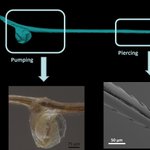


Here's a little more about our honey bee stinger work :)
link.growkudos.com/1e2ais326…
2
78
Earlier this week I sat down and had a long chat with Anand from @CBC about my work on the #honeybee #stinger. Here is his write up of our conversation: cbc.ca/news/science/honey-be…

1
33

🧵And now you know how #bees pump #venom!!!
Read the full paper here: pnas.org/doi/10.1073/pnas.26…
or watch the videos here:
youtube.com/@FiorellaRamirez…
or interact with our #microCT 3D models here:
skfb.ly/pOSrC

33
🧵Many wasps like yellow jackets do something similar but it’s likely that that at least some bees, ants and wasps pump venom in a similar way to honey bees.
18
🧵Why is this unusual/interesting?? Well, most animals that inject #venom (#snakes, #scorpions, etc) have circular muscles around the venom sac and to get the venom out, they contract these muscles directly.
29
🧵 We still don’t know everything about how the stinger works, it’s quite complicated and difficult to observe! But! This is the first time we’ve been able to directly observe the stinger in action!
28
🧵 Simple right? Well the thing is there are two valves in the pumping chamber. So they have to be able to (a) move past each other while still making a seal and pumping venom and (b) allow the pumping chamber to refill. This is why we describe the valves as collapsible pistons.
67
🧵 When the lancet extends into your skin the valve goes down. During the downstroke the valve opens up, spanning the pumping chamber and pumping the venom down. When the lancet retracts, the valve goes up with it and it collapses like a folded umbrella.
51
🧵 Long story short: The valves sit inside the pumping chamber and work a little bit like tiny umbrellas.
36
🧵 Halfway up the lancet/harpoon, on what we would consider the handle are THE VALVES. These things were the bane of my existence for a long time. They are teeny tiny, flexible, and translucent bits of cuticle. They are super hard to image 😭And they are responsible for pumping.

34
🧵The stinger has multiple sets of muscles; their main job is to extend and retract two long sharp parts that we call the lancets. The lancets are like little harpoons that extend one at a time, this reciprocating movement helps the stinger to work itself deeper into your skin.

36
Did you catch that? When separated from the body the stinger has its own mini brain that helps it to move! We actually described it in our previous paper: cell.com/iscience/fulltext/S…

22
🧵 Well, the stinger has little sensors along its length that let the stinger know whether its in the skin or not and where all of its parts are in space. This information then goes into the Terminal Abdominal Ganglion, a small bit of neural tissue that coordinates the movements.

31
🧵 But! It means that even if the bee is crushed or brushed off, the stinger will continue to do its job in defending the hive. How does it do that all on its own!?!?!

34
🧵 If you’ve been stung you might know that honey bees do this nasty trick, they insert the stinger into your skin and fly away leaving the stinger behind to KEEP ON STINGING. This can (but doesn’t always) kill the #bee, so they don’t do it lightly.
161
Our work made it into the Science news page! So stoked :)
science.org/content/article/…

16
I wrote an article explaining our work on the #honeybee #stinger out today in #PNAS
theconversation.com/how-does…

1
28
Our paper on the honey bee stinger 🐝💉is out today in PNAS!!! You can read it here:
pnas.org/doi/10.1073/pnas.26…
We also put together a video to explain some of what we did, check it out!!
youtu.be/Lbi4YLJlChU?si=b986…
17