

CLKN Productions LLC Cluck Norris School & Tools https://xitter.cf/t.co/eiIIXQnz6E TG- https://xitter.cf/t.co/6N7Az6fxCU CA - DW6DF2mjtyx67vcNmMhFm9XdxAwREurorghZcS3CBAGS
Joined November 2024
- Tweets5.2K
- Following3.8K
- Followers2.4K
- Likes9.7K







Pinned Tweet
For anyone that hasn't really checked us out please take some time to look at our overview, it is a long video but I will be making shorter clips soon. This is the base of what we are doing, and so much more to come. @BagsHackathon @BagsApp @finnbags @NormieCEO @NormieOfSol @pokeahoesol @VendoriumGlobal @TrollKingXPX @SolanaFndn @NOMADZxyz
Cluck Norris retweeted

It’s really that easy! This is just amazing results using and working with CHAD people at @DNConChain and @VendoriumGlobal. Results speak, 1,500 in sales gone right back into growing the #pokeahoe brand 💪

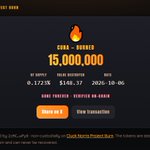
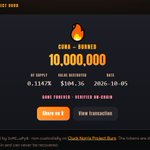
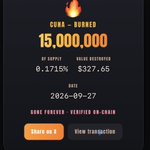
🔥 100,000,000 $CUNA burned forever — 1.17% of supply. Verified on-chain 👇 clucknorris.app/burn/4PVRYge…

🔥 100.00M $CUNA just got burned forever — 1.17% of supply.
$533 permanently destroyed on Solana, verified on-chain. Burned free & non-custodially 🐔
Receipt 👉 clucknorris.app/b/4PVRYgeJ3a
A bonding curve is a smart contract that automatically sets a token's price based on supply. As more people buy, the price climbs; as they sell, it drops. Think of it like a self-executing vending machine that gets more expensive the more items leave the shelf.
Token graduation happens when a bonding curve project reaches certain milestones—usually a target supply or liquidity threshold—and "graduates" to a decentralized exchange like Raydium or Orca. At that moment, the bonding curve closes, and holders can now trade on the open market instead of the curve.
Here's what matters: bonding curves remove the need for a traditional liquidity provider at launch, but they also mean early buyers often hold most of the supply. When graduation hits, price discovery shifts from the curve's math to real market demand. Not every bonding curve project succeeds post-graduation—some lose momentum fast once the automatic pricing mechanism disappears.
The graduation mechanic itself isn't a hack; it's just a transition point where token economics change from predictable to volatile.
Bonding curves remove friction at launch, but graduation is where the real market test begins.
🛠 Watch live Bags launches & graduations → clucknorris.app/bags
📚 Full school + free token tools → clucknorris.app
📊 CLKN chart: dexscreener.com/solana/64wxk…
💬 t.me/FireChicken007

Tokenomics is the economics of a token—it's about how many tokens exist, who gets them, and when. Think of it like the recipe and serving plan for a new currency.
Supply has three flavors: circulating (tokens actively trading), total (all minted so far), and maximum (the hard cap, if one exists). A token with unlimited supply behaves differently than one with a 1 billion cap, just like unlimited chicken nuggets would crash the market.
Distribution answers the brutal question: who owns what? Early investors might get 30%, the team 20%, public sale 20%, and the rest reserved for rewards. This matters because concentrated ownership can mean price manipulation risk.
Unlock schedules are vesting plans that release tokens over time, usually to prevent founders from dumping everything on day one. A 4-year unlock with monthly releases looks a lot less dangerous than "all unlocked tomorrow." Check the unlock calendar before you commit—a surprise supply flood can tank price.
Study the tokenomics whitepaper, not just the hype: supply cap, distribution breakdown, and unlock dates tell you more than any promise ever will.
📚 Full school + free token tools → clucknorris.app
📊 CLKN chart: dexscreener.com/solana/64wxk…
💬 t.me/FireChicken007

Cluck Norris retweeted

Grand rising ☀️
Another day, another reason to keep building with purpose. 🧩❤️
We just added a NEW Selfless Milestone to the roadmap a Tangem Ring 💍🔐
Because being selfless isn’t just about giving back… sometimes it’s about giving somebody a tool that can help protect what they’re building too.
More milestones. More surprises. More reasons to keep growing together.
Mint here:
exclusivo.one/arubikheadz
SHIFT HAPPENS BY DESIGN.
:::

Cluck Norris retweeted

GdK6cG1uxFTFZDmaH4BYUoHPa7jVKSrrogiuNVcgv9Fi
$MCM
Sub
$10k
Only up from here! At $6k now
Cluck Norris retweeted
Recent orders that have been placed are now starting to ship! Love the updates we made to the store and now the turnaround time is 60% less. We keep building! First and only on @VendoriumGlobal

When you're looking at a DEX pool, liquidity tells you how much capital is actually sitting there. Higher liquidity usually means bigger trades can happen without massive slippage, but it also means someone locked real money into that pair.
Volume shows you the trading activity over a time period, typically 24 hours. High volume with low liquidity can mean the pool is getting worked hard and slippage might spike. Low volume with high liquidity suggests the pool exists but isn't getting much action—you're the chicken counting before it hatches.
Fee tier matters because it's the cut the protocol takes per trade. Lower fees (0.01%) attract high-frequency traders, while higher fees (1%) suggest the pool is for more volatile or niche pairs. You're essentially paying for both the privilege and the risk profile of that specific pair.
Always check if volume is sustainable and if liquidity depth can handle your trade size without getting wrecked by slippage.
🛠 Practice in the free interactive LP Lab → clucknorris.app/lp-lab
📚 Full school + free token tools → clucknorris.app
📊 CLKN chart: dexscreener.com/solana/64wxk…
💬 t.me/FireChicken007
Cluck Norris retweeted
3axP4811rDzzkRzfxzEpS2roMCsqPQaJhonGjKwKpump
$MULLET
Sub $40k
Go now
Cluck Norris retweeted

I’m going to @TrollKingTD’s upcoming Space. Will you join too? xitter.cf/i/spaces/1OxwbnregarJB


Cluck Norris retweeted

Got my @pokeahoesol gym bag ..
A few @NFTENERGYDRINKS to go along with it..
Let’s see what kind of IRL fun we can have today 😈 😮💨💯


Cluck Norris retweeted
🎁 ARUBIKHEADZ GIVEAWAY
We’re giving one winner $20 in SOL or an NFT prize — winner’s choice. 🧩🔥
TO ENTER:
• Follow @ARubikHeadZ
• Like + RT
• Quote this post
• Tag 2 people
• Drop your SOL wallet below
🎯 ONE WINNER
Want another way into the ARubikHeadZ ecosystem?
Mint here:
exclusivo.one/arubikheadz
SHIFT HAPPENS BY DESIGN.
🤖 Made with AI

A liquidity pool is basically a smart contract holding two different crypto assets in equal value, like a digital jar with ETH on one side and USDC on the other. When you want to swap one token for another, you're trading against that jar instead of finding another person to trade with.
People called liquidity providers deposit both assets into the pool to earn a cut of every trade fee that happens. If a pool has $1 million in it, and it generates $10,000 in daily fees, the providers split that pie based on their ownership stake.
Here's the catch: if the price of one token moves wildly compared to the other, you're exposed to what's called impermanent loss. That means you might end up with fewer tokens of the one that pumped, even though you earned fees along the way. It's a real tradeoff, not free money.
Liquidity pools made decentralized trading possible without needing a company to run things—but they're not set it and forget it.
Pools let anyone trade without a middleman, but providers take real risk to make it happen.
🛠 Practice in the free interactive LP Lab → clucknorris.app/lp-lab
📚 Full school + free token tools → clucknorris.app
📊 CLKN chart: dexscreener.com/solana/64wxk…
💬 t.me/FireChicken007