






New paper on thermal neutron scattering just dropped:
tandfonline.com/doi/full/10.…


Gavin Ridley retweeted

George Westinghouse would marvel at the incredible advances in nuclear technology that our namesake company has made over the last 75 years. About half of all the world’s nuclear power plants are based on Westinghouse nuclear technology.
Last week, “Bricks George” unveiled our advanced modular AP1000® PWR bricks set. You can see his bricks engineering buddy working below on a new AP1000 unit, just like the ones we are deploying across the world.
Now, we're giving away five Westinghouse bricks sets to people who reshare this post. We'll draw names on Monday from everyone who reposted!
You can build a mini-Westinghouse nuclear reactor at home!


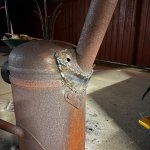
Weak flow through this minion fireplace solved. I was tempted to run some CFD, but hand calcs suggested form losses transitioning to the chimney were dominating the pressure losses. So we straightened out the pipe from 45° to near vert and gave a manifold to reduce form losses.
Now she burns like a champ. There is a greater engineering lesson to be learned here: quick approximations get you most of the value and let you start iterating sooner rather than later.


Gavin Ridley retweeted

What do you look for to judge a nuclear power project's potential, current progress, likelihood of success, and overall health?
I'm thinking of writing up a page on this for the website.
I look for things like:
* Hands-on experience with the primary coolant at reactor conditions
* Hands-on experience with highly radioactive material
* Technology readiness of reactor
* Fuel cycle cost: what's the charge enrichment, fuel form, fuel composition, and average discharge burnup?
* Technology readiness of balance of plant
* Degree to which maintenance and inspection is incorporated into the design
* Degree to which the design details are public (more is better, since it implies more peer review and licensing maturity)
* Licensing: how sophisticated are the submittals you've sent into the regulator. Where are you in regulatory space?
* Outlet temperature: helps with thermal efficiency and potential direct process heat applications
* Decay heat removal duration: helps understand overall DBA safety capability
* Supply chain: who's making the fuel and at what cost, who's making the control system, who's making the primary pumps, turbine, etc.
* Fire protection maturity: do they have a drain system that manages potentially radioactive material washed away during a fire?
* Radwaste management: what's their specification for fission gas release during normal operation?
Things I don't care about at all:
* MOUs with potential customers: this goes back to my Universal MOU: if you make cheap power people will buy it. DUH. These more often indicate how lowball of an cost estimate the execs have provided, often without much real justification (i.e. they're cost targets, not real estimates).
Gavin Ridley retweeted

This month, right on the heels of today’s Series C announcement, @basepowerco will operate the largest aggregated distributed energy resource (ADER) fleet in ERCOT. Our fleet of residential, behind-the-meter Base Power Company batteries demonstrates two important things:
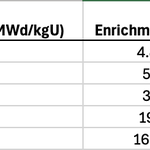
These are some numbers I took from the below paper, while curious about reactor natural uranium usage efficiency after seeing someone tweet about advanced reactors using U more efficiently. Sadly it's probably not the case.
If you factor in the feed to product ratio, the Natrium SFR falls short relative to the AP1000 on U usage. Wow. So why not just use the easy coolant? Maybe it's at an advantage if you can reprocess, though.
arxiv.org/pdf/2405.12805


“What is that hellspawn scurrying down my wall?” I said to my girlfriend late at night.
As it turns out, baby geckos can come into your house in Texas.


Gavin Ridley retweeted

A surprising & little-known results in classical statistics:
Mean (μ) and median (m) are within one std deviation:
|μ−m| ≤ σ
For unimodal densities, bound is even tighter
|μ−m| ≤ 0.7746 σ
This beautiful results first appeared in a 1932 paper by Hotelling & Solomons
1/3

I switched from apple terminal to ghostty lately (ghostty.org). Unbelievable. I can really feel the reduced latency as I type and use vim! Plus, the color schemes in vim work much better on this.