

Assistant Professor at INB, UNAM, México. Speech perception and production. Speech rythms. Brain oscillations.
Querétaro Arteaga, México
Joined January 2018
- Tweets165
- Following1.1K
- Followers1.3K
- Likes264






Why is the literature relating music and cognition so contradictory? Some studies report strong cognitive advantages associated with musical training, while others find weak or null effects. How can both be true?
In this paper, we proposed a theoretical explanation: musical training may only benefit cognition once rhythmic abilities cross a critical threshold. journals.plos.org/plosbiolog…
Phonological processing=left dorsal stream? Not in Mexican Spanish-speaking children at reading onset. Here, bilateral ventral pathways predict phonological awareness. Neuroscience must broaden the populations it studies to build generalizable brain models.doi.org/10.1162/NOL.a.246

Is musical training really beneficial for cognition? @PabloRiVi @Fher_LizcanoC, and I hypothesize that it enhances cognition but ONLY for certain individuals, with rhythmic abilities being a key factor. Check out our new PlosBiol Perspective!
journals.plos.org/plosbiolog…
Our collaboration with pip from San Luis Potosí University is out! Very nice work showing difficulties to whisper in noise and to keep stable the syllabic rhythmic structure in adults with Parkinson. nature.com/articles/s41598-0…

Did you ever wonder if statistical learning is still plausible for non rhythmic stimulus? My friends @Ireririri @PabloRiVi @JOGBCN @davidpoeppel and I answered this question here: authors.elsevier.com/sd/arti…
Are relative and absolute timing truly two different mechanisms? Here, with @KeithD11 and @Luc_H_Arnal we show by bringing together behavioral data, oscillators and Bayesian predictions that they can be sides of the same coin.
journals.plos.org/ploscompbi…


Happy to share the first paper 100% done in hablab (my new lab at @UNAM_MX). Auditory-motor synch is much more restricted than previously assumed, not everyone can synchronize to anything! rdcu.be/de4wx
Yesterday we had the last day of the audiomotor symposium. We finished by two immense talks. Steven Eliades with a brilliant feedback loop model in marmosets and Robert Zatorre explaining the dosal and ventral streams for music. What a great meeting! #AIC2023


@JRauschecker what a great talk culminating with monkeys playing piano! #AIC2023


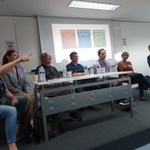
Thank you Virginia Penhune for moderating this incredible round table about auditory-motor integration. I am still thinking about what integration does really mean.

Thank you Vanessa Ruiz Stovel and @HMerchanr for a great mini symposium. We learned a lot about vibrotactile learning in deafness and monkeys abilities to synchronize their movements to a beat. #audiomotor


8
723
Deadline extended! Do not forget to register and to submit your abstract to the audiomotor symposium. audiomotor.inb.unam.mx/

Last days to register! Do not miss the opportunity to attend to the audio-motor symposium. Registration will be closed on April 1st. audiomotor.inb.unam.mx/

The audio-motor symposium is coming soon! Do not forget to register before April 1st. audiomotor.inb.unam.mx/regis…
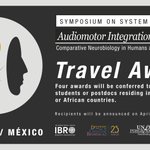
PhD students and postdocs based in Latin America or Africa do not forget to apply for the travel grant! audiomotor.inb.unam.mx/trave…

Save the Date! Super excited to announce this amazing Symposium on auditory-motor integration to be held next year in Mexico. Take a look the amazing speakers we will be hosting! audiomotor.inb.unam.mx/

ALT https://audiomotor.inb.unam.mx/
It was a great honor to introduce @marc_trev, best PhD advisor ever. Thank you Marcos for a great talk on language dynamics!

Individual differences in auditory-motor synchronization abilities predict different neural networks underlying statistical word-form learning. @JOGBCN @PabloRiVi @DianaLopBarr @davidpoeppel @Ruth_d_Balaguer journals.plos.org/plosbiolog…

Speech-to speech synch and MAIA: two quick online assessments that can indicate different types of stuttering severity!
frontiersin.org/articles/10.…
