

Breaking news & commentary from #Georgia
Georgia
Joined November 2019
- Tweets7.7K
- Following117
- Followers22.8K
- Likes63







Georgian Dream-aligned media outlets and commentators launched a wave of attacks against the opposition’s large October 25 rally in Tbilisi, portraying the demonstration against Bidzina Ivanishvili’s rule as an LGBTQ Pride parade.
The claims were widely amplified by government-aligned broadcasters, including Imedi TV, sanctioned by the United Kingdom in February 2026 for spreading Russian disinformation.
Commentator Nikoloz Metreveli declared: “What is taking place today is not a political rally, but an ordinary LGBT Pride parade,” alleging that foreign sponsors had selected opposition leader Nika Gvaramia to lead it.
Lado Sadghobelashvili similarly described the demonstration as a “gay parade,” urging Orthodox Christians not to attend and claiming that participants financed by German, French and British foundations had been instructed to carry rainbow flags.
“Anyone who participates in Gvaramia’s announced rally, knowingly or unknowingly, automatically becomes a participant in an LGBTQ parade,” Sadghobelashvili wrote.
Kakha Dzagania, leader of the Left Alliance party, also attacked the protesters, referring to them as “collective LGBT Gvaramias.”
The statements were circulated by government-aligned outlets, including Imedi and Rustavi 2, as commentary on the opposition demonstration.
The October 25 rally, held under the slogan “Georgia without Ivanishvili — Georgia deserves better,” launched an opposition campaign against Georgian Dream’s efforts to ban major opposition parties.

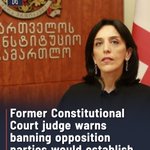
Former Georgian Constitutional Court judge Ketevan Eremadze has warned that Georgian Dream’s lawsuit seeking to ban five major opposition parties would effectively legalise dictatorship and dismantle political pluralism in the country.
Speaking to Formula TV, Eremadze accused the Georgian Dream government of using the courts and legislation to suppress political freedoms and protect its own grip on power.
“The government is now using the law and the courts to assault our freedom. It uses power not to protect people’s liberty, but to suppress it and save itself,” she said.
Eremadze argued that Georgian Dream was deliberately conflating its own political survival with the protection of the constitutional order, portraying challenges to its rule as threats to Georgia’s independence, territorial integrity or constitutional system.
“Granting this lawsuit would not merely abolish political pluralism — it would mean legalising dictatorship,” she warned.
According to Eremadze, a one-party system does not simply create conditions favourable to dictatorship but inevitably produces it by destroying popular sovereignty and citizens’ ability to shape their country’s future.
"It kills the right to vote,” she said.

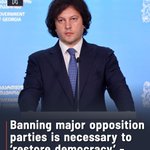
Georgian Dream Prime Minister and Bidzina Ivanishvili's representative Irakli Kobakhidze has defended his party’s lawsuit seeking to ban five major opposition parties and coalitions, arguing that outlawing them is necessary to “restore the health” of Georgia’s democratic system.
“In reality, these are not political parties. This is one party. The lawsuit concerns declaring one party unconstitutional, and that party is called the collective National Movement and foreign agents,” Kobakhidze said.
“There is no place for foreign agents in our political system,” he added.
Kobakhidze claimed that banning the opposition groups would help Georgia escape what he described as an artificially imposed political deadlock.
“Declaring this particular party unconstitutional is necessary to restore the health of Georgia’s democratic system once and for all and to break out of the vicious circle in which Georgia has been artificially trapped for all these years,” he said.
Georgian Dream’s lawsuit seeks to outlaw five major opposition political groups, including the United National Movement, Coalition for Change, Strong Georgia–Lelo, the Federalist Party and Gakharia for Georgia.

“Georgia without Ivanishvili!” - On day 697 of Georgia's uninterrupted protest several thousand Georgians gathered to protest Georgian Dream's push to ban opposition parties in the country in the face of unprecedented repression.
Georgian journalist and civic activist Eliso Janashia, who was physically assaulted in December 2024, says authorities have turned the investigation against her, nearly two years after the attack, while her alleged assailant remains unpunished.
Janashia, a journalist based in the Black Sea port city of Poti and founder of the EU-supported social enterprise Limeni, says investigators have split the original assault case into two separate proceedings: one examining the attack against her and another investigating her actions in self-defence.
“Instead of punishing the attacker, they are now trying to turn the case against me, as though I were the one who attacked her,” Janashia wrote on social media.
The incident occurred on December 23, 2024, when Janashia alleged that Georgian Dream activist Nineli Kulonava entered Limeni's premises and physically assaulted her. Janashia told Radio Free Europe/Radio Liberty that Kulonava had ripped out her hair and injured her scalp, requiring emergency medical assistance. According to Janashia, the attacker had objected to Limeni receiving financial support from the European Union.
Janashia also alleges that Poti Mayor Beka Vacharadze subsequently included Kulonava in his election campaign and published a photograph of them together, raising suspicions about possible political connections behind the attack.

Polish authorities have arrested a second Georgian citizen in connection with the murder of Russian opposition artist and Kremlin critic Semyon Skrepetsky, whose real name was Robert Kuzavkov.
The suspect, identified as 22-year-old Makhmud A., has been placed in three months of pretrial detention. He is accused of aiding and abetting murder and illegally possessing firearms and ammunition. He denies the charges.
Skrepetsky, 44, was shot five times and killed on June 15, 2026, in Biała Podlaska, Poland.
Three days after the murder, Polish authorities arrested the first suspect, Georgian citizen Elnur A. Investigators now believe Makhmud A. may have assisted Elnur A. in carrying out the killing.
Makhmud A. arrived in Poland from Georgia on October 18. The following day, officers of Poland’s Internal Security Agency (ABW) detained him at a parking area near the A2 motorway. He was travelling with two other Georgian citizens.
The two accompanying Georgian nationals were also detained and handed over to Poland’s Border Guard. Deportation proceedings have been initiated against them, potentially resulting in a ten-year ban on re-entering Poland.
The investigation into the murder of the Russian anti-Kremlin artist remains ongoing.
The first suspect, 36-year-old Georgian citizen Elnur A., was formally charged on June 19 with shooting and killing Skrepetsky and placed in pretrial detention on June 20; he denied the charges, and a Polish court subsequently extended his detention until December 15, 2026.

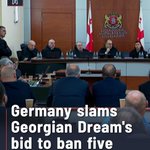
Germany has expressed deep concern over ongoing proceedings in Georgia’s Constitutional Court aimed at banning five major opposition parties, warning that political pluralism is essential for democracy and EU membership.
“We are deeply concerned about the ongoing court proceedings seeking to ban five opposition parties in Georgia. Political pluralism is essential for democracy and crucial for EU accession,” wrote Niklas Wagner, Director for Eastern Europe, the Caucasus and Central Asia at Germany’s Federal Foreign Office.
The statement comes as Georgia’s Constitutional Court holds hearings on Georgian Dream’s lawsuit seeking to outlaw five major opposition parties and coalitions, including the United National Movement, Coalition for Change, Strong Georgia–Lelo, Federalists and Gakharia for Georgia.

Georgia’s Prosecutor General’s Office has arrested Dito Chubinidze, a journalist with Asaval-Dasavali, an ant-Western weekly newspaper, on charges of treason through sabotage. The charges carry a prison sentence of up to four years.
The arrest follows a series of articles and public statements in which Chubinidze alleged that Georgian Dream Prime Minister Irakli Kobakhidze had secretly agreed to transfer part of the disputed Davit Gareji monastery complex to Azerbaijan.
At a briefing, Deputy Head of the Prosecutor General’s Investigative Department Beka Kvitsiani accused Chubinidze of systematically spreading false information since February 2026, claiming that the allegations were fabricated and intended to undermine Georgia’s state interests.
Prosecutors argued that the prime minister cannot unilaterally transfer Georgian territory to another country, as border agreements require negotiations by a government commission and parliamentary ratification. They maintained that no agreement with Azerbaijan concerning the disputed monastery complex has been reached.
The prosecution also accused Chubinidze of spreading allegations linking the death of his interviewee, former human rights activist Lazare Jorbenadze, to possible retaliation for Jorbenadze’s accusations against Kobakhidze.
"The case is particularly notable because Chubinidze’s reporting had previously become a source of tension within Georgian Dream itself,” Former Prime Minister Irakli Garibashvili, currently imprisoned, claimed in a September 1 letter that Kobakhidze and senior official Mamuka Mdinaradze suspected him of being behind Chubinidze’s critical articles.
Garibashvili said he had received a message questioning whether he had orchestrated a February 2 interview in which Jorbenadze made serious allegations against Kobakhidze. In the same letter, Garibashvili publicly questioned the circumstances of Jorbenadze’s death.
Prosecutors say Chubinidze was arrested under a court warrant and that they will seek his pretrial detention. The investigation remains ongoing.

The Georgian Diplomats’ Society has warned that Georgian Dream Prime Minister Irakli Kobakhidze’s appointment of First Deputy Foreign Minister Giorgi Zurabashvili as his special representative for relations with Russia marks a “dangerous trend” that could undermine the Geneva International Discussions and pave the way for restoring diplomatic relations with Moscow.
The association stressed that previous special representatives had never been serving Foreign Ministry diplomats and that their mandates were limited to economic, cultural and humanitarian matters, with meetings conducted informally.
“Granting this status to the incumbent First Deputy Foreign Minister could be regarded as a form of restoring diplomatic relations, or as preparing the ground for doing so,” the statement said.
*The diplomats expressed particular concern over the expansion of the envoy’s mandate to include the “peaceful resolution of the conflict with Russia,” warning that this effectively creates an alternative to the Geneva International Discussions.
Established following Russia’s 2008 invasion of Georgia, the Geneva format involves the EU, UN and OSCE as co-chairs, with US participation. The association stressed that the format was designed to ensure Georgia would not be left negotiating with Russia alone.
The diplomats warned that the appointment threatens both Georgia’s longstanding position of maintaining no diplomatic relations with Russia and the prospects for a peaceful settlement.
Kobakhidze announced Zurabashvili’s appointment on October 21, saying he would retain his position as First Deputy Foreign Minister. Russian politician Konstantin Zatulin welcomed the move as a “step in the right direction.”

Georgian Dream Prime Minister Irakli Kobakhidze has appointed First Deputy Foreign Minister Giorgi Zurabashvili as his special representative for relations with Russia, restoring a position that had remained vacant since December.
Announcing the appointment at a briefing, Kobakhidze said Zurabashvili would retain his position as First Deputy Foreign Minister while taking on responsibility for relations with Moscow.
“The peaceful resolution of the conflict with Russia, the preservation and development of existing trade and economic relations, and continuous dialogue on humanitarian issues are among our country’s most important priorities,” Kobakhidze said.

Georgia’s Constitutional Court began hearings in Batumi on October 21 on Georgian Dream’s lawsuit seeking to ban five major opposition parties and coalitions.
The lawsuit seeks to declare unconstitutional and prohibit the activities of Unity – National Movement, Coalition for Change, Strong Georgia – Lelo, the Federalist Party, and Gakharia for Georgia.
The hearings are scheduled for October 21–23 before a seven-member panel of Constitutional Court judges, chaired by Revaz Nadaraya, with Vasil Roinishvili serving as rapporteur.
The proceedings follow the resignation of Constitutional Court judge Manana Kobakhidze, a former Georgian Dream chair, after the court rejected her request to recuse herself from the case over concerns about her impartiality.
In a joint statement on October 21, Georgian civil society organisations condemned the effort to ban opposition parties, describing it as a new and particularly grave stage of Georgia’s authoritarian transformation that would “formally establish a one-party dictatorship.”

Georgia’s imprisoned former Prime Minister Irakli Garibashvili has claimed that the ruling Georgian Dream party consistently lost elections at military polling stations before 2020, but that he reversed the trend during his tenure as Defence Minister, securing 85–90% of the vote for the party.
In a letter published on Facebook from prison on October 20, 2026, Garibashvili highlighted the dramatic reversal in voting patterns at closed polling stations within the Georgian military.
“Until 2020, Georgian Dream lost every election at the military’s closed polling stations. Only during my time as minister did the party receive 85–90% of the votes. This, too, says a great deal,” Garibashvili wrote.
Garibashvili, who served as Defence Minister from 2019 to 2021 and twice as Prime Minister under Georgian Dream, also denounced the proceedings against him as politically motivated.
“The political persecution against me is an insult to the country and the ruling party,” he said.

Georgian Dream is moving ahead with its Constitutional Court lawsuit seeking to ban nearly all major opposition parties in Georgia, with hearings scheduled for October 21, 22 and 23.
Parliament Speaker Shalva Papuashvili announced that four Georgian Dream MPs — Archil Gorduladze, Giorgi Kakhiani, Tengiz Sharmanashvili and Tornike Cheishvili — will represent the party before the Constitutional Court.
The lawsuit seeks to ban five opposition parties and coalitions: Unity – National Movement, Coalition for Change, Strong Georgia – Lelo, the Federalist Party, and Gakharia for Georgia.

Georgia’s Foreign Ministry has accused the European Union of interfering in the country’s domestic affairs after Brussels criticised Georgian Dream’s efforts to ban five major opposition parties.
In a statement, the ministry, headed by Maka Bochorishvili, expressed concern over EU officials’ criticism of the ongoing Constitutional Court proceedings, describing it as inappropriate pressure on an independent judicial institution.
The ministry argued that questioning the legitimacy of the case before the court examines its merits amounts to prejudging the proceedings and interfering in Georgia’s internal affairs. It urged EU representatives to refrain from statements that could undermine judicial independence.
The statement followed remarks by European Commission spokesperson Christian Wigand, who said the EU was closely monitoring the party-ban lawsuit and the Constitutional Court’s handling of it.
Wigand described the developments as evidence of a “worrying instrumentalisation of the justice system,” warning that they threatened fundamental freedoms, democratic pluralism and fair political competition.
Georgian Dream’s lawsuit seeks to ban five major opposition parties and coalitions, including the United National Movement, Coalition for Change, Strong Georgia–Lelo, the Federalists and Gakharia for Georgia.
The Constitutional Court has scheduled consecutive hearings for October 21–23.

Fake job advertisements offering employment in Georgia may be used to recruit people into contracts with the Russian Defence Ministry, according to the Russian anti-war organisation Idite Lesom (“Get Lost”), which helps Russians avoid conscription and leave the military.
The organisation reported that a man responding to an advertisement for manual labour in Tbilisi and Rustavi was offered a daily wage of 200 GEL, free accommodation and three meals a day.
However, after contacting the advertiser, he was told the positions in Georgia had been filled and was instead offered work in Russian-occupied Kherson or Russia’s Belgorod region, with a monthly salary of 170,000–210,000 rubles and free travel from Tbilisi to Moscow.
The employer requested a copy of his passport and explained that he would have to sign two contracts: one with the employer and another with the Russian Defence Ministry.
“We will sign two contracts. I want to tell you from the outset: one with us and the other with the Ministry of Defence of the Russian Federation,” the employer wrote in messages published by Idite Lesom.
The recruiter claimed that the military contract was necessary to obtain permission to work in border areas. The documents provided included employment contracts referencing a Russian private security company and positions such as security guard and communications specialist.
According to the man, an identical advertisement using the same Telegram contact details appeared on another platform on October 18.

Formula TV host Vakho Sanaia is seen handcuffed and sent to detention for 30 days for mocking Georgian Dream figures, including Parliament Speaker Shalva Papuashvili on Facebook in a development that signals even deeper fall of freedom of speech in Georgia under Georgian Dream.
Georgian Dream Parliament Speaker Shalva Papuashvili has lashed out at France over ongoing demonstrations, suggesting that Paris is facing the consequences of its involvement in Georgia.
“Those who sow the wind in another country will reap a storm in their own,” Papuashvili wrote on social media, commenting on protests in France.
His post was accompanied by a photograph published by the French Embassy in April 2025, showing embassy representatives alongside members of SovLab, the Soviet Past Research Laboratory, a Georgian research organisation.
The photograph was taken after SovLab received a French Embassy grant for a project documenting the geography of Soviet terror in Gori and Kutaisi. With the embassy’s support, SovLab developed educational walking tours in both cities, highlighting suppressed and forgotten histories of Soviet repression following Russia’s occupation of Georgia in 1921.
Papuashvili also wrote that the people pictured were “neither Venetian cartographers nor Egyptian students eager to learn,” an apparent reference to the historical mapping project and the controversy surrounding French support for Georgian civil society.
The post linked contemporary demonstrations in France to the French Embassy’s support for a Georgian historical research initiative, without explaining how the two were connected.

Prominent Georgian journalist and Formula TV presenter Vakho Sanaia has been sentenced to 30 days of administrative detention for social media posts mocking Georgian Dream Parliament Speaker Shalva Papuashvili and MP Lado Bozhadze.
The decision was handed down by Judge Tornike Kochkiani. This is Sanaia’s second administrative detention for social media posts about the two politicians.
Sanaia had previously served 14 days in detention for allegedly ‘insulting’ Papuashvili and Bozhadze..
After his release, Sanaia published another sarcastic post asking whether the politicians themselves would face imprisonment if they asked people not to call them the same word.
Authorities also cited a video mocking Papuashvili’s description of anti-government protesters as a “pseudo-religious sect.”
The Interior Ministry said it requested 30 days of detention because Sanaia had repeated the alleged offence. A ministry representative argued that his posts exceeded the limits of freedom of expression and the criticism politicians are expected to tolerate.

Georgian Dream Prime Minister Irakli Kobakhidze met Iranian President Masoud Pezeshkian in Yerevan on Friday, with Tehran calling for a concrete action plan to deepen bilateral cooperation amid growing concerns over Iranian influence in Georgia.
The meeting took place on the sidelines of an international summit in the Armenian capital. According to the Iranian presidency, Pezeshkian called for a clear framework and timetable to expand economic, cultural and tourism cooperation between the two countries.
Kobakhidze, for his part, stressed Georgia’s “opposition to foreign interference in neighbouring countries’ domestic affairs” and emphasised the “importance of friendship and cooperation with Iran.”
During the meeting, Pezeshkian also criticised U.S. sanctions against Iran, defended Tehran’s nuclear programme and insisted that Iran would not submit to external pressure.

Georgia’s government channels public advertising and information-service contracts to pro-government media outlets involved in coordinated disinformation campaigns and attacks on political opponents, journalists and independent institutions, according to a new report by the Media Development Foundation (MDF).
MDF identified 351 instances in 2025–2026 in which pro-government outlets amplified posts from fake Facebook accounts, some of which repeatedly changed their names and profile photographs.
The outlets most frequently citing these accounts included Reportiori, Lideri, Kviris Media Holding, Infopostalon, NSP.ge, Mkhare and Newshub, as well as the online platforms of pro-government television channel Imedi.
The report also documents the publication of confidential information potentially obtained through state surveillance, leaked private communications and non-public documents used to discredit government critics.
MDF says the findings point to close coordination between state institutions and publicly funded pro-government media in disseminating disinformation and targeting political opponents.
