

Founder, @passportturtles 🐢 | Unlocking Sub-Saharan Africa’s Agricultural Alpha via Asset-Light Projects & Capital Networks (#AfricaIsNext)
Singapore
Joined September 2010
- Tweets2.4K
- Following271
- Followers332
- Likes1.7K




Pinned Tweet
Most founders waste months coding software nobody wants.
Meanwhile, I’m a software engineer running asset-light agricultural trade plays across Africa using a secret data moat.
We’re bridging Asia tech with African agriculture.
Here is the master plan for Passport Turtles 🐢👇
Over the last few months, I accidentally built an organic, highly active network of 47,000+ smallholder farmers and cooperatives across Sub-Saharan Africa.
My phone lights up daily with raw, ground-truth data logs.
Local crop surpluses, regional trucking gridlocks, and real-time factory buy-orders.
To an engineer, this isn't farming. It's un-optimized code.
The global agriculture market is a $13.4 trillion giant running on completely analog rails.
Mainstream capital is oversaturating tech stocks and real estate.
Meanwhile, the real "alpha" is sitting in emerging agricultural corridors trading at massive valuation discounts.
Traditional VCs won't touch it because they don't have eyes on the ground. We do.
At Passport Turtles, we use software leverage to run a highly efficient, two-speed model:
⚡ 30-90 Day Trade Runs: We pool angel capital to finance local logistics, moving crops from cooperatives to pre-signed factory weighbridges for quick double-digit returns.
🚀 The VC Track: We turn those supply constraints into lean AgTech SaaS apps built for 4-6 year corporate M&A buyouts.
Every single day, I am open-sourcing one raw, validated agricultural opportunity or startup concept straight from our 47k network right here on your feed.
No gatekeeping. Just hard metrics.
We don’t fly alone.
Lock in your syndicate access key and view today’s gated concept:
👉 passportturtles.com
#AfricaIsNext #BuildInPublic

1
1
150
Tanzania’s tea sector holds massive untapped potential, yet its biggest growth engine is stuck in the "missing middle." 🍃🇹🇿
Smallholder farmers produce a significant share of Tanzania’s tea, feeding directly into local processing factories, aggregators, and regional logistics firms.
These mid-sized agribusinesses are the vital bridge between rural farms and global export markets—employing hundreds of people and anchoring local economies.
Yet, when they need $250K to $2M to scale, they hit a wall:
❌ Too large for microfinance.
❌ Too "risky" or collateral-light for traditional commercial banks, which often prefer high-yielding government securities over agricultural lending.
Without flexible growth capital, local processors can’t upgrade to energy-efficient machinery, aggregators struggle to pay farmers on time during peak harvest, and climate-resilient farming practices remain out of reach.
This is where blended-finance private credit changes the game.
Instead of forcing profitable agribusinesses into premature equity dilution—or leaving them starved of cash—tailored debt instruments can unlock immediate value across the entire tea value chain:
1️⃣ Working Capital & Offtake-Backed Loans: Tying repayments directly to verified export contracts and harvest cycles so processors can buy green leaf faster and pay farmers reliably.
2️⃣ Asset-Backed Equipment Financing: Funding solar-powered irrigation, modern withering troughs, and clean-energy boilers that slash factory operating costs and carbon footprints simultaneously.
3️⃣ Local-Currency & Blended Structures: Using catalytic first-loss capital to de-risk transactions and protect Tanzanian SMEs from FX volatility.
Investing in Tanzania’s missing middle isn’t charity—it’s smart, risk-adjusted private credit. When we equip local tea processors and aggregators with the right capital, yields rise, rural incomes stabilize, and global investors capture resilient, impact-driven returns.
Are you building, lending, or investing in East Africa's agricultural value chains ahead of 2027?
#AfricaIsNext #Tanzania #EmergingMarkets
🤖 Made with AI

22
I’ve spent the last few weeks deep-diving into the playbook of Novastar Ventures—studying how they scaled from an informal angel club in 2013 into a $350M+ institutional powerhouse across Africa, recently closing their $147M People and Planet Fund III.
For emerging fund managers building in frontier and high-growth markets, their blueprint offers a masterclass in turning structural challenges into defensible advantages.
Here are 5 takeaways from their model that every VC should study:
1. Bet on "The Many, Not Just the Few"
While traditional tech VCs often chase high-margin software for the top 5% of consumers, Novastar builds moats around essential services—food, energy, mobility, and agriculture—for the mass market. High volume at accessible price points creates unmatched resilience in emerging economies.
2. Concentration + Milestone-Based Reserves
Instead of spray-and-pray seed investing, they build high-conviction portfolios of 12–15 companies per fund. Crucially, they hold back 40%–50% of their capital for follow-ons, unlocking larger checks only when founders hit strict unit-economic and governance milestones.
3. Engineer a "Crowding-In" Multiplier
In frontier markets, early-stage equity is scarce because global investors worry about governance risk.
Novastar acts as an institutional stamp of approval—installing dedicated talent, ESG, and governance specialists inside seed-stage startups.
The result? For every $1 Novastar invests, their portfolio companies raise $4.50 in follow-on global capital.
4. Build a Cross-Continental LP Bridge
Most emerging managers struggle to raise from institutional LPs because they lack local-to-global translation.
Novastar split its footprint intentionally: on-the-ground deal teams in Nairobi and Lagos paired with capital and governance hubs in London and Tokyo.
By offering Japanese corporate giants like Mitsubishi and SMBC co-investment rights and market-entry insights, they unlocked a completely new pool of strategic capital.
5. Impact is a Commercial Driver, Not a Concession
Their Fund III thesis proves that climate adaptation and commercial scale are two sides of the same coin.
Backing companies that solve post-harvest loss, clean mobility, or smallholder resilience isn't philanthropy—it’s capturing massive, underserved market demand.
My biggest realization from studying their journey:
You don't need a $100M fund on Day 1 to use an institutional playbook.
Whether you're starting with deal-by-deal SPVs or raising Fund I, pairing deep local operating empathy with world-class governance is how emerging managers win.
To my fellow GPs, LPs, and ecosystem builders:
Which venture firm's blueprint has influenced how you think about fund construction? 👇
#VentureCapital #FrontierMarkets #AgTech #AfricaIsNext
42
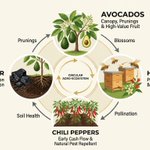
Still in Avocado... 🥑
Monoculture avocado farming is thirsty, input-heavy, and vulnerable.
The future of profitable, climate-resilient horticulture lies in biological stacking.
Instead of treating a farm as a factory with expensive external inputs, forward-thinking growers are designing closed-loop ecosystems where every crop, insect, and waste stream actively supports the next.
Here is how combining Avocados, Chili Peppers, Honey Bees, and Biochar creates a high-margin, self-sustaining agricultural powerhouse:
🐝 Honey Bees (The Yield Multiplier):
Avocado flowers have a notoriously complex pollination window (opening as female one day and male the next).
Placing apiaries inside the orchard boosts pollination rates and fruit set by up to 30%—while generating an immediate, high-margin secondary revenue stream through raw, avocado-blossom honey.
🌶️ Chili Peppers (The Cash-Flow & Pest Buffer):
Avocado trees take 3 to 4 years to reach commercial maturity.
Intercropping fast-growing chilies between young tree rows solves the early-year cash-flow gap for farmers.
Better yet, chilies act as a natural bio-repellent against orchard pests and provide low-lying nectar that keeps bees active when avocado trees aren't blooming.
🪵 Biochar (The Carbon & Water Vault):
Every avocado orchard generates tons of pruning waste, wood trimmings, and rejected pits.
Instead of burning or dumping this biomass, pyrolyzing it into biochar locks away carbon and creates a permanent, porous sponge in the soil.
Mixed into the root zone, biochar slashes irrigation needs by retaining moisture and holding onto nutrients so fertilizer doesn't wash away.
🔄 The Full Circular Loop (Added Value):
Compost + Biochar:
Charging biochar with organic compost or livestock manure supercharges soil microbiology, protecting shallow avocado roots from devastating fungal diseases like Phytophthora root rot.
Spiced Honey & Chili Oil:
Vertically integrated farms can infuse their raw honey with estate-grown chilies—creating a trendy, export-ready "hot honey" product alongside cold-pressed avocado oil.
When you stack biological synergies like this, you don't just protect the environment—you de-risk the asset.
Farmers cut input costs, diversify revenue across multiple harvest cycles, and build drought-proof soil equity.
For investors and operators in agribusiness: what other integrated crop-and-insect combinations are you seeing deliver outsized unit economics?
#AfricaIsNext #CircularEconomy #RegenerativeAgriculture #AvocadoFarming
🤖 Made with AI

28
Kenya is quietly becoming the world’s next major avocado superpower—and the real money isn't in the orchards. It’s in the packhouses. 🥑
As Africa’s largest avocado exporter and a top-six global supplier, Kenya’s Hass avocado sector has exploded over the past few years.
With new phytosanitary protocols unlocking massive consumer markets in China and India alongside traditional European buyers, demand is outpacing supply chain capacity.
For global investors looking at East African agribusiness, the thesis here is remarkably clear.
You don't need to take on agricultural production risk to capture this growth.
The highest-margin opportunity sits in export-grade packhouses and cold-chain logistics.
Here is why smart capital is targeting Kenya’s avocado mid-stream right now:
🚢 The Shift from Air to Sea Freight:
Airfreight margins are getting squeezed.
Exporters are rapidly transitioning to Controlled Atmosphere (CA) refrigerated sea containers via the Port of Mombasa.
However, surviving a 25-to-35-day ocean voyage requires strict pre-cooling within hours of harvest—creating urgent demand for modern packhouse infrastructure.
📋 Traceability & Compliance Moats:
Strict EU and Chinese import regulations require precise dry-matter testing, pest-free certification, and farm-to-port traceability.
Modern, tech-enabled packhouses that aggregate smallholder fruit and guarantee compliance command massive pricing power.
🥑 By-Product Monetization (Crude Avocado Oil): Export rejection rates for cosmetic blemishes can reach 20–30%.
Vertically integrated packhouses are turning those "imperfect" avocados into high-margin crude and extra-virgin avocado oil for global food and cosmetic buyers—turning waste into pure profit.
Investing in Kenyan avocados isn't about betting on weather or land.
It’s about financing the processing, sorting, and cold-chain bottlenecks that connect millions of existing trees to hungry global ports.
#AfricaIsNext #KenyanAvocados #ColdChain #FoodExports

32
Is Rwanda the Silicon Valley of global agritech? 🌍🌱
I’m currently mapping out a concept that’s been on my mind for a while: establishing a specialized Media-Ag Incubator Space right in the heart of Kigali. 🇷🇼
Rwanda’s Fifth Strategic Plan for Agriculture Transformation (PSTA 5) has built an incredible foundation.
The country has the tech infrastructure, the stability, and the ambition.
But when looking closely at the wider East African landscape, two critical gaps remain:
1️⃣Scaling early-stage agritech founders from seed to regional expansion.
2️⃣Telling the vibrant, data-driven story of African agricultural innovation to the global market.
To bridge this, we are considering a physical hub designed to cross-pollinate breakthrough science with world-class media:
💡 A Co-Working Space built specifically for ag-SaaS and fintech founders to build cross-border platforms.
💡 An Experiential Food-Tech Lab & Kitchen for testing, refining, and launching consumer agritech products.
💡 A State-of-the-Art Video/Podcast Studio to broadcast the realities, triumphs, and investment returns of East African agriculture directly to global LPs.
By creating the ultimate ecosystem for Ag-Tech storytelling in East Africa, our goal is simple: capture proprietary deal flow and build an unshakeable bridge between local talent and international venture capital.
Where we stand right now:
We are heavily evaluating the feasibility, local partnerships, and economic modeling of this project.
Over the coming weeks, I’ll be sharing our deep dives, constraints, and learnings here.
Stay tuned—I will formally update my network on whether we are greenlighting this project and pushing through with construction. 🚀
If you are an investor, founder, or ecosystem builder working in the intersection of climate-smart ag, SaaS, or media in East Africa, let’s connect.
Drop a comment or slide into my DMs—I'd love to hear your thoughts on this thesis.
#AfricaIsNext #RwandaTech #VentureCapital #PSTA5

3
4
103
Do Local Aggregators become "Greedy Middlemen" As They Grow Bigger?
In Sub-Saharan African agriculture, the "evil middleman" narrative is deeply entrenched.
We are told they exploit smallholders, manipulate scales, and capture all the margin.
But if you look past the VC-backed agrotech echo chamber, the ground reality is completely different.
The real economic engine of rural Africa is powered by local commodity aggregators who have proprietary networks of thousands of smallholder farmers, highly resilient operational cash flows, and zero online footprint.
They don't have websites, PitchBook profiles, or institutional capital.
But they do have trucks, warehouses, and the deep local trust required to move thousands of tonnes of grain, cocoa, and cashew every single crop cycle.
As these bootstrapped aggregators scale, do they structurally become predatory middlemen?
The candid answer is: yes, many do.
As overhead grows and commission-based agents take over personal relationships, margins are often protected by squeezing the most defenseless node in the chain—the farmer.
But there is a high-value exemption.
The best local aggregators understand that cutthroat arbitrage is a race to the bottom. Instead of just buying raw commodities to flip them, they build value-driven ecosystems:
1️⃣Localized Primary Processing:
They invest in millers, dryers, or hullers. To keep this machinery running, they need premium, predictable quality—meaning they actively invest in the farmer's inputs and agronomy.
2️⃣Traceable Export Pathways:
In high-value chains like Hass avocados, macadamia, or organic cacao, global compliance demands traceability.
These aggregators pass export premiums back to farmers to lock in supply loyalty.
3️⃣Informal Social Safety Nets:
They advance emergency capital for school fees and medical expenses during the lean season, absorbing post-harvest and structural risks that commercial banks won't touch.
The future of SSA agrotech shouldn't be about displacing these figures.
It should be about identifying these asset-heavy, operationally resilient, un-leveraged local entities and providing them with the structured finance and tooling to scale their impact.
Right now, I am communicating with local aggregators who genuinely lift farmers out of poverty rather than trapping them there.
I call them my "Angel Aggregators".
Stay tuned for my highlight stories on these aggregators in my upcoming posts.
#AfricaIsNext #AgroTech #SupplyChain #ImpactInvesting

60
The VC funding landscape in Sub-Saharan Africa (SSA) has transitioned out of the "VC winter" of 2022–2024 and entered a cycle focused on capital concentration, structural diversification, and climate-centric validation.
Following a baseline recovery where African tech startups raised $2.49 billion in the first nine months of 2025, projections for late 2026 into 2027 point toward calculated expansion under strict investor scrutiny.
1️⃣ Macro Projections: Baseline vs. Total Addressable Capital
➡️The Aggregate VC Recovery: Total tech VC in SSA is projected to steadily stabilize between $3.5 billion and $4.0 billion annually through 2027. This is supported by an influx of domestic dry powder and stabilizing macroeconomic conditions—with the IMF and World Bank projecting regional GDP growth of 4.3% to 4.5% for 2026/2027.
➡️The Agritech and Agrifood Share: Out of the broader VC pool, dedicated equity for Agritech is correcting toward a sustainable $250 million to $350 million annual baseline.
➡️The Massive Funding Deficit: Despite the VC recovery, a staggering $117 billion unmet agri-finance gap remains in SSA. Consequently, VC equity will only account for a fraction of the market, serving strictly as the catalytic "R&D layer" for highly scalable software, fintech, and hardware networks.
2️⃣ Structural Forecasts: The "Flight to Quality" & Series A Bottleneck
➡️The Series A Squeeze: Seed-stage activity remains resilient, but a major crunch exists at the Series A layer. Investors are bypassing mid-stage experimentation. Projections show that less than 15% of Seed-funded Agritech startups will successfully bridge to a Series A over the next year.
➡️Concentration in Top-Tier Winners: A small group of highly mature companies will absorb the lion's share of available cash. Late-stage rounds are capturing almost half of all active venture capital, heavily weighting headline numbers toward established players.
➡️Shift to "Blended Finance" and Venture Debt: Equity is no longer the sole instrument. Venture debt, hybrid instruments, and first-loss catalytic capital now make up roughly 40% to 50% of early-to-growth stage funding allocations. Dedicated vehicles—such as the recent $85 million injection into AgDevCo—are combining equity with debt to protect startups from equity dilution while navigating tight global markets.
There's more.
There have been Sector Rotations where ClimateTech Surpasses FinTech
The fundamental priority of African venture capital has flipped.
For the first time, climate-focused investments have displaced fintech as the largest venture bet in Africa. Climate tech and sustainable agribusiness absorb roughly 38% of total venture capital value.
So it is Utility over Hype.
The rotation from pure FinTech to ClimateTech offers a profound lesson for global venture capital: Capital ultimately flows to where the existential pain point is greatest.
#VCFunding #ClimateTech #AgTech #VentureCapital #AfricaIsNext
33
Big impact comes in small packages. 🌍🚀
When global investors think about the future of food security, climate resilience, and economic growth, their eyes should be on Sub-Saharan Africa (SSA)—specifically on plots of land no larger than 5 acres.
While individual plots may be small, the aggregate economic powerhouse of African smallholder farmers is massive.
Here are the numbers driving the next frontier of impact investing:
📊 The Macro View of SSA Agriculture:
➡️33 Million+ – The estimated number of smallholder farms operating across the continent.
➡️80% – The overwhelming percentage of all farms in Sub-Saharan Africa managed by smallholder farmers.
➡️Under 5 Acres – The size of the vast majority of these farms (with a massive portion operating on fewer than 2.5 acres).
➡️23% of GDP – The massive economic footprint agriculture contributes to the Sub-Saharan African economy.
💡 Why This Matters for Global Investors
1. The Bedrock of Food Security 🌾
Smallholder farmers are not just sustaining their households; they produce up to 80% of the food supply in Sub-Saharan Africa. Investing in these ultra-small farms directly unlocks the agricultural potential of a region aiming to feed a rapidly growing population, pivoting agriculture from subsistence to a highly lucrative, commercialized value chain.
2. Engines of Local Economies 💼
Smallholders constitute the largest private-sector group in Africa, employing up to 65% of the labor force. Capital injections here create a powerful multiplier effect: boosting farmer incomes directly drives rural development, financial inclusion, and localized market growth.
3. Champions of Biodiversity & Climate Resilience 🌱
Unlike massive, single-crop industrial farms, smallholders are the true custodians of biodiversity. They cultivate a rich variety of climate-resilient crop strains and traditional breeds. Supporting these systems scales Climate-Smart Agriculture (CSA), protecting delicate ecosystems while mitigating systemic supply chain risks against extreme weather events.
📈 The Investor Opportunity
Historically, traditional financial institutions viewed smallholders as "un-bankable".
Today, innovative blended finance, agritech platforms, and decentralized supply chains are completely de-risking the sector.
With Africa's food market projected to reach $1 trillion, these small 5-acre plots represent one of the greatest untapped asset classes for generating both high-signal financial returns and measurable ESG impact.
Let’s change the narrative from developmental aid to strategic, commercial investment.
👉 Are you looking at smallholder agritech and infrastructure in your current portfolio?
Photo Credits to John Kourkoutas
#AfricaIsNext #ImpactInvesting #FoodSecurity #ESG #SustainableAgriculture

1
80
Why #AfricaIsNext is the Ultimate Frontier
Global investors often misunderstand African agriculture, viewing it through a lens of risk rather than massive growth potential.
Our campaign is inspired by these structural realities:
1️⃣The Demographic Engine:
By 2050, Africa will account for 25% of the world's population.
Agriculture employs over 50% of the workforce in SSA (Sub-Saharan Africa).
Feeding this population requires a massive shift from subsistence to commercialized tech-driven farming.
2️⃣The Climate Leapfrog Opportunity:
Global South farmers are at the absolute frontline of climate change.
SSA is the ultimate testing ground for regenerative agriculture, drought-resistant biotech, localized carbon-credit systems, and decentralized solar irrigation.
Tech proven here can be exported globally.
3️⃣The Mobile-First Financial Backbone:
Thanks to pioneering rails like M-Pesa, MTN MoMo, and modern crypto/stablecoin off-ramps, SSA smallholders are highly financially included via mobile money.
This makes deploying capital, collecting micro-revenues, and tracking supply chains computationally seamless.
Stay tuned for our "Weekend Project" which we will announce tomorrow.
Happy weekend!
#AfricaIsNext
27
While the broader market chases volatile tech multiples, sophisticated capital is quietly positioning itself in a massive, uncrowded frontier:
Zimbabwe’s high-alpha agricultural sector. 📈🫐
This isn't speculative farming.
This is a highly calculated, time-based financial arbitrage leveraging Undervalued Assets.
The thesis is built entirely on the anatomy of Zimbabwe's "Perfect Microclimates."
Crisp, frost-free winters combined with intense daily sunlight allow local growers to harvest early-season export blueberries weeks ahead of global titans like Peru and South Africa.
By capturing this exclusive May-to-July global supply gap, these early harvests command premium prices of $5.00 to $6.00+ per kg, long before the international market faces a supply flush.
To help our private investor groups capitalize on this opportunity, we are structuring a high-velocity, asset-light Micro-SPV targeting this exact horticultural goldmine.
Here is a glimpse of the financial modeling we are deploying:
💰 CapEx Entry: Highly optimized by utilizing a structured Joint Venture (JV) model with established commercial farms, eliminating raw land risks.
📊 Projected Returns: Targeting a striking 35% – 42% Project IRR, with initial capital payback fully achieved within 36 months.
⏳ Exit Timeframe: A clean 5-to-7-year liquidity event, selling the fully mature, cash-flowing asset to regional agro-conglomerates or African-focused private equity funds.
But this is just the foundational layer.
The real asymmetric upside lies in how we plan to layer a high-scale AgTech play over this physical trade run—turning raw crop yields into a venture-scale enterprise.
💡 The complete operational breakdown, precise CapEx dollar figures, risk-mitigation frameworks, and tech expansion roadmap are available exclusively in our paid "Insider Newsletter" dropping this week.
Drop a comment below or send a DM to secure your access to the full briefing.
#AfricaIsNext #AlternativeInvestments #FrontierMarkets #AgTech #UndervaluedAssets #ZimbabweAgriculture

44
Investing in Sub-Saharan Africa’s water infrastructure isn't just a climate adaptation play—it’s an untapped, high-alpha asset class. 🌍💧
Deep-aquifer borehole development, structured via Special Purpose Vehicles (SPVs), offers institutional-grade infrastructure yield by treating water as a premium utility for commercial agriculture.
While surface water is failing due to climate volatility, deep ground aquifers provide a climate-immune asset base.
The key to unlocking this value lies in a Water-as-a-Service (WaaS) model financed through hard-currency (USD) or stable digital pricing.
This completely insulates investors from local currency depreciation while securing a predictable, recurring cash-flow stream.
Here is how the investment thesis splits across two distinct, high-performing sandboxes:
🇰🇪 1. Kenya: The AgTech & Mobile Money Sandbox
➡️The Alpha: High-margin, dense export value chains (fresh horticulture, premium avocados).
➡️The Economics: These cash crops can seamlessly absorb a $0.50 per m³ volumetric water tariff.
➡️The Scale: Integrating automated smart meters with mobile money rails (like M-Pesa) reduces operational overhead, ensures real-time revenue collection, and minimizes counterparty risk.
🇿🇼 2. Zimbabwe: The High-Alpha Catch-Up Market
➡️The Alpha: Severe localized supply deficits.
➡️The Economics: Premium food commodities in Zimbabwe often trade at a 30% to 50% price premium compared to regional averages.
➡️The Scale: This pricing anomaly provides extraordinary cash-flow margins for irrigated farms. Operating the SPV entirely in USD acts as a natural hedge, enabling investors to capture massive arbitrage while providing critical food security infrastructure.
💡 The Strategic Add-On: Solar Hybridization
To maximize the IRR of these SPVs, we shouldn't just build boreholes; we should build Solar-Powered Water Hubs.
By eliminating diesel reliance, we lower OPEX to near-zero post-CAPEX, instantly boosting net margins while ticking critical ESG and carbon-credit boxes.
By anchoring deep-aquifer infrastructure to high-value agricultural off-takers, we turn a fragmented, high-risk sector into a structured, bankable yield engine.
Which playbook moves the needle faster for an infrastructure fund?
The tech-enabled, high-velocity export model in Kenya, or the high-margin supply deficit play in Zimbabwe?
#AfricaIsNext #Kenya #Zimbabwe #WaterInfrastructure #ClimateTech

77
While the global climate conversation focuses heavily on surface water management, macro allocators in Southern Africa are looking deep underground.
The real key to agricultural resilience in the SADC region isn’t dams or rivers.
It’s deep-aquifer borehole infrastructure.
Southern Africa—stretching across nations like Zimbabwe, Zambia, Namibia, Botswana, and parts of South Africa—is experiencing unprecedented hydrological volatility.
El Niño-induced droughts are severely crippling rain-fed agriculture.
When surface water reservoirs evaporate and shallow wells dry up, agricultural productivity collapses, dragging regional GDP down with it.
Yet, beneath our feet sits a massive, underutilized asset class: transboundary deep-aquifer systems (like the Stampriet or the Karoo sedimentary aquifers).
Accessing these deeper, climate-resilient water tables via industrialized borehole networks is the single most vital intervention required to transition millions of smallholders from high-risk, seasonal rain-dependent farming to predictable, high-value, year-round commercial production.
But drilling a hole in the ground is no longer enough.
To truly unlock this resource at scale, countries across Southern Africa need to aggressively enhance three critical layers of their borehole infrastructure:
The "Water-as-a-Service" (WaaS) Financial Framework
The primary barrier to deep-borehole development is the massive upfront Capital Expenditure (CapEx).
Expecting a cluster of smallholder farmers to fund a $15,000 to $30,000 high-yield industrial solar borehole is unrealistic.
Southern African nations need to establish regulatory frameworks that support the Water-as-a-Service model. Institutional investors fund the drilling, solar arrays, and localized piping networks.
In return, smallholders or local water user associations pay a highly affordable, usage-based volume tariff (via mobile money) as an operational expense (OpEx) tied directly to their harvest cycles.
When you secure groundwater at a deep, climate-immune level, you eliminate weather risk from the agricultural investment equation.
You turn volatile smallholder farming tracts into highly predictable, multi-season commercial agri-hubs.
#AfricaIsNext #WaterSecurity #AgTech #SouthernAfrica

1
1
69
The most overlooked arbitrage in macro investing right now isn’t in energy or semiconductors.
It’s the hidden structural trade between the Kenyan highlands and the Gulf Cooperation Council (GCC) dairy markets.
The macro data paints a clear picture:
Saudi Arabia and the UAE have restricted the domestic cultivation of water-intensive forage crops to preserve their hyper-depleted aquifers.
Yet, the GCC’s sovereign food security mandates require their massive commercial dairy herds to maintain an uninterrupted supply of high-grade Alfalfa (Lucerne).
They cannot grow it. They must import it.
This has created a structural supply deficit.
The solution isn't corporate mega-farms, which face intense geopolitical and land-tenure headwinds in East Africa.
The institutional play lies in aggregating the localized hydrological abundance of Sub-Saharan African smallholder networks.
By deploying targeted capital to optimize smallholder production, investors can capture an exceptional spread: converting localized, renewable rainfall into high-value, dollar-denominated export contracts.
Here is the operational framework required to institutionalize this asset class across a network of smallholder farmers:
1️⃣Distributed CapEx via Shared Irrigation Infrastructure
Alfalfa requires a strict 28-to-30 day harvest cycle to hit the necessary crude protein levels (>20%) required by GCC buyers. Instead of standard asset-heavy land acquisition, capital is deployed into centralized, solar-powered borehole and drip networks shared by clusters of trusted smallholder farmers. This shifts the investment from a politically sensitive land play to a high-yield infrastructure play.
2️⃣Compressing Post-Harvest Degradation
The primary point of failure in East African agricultural supply chains isn't yield; it's post-harvest moisture management. To meet international commercial shipping standards, alfalfa must be compressed and dried to a uniform moisture level below 12%. Building localized, sensor-driven solar drying and mechanical baling hubs within smallholder clusters de-risks the product before it ever reaches the Port of Mombasa.
3️⃣Structured Currency and Offtake Management
By securing multi-year, dollar-denominated offtake agreements directly with sovereign backed dairy entities in the Gulf, the fund establishes a hard-currency revenue stream. Conversely, local operational inputs and smallholder payouts are executed in local currency with guaranteed floor pricing, creating a highly resilient structural hedge against inflation.
This is a pure macro resource play.
It treats agricultural capacity as a high-velocity manufacturing network rather than a volatile commodity gamble.
#AfricaIsNext #Alfalfa #GCC
58
The average farmer in Sub-Saharan Africa is 60 years old.
The average African is 19.
Read those two sentences again.
We are looking at the greatest demographic mismatch in human history, right in the middle of our most critical sector.
Traditional farming in Africa is facing an existential crisis because the youth don’t want to inherit a life of backbreaking, low-margin labor.
And honestly? Can you blame them?
But a quiet, massive shift is happening.
The next generation isn’t leaving the farm—they’re redefining it.
They aren't "farmers." They are Agri-preneurs.
They treat a plot of land exactly like a tech startup treats a codebase: an asset to optimize, scale, and monetize.
Here is the blueprint for a massive, high-substance opportunity driving this youth shift right now:
1️⃣The "Cloud Kitchen" Model for Arable Land (Land-as-a-Service)
The biggest barrier for a 22-year-old brilliant agronomist isn’t ambition; it’s land tenure. Land ownership is tangled in legacy, tribal, or bureaucratic red tape.
The winning play here is fractionalized Land-as-a-Service.
Companies that lease massive tracts of underutilized land, clear it, install solar-powered irrigation pipelines, and "sub-let" 1-hectare smart plots to young Agri-preneurs.
It turns capital expenditure into a variable monthly subscription.
So you see, the 50,000+ farmers in my network aren't looking for pity or handouts.
They are looking for leverage.
The future of African food security won’t be solved by legacy development funds.
It will be solved by 23-year-olds with a smartphone in one hand, soil data in the other, and an unshakeable startup mindset.
To the builders and investors:
Stop looking at African agriculture as a social cause.
Start looking at it as the ultimate growth-equity asset class.
To the Agri-preneurs in my network:
What is the biggest barrier keeping you from scaling your agribusiness from a side-hustle to a full-scale enterprise?
Land, machinery, or distribution?
Drop your thoughts below.
#AfricaIsNext #Agripreneur
1
1
56
💡 "Did you know"
Are you aware that in Sub-Saharan Africa, the ultimate agritech "security guard" doesn't wear a uniform, cost $5,000, or require a software update? 🤖🚫
It’s Sunday.
Put away the complex VC pitch decks and let’s talk about a brilliant, hilarious piece of natural engineering that is saving millions of dollars in crop damage across East Africa.
Enter: The Honeybee. 🐝
If you are a smallholder farmer in Kenya or Tanzania growing high-value maize or potatoes, your biggest operational threat isn't a software bug or a sudden market crash.
It’s a 6-ton wild elephant walking straight through your fence and eating your entire year's paycheck in 20 minutes. 🐘🌾
For decades, farmers tried everything to stop them: heavy wooden fences, fire, loud air horns, and expensive solar-powered electric wires.
The Result?
Elephants are incredibly smart.
They would literally pick up large logs with their trunks, drop them onto the electric wires to short-circuit the fence, and walk right through anyway.
But it turns out, the world's largest land mammal has one absolute, terrifying kryptonite: The buzz of a tiny honeybee.
Elephants have extremely sensitive skin around their trunks, mouths, and eyes.
They absolutely dread being stung.
The Brilliant, Low-Tech Hack:
Instead of buying expensive imported surveillance hardware, innovative community networks (pioneered by organizations like Save the Elephants) built "Beehive Fences."
➡️They hang simple wooden beehives every 10 meters along the farm boundary, connected by a long, low-tech wire.
➡️When an elephant approaches the field and bumps into the wire, it shakes the hives.
The bees get angry. They start buzzing.
➡️The elephants hear the buzz, emit a unique "bee alarm" rumble to warn their buddies, and run away at top speed. 🏃♂️💨
The Ultimate Sunday Business Model Evaluation:
1️⃣Capital Efficiency: A wire and a few local wooden boxes cost a fraction of a heavy industrial fence.
2️⃣Dual-Revenue Stream: The fence doesn't just protect the maize crop; the farmers harvest and sell premium "Elephant-Friendly Honey" to urban supermarkets for a massive extra profit margin.
3️⃣Uptime: 100%. No battery replacements needed, no cellular network dropouts in the bush, and zero code updates.
Sometimes, the most disruptive, venture-grade solution in emerging markets doesn't require a Silicon Valley lab or a complex subscription model.
It just requires understanding the local environment, listening to nature's blueprints, and letting a swarm of tiny insects do the heavy lifting.
Enjoy the rest of your Sunday!
Go find a solution that's as simple as a beehive. ☕
👇 What’s the funniest or most unconventional "low-tech" hack you’ve ever seen work in the real world?
#SundayVibes #AfricaIsNext #AgTech #SubSaharanAfrica #NatureIsSmart

71
The Bitter Brew: How Middlemen Cartels Are Choking the Coffee Industry
When you pay $5 or $6 for your morning latte, it feels like a premium experience.
But behind that smooth cup lies a staggering structural crisis.
The global coffee industry is valued at roughly $83 billion, yet the smallholder farmers who do the grueling work of planting, nurturing, and harvesting the beans capture between 1% and less than 10% of the retail value.
In many regions, they walk away with less than 1%.
Where is the rest of the money going?
A massive chunk is swallowed by deep-rooted networks of middlemen, corporate oligopsonies, and informal supply chain cartels.
Here is how these middlemen cartels rose to power, how they exploit smallholders, and how the industry is fighting back.
The Origin: How Middlemen Gained a Stranglehold
The dominance of coffee middlemen is a structural hangover from colonial trade routes and failed global policies.
1.) The Colonial Blueprint: Historically, European powers established extractive economic frameworks in the Global South designed to export raw, low-value agricultural goods while keeping the lucrative processing and distribution in the Global North.
2.) The Collapse of Price Controls (1989): For decades, the International Coffee Agreement operated much like an OPEC-style cartel, setting strict production quotas to stabilize global prices. When this agreement collapsed in 1989, the market deregulated entirely.
3.) The Infrastructure Gap: Smallholder farmers—who produce roughly 80% of the world's coffee—are often highly fragmented and isolated in remote, mountainous regions. Lacking direct access to processing facilities, transport, or international buyers, they became entirely dependent on local intermediaries to get their harvest to market.
These local buyers, colorfully known in Latin America as "coyotes," weaponized their position. By controlling logistics, credit, and market information, they evolved from simple service providers into powerful regional cartels that dictate rock-bottom prices.
The Human and Economic Cost to Smallholders
Middlemen cartels trap smallholder farmers in a vicious cycle of poverty through several distinct mechanisms:
1.) Predatory Lending: Because smallholders lack access to traditional banking, middlemen offer cash advances for fertilizers or emergency living expenses during the off-season. In exchange, farmers are forced to pledge their upcoming harvest at fractions of its actual market value, creating a system of perpetual debt bondage.
2.) Asymmetrical Information: Isolated farmers rarely know the real-time global trade value of coffee. Intermediaries exploit this blind spot, fixing artificially low prices and claiming the beans are of "lower quality" to justify the underpayment.
3.) Choking Value Addition: Emerging economies export 70% of their coffee as low-value, unprocessed green beans. Wealthy nations enforce steep tariffs on processed coffee (like roasted or instant) while keeping raw bean tariffs at 0%. This dynamic allows multinational trading giants and local middlemen to capture all the value-added margins while farmers remain stuck in subsistence loop.
Which Countries Are Most Affected?
The impact of middlemen exploitation is felt globally, but it heavily concentrates in major producing regions where smallholder farming dominates:
1.) Colombia & Brazil: Despite having national coffee federations and advanced anti-trafficking programs, informal middlemen networks still heavily manipulate localized supply chains, leaving millions of farmers vulnerable to extreme price volatility.
2.) Uganda & Kenya: In East Africa, where tens of thousands of middlemen operate, smallholders frequently experience severe systemic imbalances. Farmers often sell their premium Arabica or Robusta beans below production costs just to secure immediate cash flow.
3.) Vietnam & Indonesia: As major Asian producers, these nations rely heavily on smallholder networks. In remote regions, a handful of consolidated buyers dictate regional prices, forcing farmers to overproduce under harsh conditions to meet slim margins.
Disrupting the Cartels: The Way Forward
The narrative is slowly shifting as innovative models attempt to bypass these exploitative bottlenecks entirely.
Progress is happening through Direct Trade and "Arakunomics." A prime example is India's Araku Valley. For decades, middlemen controlled the region's tribal coffee supply. Through the Naandi Foundation, a direct-to-consumer cooperative model was built. By removing every middleman and paying farmers directly on harvest day, they turned a marginalized community into a globally recognized, premium specialty coffee brand.
Furthermore, leverage can be gained by Professionalization and Traceability. Organizations like the Sustainable Trade Initiative (IDH) argue that where middlemen cannot be eliminated, they must be professionalized. Integrating blockchain traceability ensures that corporate buyers can track exactly how much of the final price reaches the actual farmer.
The Bottom Line
The current coffee crisis isn't driven by a lack of consumer demand or low retail prices—it is driven by an inequitable distribution of value. As climate change and soaring production costs squeeze the coffee belt, fixing the broken middle of the supply chain is no longer just an ethical obligation. It is a requirement for the survival of the industry.
The next time you source coffee for your business or your morning routine, look past the generic certifications.
Ask the hard question: Who actually captured the profit of these beans?
#AfricaIsNext #Coffee #SpecialtyCoffee #ThirdWaveCoffee
🤖 Made with AI

115
Most venture capitalists looking at "Alternative Proteins" are chasing the exact same three trends: crickets, black soldier flies, or marine algae.
They are bringing highly technical European bioprocessing hardware into environments with volatile power grids.
Meanwhile, a massive, uncrowded alternative protein asset is already deeply integrated into the local food trade of Central and West Africa.
And it requires absolutely zero electricity overhead.
It’s called the Edible Weevil Larva—specifically, the Palm Weevil Larva (Rhynchophorus phoenicis), known locally as Akokono in Ghana or Mpose in the Congo Basin.
For centuries, this has been an indigenous delicacy harvested from fallen palm trunks.
But if you look at it through a modern, venture-scale bioprocessing lens, it is an invisible, hyper-profitable manufacturing engine.
Here is the high-margin asset-light playbook that sounds completely out of the ordinary, but makes perfect economic sense:
1️⃣ The Upstream Waste Arbitrage
Across West and Central Africa, millions of hectares are dedicated to oil palm and raffia cultivation.
After harvesting the oil, millions of metric tons of agricultural waste—specifically, the massive, fibrous palm logs—are left to rot on the plantation floors.
To a plantation owner, it’s a waste disposal headache.
To an alternative protein builder, it’s free, pre-pulped biological feed.
2️⃣ The Hidden Biological Edge
Unlike crickets or mealworms which require highly specific, automated temperature controls and starch feeds, the palm weevil larva is a biological tank:
➡️The Macronutrients: They contain up to 65% high-quality protein by dry weight, packed with essential amino acids, zinc, and iron.
➡️The Thermodynamic Miracle: They grow effortlessly in high-density, low-tech, ambient tropical heat inside the discarded, moist palm logs.
3️⃣ The Asset-Light Syndicate Play
You do not need to build multi-million dollar industrial bioreactors. The winning model uses a decentralized, outgrower framework:
➡️The Sourcing: Partner with major oil palm plantations to place small, modular, stackable mesh bins over their discarded logging debris right on the farm floor.
➡️The Micro-Franchise: Hire local smallholders to seed the bins with hatchery-reared weevil eggs and monitor the 28-day rapid harvest cycles.
➡️The Processing: Harvest the fat, mature larvae, dry them using low-cost solar dehydrators, and mill them locally into a highly stable, odorless, lipid-rich high-protein flour.
The Builder Playbook:
The first wave of alternative protein failed because it tried to force delicate, foreign hardware onto a rugged landscape.
The next wave of high-margin emerging market winners will build hyper-native bio-manufacturing loops—rugged innovations that turn zero-cost localized waste into high-demand industrial protein assets.
Stop looking at the screen. Go find the waste.
#AfricaIsNext #AlternativeProtein #FoodTech #CircularEconomy

23
Most investment bankers spend their careers shifting numbers on a spreadsheet.
Miraj Shah did something far more lucrative.
He left the banking world to look at a massive, uncrowded agricultural arbitrage hidden in plain sight.
He looked at discarded avocados in Kenya. 🥑
Kenya is officially Africa’s largest avocado producer.
But every single harvest season, a heartbreaking percentage of the crop is rejected by international fresh-market exporters simply because the fruit is slightly bruised, oddly shaped, or "ugly."
To a traditional farmer, it’s a total loss.
To an ex-banker, it’s dirt-cheap, high-margin raw material raw alpha.
Miraj and his cousin, Mitul, founded Crofts Ltd.
Instead of fighting the crowded fresh-fruit export market, they built an asset-light processing play to turn Kenya's surplus avocados into premium oil.
Today, they export Kenyan-made avocado oil to more than a dozen markets around the world.
In a recent interview with Jaco Maritz, editor-in-chief of How we made it in Africa, Miraj broke down the unsexy reality of scaling an emerging-market agribusiness:
1️⃣ The Post-Harvest Value Arbitrage
The "Uber for tractors" era of African agritech died because it ignored the middle layer of the supply chain.
Crofts Ltd succeeded because they focused purely on downstream value-addition.
They bought up the surplus, "sub-standard" fruit from smallholder networks at a discount, compressed the volume, and transformed a perishable liability into a shelf-stable, dollar-denominated premium export.
2️⃣ Sourcing Architecture Over Software
You can't code a supply chain from a laptop in Nairobi.
Building an international client base requires structuring high-trust, decentralized networks with thousands of smallholder farmers.
By guaranteeing a consistent buy-back for fruits that would otherwise rot, Crofts built an unshakeable, climate-resilient moat around their raw material sourcing.
3️⃣ Overcoming the Early Setbacks
In emerging markets, your biggest constraint isn't a lack of ideas—it's infrastructure subsidiarity.
Early-stage setbacks in power reliability, processing machinery delivery, and meeting strict international food-grade standards break most generalist founders.
The winners are operators who treat logistics as a core product feature, not an afterthought.
The Builder Playbook:
The real, venture-scale empires in Sub-Saharan Africa are being built by founders who know how to convert vulnerable, physical agricultural atoms into high-margin, global digital trade bits.
Find the waste. Build the processing layer. Export to the world.
💬 Are you building or investing in downstream agricultural processing across East Africa?
Let’s compare notes in the comments below.
#AfricaIsNext #Kenya #AvocadoOil #EmergingMarkets

1
37
🌍 The $1.7 Billion Blueprint: Collecting the Dreams of Every African on Earth 🚀
While global capital allocators are playing defensively in mature markets, a massive architectural shift in emerging finance is quietly taking shape.
The Africans & Diasporians Bank is stepping up to fundamentally rewrite the financial infrastructure connecting Africa to its global diaspora.
Led by founder and incoming chairman Anderson Anonzo, a dedicated Researcher in Business Development and Entrepreneurship, ADB is executing a paradigm-shifting vision to move beyond traditional banking and unlock the continent's true economic sovereignty.
At the core of this institutional architecture is a bold, radical $1.7 billion fundraising campaign.
This campaign isn't just about accumulating capital—it is designed to collect the dreams of every African on Earth and fund the best of them.
My pragmatic view:
1️⃣ Re-Routing the Global Diaspora Pipeline
Historically, diaspora capital has flowed through fragmented, high-fee remittance channels, serving primarily as emergency consumption safety nets.
➡️The Paradigm Shift: ADB is building the institutional rails to convert these multi-billion dollar remittance flows from casual consumption into long-term, high-yield productive investment capital.
➡️By creating a trusted, tier-one sovereign-grade financial home, the bank is positioning global Africans to directly own equity in the continent’s core infrastructure.
2️⃣ Financing "The Middle Layer" of Innovation
Traditional commercial credit across Africa is notoriously restricted, with less than 5% of commercial bank loans reaching vital productive sectors like agricultural logistics, circular manufacturing, and sovereign tech stacks.
➡️Under Anderson Anonzo's strategic vision, ADB is targeting the undervalued middle layer of African enterprise.
➡️Capital mobilization is explicitly geared towards hard-asset velocity—funding localized processing hubs, cross-border trade under the AfCFTA, and deep-tech infrastructure.
3️⃣ A Decentralized Repository of Innovation
The true alpha of a $1.7B deployment strategy lies in its sourcing model.
By creating a transparent framework to collect enterprise ideas directly from the global community, ADB functions as a decentralized, pan-African venture-building matrix.
It bypasses traditional, legacy gatekeepers to fund execution-ready builders on the ground.
💡 The Takeaway:
Emerging market development is moving away from the era of external aid and foreign debt dependencies.
The next economic superpowers will be funded by localized, sovereign capital architecture that leverages the economic muscle of its global diaspora.
Anderson Anonzo and the team at Africans & Diasporians Bank aren't just launching a financial platform; they are constructing the structural engine for a self-sustaining African economic future.
The blueprint is set, and the campaign is moving forward.
#AfricaIsNext #EmergingMarkets #DiasporaFinance #PanAfricanism
44
Most venture capitalists look at the EU Deforestation Regulation (EUDR) and see a massive, bureaucratic compliance nightmare.
They think it requires multi-million dollar satellite arrays, heavy field teams, and complex enterprise software.
Meanwhile, a quiet pilot in Cameroon just proved that the future of multi-billion dollar supply chain compliance isn't a complex app.
It’s a simple WhatsApp text.
The company Orijin just flipped the entire global traceability model on its head.
And it’s a masterclass in how "Tech Tuesday" actually works in the real world.
Here is the unsexy, high-margin reality of how simple tech is securing Africa's multi-billion dollar cocoa export market:
1. The $50B Compliance Brick Wall
Under the new EUDR rules, every single bag of cocoa entering Europe must be traced directly back to a specifically mapped, non-deforested plot of land.
➡️The Broken Status Quo: Western corporations are spending millions sending clipboard-heavy field teams to map farms from the top down.
➡️The Friction: The data is messy, the mapping is unverified, and the farmer doesn't even own the data. It’s an expensive, forced cost imposed on the most vulnerable part of the chain.
2. Enter WhatsApp-Native Geomapping
Instead of sending a tech team to map the farmer, Orijin realized the farmer already has the most powerful tool in their pocket:
a basic smartphone.
The process is brilliantly friction-free:
➡️The cocoa farmer types "hello" on WhatsApp.
➡️They stand at the boundary of their farm and simply share their live location.
➡️They answer about 20 simple questions about their land practices and commitments in English or French.
➡️15 minutes later, their verified farm data is uploaded directly into the global supply chain database.
No heavy apps to download. No expensive equipment. Zero friction.
3. The Shift from "Cost Center" to "Farmer Asset"
The real genius here isn't just the software—it's the financial architecture. Because the farmer maps themselves, the farmer owns their data token.
➡️They don't belong to a single corporate buyer.
➡️They can take their verified compliance data and shop it to any international factory willing to pay a premium for EUDR-compliant cocoa.
➡️Compliance shifts from a penalty to an asset that puts cash directly into the farmer's mobile money wallet.
The new wave of emerging market winners is building Conversational-Native Infrastructure.
They take existing, high-frequency habits (like WhatsApp) and wrap them around massive, unavoidable global regulatory pivots (like EUDR).
Kudos to Donald Lees for innovating an amazing product for the smallholder cocoa farmers in Cameroon. 👏
#AfricaIsNext #Cameroon #CocoaTrade #Agritech

1
37