

Full-time swing trader. Those who have a 'why' to live, can bear with almost any 'how'.
Joined August 2022
- Tweets2.2K
- Following193
- Followers1.6K
- Likes3.7K




Thank you so much. I really appreciate your comment.
I recently shorted $BE , $HUT , $RKLB , $LITE , $RIVN , and $CLMT , all with success.
For some I was using just a simple 5-minute ORB as my tactic. For others (like RIVN) I just waited for the first 30 min chop and then used the HoD as my stop.
It really comes down to the market environment and position sizing much more than the entry, the setup, or anything else.
Don't overthink it.

Hey, great content as always, and congrats on becoming a father! :) Question: For these short setups, what signals your entry? An intraday touch of the daily 10 EMA or a VWAP rejection/cross? And do you place your SL at High of Day or premarket high as you enter?
2
4
660
The man who turned $5,000 into $53 million over twenty years still says blowing up scares him.
Phil Goedeker @Tradestl is chapter five of Market Wizards: The Next Generation by @jackschwager and George Coyle.
The start was rough. His first two accounts, $3,000 each, were both lost in full. The $5,000 that finally worked came from a summer selling furniture for his father.
"Took me two years to become profitable," he says in this conversation.
It's from October 2025, when JJ @vwaptrader1 and Ray @AllxDayxRayx had him on @MarketMakerSins, just before the book came out.
He tells them about shorting DryShips in 2017.
"And I knew it was garbage."
"I lost a million dollars and I thought to myself... I will never do that again, never do that again."
Then he explains what he does today.
"I take paper cut, take paper cut losses."
"How many paper cuts can your finger take before it's amputated? I can take a lot."
"I don't want that amputation cut where I just get stubborn and then you're done."
"I still think about blowing up. It's scary."
According to the chapter, he has had exactly one losing year in twenty, and it cost him about $30,000.
Hats off to Phil for putting the million-dollar mistake on the record, and to JJ and Ray for the long, easy conversation.
I can never impose my will on the market.
@TheOneLanceB says it better than I can in Jack Schwager's newest Market Wizards book:
"The market doesn't care if you have a mortgage payment due. It doesn't care if you want a new car. It doesn't care if you want to set a new firm record. The market demands you size your trades objectively based upon expected value."
4
384
I find leading stocks by scanning for the biggest movers of the last few months.
@Qullamaggie 's advice: "you want to focus on leading stocks. One way to identify those stocks is to scan for the 1% or 2% stocks with the largest upmoves in the past one, three, and six months."
A trade has a much higher probability of working when it's a leading stock in a group with strong momentum.
Personally, I sort my scanner by 1-month combined with 3-month performance. That way I capture the more recent leaders.
In real-life trading, there is no such thing as a perfect flat base breakout.
Many of them will feel uncomfortable, and real-world examples rarely tick every box.
One trade I took was $DELL . It didn't follow all the rules. It was a combination of a flat base breakout and an EP. The price broke out of a two-month base with increased volume, then consolidated for the next 10 days.
I bought that undercut and rode it for about a 30% gain.
nd the whole move was roughly 300%. Who would have known? Haha, easy in hindsight.
Patterns like this form over and over again on hundreds of stocks.

8
581
Entering too soon is the most common mistake in flat base breakouts, and I'm guilty of it as well.
Often I'm eager to get into a stock. The market won't serve up these trades on a silver platter. I have to be patient and allow at least 4 weeks for the base to form.
When that rule isn't followed, the price movements are much less significant.
Over time I've noticed that the fastest upward moves are the least sustainable. They're erratic movements that trigger stop-outs for both longs and shorts.
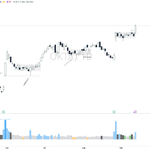
$OKTA

2
411
Anthropic($ANT ) is expected to start trading on Thursday.
A new IPO earns a spot on my watchlist only after it builds a structure.
Once a week, at the end of the week, I check my IPO screener. It looks for listings from the last year where price discovery is still underway: mid-cap, average volume above 1M and positive institutional transactions, a sign that big money is coming in.
I have included in the pictures the filters I use for the IPO screener.
Then I study the post-IPO chart: base, consolidation, breakout. I add only the stocks that are holding up well and have volume.


4
374
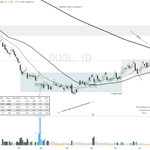
A beaten-down stock has to validate its base before I buy it.
One of my scanners looks for stocks that have been heavily sold off but are beginning to form a base. I never buy from it blindly.
First I want a clear base: tight consolidation, stabilizing volume. Then the first signs of a rebound: higher highs, higher lows, volume at the breakout. I keep my stop tight, because the rebound can be quick, but so can the failure.
$DUOL

2
10
504


I need stability outside the charts to perform well within them.
If my life is chaotic, my trades will reflect that. If my financial situation is unstable, I'll feel pressure with every decision.
Strained relationships affect my focus and emotional control.
Trading is already mentally demanding.
Add personal stress and it becomes exponentially harder to stay disciplined and consistent.
keep a clear routine and structure to your day.
2
7
373
My daily focus list has a limit of 10 tickers.
I add all the tickers I like from my preliminary watchlist into a watchlist called Focus List. Then I enforce the limit, otherwise I'd end up piling a bunch of names in there.
It's very important, because having too many will affect my execution.
You know the saying: if you try to catch two rabbits at once, you won't catch either one.
$QQQ
6
373
A stock's average daily dollar volume must be at least 100 times my capital.
That's my simple rule.
For example with a $1 million account, I wouldn't trade anything smaller than $100 million in average dollar volume per day. The bigger, the better.
I want as many institutions as possible involved in that stock. Institutions need liquidity to move their positions.
They can't enter and exit instantly like we do with a 10k to 10 million account.
50 winning trades in a row, handed to 100 traders.
Ross Haber @RossHaber says more than 90 of them would still lose money.
He started as a retail broker at the end of 1994. The first book he was given was How to Make Money in Stocks by William O'Neil.
In 1998 he went to work for O'Neil in California. Within a year a hedge fund client made him an offer. When he came in to resign, Bill sat him down and asked him to stay and manage money at the firm.
He managed money there in 1999 and 2000, traveled the country teaching O'Neil's workshops, and later co-ran a fund in New York for six years.
On the WOLF Financial Show with @WOLF_Financial this September, he shared what those years taught him:
"Picking stocks is the easy part."
"Honing in on the right stocks, that's not hard anymore."
"I always say I can give you 50 winning trades in a row to let's say 100 traders in a row, 90 plus percent will still lose money."
"How many times have we all been shaken out of a stock that just continues to go higher?"
"So if you can't hold your stock, it doesn't matter how right you are."
Seconds later he adds that managing risk and position sizing are what it all comes down to.
The episode has fewer than 3,000 views on YouTube.
Such an underrated video, imo.
1
9
728
Good morning, traders! I hope your weekend was better than mine. I spent mine in the emergency room with kidney stones, experiencing the worst pain of my life.
Even the pain this market has put me through over the past few months was nothing compared to that. 😂
Looking at the premarket, there’s red across the board. $IWM , bitcoin:native , $QQQ , gold, and even crude oil are all gapping down.
In my opinion, now isn’t the time to initiate shorts. The time for that was last Thursday, or Friday at the latest. Don’t chase the gap down.
Instead, I think today is a good day to look for relative strength.
Scan your favorite stocks and see how they behave relative to the broader market. The strongest stocks tend to hold up best on red days and are often the first to break out when the market turns around.
1
5
410
I experienced the worst pain of my life.
spent last Sunday evening in the ER.
I found out I have 3 kidney stones.
The nurses told me that the pain is apparently comparable to childbirth.
To anyone who has ever been through something like this, I have nothing but respect.
I now have a much better sense of what real pain feels like, and I feel like I could take 1,000 stop losses without feeling a thing. 😂😂
2
10
715
Livermore said the big money always came from his sitting, his sitting tight. Men who can both be right and sit tight are uncommon, and he found it one of the hardest things to learn.
Once you are right, your job is to sit tight and stay with the main trend.
Position size is what blows up an account.
That's why they say: price will hurt you, position size will kill you. So I structure every position based on how much I want to risk per trade.
@Qullamaggie said he will typically risk 0.5% or less of his account per trade, and up to a maximum of 1% on some trades. All of his massive gains were achieved while risking less than 1% per trade.
I can get there without full-porting my account into 0DTE. It won't happen overnight, and I definitely sleep better at night.
My sleep, my health and my routines are part of my edge.
Livermore wrote that the game of beating the market interested him from ten to three every day, and after three, the game of living his life.
He was usually in bed by ten, because he could not do business properly on insufficient sleep.
So I treat trading as a focused job. I show up rested, sharp and disciplined.
If I show up tired or unfocused, I can't blame my losses on bad luck.
I trade when I'm at my best and step away when I'm worn out.
5
498
The exhaustion gap is one of @TheOneLanceB Breitstein's favorite setups.
It's a euphoric move on high volume.
On Day A the stock moves up on high volume.
On Day B there's another big upmove on high volume. Day C brings a third.
On Day D there's a wide upside gap at the open on even higher volume.
That's the day of pure euphoria, when the trend exhausts itself and Lance looks for a major price reversal.
if the stock has a significant catalyst that day, he stays away, because news adds more fuel to the fire.
$SMCI

1
11
1,530
A setup that works perfectly in a trending market can destroy an account in choppy conditions.
That clicked in the stage where the strategy became mine. I adapted the framework to my personality, my risk tolerance, the hours I can be active, and the setups that suit me psychologically.
I know when to push and when to stay on the sidelines.
Drawdowns still exist. They are controlled, expected, and no longer trigger panic.
I know exactly why I win or lose, and that makes all the difference.
$QQQ
4
16
747