

A lab at Stanford University studying protein biogenesis, folding, and aggregation in health and disease. Tweets by lab members.
Stanford, CA
Joined February 2020
- Tweets195
- Following131
- Followers1.3K
- Likes158





Another great story from Jae Ho Lee in the lab: a new concept in cotranslational proteostasis-ribosome communication via chaperoneNAC. An exciting collaboration with Elke Deuerling's lab @DeuerlingLab and Marina Rodnina's lab biorxiv.org/content/10.1101/…

New exciting work from Jae Ho Lee in our lab, in a fantastic collaboration with Alessandro Ori @AOri_lab and Alessandro Cellerino @Alessan82703458 on why and how the brain ages and becomes vulnerable to neurodegenerative diseases science.org/doi/10.1126/scie…

Frydman Lab retweeted

Paging @NIHDirector_Jay . Is abruptly cutting these grants going to "make America healthy again"?

Frydman Lab retweeted

Triglycerides are an important fuel reserve for synapse function in the brain go.nature.com/4nvjk7k

Frydman Lab retweeted

I stand with dozens of other biopharma leaders highlighting the potential catastrophic effects of proposed research cuts on bringing innovation to patients! statnews.com/2025/06/27/biot…

Frydman Lab retweeted

My NIDA grant renewal is almost 2 months late and I’m going to have to start firing my students and staff. Not a lot of transformation to be had in my lab.

Frydman Lab retweeted

Our lab at the Weizmann Institute was hit tonight by Iran
We will rebuild and return 💪


Frydman Lab retweeted

It was a pleasure to participate in the "Protein folding & Chaperones" platform session this morning in #bps2025 sharing our story from the @FrydmanLab about TRiC mutations and their link with brain malformations. A session with a nice mix of cool stories focused protein folding


Frydman Lab retweeted

Closing an unforgettable chapter at Stanford. Grateful for the science, the growth, and the incredible people who shaped this journey—especially Judith, with whom I had the privilege of doing great science. This place and its people will always mean a lot to me. Very excited!

3) Two surprises that could only be revealed by cryoET raise new cool future questions (I) It uncovered a new cofactor, PDCD5 which binds to ALL open TRiC complexes (and was missed by biochemical studies) and (II) closed TRiC forms stereotypic clusters of mysterious function.
2) The MS also quantified TRiC-Prefoldin cooperation in vivo. Importantly it establishes that closed TRiC engages in specific interactions with quasi-folded substrate folding intermediates in its closed folding chamber, which is clearly NOT an "Anfinsen cage"
Check out our MS describing the in vivo cycle of chaperonin TRiC/CCT, in a wonderful collaboration with Martin Beck's lab: nature.com/articles/s41586-0…
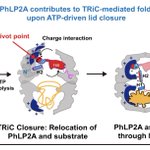
1) The study established TRiC's important function in folding newly translated proteins and defines its ATP-driven cycle

A really nice piece on our recent study: med.stanford.edu/news/all-ne…

4. The concept of chaperonin function as central in brain development is a new paradigm opening the door to many additional mysteries.
Thanks to all: Ingo, Miriam, Stephen, Florian, Piere for the fun collaboration and to Manu Sharma for the highlight: science.org/doi/10.1126/scie…

3. From a clinical perspective, these patients with "TRiCopathies" may be at an extreme end of a spectrum, with frequent but less-severe TRiC genetic variants causing milder intellectual disability and seizure phenotypes.
2. Despite its ubiquitous expression, de novo mutations in seven out of the eight CCT-genes led to brain malformations, intellectual disability, and seizures in a total of 22 patients. Thus, insufficient TRiC folding capacity becomes a bottleneck in brain development.
1. Check out our latest and exciting MS describing a new class of neurodevelopmental diseases caused by mutations in most subunits of the chaperonin TRiC/CCT. science.org/doi/10.1126/scie… (part 1 of series)

5. We hope others use this robust strategy for reliably detecting pausing events even in low coverage data. Our approach may open the way to understand translation dynamics in rare and valuable samples, such as donor tissues or single cell analyses.
4.
iii) We identify nascent chain sequences in the exit tunnel that contribute to sequence-specific pausing
iv) We find that ribosome collisions arise from an elongation rate mismatch of proximal ribosomes translating sequences with opposite elongation rates.