

Multi-Ledger Rollup Network of Networks. The institutional-grade Layer 2.5 rollup network powered by QNT for unified interoperable assets and networks.
Joined June 2025
- Tweets75
- Following1
- Followers3.6K
- Likes1




The infrastructure problem holding regulated finance back from #blockchain now has an answer.
Public L1s lack the controls institutions need.
Private permissioned networks solved that, but created silos.
Fusion sits above both, connecting existing ledgers without bridges, without wrapped tokens, without new points of failure. Every asset class. Every network. Under institutional control.
Read more: quant.network/perspectives/b…
#QuantFusion #TokenisedFinance #Interoperability

Tokenised finance is fragmenting fast. Every bank, market infrastructure and fintech is building its own chain, and connecting them one bridge at a time gets harder with every network added.
Quant Fusion takes a different approach: one neutral fabric that connects permissioned networks and public chains, without asking anyone to migrate.
🔗 One canonical bridge per network, built and secured by Quant
🏦 Assets keep their origin-chain trust
⚖️ No single institution owns the fabric
Why neutrality is the precondition for core infrastructure: quant.network/perspectives/o…
#QuantFusion #FinancialInfrastructure
Most cross-chain systems rely on bridges: lock an asset on one chain, mint a synthetic copy on another, and hope the bridge holds.
Quant Fusion takes a different route. It's a multi-ledger rollup, a shared execution environment connecting to many ledgers at once, so a bank's tokenised deposit, an Ethereum stablecoin and a tokenised bond can all be referenced in the same execution, settling together or not at all. No bridge, no synthetic peg, no exposure window.
Read how it works:
quant.network/perspectives/h…
#QuantFusion #Blockchain

Institutions evaluating #publicblockchains often arrive at the same question: who is processing the transaction?
In our latest article, we cover what the Trusted Node Program is, why it matters for compliance, and how it fits with Fusion’s other controls.
#QuantFusion #Blockchain #Compliance
What if an AI agent could execute the exact same #blockchain workflow a human uses? That's what Flow Applications on #Overledger do today, MCP-compatible agents included. Learn more: quant.network/perspectives/f…
#Blockchain #QuantFusion

For institutions already operating tokenised payment infrastructure, #QuantFusion is the connective layer that lets those islands of bank money interoperate without any of them giving up the control that makes a deposit a deposit.
Learn more in this article: quant.network/perspectives/q…
#TokenisedMoney #PaymentInfrastructure

Collateral is fragmented by design, stuck in the wrong place at the wrong time. This article makes the case for Quant Fusion in #capitalmarkets.
What you'll learn:
✅ Why solving mobility within a single consortium isn't the same as solving it across the market
✅ The real cost of stuck collateral: settlement fails, CSDR penalties, funding costs
✅ Why institutions that connect early with Quant Fusion shape the standards the market settles on
Read the full article: quant.network/perspectives/c…
#QuantFusion #CollateralMobility #Tokenisation
Blockchain is fragmented across siloed assets and split liquidity. Luke Riley compares Circle's Gateway and Quant Fusion's Rollup on #interoperability.
Fusion generalises Gateway's USDC model, letting institutions build one #unifiedportfolio across public and permissioned chains.
Learn more: quant.network/perspectives/c…
The Overledger and Fusion Firewall is how #QuantFusion extends your perimeter onto the public chain rather than stopping at its edge.
It is the first blockchain firewall to enforce institutional access policy at both the authenticated user layer and the on-chain address layer across a multi-chain environment: quant.network/perspectives/t…
#BlockchainFirewall #Blockchain

Stablecoins live on public chains. Tokenised deposits live on banks' permissioned networks. The gap between them is where settlement risk hides.
Fusion is the shared layer that lets both settle synchronously across ledgers, PvP, DvP, cross-network transfers, without third-party bridges or wrapped tokens.
Read more: quant.network/perspectives/q…
#QuantFusion #Settlement #TokenisedMoney

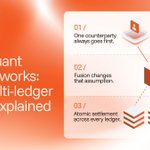
When settlement systems can't interact atomically, one counterparty always goes first. CLS's netting window handles this well for the flows it was built for.
The gap is same-day, deadline-driven payments and intraday liquidity, where one party can stay exposed all day.
Fusion's multi-ledger rollup is designed to close that gap - and in a market full of interoperability claims, how it actually works is worth explaining: quant.network/perspectives/h…
#QuantFusion #MultiLedger

What if an AI agent could execute the exact same blockchain workflow a human uses? That's what Flow Applications on Overledger do today, MCP-compatible agents included.
Learn more: quant.network/perspectives/f…
#Blockchain #AIAgents #FlowApplications

Every institution building its own chain. Every chain needing its own bridge. That path leads to fragmented liquidity and rising integration costs.
Fusion takes a different approach, one canonical bridge per network, secured by Quant. A single layer connecting permissioned ledgers, public chains, and every institution on the fabric.
Learn why neutrality is the precondition for interoperability: quant.network/perspectives/o…
#Tokenisation #Interoperability #QuantFusion
In this video, hear our Head of Innovation, Luke Riley, explain the significance of the Fusion Rollup mainnet launch, and what it unlocks for institutions operating across multiple ledgers.
Learn more: quant.network/news/a-new-cat…
#QuantFusion #Blockchain
AI agents are already transacting and settling autonomously, at machine speed. That's why Quant has joined the x402 Foundation, hosted by the @linuxfoundation.
x402 lets AI agents pay each other directly, without a human approving every step. Fusion supports it out of the box, connected to 70+ networks from day one.
We're connecting these internet-native payment protocols to regulated banking rails, so agents can settle in tokenised bank money with the compliance and certainty wholesale markets demand: quant.network/news/how-quant…
#QuantFusion #AgenticPayments #AIAgents

Most #interoperability solutions move one asset between chains. Quant Fusion is different - a Layer 2.5 rollup that treats every connected ledger, public or permissioned, as part of one unified environment.
State aggregation, not just asset transfer. Here's what that unlocks: quant.network/perspectives/c…
#QuantFusion
Quant secured a Japanese patent earlier this year for its multi-DLT token innovation, protecting the core technology behind Fusion's rollup capabilities and multi-network tokenisation.
Read this article to learn more: quant.network/news/quant-sec…
#QuantFusion
The #Overledger and #FusionFirewall is Quant's policy enforcement layer, deciding, for every request, whether the caller is permitted to act.
It operates across two layers: the Connector layer enforces access across every #DLT network the Gateway reaches.
The Fusion Firewall enforces on-chain, via contracts deployed on the #FusionRollup and each connected L1, so the rules hold even if the Gateway is bypassed.
Learn more: quant.network/perspectives/t…
#QuantFusion #Blockchain
