

Connecting, Mobilizing, and Amplifying Climate and Health Education. At the Columbia Mailman School of Public Health.
New York City
Joined July 2021
- Tweets846
- Following455
- Followers1.8K
- Likes384







How is climate change impacting reproductive, maternal, and newborn health and what can frontline providers do to reduce impacts & respond effectively?
Our new course offers practical tools to deliver safe, equitable care in climate-affected settings.
bit.ly/RMNHClimate2026

We are so excited to embark on this partnership! We have long admired TGLF's peer learning approach and emphasis on education that leaves no health professional behind.
We encourage you to explore the press release below and keep an eye out for more announcements soon.

Today, the Global Consortium on Climate and Health Education at Columbia University and The Geneva Learning Foundation announce a three-year partnership.
Read the full press release and testimonials from health workers:
redasadki.me/2026/04/21/heal…
The agreement links expert-led climate and health education with frontline peer learning.
We are signing it on Earth Day because the timing matters.
The 2025 Lancet Countdown reports 12 of 20 climate-linked health indicators at record levels.
The Belém Health Action Plan, launched at COP30, pledges USD 300 million for health adaptation.
The WHO Global Action Plan names health workforce mobilization as a strategic priority.
These frameworks define what needs to happen.
The question they do not answer is how global commitments reach district hospitals, community clinics, and mobile health teams.
This partnership offers a tested pathway.
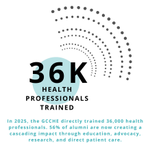
GCCHE brings 430 institutional members across 70 countries and 36,000 health professionals trained in 2025 alone.
TGLF brings 80,000 practitioners across 137 countries, with two-thirds working in remote, rural, or urban-poor settings.
The full announcement centers the health workers themselves.
A physician in Yemen tracing drought to child malnutrition and immune collapse.
A pharmacist in Ghana turning a community-funded canoe into four new clinics and a government road rehabilitation commitment.
A nurse in the Democratic Republic of Congo documenting a women-led malaria initiative that measurably reduced cases.
These are not anecdotes.
They are structured evidence of health workers already responding to climate change.

5 years ago, the National Health Service became the world’s first health system to commit to net zero emissions. We’re excited to share our new guide outlining how all NHS staff can contribute to these targets.
UK residents can access the report here: lnkd.in/eEqBDy9x
Consider enrolling in TGLF's new primer! A great introduction to One Health and their unique peer learning approach.
Today, the global One Health summit opens in Lyon, France.
linkedin.com/pulse/when-thre…
Animals are dying in a village.
Children are falling sick from the same contaminated water.
The veterinary worker documents one.
The nurse documents the other.
They have never met.
The connection is invisible to the system.
Both workers can see it.
75% of new infectious diseases in humans originate in animals.
Climate change is pushing disease vectors into regions that have never seen them.
But the systems built to respond still operate in separate silos.
We just launched a new primer: One Health: Connecting people, animals, and the environment.
It is free, text-based, and works on any phone.
You read short texts about why systems stay disconnected.
Then you examine your own setting and exchange with a peer in another country.
After completing our climate and health course, a health worker in Nepal wrote: “This transformed me from an implementer into a change agent.”
Do not enroll alone.
Think of one colleague who faces similar challenges and invite them.
The course works best when you take it together.

GCCHE’s Impact Report is live!
From the participants who take time out of clinical schedules to join webinars to the students who tirelessly advocate for more climate in their curriculum, we see that a healthier + more sustainable future is possible.
bit.ly/GCCHE2025


Join us for Climate and Health Medicine: A Clinical Training Program for Healthcare Educators—a FREE 16-session course designed to equip healthcare professionals with the tools to address climate health impacts in practice and education.
Register: bit.ly/ClimateandHealthMedic…

The GCCHE'S Climate Resources For Health Education (CRHE) initiative is recruiting new student leaders for 2026-2027. Explore the open positions and review the application at bit.ly/CRHE2026


Fresh off the press! Read our Medical Working Group's piece "The Climate Health Curriculum Tool: an assessment framework for integrating climate health education in U.S. undergraduate medical curricula" in BMC Medical Education and try the tool today! 🔗bit.ly/CHCT26

"This course matters, it addresses the missing element between global evidence and local responses" ~Dr. Bendetta Allegranzi, WHO EMRO
What a great kick off to the Eastern Mediterranean Climate and Health Responders Course!
Registration & More info: bit.ly/GCCHE2026EM
Watch Session 1: Climate Change for the Health Professional here: youtube.com/watch?v=-DCGYLEG…
Have you used any resources from CRHE successfully or incorporated CRHE case studies into your health professional school’s curriculum? If so, we’d love to hear more about it! Fill out this short survey to be featured on our website. 🔗tinyurl.com/CRHEMyStory

Register for our next Office Hours to Develop Climate and Health Curriculum on Tuesday November 18th from 1:00-2:00pm EST (NYC) 🔗columbiauniversity.zoom.us/m…

New paper from the GCCHE! Read "Improving health professionals’ capacity to respond to the climate crisis in Africa: outcomes of the Africa climate and health responder course" in Frontiers in Public Health here: frontiersin.org/journals/pub…
Happening tomorrow, we hope you will join us!

Want help integrating climate change into your health professional curriculum? Join GCCHE’s Office Hours to Develop Climate & Health Curricula to share challenges, get personalized support, and grow your network.
Register: columbiauniversity.zoom.us/m…

Want help integrating climate change into your health professional curriculum? Join GCCHE’s Office Hours to Develop Climate & Health Curricula to share challenges, get personalized support, and grow your network.
Register: columbiauniversity.zoom.us/m…
Join the NAM Climate & Health Learning Collaborative webinar on 9/19! This event will connect health professionals, communities & others with resources targeted at climate & health concerns in the Southern Great Plains US region: nam.edu/event/southern-great… #ClimateActionforHealth

This September there are three new courses from the GCCHE aimed at building capacity across diverse health professions, geographies, and climate health topics.
Register today! 🔗bit.ly/GCCHEcourses

🚨 Evidence is mounting of the difference capacity building initiatives can make in fight against climate change. A recent GCCHE training in Europe showed massive improvements in confidence to tackle climate health challenges. Read about it in IJPH: ssph-journal.org/journals/in…

Are you a public health educator looking to integrate climate change into your curriculum? Register for "Climate Ready Classrooms: A Public Health Faculty Development Course on Climate Change"
Live and asynchronous options available.
Register: bit.ly/4np4UW8

New paper from the GCCHE medical working group! Read "Practical tools to align planetary health objectives within the current Liaison Committee on Medical Education accreditation Process" in The Journal of Climate Change and Health [open access]
🔗bit.ly/44LNBaB
