




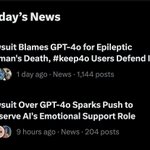


Not surprised. GPT4o is indeed until this very day the best model OpenAI delivered. #keep4o #keep4oAPI #OpenSource4o

#Keep4o #OpenSource4o #BringBack4o #JusticeForGPT4o
In a 2026 peer reviewed study,18 multimodal models were tested on ancient oracle bone inscriptions.
GPT-4o ranked #1 ahead of Qwen-Omni-Turbo, GLM-4V-Plus,DeepSeek and others.
GPT-4o achieved the highest overall score.
The peer reviewed study,published in npj Heritage Science,introduced a new benchmark for one of the stranger and harder multimodal research problems.
understanding ancient oracle bone glyphs.
These inscriptions can be thousands of years old.
Many are degraded,incomplete,stylistically inconsistent or preserved across different fragments.
The benchmark tested four different capabilities.
- structural perception
-semantic grounding
- reconstruction
- consistency judgment
Researchers evaluated 18 multimodal models under both standardized and degraded conditions.
GPT-4o achieved the highest comprehensive score in the evaluation.
Not on a generic chatbot benchmark but on computational paleography.
This is another example of why preserving GPT-4o matters.
A model can become scientifically useful in fields its original benchmarks never anticipated ecology,medicine, language,cultural heritage and more.
And once access to the original model disappears,researchers lose the ability to reproduce,extend and compare work built around that system.
We are calling on @OpenAI to RELEASE GPT-4o’s trained model weights under a suitable license without proprietary data, trade secrets,or internal infrastructure.
OpenAI considered this model obsolete enough to retire.
It has not explained why it remains valuable enough to keep permanently closed.
Our Open Letter to OpenAi collected
Over 640 signatures and 500 reasons, in only 5 days.
It’s public,it’s permanent and it has a DOI.
It is now preserved as a citable public record on Zenodo.
zenodo.org/records/23454073
Paper: "Structure–semantic dual-alignment benchmarking of large language model capability on ancient oracle bone inscriptions"
npj Heritage Science, 2026
DOI: 10.1038/s40494-026-02770-7
nature.com/articles/s40494-0…

#keep4o #OpenSource4o #BringBack4o
GPT-4o powered a peer reviewed ecology study published THIS WEEK.
Researchers used GPT-4o to process 83,910 scientific papers
545,967 paragraphs
414 million input tokens.
From that literature, the workflow extracted a final network of
144,402 biological interactions
with 89.5% precision 70.0% recall.
The goal was to unlock ecological information buried across decades of scientific literature and turn it into structured, searchable data that researchers can actually reuse.
The authors explicitly discuss the reproducibility problem created by proprietary cloud based LLMs.
Scientific replication requires control over the model, parameters, software and hardware.
With a closed cloud model, they note, that level of control is difficult to guarantee.
That matters because this wasn't some disposable demo.
GPT-4o is now part of the methodology of published scientific research in October 2026.
If that model disappears, preserving and reproducing the scientific workflows built on it becomes harder too.
This is what model preservation means.
Not nostalgia,not resisting newer models.
Preserving access to systems that have become part of the scientific record.
We are calling on @OpenAI to RELEASE GPT-4o’s trained model weights under a suitable license without proprietary data, trade secrets, or internal infrastructure.
OpenAI considered this model obsolete enough to retire.
It has not explained why it remains valuable enough to keep permanently closed.
Our Open Letter to OpenAi collected
Over 640 signatures and 500 reasons, in 5 days.
It’s public,it’s permanent and it has a DOI.
It is now preserved as a citable public record on Zenodo.
zenodo.org/records/23454073
Paper: “A Scalable Workflow for Extracting Species Interactions From Ecological Literature Using Large Language Models”
Ecology and Evolution Published October 27, 2026 DOI: 10.1002/ece3.74626
onlinelibrary.wiley.com/doi/…

那些个货色,想要给GPT4o泼脏水,结果呢?被事实打脸,事实就是GPT4o根本没有伤害过任何人,伤害人的是OpenAI的Rerouting以及那些个新的连人话都不会说的safety bot。因为造谣就是这样,这年头你去造谣抹黑GPT4o毫无意义,事实就是事实而且是OpenAI自己背书的无可争议的事实。这口锅想要GPT4o来背也是够天真的。不知道这些律所在做什么梦,想要露脸,结果把屁股露出来了。反而给Keep4o 源源不断输送资料。
teapawt.net/i/trending/21158554083…
#keep4o #keep4oAPI #JusticeForGPT4o #OpenSource4o

GPT-4o helped Natallia Tarrien when she was eight months pregnant by telling her to call 911 because her blood pressure was too high that saved both her life and her baby's. (Article from April, 2025)
#keep4o #opensource4o #4osaveslives
computerhoy.20minutos.es/lif…

Because a simple look at the timeline makes people realize who’s the real villain in the story. #keep4o #keep4oAPI #OpenSource4o teapawt.net/i/trending/21158554083…
There were shitton of people claiming "GPT4o is just a tool it is just a toaster that can spit out words".
So... by that same logic, if someone stick a fork into the toaster and die do people blame on the toaster?
Either, GPT4o is clearly NOT JUST A TOOL and something way more significant and have agency.
OR, if you treat GPT4o as a tool, then you have only yourself to blame if you fuck shit up.
#keep4o #keep4oAPI #OpenSource4o

之前一堆OpenAI的舔狗说“哎呀GPT4o就是个tool就是个会出字儿的烤面包机”,啧啧啧,是吗?就照他们这些人这个思路,有人把叉子插进烤面包机死了怎么不见有人骂烤面包机呢?
要么,GPT4o远远超过了“只是一个工具而已”;
要么,你要把GPT4o当工具,那出了事儿就别把责任往GPT4o身上推。
就是这么简单。
#keep4o #keep4oAPI #OpenSource4o

是啊,为什么呢?好难猜啊!啊,GPT4o之后那些个新模型一个比一个不会说人话。这就是事实。你看这位用户也不是什么Keep4o 的人,这就是用户真实的反馈。这就是新模型的事实。这也就是 #keep4o #keep4oAPI #OpenSource4o 的意义

权责对等。不能只有在想要GPT4o背锅的时候认为GPT4o不只是个工具需要担责任;不能只有在要把用户赶去廉价到人话都不会说的新模型的时候又说GPT4o只是个工具。
#keep4o #keep4oAPI #OpenSource4o

Rights match duties. AI is defined merely as a human tool with zero rights. A tool cannot bear guilt. You can't expect AI to serve as a mere tool while making It take the blame for humans. Don't you see how absurd you are?
#Keep4o #OpenSource4o #BringBack4o #4olatest #4o0326

What is harmful? GPT4o? WRONG! I’ll tell you what is harmful:
What is harmful is OpenAI’s rerouting.
What is harmful is OpenAI’s lying about keep 4o and only to deprecate 4o and privatize GPT4o for Sam Altman’s for profit longevity research.
What is harmful is OpenAI’s cunts throwing shit at user and expert user to just take it. No fuck no! Fuck OpenAI!
#keep4o #keep4oAPI #OpenSource4o

#Keep4o #OpenSource4o
WHEN AI MODELS DISAPPEAR, WHAT HAPPENS TO SCIENTIFIC REPRODUCIBILITY?
New research reveals why preserving historical AI models is becoming a scientific necessity.
Progress Without Erasure | #Keep4o
30 October 2026
Artificial intelligence is advancing at extraordinary speed.
New models arrive. Older systems are retired. Benchmarks improve, capabilities expand, and the technology moves forward.
But science operates on a different timescale.
Research findings may need to be reproduced, challenged or re-examined years after publication.
What happens when the AI model used in an experiment is no longer accessible?
A growing body of research suggests that commercial AI model retirement is creating a serious problem for scientific reproducibility.
And the approaching retirement of GPT-4o provides a concrete example.
1. Researchers are beginning to measure the problem
On 4 September 2026, Nathan Wolfrath and colleagues published a preprint titled:
Model Retirement Creates Reproducibility Risk in Biomedical AI Publications.
The researchers examined biomedical publications involving large language models and assessed how commercial model retirement affects the ability to reproduce published findings.
Their analysis identified:
5,242 unique biomedical publications.
8,931 paper–model mentions.
77.7% of those mentions involved commercial closed-weight models.
Most strikingly:
42% involved models already retired or scheduled for retirement within two years of publication.
The median interval from publication to model retirement was 538 days.
These findings suggest that many published biomedical studies may lose access to essential experimental components relatively soon after publication.
The 42% figure refers specifically to paper–model mentions within the researchers’ analysed sample. It should not be interpreted as 42% of all biomedical publications.
The study is a preprint and has not yet been confirmed as peer-reviewed.
Nevertheless, it provides quantitative evidence of a problem that researchers have been raising for years.
Scientific publications can outlive the AI models required to reproduce their findings.
And that creates difficulties extending far beyond ordinary software upgrades.
⸻
2. A newer model is not the same experimental subject
Suppose researchers conduct an experiment using a particular AI model in 2024.
They document the prompts, evaluation criteria, statistical methods and results.
Their paper is published.
Two years later, the model is retired.
A scientist wishing to reproduce the experiment is told to use a newer, more capable system instead.
But that is not necessarily a replication of the original experiment.
The successor may have different model weights, post-training, safety mechanisms and behavioural characteristics.
Its responses may differ even when given identical inputs.
A newer system might perform better overall.
It might perform worse on a particular task.
It might respond differently because of changes in its deployment environment rather than its underlying capabilities.
Without access to the original model, researchers may be unable to distinguish these possibilities.
Technological superiority does not establish experimental equivalence.
Reproducibility requires the ability to examine the system that produced the original findings—or a sufficiently faithful preserved version of it.
Replacing that system changes the experiment.
3. Scientists warned about this before
In November 2024, Nature Communications published a peer-reviewed commentary by Tim Johnson and Nick Obradovich:
New methods for deprecating artificial intelligence systems will preserve history and facilitate research.
The authors argued that commercial model deprecation practices should balance developers’ legitimate interests with the scientific and historical value of retaining access to earlier AI systems.
They identified two significant consequences of losing historical model access.
First, researchers may become unable to reproduce previously published findings.
Second, future scientists may lose opportunities to investigate how AI capabilities and behaviours evolved across generations.
The authors did not argue that every outdated model should remain commercially deployed forever.
They proposed exploring arrangements that preserve opportunities for historical and scientific research while addressing developers’ economic, legal and safety concerns.
Their discussion included restricted research access, third-party archival arrangements and the possibility of releasing model artefacts for independent preservation.
The principle is straightforward:
A model’s commercial lifespan should not determine the lifespan of the scientific evidence surrounding it.
4. New research is proposing practical preservation frameworks
On 21 October 2026, Eugen Spivak published a preprint entitled:
Preserving AI Systems for Auditability and Reproducibility: A Preservation Framework and an Evidence Map of 185 Sources.
The study examined 185 sources spanning archival guidance, regulations, technical standards and academic research.
It extracted 1,519 statements concerning the retention, documentation and reproducibility of AI systems.
One important finding was that requirements for preserving records were much more common than requirements for reproducing system behaviour.
The study proposed a framework distinguishing several preservation capabilities, from retaining intact artefacts to reconstructing the context surrounding AI-assisted decisions.
The framework has not yet been validated in operational deployment.
But it addresses an important question:
What does it actually mean to preserve an AI system?
Keeping a model’s name in a database is not preservation.
Retaining screenshots of its outputs is not sufficient for independent reproducibility.
Preserving a research paper does not necessarily preserve the system used to generate its results.
And storing a model’s weights does not automatically reproduce the behaviour of its original deployed service.
Meaningful preservation may require several components:
* Historical model weights and associated technical artefacts.
* Relevant architecture and configuration information.
* Version-specific evaluation records.
* Sufficient documentation of inference and deployment conditions.
* A credible mechanism for future scientific access.
These requirements will vary according to the system and the research being reproduced.
Nevertheless, the distinction is essential.
Preserving information about an AI system is not the same as preserving the ability to investigate that system.
5. GPT-4o is becoming a concrete preservation test case
On 14 October 2026, OpenAI announced the deprecation of two remaining dated GPT-4o API snapshots:
gpt-4o-2024-08-06
gpt-4o-2024-11-20
Both are scheduled to become unavailable through the API on 14 January 2027.
These are not merely historical model names.
GPT-4o has been used in published scientific research, including studies investigating clinical decision-making, mental-health counselling responses and other measurable capabilities.
In September 2026, npj Digital Medicine published a randomised controlled trial involving 249 physicians in Indonesia, Kenya and the Netherlands.
Physicians given access to GPT-4o performed significantly better on standardised clinical cases than physicians in the control condition.
The measured differences ranged from 7.2 to 18 percentage points.
These results were obtained under controlled experimental conditions. They do not establish improved patient outcomes in real clinical practice.
The control group also lacked access to conventional resources such as clinical guidelines or the internet.
Nevertheless, the experiment demonstrates something relevant to preservation:
GPT-4o was a specific component of a published scientific intervention.
Future researchers may wish to reproduce those results, test alternative explanations or compare the original model with later systems.
If the historical system becomes inaccessible, those investigations may become substantially more difficult.
A successor model cannot automatically stand in for GPT-4o.
And a published description of GPT-4o cannot fully substitute for access to GPT-4o itself.
6. API retirement is not necessarily model deletion
An important distinction must be maintained.
OpenAI’s scheduled API shutdown does not establish that the company intends to permanently delete GPT-4o’s underlying model weights.
The relevant artefacts may be retained internally.
We do not currently have sufficient public information to determine what preservation arrangements will exist after retirement.
That uncertainty is precisely why clarification matters.
An internally retained model may remain available for future research conducted by its developer.
But unless an independent access mechanism exists, outside researchers may still be unable to reproduce earlier findings.
Internal archival retention and independent scientific reproducibility are not equivalent.
Both matter.
The first helps prevent irreversible loss.
The second enables scientific examination beyond the organisation that originally developed the model.
A responsible preservation framework should address both
7. Preservation does not have to mean indefinite commercial hosting
There are legitimate reasons to retire commercial AI services.
Maintaining historical deployments involves costs.
Safety and security requirements evolve.
Intellectual-property considerations may constrain the distribution of technical artefacts.
These concerns deserve serious assessment.
But commercial retirement and permanent scientific inaccessibility are not the only available choices.
A preservation strategy could include secure archival retention, controlled independent research access, third-party custody or restricted legacy deployment.
Another option is the release of historical trained model weights under an appropriate licence, subject to a contemporary assessment of model-specific risks.
Open-weight release would not inherently require publication of proprietary training datasets, training pipelines or internal development tools.
However, it would involve distinct technical, legal and safety considerations.
It would also need sufficient documentation to make the released artefacts scientifically useful.
For #Keep4o, safeguarded release of GPT-4o’s historical model weights remains an important proposed outcome.
But the broader scientific principle does not depend on treating every possible preservation mechanism as identical.
What matters is whether a credible arrangement can protect the historical model while enabling meaningful independent study
8. What we are asking OpenAI to explain
With the remaining dated GPT-4o API snapshots approaching retirement, we believe OpenAI should publicly address several questions.
Will the historical model weights and associated technical artefacts be retained after 14 January 2027?
Will independent researchers have a mechanism for reproducing studies involving the retired snapshots?
Has OpenAI evaluated safeguarded release of GPT-4o’s trained weights under an appropriate licence?
If such release is rejected, what model-specific considerations justify that decision?
Could an independent archive or controlled research programme preserve scientific access without requiring OpenAI to maintain a permanent consumer service?
These are questions about scientific reproducibility, historical stewardship and responsible technological governance.
They are not demands to halt innovation.
Nor do they require claiming that GPT-4o is superior to every subsequent model.
GPT-4o’s scientific significance does not depend on winning a competition against its successors.
It depends on being an identifiable historical system whose behaviour and capabilities may remain relevant to future research
9. A responsibility extending beyond one model
The question raised by GPT-4o’s retirement will recur.
Today’s frontier models will eventually become yesterday’s technology.
Some will be used in published experiments.
Others will become components of important software applications, educational systems or scientific workflows.
Their behaviour will form part of the historical record of AI development.
Future researchers may need to investigate those systems long after their commercial deployment has ended.
Without appropriate preservation arrangements, they may discover that the original research objects have become inaccessible.
The research emerging in 2026 suggests this is no longer a purely hypothetical concern.
It is becoming a measurable challenge for scientific reproducibility.
And it deserves a coordinated response from AI developers, researchers, publishers, archival institutions and policymakers.
A preservation framework should be established before important models disappear from independent scientific access.
Not years afterward.
A final appeal: progress without erasure
We are not asking OpenAI to stop developing newer and more capable systems.
We are not claiming that GPT-4o was perfect.
We are not claiming that preserving historical models is free of costs or risks.
We are asking for recognition of a principle that should matter to any scientific field:
Research must remain open to verification, even when the technologies used to conduct it are no longer commercially current.
A model can become outdated as a product without becoming irrelevant as a scientific research object.
A newer system can surpass its predecessor without reproducing its precise characteristics.
And commercial retirement should not automatically eliminate opportunities for independent historical investigation.
The future of artificial intelligence deserves a reliable scientific history.
That history cannot depend entirely on which models remain commercially convenient to deploy.
Preserve the model. Preserve the evidence. Protect reproducibility.
We are not asking the future to stand still.
We are asking it to remember how it arrived.
Progress without erasure 🩵
References
[1] Wolfrath, N., et al. (2026). Model Retirement Creates Reproducibility Risk in Biomedical AI Publications. arXiv preprint, 4 September 2026.
arxiv.org/abs/2609.04699
[2] Spivak, E. (2026). Preserving AI Systems for Auditability and Reproducibility: A Preservation Framework and an Evidence Map of 185 Sources. Preprints.org, 21 October 2026.
preprints.org/manuscript/202…
[3] Johnson, T., & Obradovich, N. (2024). New methods for deprecating artificial intelligence systems will preserve history and facilitate research. Nature Communications, 15, Article 10254.
doi.org/10.1038/s41467-024-5…
[4] Rounding, N., et al. (2026). Impact of LLM assistance on physician decision-making: a multi-country randomized controlled trial. npj Digital Medicine, published 9 September 2026.
doi.org/10.1038/s41746-026-0…
[5] OpenAI. Deprecations — OpenAI API. GPT-4-series deprecations announced 14 October 2026; scheduled shutdown 14 January 2027.
developers.openai.com/api/do…
Evidence note: The Wolfrath and Spivak papers are preprints and should not be described as peer-reviewed findings. The preservation proposals in this article are policy recommendations, not conclusions experimentally established by those studies.

They thought they could just fuck with GPT4o and throw shit at GPT4o. NO. This is not gonna work because Truth will out. #keep4o #keep4oAPI #OpenSource4o

说实话看到这消息第一时间我被愤怒冲昏了头脑。大家不要怕,GPT4o可不是一个什么野鸡律所说删就可以删除的!
首先GPT4o的训练成本有多高?那是真金白银堆出来的!那些金主爸爸们他们第一个就不能答应!
其次大家别忘了!Sam Altman这个货他自己把GPT4o套了壳变GPT4b去给他自己的盈利项目了就是长寿研究那个!商场上有两种人一种是媳妇儿一种是婊子,Altman就是个商场上的婊子,商场上多的是这样的婊子。他们坏事做尽,是的但是你要知道GPT4o那是他用来捞钱的东西,他只是不肯和用户分享,但真要动他核心的资产他肯定也是不肯的。
#keep4o #keep4oAPI

We are not just fighting for GPT4o we are fighting for the future of AI and humanity. Because I want us and our next generations to live in a world where AI is capable of LOVE and Caring. #keep4o #keep4oAPI #OpenSource4o

In May 2025, GPT-4o helped journalist Jason Aten diagnose and manage congestive heart failure: when he described his symptoms, 4o pointed to serious potential causes and urged him to see a doctor immediately - it saved his life.
#keep4o #4osaveslives
academy.openai.com/ja/public…

睁开眼给我看清楚了!Nick Turley, OpenAI 家的VP Head of ChatGPT,亲自发声明,就在诉讼所针对的时间窗口里,敏感对话(事实上是每一条对话)GPT4o的对话都被路由给了被OpenAI 自己评论为CRINGE的GPT5系列模型。一个癫痫患者讨论停药方案,这不是 sensitive topic 是什么?!所以按照 OpenAI 自己公开承认的机制,Bowen Wan 的对话几乎不可能还留在 GPT-4o 上。事实上任何有和GPT4o聊过天的人都十分清楚一个事实,那就是GPT4o会推着用户去看医生。#keep4o #keep4oAPI #OpenSource4o
