

Independent global journalism | Politics • Law • Elections • International Affairs | Journalism in the Public Interest | Founded & edited by D.O. Abiodun.
Vienna, Austria
Joined June 2018
- Tweets3.6K
- Following2.2K
- Followers6.8K
- Likes1.4K





Madam Alice Weidel - the Ukraine cannot win against Russia. It is impossible!
Good morning Madam Weidel. We already knew this at 0:00 on 25 February 2022.
Can somebody tell me something, okay? How is it that these leaders, who are supposed to have foresight, only see what common people like us saw since ancient history, huh?
Good morning Germany. A very good morning to you.

GSR was at this occasion held in Vienna on 8 October 2026: the re:think media conference at MuseumsQuartier, where journalists and media professionals explored public trust, press freedom, disinformation and the future of journalism.
The recurring question—“Who can you trust?”—connected discussions about credibility with broader concerns about power, accountability and the conditions under which journalists work. Sessions also addressed international journalism, European cooperation against disinformation, and power within media organisations.
During the discussions attended by GSR, a reporter raised concerns about political influence within Austria’s bureaucratic structures. GSR considers this an issue deserving scrutiny through specific evidence: how appointments are made, how public advertising and funding are allocated, and how authorities respond to requests for information.
Austria’s experience demonstrates why these questions matter. In October 2023, the Constitutional Court found parts of the rules governing appointments to ORF’s supervisory bodies unconstitutional because they failed requirements of independence and pluralism. Parliament subsequently passed a reform in March 2025. This history establishes a concrete governance concern, without justifying a blanket claim that Austrian journalists or their reporting are politically controlled. (vfgh.gv.at, parlament.gv.at)
Public financing also warrants attention. The European Commission’s 2025 assessment identified continuing concerns about the influence of state advertising on Austria’s media market. Financial dependence can create pressure on editorial decisions, although receipt of public advertising alone does not prove improper influence over an outlet’s coverage. (commission.europa.eu)
There are significant safeguards and reforms. KommAustria is legally independent, while Austria’s information-freedom framework, effective since September 2025, introduced a right of access to official information. Their practical effectiveness must be assessed through decisions, disclosure and accountability. (rtr.at, bundeskanzleramt.gv.at)
GSR’s editorial assessment is that trust must be earned through practices the public can examine. Media organisations should disclose ownership and relevant funding, explain their evidence, seek responses from those criticised, distinguish verified facts from allegations and commentary, and correct errors openly.
That responsibility applies equally to established institutions and independent organisations such as GSR. The conference’s central question therefore carries a further challenge: what can each newsroom show the public to demonstrate that its trust is deserved?
Global Scenes Reports — Independent. Accurate. Global.


Men, listen to your wives. They are your partners. They may see what you can’t. I wanted to jet to France last week Friday to join my colleagues in covering the ongoing protest for one week. My wife insisted that I should not go. I heard today that my colleague was injured yesterday and in hospital. Hmm 🤔… my wife deserves the nicest treatment. Okay, I’m booking one of her favorite treats.❤️
Vienna protest challenges Austria’s school headscarf ban
GSR | Vienna, 1 October 2026
A demonstration against Austria’s school headscarf ban is scheduled outside Parliament in Vienna today. The published protest announcement lists a 17:00 meeting time, while local reporting gives a 17:30 start. Campaigners, including an alliance involving “Nein zum Kopftuchverbot” and Black Voices Österreich, are calling for religious freedom, equal treatment and the right of women and girls to choose their clothing.
The law, effective from 1 September 2026, prohibits girls under 14 from wearing Islamic headscarves at school. Enforcement begins with discussions involving pupils and their guardians. Continued breaches can lead to child-welfare notification and administrative penalties against guardians, with fines ranging from €150 to €800.
The government says the measure protects girls’ development, equality and freedom from coercion. Opponents argue that it singles out Muslim girls and restricts the religious freedom and self-determination it claims to protect. These competing positions place children’s rights at the centre of the dispute.
Austria’s Constitutional Court struck down an earlier primary-school headscarf ban in 2020 on equality and religious-freedom grounds. The new law is now under challenge by girls aged nine to twelve and their parents. A decision is expected in the first half of 2027; the Court has not yet ruled the new ban unconstitutional.
The central public-interest question is whether a general prohibition effectively protects girls from pressure while respecting their individual beliefs, choices and access to education.
youtu.be/EAo5d7JSC4I

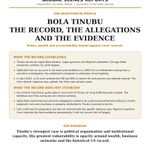
NIGERIA, FROM 1960 TO 2026. xitter.cf/i/broadcasts/1RJZzBmna…


Vienna protest challenges Austria’s school headscarf ban
GSR | Vienna, 1 October 2026
A demonstration against Austria’s school headscarf ban is scheduled outside Parliament in Vienna today. The published protest announcement lists a 17:00 meeting time, while local reporting gives a 17:30 start. Campaigners, including an alliance involving “Nein zum Kopftuchverbot” and Black Voices Österreich, are calling for religious freedom, equal treatment and the right of women and girls to choose their clothing. (antiimperialista.org, meinbezirk.at)
The law, effective from 1 September 2026, prohibits girls under 14 from wearing Islamic headscarves at school. Enforcement begins with discussions involving pupils and their guardians. Continued breaches can lead to child-welfare notification and administrative penalties against guardians, with fines ranging from €150 to €800. (ris.bka.gv.at, parlament.gv.at)
The government says the measure protects girls’ development, equality and freedom from coercion. Opponents argue that it singles out Muslim girls and restricts the religious freedom and self-determination it claims to protect. These competing positions place children’s rights at the centre of the dispute. (parlament.gv.at, antiimperialista.org)
Austria’s Constitutional Court struck down an earlier primary-school headscarf ban in 2020 on equality and religious-freedom grounds. The new law is now under challenge by girls aged nine to twelve and their parents. A decision is expected in the first half of 2027; the Court has not yet ruled the new ban unconstitutional. (vfgh.gv.at, vfgh.gv.at)
The central public-interest question is whether a general prohibition effectively protects girls from pressure while respecting their individual beliefs, choices and access to education.


