

Genomic Studies of Contemporary & Ancient Populations and their Evolution Lab @ University of Chicago 🌎🌍🌏 (Tweets by @MaanasaRaghavan + Raghavan Lab members)
Chicago, IL
Joined January 2019
- Tweets798
- Following388
- Followers770
- Likes1.4K


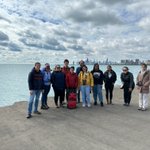




🤝🏽 We are so grateful to every community member who partnered with us. We returned to all participant communities to thank donors in person & share results! Paper: tandfonline.com/doi/full/10....
Press release: biologicalsciences.uchicago.…...
Happy to answer questions!
🥛Some communities like the Spitians have eaten wheat & dairy for generations, but others only recently added them after urbanizing; we see this in their Bifidobacterium
🩺 Controlling for community, urban folks show lower diversity & more Megamonas, linked to obesity risk.
Some key takeaways:
🌏SAMBAR microbiomes are distinct globally, but there's no single "South Asian microbiome." Culturally-specific diets matter!
🫘The Pochury Naga eat Axone, a fermented soybean condiment, and we detect more Bacillus in their gut microbiomes than rest of SAMBAR
Urbanization & lifestyle transition affect gut microbiomes worldwide, but South Asia has been left out of the conversation. We worked w/ 10 diverse communities to see how microbiomes reflect local diets/dietary shifts. Our dataset: the South Asian MicroBiome ARRay, or SAMBAR🍛
Thrilled to share our lab's newest paper! A collaboration with @NirajRai3 and team, led by GenSCAPE postdoc Shreya Ramachandran and @NagarjunaPasup5, with our incredible team across India and Sri Lanka! 🧵below on what we found studying South Asian gut microbiomes:
GenSCAPE (aka Raghavan) Lab 🧬 retweeted

What did #ancient #viral #ecosystems look like? 🦠🧬 Sedimentary #aDNA from lakes and oceans reveals 2,000+ viral taxa and shows how #virus–host interactions changed from the #Pleistocene to today.
doi.org/10.1093/ismejo/wrag0…
#MetagenomicsMonday #SPAAM #aDNA #sedaDNA

GenSCAPE (aka Raghavan) Lab 🧬 retweeted

📢Our aDNA study has been published today in @NatureComms! A great collaboration with Ricardo RodríguezVarela, Anders Götherström, @cschlebu & team.
Analysis of medieval burials from Ibiza reveals genetic and pathogenic diversity during the Islamic period. nature.com/articles/s41467-0…

GenSCAPE (aka Raghavan) Lab 🧬 retweeted

Last month, I published part of my PhD thesis in @NatureMedicine : Clinical genetic variation across Hispanic populations in the Mexican Biobank.
🔗 nature.com/articles/s41591-0… ... and we got the cover of the February issue!

GenSCAPE (aka Raghavan) Lab 🧬 retweeted

Second time the MX biobank project (mxbiobank.org) gets the cover in a @Nature journal! This time in @NatureMedicine highlighting the work by @BarjonCar on Clinical genetic variation in Mexico. Another amazing cover by @mauguz33! nature.com/nm/volumes/32/iss…

GenSCAPE (aka Raghavan) Lab 🧬 retweeted
Our paper on clinically relevant genetic variation in the MX Biobank is out today in @NatureMedicine! Big congrats to @BarjonCar, who led the development of the MexVar platform. A joint effort by @cinvestav @inspmx @incmnszmx @LIIGH_UNAM and @ucsc nature.com/articles/s41591-0…

GenSCAPE (aka Raghavan) Lab 🧬 retweeted

In #GENETICS, @JeremyJBerg et al. introduce an evolutionary model of complex disease susceptibility, where a variant's effect on disease risk follows from liability threshold model and a variant's effect on fitness follows from its effect on disease risk. buff.ly/XkB8hPb

GenSCAPE (aka Raghavan) Lab 🧬 retweeted

🚨 NEW pub in @ScienceMagazine !!! 🚨
🐈⬛🐈 The dispersal of domestic cats from North Africa to Europe around 2,000 years ago 🐈⬛🐈
Our article provides novel evidence suggesting new hypotheses about the history of domestic cats! 🧬

ALT Cover of the vol. 390, issue n°6776 of Science (AAAS) featuring a shorthair domestic cat.
GenSCAPE (aka Raghavan) Lab 🧬 retweeted

After a four-year journey, my PhD work is out in @ScienceMagazine!
Endless gratitude to the amazing @felix_erc team, all coauthors and collaborators, and my loved ones. Without you all this could not be real! 💛🐱✨
@ERC_Research @NatGeo @unitorvergata2 #aDNA
GenSCAPE (aka Raghavan) Lab 🧬 retweeted

Carla Daniela Robles Espinoza, coordinadora del @LIIGH_UNAM, nos comparte su experiencia de hacer el doctorado en el Reino Unido… #AlumniUK ➡️ t.ly/wBxIO

GenSCAPE (aka Raghavan) Lab 🧬 retweeted

✨Thrilled to share that the first chapter of my Ph.D. thesis is NOW OUT in Science Advances (science.org/doi/10.1126/scia…)! ✨🥳🎉 🧬. This couldn't have been possible without the support of everyone involved @MaanasaRaghavan @NirajRai3 @Conydelafc @mootspoints and others.


1/n Delighted to share our newly published work in Science Advances, investigating human genetic histories at the northern frontier of the Himalayas 🧬🏔️: science.org/doi/10.1126/scia…
6/n This study could not have been possible without the incredible support of the local communities in Himachal Pradesh, our archaeological collaborators, and every co-author who made this work possible - Thank you all! 🥳
5/n This study provides first insights into the admixture dynamics and adaptive histories at the northern frontier of the Himalayas.
4/n Some present-day individuals also show admixture with lowland South Asian ancestry, highlighting a dynamic history of genetic continuity and admixture in this region of the Himalayas.
3/n Our results show that ancient and present-day individuals from the region largely carry Tibetan ancestry (source of high-altitude adaptive introgression signal), with substantial Steppe-related ancestry observed in individuals dating from ~1,300 years ago to present times.