

defi researcher @magpiexyz_io · onchain since '22 liquidity, points & whatever's printing 📈 ex @Quboid_hq · ex @CoinstoreExc not financial advice, probably
Singapore
Joined April 2022
- Tweets1.1K
- Following935
- Followers175
- Likes1.9K



Pinned Tweet
started a series on how vault exits actually work, because most vaults explain their yield and say nothing about how you get out.
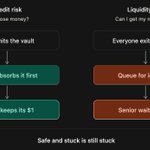
the starting point: credit risk and liquidity risk are different problems.
credit risk asks if you’ll lose money. liquidity risk asks if you can leave when everyone else wants to. tranching solves the first one. senior gets protected from losses, but it can still sit in a queue for weeks waiting on idle cash. safe and stuck is still stuck.
so far:
what does the backstop cover?
tradfi had two kinds of bank promise behind a par exit. sbpa covers waiting only and walks away on a default. loc pays par even after a default. on a calm day they look the same. onchain, almost every “instant redemption” is the first kind.
who has to buy?
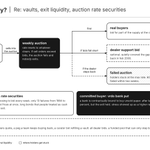
auction rate securities ran for 22 years on dealers quietly filling every gap. feb 2008 they stepped back, and 60–80% of auctions failed in two weeks. vrdos had a bank contractually bound to buy, and their exit held through lehman. the difference was the obligation, not the asset.

every vault exit has a backstop. what matters is what it covers on a bad day.
tradfi muni floaters made this distinction decades ago. two kinds of bank promise sat behind the par exit:
sbpa: the bank buys your bond if no one else will. liquidity only. if the issuer defaults or gets downgraded to junk, the promise ends immediately and you’re left holding the bond.
loc: the bank pays par no matter what, default included, then chases the issuer itself. covers liquidity and credit. costs more.
on a calm day they look identical. both pay $1.
onchain, almost everything is the first kind, or doesn’t have a backstop at all.
@upshift_fi Clear gives @superstateinc USCC holders instant USDC at oracle nav minus a spread. it’s a great product for skipping a t+1 queue. but if nav reprices down, you exit at the lower number, just faster. it covers waiting, not losses.
@centrifuge and @maplefinance pools pay exits from available cash and repayments. tranching protects senior from losses, but nothing stands behind senior when it wants out at the same time as everyone else.
on the credit side, the closest thing to an loc is cover. @nexusmutual sells protection on vault and curator failures. @InverseFinance’s jrDOLA puts first-loss capital in front of DOLA’s bad debt. both cost something, because covering losses is insurance.
neither model is wrong. they’re different products. but “instant redemptions” on a landing page should say which one it is:
does the exit still pay par after a default?
or does it just get you the impaired price sooner?
covering waiting is cheap. covering losses is insurance.
h/t @0xPutAmaterasu, whose TOB redemption piece sent me down this hole.
I built an onchain indexer from scratch that refuses to publish a number it can't prove.
It's called chainproof. Python + DuckDB, public RPCs only, no API keys.
Real run, 1 hour of USDC on Base:
• 129,157 transfers indexed in 35s
• Δ totalSupply = +336,671.309803 USDC
• mints − burns = +336,671.309803 USDC
• 20/20 holders' balanceOf match their net flows
• Difference: 0, to the last raw unit
How it works:
1. Read only finalized blocks
2. Pull every Transfer log into a staging table
3. Re-read the same range from a second RPC and compare every row
4. Check the totals against the token's own state on-chain
5. Publish only if every check passes, in one transaction
What I learned building it:
1. One check is never enough.
Send Bob 1 extra unit from Alice. Total supply doesn't change, so a supply check passes. Only the balance check catches it.
2. A check that can't fail proves nothing.
Every run sabotages itself. It adds +1 unit to one row, and the checks must turn red. If they don't, the run fails.
3. Never write straight to the tables people read.
I made a provider silently drop every 7th log. Result: 47 rows missing, supply off, 18 of 20 balances wrong. The run was refused, and published data didn't move.
4. A block number isn't an identity.
After a reorg, the block number still exists but its contents change. So I store the block hash. If it changes, the pipeline stops, rewinds and re-indexes.
5. Never let a float touch a token amount.
Above 2^53, floats can't represent every integer. Amounts stay exact integers end to end.
6. Free RPCs lie in their error messages.
drpc answered a 200-block request with "ranges over 10000 blocks are not supported". You have to read the error body, not the status code.
30 tests on a fake chain where I can force what mainnet won't: dropped logs, off-by-one amounts, silent mints, reorgs. Plus a daily live run on Base, Ethereum and Arbitrum.
Built while working through @0x_vcharles's Blockchain Data Engineering Guide.
Code: github.com/parthger/chainpro…

very instant exit in defi is a promise that someone will buy. the question is whether they have to.
auction rate securities were long bonds people treated like cash. every week, holders who wanted out sold into an auction. when bids fell short, the dealers quietly bought the rest themselves. 1984 to 2006: 13 failed auctions in 22 years.
feb 2008 the dealers stepped back. within two weeks, 60 to 80% of auctions failed. nobody could sell. “cash” got locked for months, some of it for years.
same crisis, vrdos had a bank contractually committed to buy. after lehman their rates spiked to 7.96%, but the exit held. stress showed up as a higher rate, not a frozen door.
the asset wasn’t the difference. the obligation was.
onchain, a lot of exits are ars-shaped:
a pool that’s deep while market makers keep quoting
a peg that holds while a team keeps buying it back
a vault a curator bot keeps refilling
all real liquidity, all optional.
the vrdo version is a funded pool that can only step back on triggers written in advance.
before you call a vault liquid, ask who has to buy when nobody wants to.

every vault exit has a backstop. what matters is what it covers on a bad day.
tradfi muni floaters made this distinction decades ago. two kinds of bank promise sat behind the par exit:
sbpa: the bank buys your bond if no one else will. liquidity only. if the issuer defaults or gets downgraded to junk, the promise ends immediately and you’re left holding the bond.
loc: the bank pays par no matter what, default included, then chases the issuer itself. covers liquidity and credit. costs more.
on a calm day they look identical. both pay $1.
onchain, almost everything is the first kind, or doesn’t have a backstop at all.
@upshift_fi Clear gives @superstateinc USCC holders instant USDC at oracle nav minus a spread. it’s a great product for skipping a t+1 queue. but if nav reprices down, you exit at the lower number, just faster. it covers waiting, not losses.
@centrifuge and @maplefinance pools pay exits from available cash and repayments. tranching protects senior from losses, but nothing stands behind senior when it wants out at the same time as everyone else.
on the credit side, the closest thing to an loc is cover. @nexusmutual sells protection on vault and curator failures. @InverseFinance’s jrDOLA puts first-loss capital in front of DOLA’s bad debt. both cost something, because covering losses is insurance.
neither model is wrong. they’re different products. but “instant redemptions” on a landing page should say which one it is:
does the exit still pay par after a default?
or does it just get you the impaired price sooner?
covering waiting is cheap. covering losses is insurance.
h/t @0xPutAmaterasu, whose TOB redemption piece sent me down this hole.
been reading about onchain fixed income and finally got the difference between credit risk and liquidity risk.
credit risk: will i lose money?
liquidity risk: can i get my money out when i want?
most vaults only solve the first one. tranching puts a junior in front of the senior, so the senior is safe from losses. but when everyone wants out together, the senior still waits in a queue for idle cash or the next maturity.
tradfi fixed this decades ago with committed buyers. in 2008 the bonds behind tender option floaters lost nothing. people ran anyway, because they doubted the banks promising to buy them back.
safe and stuck is still stuck.
Reading @0xPutAmaterasu tweet helps a lot


notparth retweeted

Tokenised stocks are the fastest-growing RWA category, despite being the smallest.
In May 2026, tokenised stocks added $549M in a single month.
In July, they added another $511M.
Two months. More than $1B in additional market value.
Here’s what that growth says about the market:
1. The smallest market is growing the fastest
As of October 19, 2026, tokenised stocks reached $3.42B, up from $630M a year earlier.
That’s a 441% increase in 12 months, adding $2.79B in market value.
For context, the other major tokenised RWA categories grew at a much slower pace:
• US Treasury Debt: $8.87B → $14.50B (+63%)
• Tokenised Credit: $4.63B → $8.13B (+76%)
• Commodities: $3.15B → $5.29B (+68%)
• Tokenised Stocks: $0.63B → $3.42B (+441%)
Treasuries remain the largest market, but tokenised stocks are the clear growth outlier.
2. The growth came in sudden jumps
The market spent much of 2025 moving within a relatively narrow range of $300M–$700M.
Then came several sharp increases:
• September 2025: approximately +$302M
• May 2026: approximately +$549M
• July 2026: approximately +$511M
The major breakout began around April 2026. May delivered the largest monthly increase, and July brought another substantial jump.
September 2025: +$302M: @xStocksFi scales up
Market value jumped from $335M to $637M. xStocks had launched in June across @krakenfx , @Bybit_Official and @solana, offering around 60 tokenised US stocks and ETFs. Its expansion, alongside Ondo’s tokenised-equity offering, helped bring these assets to more platforms and users.
May 2026: +$549M: the breakout
Market value surged from $1.20B to $1.75B, the largest monthly increase. @Ondo's expansion across chains, growing interest in AI and semiconductor stocks, and rising holder counts may have contributed to the acceleration.
July 2026: +$511M: major platforms enter
Market value climbed from $1.94B to $2.45B. @binance bStocks launched in June and scaled rapidly, while @RobinhoodApp expanded its tokenised-stock offering. Tokenised-equity trading volume reached approximately $18.2B in July, reflecting a sharp increase in market activity.
Tokenised stocks grew in sharp bursts rather than through steady monthly increases. New products, wider exchange distribution and rising participation coincided with these jumps, although the exact contribution of each factor remains uncertain.


everyone say it only work for girls.
but i am in contact with 1-2 brands that might sponsor the temporary tatoo let's see will keep you updated.
It it works it works but have to try
if not then it was only the girl charm that works for brands
I want to sell myself for exactly $2900. DO AS YOU PLEASE.
I am attending Devcon 8(@EFDevcon) in Mumbai and selling ad spaces all over my body.
And I promise to give you a better dress and aura than the girl you wasted money on during token2049
Read the details 🧵
app.notion.com/p/Sponsor-My-…
The best deal->
I am getting a temporary tattoo of your brand on my forehead(its a big space ngl) for exactly $900
You get exclusive photos, interviews that can be used to produce clips, posts, tiktok, etc.

I want to sell myself for exactly $2900. DO AS YOU PLEASE.
I am attending Devcon 8(@EFDevcon) in Mumbai and selling ad spaces all over my body.
And I promise to give you a better dress and aura than the girl you wasted money on during token2049
Read the details 🧵
app.notion.com/p/Sponsor-My-…
The best deal->
I am getting a temporary tattoo of your brand on my forehead(its a big space ngl) for exactly $900
You get exclusive photos, interviews that can be used to produce clips, posts, tiktok, etc.
notparth retweeted

was intrigued by risk tranching a month ago...built a tranching financial model recently, so you dont have to!!
will be sharing implementation and more docs with real time feed stress testing shortly.
building in public is essential for onchain finance.

notparth retweeted

to get into arc, bridge USDC using bridge.usdc.com/ or @jumperapp
Apps:
Trading: @fomo
LP: @Uniswap
Launchpads: @Arguspad @TollyLabs
Launchpad agg: @ArcToolsBackup
PS. Please create a burner. NFA and Goodluck


notparth retweeted
Spent some time today with @gil_n_santos_ from @CredoraNetwork / @redstone_defi going deep on tokenization, quant risk frameworks, SPVs, tranching, and where offchain risk monitoring meets onchain finance.
had a good discussion around current trancher scenarios, quant based risk frameworks and how they work for each different asset/ instrument, proof of reserves, new oracles etc.
its obvious to say that real unlock is when risk can be quantified, monitored, rated and ultimately structured onchain.
that’s where tokenization starts looking less like RWA plumbing and more like a new financial primitive.
bullish on this effect: more to build on risk tranching, SPVs, onchain rating and stuff.
reading @centrifuge v3 docs: nav is computed on one hub chain and pushed to every other chain as a wormhole message. your deposit price on arbitrum was never calculated on arbitrum. multichain vaults don't just assert the number under them they mail it.
and the hub-and-spoke NAV push is the sharpest answer to standing question #1 who sets the share price because it shows the price on a spoke chain is a relayed message, which extends his "is the number real" thesis with a new hop to verify.
everyone worries about price oracles. spent today on onchain index design and the scarier input is the one nobody watches: circulating supply
an index weights by market cap = price × supply. price has chainlink, heartbeats, deviation checks, a whole industry. supply? usually someone's api number, pasted in.
and whoever controls that number controls the index. bump a token's "circulating supply" and the index MUST buy it. front-run the rebalance, profit. no exploit, no hack just a wrong input the contract obeyed.
the honest fix i saw: don't trust a number, trust a list. circulating = totalSupply minus balances of a public excluded-address list (team multisig, vesting, burn). every entry is a falsifiable claim anyone can audit. changes timelocked. residual uncertainty = one 0-to-1 factor, median of independent reporters, moves one bounded step per commit, freezes on disagreement.
same lesson as every vault blowup this year, one level up: price feeds got hardened because they broke loudly. supply feeds haven't broken loudly yet.
CPPI vault math (the "deposit $100, get back min $90 + ETH upside" design) and the cleverest part is also the quietest assumption
the whole machine rests on a "safe leg" a zero-coupon PT that redeems at par no matter what ETH does. floor = PV of the promise, cushion = what you can lose, exposure = 2x cushion, rebalance. beautiful.
but "redeems at par" is doing enormous work in that sentence.
a PT is only as safe as what it redeems INTO. PT on USDC ≈ a bond. PT on a synthetic dollar = the $90 floor is conditional on that dollar's solvency. and PTs trade on an AMM mid-term the "riskless" leg has its own price, its own liquidity, its own NAV.
so even the most elegant structured vault reduces to the same question as everything else this month: is the number under the promise real?
protection math is solved. verifying the thing the protection is made of isn't.