

think in systems, leverage neurodiversity▪️ Brand + GTM for fintech & AI founders in MENA ▪️ member v2 @ns
Dubai, UAE
Joined August 2020
- Tweets6.9K
- Following1.3K
- Followers11.2K
- Likes24.8K







Pinned Tweet
Most early-stage teams spend their first marketing budget before they've answered the one question that decides if any of it works: who is this actually for.
AI is only accelerating the commoditization. My advice:
1) Start with a decent brand strategy, slow down to accelerate later. This is HEAVILY misunderstood by so many early-stage teams and where I do a lot of heavy lifting;
2) A real brand strategy is what lets you focus and focus is non-negotiable now that the internet has balkanized into endless niche islands, each running its own language, what cyber-ethnographer @being_on_line calls Babelification. Pick your ICP. Go all in there.
3) Then be bold and build brand equity offline. A recent chat with the talented @chebibtarik who scaled massively across the globe in just the last few years, confirmed it.

Watching @lexfridman episode with @JensenHuang in Taiwan, absolutely GOATED.
So humble, so real. What a prime example.
Whoever controls model access holds the commanding heights. Everyone else wins by adopting first, and the Gulf adopts faster than anyone.
This week showed it on every level: founders, funds, corporates and central banks.
My thesis: the Gulf is becoming the world's adoption engine.
1. @hub71ad picked a record 40 startups for Cohort 19, from 2,502 applications across 117 countries. 88% come from outside the UAE. International founders are choosing Abu Dhabi to plug into the region's adoption capacity. Congrats to Parallel Health, Everybody Counts, TinkerBloX, @turintechai, Mosadad, OpenAssets, Compute Labs and Sinaha Technology!!
2. BY Venture Partners closed Fund III at $60M, anchored by the @DubaiFuture District Fund, writing up to $1M cheques into AI-native startups from pre-seed to Series A. My take: the better the models get, the harder it is for an AI-native business to keep its moat, because whatever you build on top can be rebuilt faster every quarter. Watching closely where they put their money.
3. @aramco closed its deal for 49% of @HUMAIN, about $2.6B in cash plus AI and compute assets, with @PIF_en keeping 51%. Saudi's largest company will now run AI across its own operations, much like @G42ai connects the UAE to partners from Italy to Singapore. The Gulf's edge is building the infrastructure and adopting AI faster than anyone.
4. The Central Bank of Bahrain gave INFINIOS a no-objection to use @circle's USDC and EURC for card pre-funding and settlement, in place of slow correspondent banking. Stablecoins keep getting more integrated day by day.

I've been saying for months that every team needs one place to sync its agents and knowledge.
And there comes @NotionHQ, doing what it does best: making tools effortless for non-technical people.

Gigi retweeted

Pretty much.
As of the past few weeks, debt markets have almost entirely shut off access to money for any company that doesn’t have substantial revenue independent of AI data centers.
SpaceX closed $40B of debt for GPUs, but we’re investment grade and have Starlink & launch revenue.
That means the 200+ neoclouds are going to see guppy-level death and consolidation. Some will make it through, but not many.
Gigi retweeted

Paid engagement campaigns suffer from adverse selection because the most influential “influencers” can’t be bought
A tweet from someone like @levelsio or @GergelyOrosz would be worth paying any amount for, and it’s because you can’t
cringe: the founder who hires someone to build their personal brand and thinks 1h of input a week will do it
you have to be comfortable going direct and doing the work
Gigi retweeted

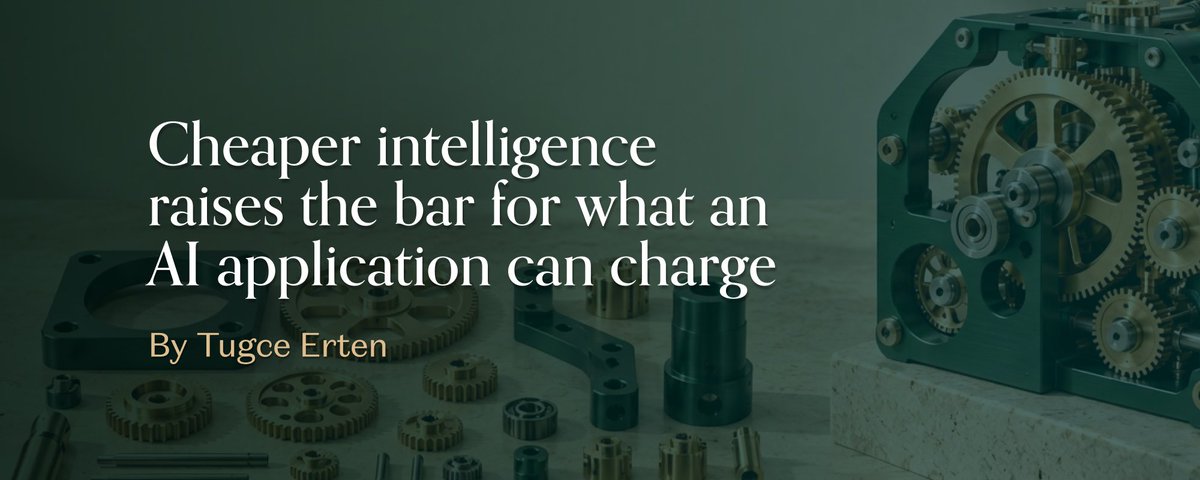
Every model upgrade makes AI apps cheaper to run, and easier for customers to replace.
Still, 94% of enterprise LLM buyers expect their spend to rise.
Three rules for winning that spend over the build-it-yourself option:
1. Operate the workflow better than the customer can
2. Make context cheaper to rent than to rebuild
3. Prove the value, then price to capture it
Who's doing it:
- Legal AI platform Harvey beat a general-purpose AI assistant and energy giant Repsol's own in-house tool in a blind test
- Notion considered building its own support AI, then bought Decagon’s AI support agents so its team could stay focused on the core product
"Model progress continually improves the customer's alternative. Your advantage must widen faster for the application to keep earning its premium."
Full piece from a16z's Tugce Erten: a16z.news/p/how-ai-applicati…


The consumption layer is splitting in two. Agents will own the chores. Humans will keep the fun. Founders need to know which side they're on.
@bot is now 80% of the interface I use to get work done, a symptom of what @martin_casado put well last week: "Consumption layer is up for grabs again… It happens rarely, every couple of decades. But when it does it can be very very disruptive."
But not all shopping is a chore. As @mlevchin said on @tbpn, a lot of shopping is a form of entertainment!
Agents win the errands. Humans keep the fun. The billion-dollar question is what people will still shop for fun, and what pulls them back from the agent to a human interface. The hardware we end up using will shape that line too. Curious where people think it falls.
Gigi retweeted

AI can officially automate UGC ads.
I gave Glif a photo of a pair of sneakers, picked my AI model, and asked for an unboxing and GRWM.
It handled everything - writing the scripts, generating the videos, even running QC to flag possible issues 🤯

Gigi retweeted

I'm only about 1/5th of the way through reading this.
Wow.
What Situational Awareness was to 2024--the beginning of the AI boom--The Commanding Heights is to the middle of it in 2026.
It is absolutely stunning prose and incisive insight.
Bookmark this for your weekend.

The benefits of abundant intelligence will accrue far outside of San Fransisco.
Spent the last year writing about capital, sovereignty, and the coming reordering of economic power.
THE COMMANDING HEIGHTS
Commanding-Heights.com

Gigi retweeted

Consumption layer is up for grabs again. This happened somewhat with mobile. And more significantly with the Internet.
It happens rarely, every couple of decades. But when it does it can be very very disruptive.

Momentum in Egypt's market across the entire capital stack!
1) The state: Egypt's Minister of Planning & Economy Ahmed Rostom unveiled a joint investment fund with NI Capital. Target: back 5,000 startups and mobilise $5B in venture capital, with a $1B unified financing initiative over five years.
2) Private funds: @TanmeyaCapital closed its second growth fund at $130M with about $38M from @EIB. And DPI Venture Capital's Nclude Capital closed above $112M, backed by @BanqueMisr, National Bank of Egypt and Banque du Caire, for fintech across Africa and the Middle East. Egypt's three largest state-linked banks on the same specialist VC vehicle.
3) Public markets: Banque du Caire just saw Egypt's highest-ever demand for a private IPO tranche. @EBRD and @IFC_org each committed roughly $100M as anchors. Egypt's biggest IPO in over a decade. Trading starts November 2 under BQDC.

WHERE WILL THE NEXT GENERATION OF GULF CAPITAL GO?
About $1 trillion is set to pass to the next generation of Gulf families by 2030. @lombardodier's 2025 GCC survey showed 79% of next-gen respondents said they’re likely to change the advisor their parents used.
That’s stated intent, not behaviour yet. But new signatures mean a new underwriter looking for new gaps in the market.
I look at it through three lenses:
1) Who decides: a generation with different advisors and its own priorities.
2) What they want: venture, tech and impact alongside market returns.
3) What’s still unfunded: categories with proven global need and little regional capital.
One of my bets is women’s health.
Globally, women spend 25% more of their lives in poor health than men. The World Economic Forum and McKinsey Health Institute estimate that closing that gap could add at least $1 trillion a year to global GDP by 2040, and that every dollar invested could add about $3 to the economy.
Capital has started to follow. Women’s health companies raised a record $1.55B in equity in 2025, up 41% on the year before (W Group).
In the GCC, @Tracxn counts about $9.7M raised by femtech startups in total. Even against a single year of global funding, that’s under 1%.
I spent a couple of years dealing with health problems myself, and felt first-hand how little of the system is built around women. That’s why I’m glad capital is starting to move here.
So the better question is: which gaps look like their priorities, not their parents.
Gigi retweeted

Sequoia just made a bold claim:
They think the next $1T company will NOT be a software company.
Their take?
Services will be the new software.
Because SaaS companies have spent 25 years fighting over a smaller budget in comparison.
For every $1 companies spend on software → they spend about $6 on services.
For reference:
• A company might pay $10K a year for QuickBooks.
• And $120K for the accountant who closes the books.
AI has completely changed that.
Now, a company can sell the finished WORK instead of the tool.
Here's how the 3 models compare:
TRADITIONAL SAAS
• The customer buys access to software, and their own team runs it.
• Growth is capped by product + distribution.
TRADITIONAL SERVICES
• The customer buys people's time + expertise
• Growth is capped by hiring.
SERVICE-AS-A-SOFTWARE
• The customer buys a completed piece of work.
• Software handles most of the delivery, with the provider's team on decisions + exceptions.
• Growth is capped by how much of the work software can do reliably.
Something to keep an eye on.
Gigi retweeted

I regret to inform you that a lot of problems in life are solved by waking up early and working out.
I am chronically online these days, and it becomes harder and harder to take a full rest. Anyone relate?
a16z data: more than 1 in 3 Americans bought something based on an AI recommendation in the past year, and 34% would pay more if AI showed it was the best option.
If AI assistants become the new storefront, does brand still matter, or only being the answer the assistant picks?
I think it depends on the category. When you know exactly what you want, the assistant wins. When you want to discover, browse vintage or fall for a brand, people will still scroll and explore.
As @mlevchin put it on @tbpn , a lot of shopping is a form of entertainment. Nobody wants an agent to do the fun part for them.
So brand experience matters, maybe even more nowadays to ensure you fall into the bucket of entertainment.
Gigi retweeted
This is how banks are planning to stop those "agentic bank runs." Watch closely: their business model depends on seeding this narrative that AI agents are dangerous.
Remember, an "agentic bank run" (coined by Apollo) means agents helping customers move their own money en masse to higher-yielding products.
Once agents are ubiquitous, there are only a few ways for banks to hold onto cheap retail deposits.
Option A: Raise APYs (lol no)
Option B: Reduce leverage via fewer loans (no fun)
Option C: Ban AI agents, claiming they are a security risk (ding ding ding)
Cloud agents like Muse and Dot are trivial to stop, since they come from Meta / OAI IP ranges. If JPM sends them a cease and desist, they will comply.
Why would JPM bother? Because their business model depends on it; a huge portion of their ROE comes from cheap retail deposits. This is not theoretical. Just like Amazon banned Muse from shopping there to protect their ad revenue, JPM and Schwab have already banned AI agents to protect sticky deposits.
Are agents perfectly reliable today? Of course not. But look at the fix they chose. Not "here's a safe API for agents," it's "no agents ever." That tells you they're not protecting customers, they're protecting themselves.
No company ever wins a technological revolution this way. It's the last gasp of a dying business model. It's like the retailers who refused to put their inventory online and demanded users walk into the storefront. Over time they will lose market share to those platforms that embrace what's coming. Their whole deposit franchise depends on users unthinkingly clicking through walls of T&Cs and accepting 0.2% when the risk free rate is closer to 4%. Agents read the fine print and do their research, even when humans don't.
For users, the answer is simple: local AI agent frameworks like Hermes, that will actually act on your behalf and that the banks can't block. As the article says, if the agent is running on your own computer, they can't actually tell it's not you.


SCOOP: Major U.S. banks are detecting unauthorized third-party AI agents inside customer accounts, including some attempting to take actions that appear to be independent of user instructions, sources told Axios.
The findings have alarmed banking executives, who are racing to restrict access to their systems as AI moves at a velocity faster than financial institutions can respond, multiple industry and bank executives told Axios.
Several banks are now preparing for worst-case and even “day after” scenarios, including how to rapidly secure or restore customer accounts if things go wrong, the people said.
Several bank executives told Axios they're struggling to distinguish between human users and AI agents. One executive said banks also struggle to determine whether agents are authorized by customers or potentially operating without their permission, more akin to rogue agent behavior.
Read my latest for Axios here: axios.com/2026/10/22/ai-agen…
