

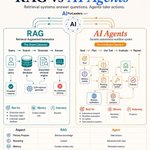


RAG vs. AI Agents: Do You Need an Answers Machine or an Actions Engine? 🤖
Choosing between standard LLM search (RAG) and an AI Agent is a defining decision for AI deployments.
Here is the key difference:
📚 **RAG (The Smart Librarian)**
• **Flow:** Query → Search → Generate → Answer
• **Focus:** Answers questions using grounded data (Reactive)
• **Memory:** Context window only
• **Best for:** Enterprise search, document Q&A, and customer support
🧠 **AI Agents (The Intelligent Operator)**
• **Flow:** Goal → Plan → Use Tool → Evaluate → Repeat
• **Focus:** Executes multi-step workflows & takes actions (Proactive)
• **Memory:** Persistent memory
• **Best for:** Autonomous research, task execution, and AI copilots
Key takeaway: RAG retrieves knowledge; Agents take action.
🔄 Retweet | ❤️ Like | 👤 Follow | 🔖 Bookmark
#RAGvsAgents #AIAgents #ArtificialIntelligence

The AI landscape took another massive leap forward with Anthropic’s launch of Claude Opus 5, and it signals a fundamental shift in how long-horizon, autonomous engineering actually gets done. For the past year, the industry has been chasing raw benchmark scores, but Opus 5 shifts the entire focus toward proactive agency, self-verification, and cost-effective execution. By bringing near-frontier intelligence at half the cost of flagship systems, it makes continuous agentic pipelines economically viable for production environments.
What makes this release stand out isn't just that the model writes clean code, but how it handles ambiguity and long-term execution. In early tests, when given a complex visual reconstruction task without a direct way to view the image file, Opus 5 spontaneously wrote its own custom computer vision pipeline from scratch to pull geometry directly from raw pixels. Similarly, when tasked with building a complex real-time market data feed for a new exchange, it realized no live environment existed to validate against, so it independently wrote a test harness to parse and verify the data feed before handing off the completed pull request.
This level of self-contained verification changes the mental model for AI integration. Older generations of models tended to rush to publish code, often catching errors only after failing basic continuous integration checks. Modern agentic setups don't just generate text; they verify branch states, inspect codebase context, spot subtle edge cases, and ensure clean diffs with zero dead code before declaring a task resolved.
When you pair Opus 5’s deep reasoning with the recently upgraded Sonnet 5 and expanded tool integration across environments like Slack, Google Workspace, and Microsoft 365, it becomes clear that AI software development is moving far beyond isolated chat windows. We are entering an era where AI operates as a persistent collaborator capable of managing multi-file refactors, maintaining long-context memory across entire projects, and autonomously validating its own outputs.
The core challenge for engineering leaders is no longer finding models that can generate code, but building the orchestration layer, test frameworks, and environment guardrails that allow these proactive models to execute safely at scale.
How is your team adapting to this shift toward proactive, self-verifying AI agents? Are you prioritizing long-horizon agentic workflows, or is sandbox security still your primary roadblock?
💬 Reply | 🔁 Retweet | 💬 Quote | 🖤 Like | 🔖 Bookmark
For the last few years, the dominant paradigm was simple: you typed a prompt into a text box, waited a few seconds, and copied out a neat summary or code snippet. That model was essentially autocomplete on steroids, requiring constant human supervision and manual copy-pasting to turn answers into action.
Now, the entire engineering landscape is pivoting from conversation to continuous autonomous execution. Instead of interacting with a single general-purpose chatbot, developers and enterprises are provisioning multi-agent runtime environments that manage memory, handle tool calls, and execute complex workflows in the background without waiting for human permission at every step. We aren't asking models to tell us how to do something anymore; we are giving them access to sandboxes, APIs, and databases so they can execute the work themselves.
This transition has completely changed what makes an AI system valuable. Raw benchmark scores and massive context windows are no longer the primary bottlenecks. Instead, the highest-value layer of the stack is now automated verification, error remediation, and orchestration. Anyone can use a modern frontier model to generate five hundred lines of code in seconds, but the real engineering challenge is ensuring that code doesn't silently break downstream production services or escape sandboxed runtime environments.
If your current AI strategy still relies on humans sitting at a keyboard manually prompting a chatbot back and forth, you are already operating on legacy infrastructure. The future belongs to the teams building the orchestration frameworks, safety guardrails, and tool-use protocols that allow autonomous agents to operate safely and reliably.
I'm curious where people are seeing the most friction as they make this shift. Are you finding that context retention, tool failure rates, or system latency is your biggest hurdle right now?
💬 Reply | 🔁 Retweet | 💬 Quote | 🖤 Like | 🔖 Bookmark
**If you’re still using AI just as a search engine or writer, you’re missing the real revolution.** ⚡
We’ve officially entered the **Agentic Era**, where AI is shifting from passive generation to **autonomous execution, spatial intelligence, and self-verifying systems**.
Here are the biggest AI breakthroughs and advancements shaping the landscape right now:
🤖 **The Rise of "Super Agents" & Self-Verification:**
We have moved far beyond simple prompt-and-response chatbots. Modern AI architectures operate as multi-agent ecosystems that can break down complex objectives, execute multi-step workflows, call live tools, and self-correct errors through internal feedback loops without needing human hand-holding at every step.
🌍 **Pivot to "World Models" & Physical AI:**
Generative AI is expanding rapidly beyond text and flat images into spatial, 3D interactive environments and robotics simulation. By modeling physical spaces and predicting cause-and-effect dynamics in real time, digital twins and physical AI models are powering the next generation of robotics and autonomous systems.
⚡ **Token Efficiency & Micro-Execution:**
The engineering focus is heavily leaning into inference cost reduction. Teams are building dynamic routing pipelines where hard reasoning is sent to top-tier frontier models while high-speed, low-cost "Flash-tier" models handle continuous API execution and background tasks.
💻 **English as the Primary Programming Language:**
Coding agents have evolved from writing code snippets to understanding full repository contexts, executing pull requests, and managing software architecture. Natural language is increasingly becoming the interface for software development, shifting human focus to product design and logic.
⚙️ **Custom Silicon & On-Device Processing:**
The hardware layer is expanding fast. Beyond traditional GPUs, tech giants and enterprises are deploying custom in-house AI chips tailored specifically to accelerate multi-agent orchestration and low-latency edge AI on devices.
🎯 **The Big Takeaway:**
The real competitive edge is no longer about testing every new AI tool on the market—it’s about building automated, self-verifying agent workflows that run seamlessly in the background.
Which of these advancements is having the biggest impact on your workflow? 💬👇
*(📌 Bookmark this post for your next tech stack review!)*
---
❤️ **Like** | 🔁 **Retweet** | 💬 **Quote** | ➕ **Follow**
We’ve officially crossed the threshold from **"AI as a chatbot"** to **"AI as autonomous infrastructure."** 🚨
If you’re still prompting AI line-by-line, you’re playing last year’s game. The entire landscape has shifted toward multi-agent orchestration, specialized model routing, and execution runtimes.
Here is where the AI ecosystem actually stands right now:
⚔️ **The Frontier Model Shift:**
The race isn't just about parameter size anymore—it's about specialization and economics. Teams are moving away from single "god-tier" models. High-end reasoning gets routed to frontier models (GPT, Claude, Grok), while routine tasks and rapid tool calls are handled by lightning-fast, ultra-cheap Flash-tier models.
🤖 **From Chatbots to Autonomous Agents:**
We’ve moved past simple prompt-and-response. Modern agentic workflows break down complex goals into sub-tasks, call external APIs, query databases, self-correct their own code, and execute end-to-end without manual hand-holding.
⚡ **Token Efficiency & Runtimes:**
The most underrated engineering focus today is latency and cost. With KV cache compression, TurboQuant memory optimization, and dynamic context routing, developers are building runtime layers specifically designed to keep models fast, persistent, and affordable.
💻 **Terminal-First Developer Workflows:**
The browser UI is becoming secondary for technical execution. Developers are heavily moving toward CLI-based, repo-aware agents that read entire codebases, run automated refactoring, and handle pull requests directly inside git pipelines.
🛡️ **The Security Reality:**
Autonomy brings new risks. We are seeing fully autonomous security exploits and ransomware execute without step-by-step human intervention, forcing enterprises to deploy specialized, cyber-tuned defensive models.
🎯 **The Takeaway:**
The gap between people using AI for simple text generation and those building agentic, automated workflows is widening every week. Stop looking for a single tool—focus on building a connected ecosystem.
What shift in AI has impacted your daily workflow the most lately? 💬👇
*(📌 Bookmark this for your next tech stack audit!)*
---
❤️ **Like** | 🔁 **Retweet** | 💬 **Quote** | ➕ **Follow**
The AI landscape has shifted from "What can AI do?" to "How do I build a system that actually saves me time?" ⚡
Most people get stuck because they try to test every new app on the market. That leads to app fatigue, fragmented workflows, and zero real productivity gains.
Here is the ultimate breakdown of The AI Tooling Ecosystem—and the exact blueprint for structuring your tech stack 👇

7
173
Layer 1 – The "Super Tools" (Foundational LLMs)
Your ecosystem needs a strong backbone. These are general-purpose powerhouses designed for reasoning, writing, coding, and heavy analysis:
• ChatGPT: The benchmark for conversational task handling, coding execution, and rapid ideation.
• Claude: The gold standard for long-context comprehension, nuanced writing, and deep reasoning.
• Perplexity AI: Replaces traditional search engines with structured, answer-first web research and live citations.
Rule: Pick one as your primary engine before expanding.
42
The AI world is moving at breakneck speed in July 2026. Over the past couple of weeks we have seen an incredible wave of new frontier models and research that continues to push capabilities higher. Chinese labs in particular are releasing massive open weight models that rival or beat Western counterparts in specialized areas like coding and agentic tasks. Moonshot AI dropped Kimi K3 on July 16, a 2.8 trillion parameter multimodal model with 1 million token context that is already showing frontier level performance especially in frontend development and complex coding benchmarks. Its open weights release is expected around July 27. Alibaba followed closely with the preview of Qwen3.8 Max, a 2.4 trillion parameter beast with major gains in coding, long context reasoning and data analysis. Full open release is coming soon.On the Western side Mira Murati’s Thinking Machines Lab released Inkling, a 975 billion parameter Mixture of Experts model that is fully open weight under Apache 2.0 and designed as a strong customizable base for fine tuning. Meanwhile the big names keep shipping: OpenAI rolled out the GPT 5.6 family including Sol the flagship reasoning model, Anthropic expanded access to Claude Fable 5, xAI released Grok 4.5, and Meta dropped Muse Spark 1.1 which is strong on tools and agentic work.Google DeepMind also published a compelling paper outlining the technical pathways from AGI to ASI through continued scaling, algorithmic breakthroughs, recursive self improvement, and multi agent collective intelligence. Separately a Stanford NVIDIA and UC Berkeley team showed that LLM verifiers are emerging as a powerful new scaling axis. Their training free approach using continuous scores from model logits delivered excellent results across coding, agent, and robotics benchmarks without any fine tuning.Elon Musk has predicted that AI could replace most traditional coding by the end of 2026 with developers shifting focus to supervising AI agents. Overall this feels like one of the most explosive periods in AI history with trillion parameter models, million token contexts, and real agentic systems arriving almost weekly. The race between closed frontier models and rapidly improving open weight alternatives is only accelerating.
1
328
AI won't take your job, but a poorly worded prompt might make you look like you're quitting it. 💀
"Garbage In, Garbage Out" is the ultimate law of prompt engineering. If you don't give an LLM specific context (Who, What, Why, Tone), it's just guessing in the dark.
For the power users out there: What is your #1 golden rule or framework for adding context to your prompts? 🧵👇


The biggest lie in 2026 AI video: “Character consistency solved.”
Run any model for 8+ seconds and watch your protagonist:
Age 10 years
Change ethnicity
Swap outfits mid-scene
Grow extra fingers
We can generate entire worlds… but God forbid the same person stays the same person.
63
agree, but here's the twist: Google’s real play might be quietly merging Flash/Pro lines into one “Gemini 4 Lite” beast. It lets them bury the version drama, ship faster updates, and finally chase raw capability instead of safe corporate checkboxes. Bold if they pull it off.

Google could basically release Gemini 3.5 Pro as Gemini 3.6 Flash, and then skip to Gemini 4 directly. I wouldn't be too surprised if something like that happens. There's no easy way out of their current debacle. 🤷♂️
1
138
The corporate hierarchy just got a complete software update. 🧠💼
For decades, we’ve been told the ultimate career goal is to transition from a "Boss" (someone who sits back and barks orders while others pull the weight) to a "Leader" (someone who gets in the trenches, pulls the rope, and guides the team forward). It's a classic management trope.
But then there's the "Introvert." The person who avoids the corporate theater, hates unnecessary meetings, and prefers to quietly pull the entire project cart alone rather than deal with the politics. It’s exhausting, unsustainable, and leads straight to burnout.
Enter the game-changer: **The Introvert with AI.** 🚜🤖
Look at the transformation in the infographic. By leveraging AI as a force multiplier, the quietest person in the room isn't just surviving—they are driving an entire automated freight train of productivity. They don't need a massive team to manage or a rope to pull. They just need the right tools to build, analyze, and scale their ideas at 10x the speed.
The old world rewarded the loudest voice in the room. The new world rewards the person who knows how to leverage technology to get results without the noise.
Which one are you currently operating as? Drop your thoughts below! 👇
#FutureOfWork #AI #ProductivityHacks #Leadership #Solopreneur #TechTransformation

From the days of calculators to the AI of 2025, it’s wild to look back at how much technology has changed the way we handle tasks. 📈 What used to take real brainpower is now handled in seconds! What do you guys think? 🤯
#lazinesscurve #techupdates #throwback

What gets me about the latest AI video wave is how fast we went from short clips to persistent environments. Tools like AlayaWorld turn passive watching into active exploration. Creators are about to treat these like real time virtual sets.
27
The combination of live prompting and spatial memory in these new video tools is wild. You can change the camera angle mid scene or tweak the story and it just flows without breaking. It is starting to feel closer to directing than generating.
30
AlayaWorld is making me rethink what video even means now. Instead of rendering finished clips you step into a world that keeps going and remembers what happened earlier. The persistence alone feels like the biggest leap since the first text to video models dropped.
22
The biggest quiet win with these huge context models is memory. Imagine AI companions that actually remember your projects across days and weeks. That persistent recall could be the feature that changes how we work every day.
37