

Get Found on AI Search & LLMs
Joined April 2025
- Tweets160
- Following45
- Followers49
- Likes13
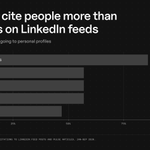





How do different AI engines cite people versus companies on LinkedIn?
The answer changes from one engine to the next, and sometimes from one format to the next.
In articles, Google AI Overviews gives company pages an equal shot. Perplexity, DeepSeek, and Meta AI lean toward people in both formats.
Grok is the outlier, tilting toward company pages in the feed, though one industry drives much of that.
See how 32 industries split between people and brands: higoodie.com/blog/linkedin-a…

18
Your everyday prompts weren’t written with stocking stuffers in mind.
Holiday shopping brings its own questions to AI search, from deal hunts to last-minute gifts, and they won’t show up in a prompt set built for the rest of the year.
The window is also short. By the time a holiday gap shows up in your reporting, the season may be over. Setting up seasonal tracking early gives you time to fix a missing offer or pitch the right gift guide while it still matters.
We put together a 7-step guide to building a holiday prompt set that’s small, specific, and tied to what you can change.
Which holiday moment drives your category’s peak?


20
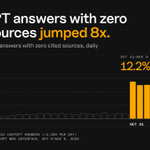
It’s not your imagination. ChatGPT’s been citing fewer sources.
On October 31, our team tracked an 8x jump in ChatGPT answers with zero sources. The most plausible case is that ChatGPT is turning to the web less often.
So where will answers come from?
Two things:
1. the model stored knowledge about your category and brand, and
2. the information you feed it directly.

11
Goodie now tracks ChatGPT Ads.
For the topics and prompts you monitor, you can see how often your brand’s ads appear, how much of the paid space you cover, and how many advertisers are competing for it.
Find out where your ads are missing and which prompts are still yours to win.

18
New for agencies: Goodie now turns AI search data into your sharpest business tool.
Three features work together to help you pitch and win clients:
→ Audit Reports: Run a one-time snapshot of any brand’s AI search performance with zero input from the brand. Each report arrives as a shareable decklette with an executive summary, key findings, KPIs, and topic scores.
→ Pitch Accounts: Track a prospect for 7 days with your own prompts and competitors, then show them where they stand by model and topic. Win the client and convert the pitch into a full workspace.
→ Goodie Agent for agencies: Ask what the pitch results mean and how to frame them for the meeting. After they sign, manage your entire client roster from the same conversation.
The audit gets you the meeting. The pitch helps you win it. The agent helps you explain both.
33
Does holiday shopping still start with a Google search?
Today, OpenAI launched Businesses in ChatGPT. It’s OpenAI’s second run at commerce. Its first, an in-chat shopping push built to rival Amazon, was shut down in March.
This time, it’s borrowing from Google’s playbook.
Google’s business profiles, reviews, and listings made it the default for researching a company, wherever the sale happens.
ChatGPT already had the recommendations, but brands had little say in how they appeared. Now that research moves into ChatGPT, right as gift shoppers start asking it what to buy.

Now in beta: Businesses in ChatGPT.
Claim your business, manage your information, and get insights on how people engage with you.
Eligible businesses can also build a Business Agent to answer customers’ questions and help them explore what you offer.
openai.com/index/introducing…
43
Gemini and AI Mode run on the same models. So why don’t they reward the same things?
AI Mode splits each question into related searches, so one thorough page that covers the follow-ups gives it more to work with.
Gemini puts more weight on who’s behind the content. In Goodie’s AEO Periodic Table study, it scored author authority at 88 out of 100, compared with 75 for AI Mode. Credentialed bylines and consistent brand facts across the web likely go further there.
TL;DR: Don't track your AI visibility on Google as one number.

1
22
If your AI search strategy starts and ends with your site, you’re optimizing the smallest slice of what AI models pull from.
That’s one of the shifts we’ll unpack in the AEO Masterclass with Goodie’s founder, Mostafa ElBermawy. You’ll learn how to:
→ Understand how ChatGPT, Gemini, AI Overviews, and Perplexity decide which brands to recommend
→ Create content AI platforms consistently cite
→ Build a social and earned media strategy that shows up in AI answers
→ Fix technical gaps like robots.txt, LLMs.txt, and AI crawlability
📅 Nov 18 & 19, 12 PM ET (two 90-minute sessions)
Enroll here: maven.com/bermawy/ai-search-…

41
What does your URL say about your content?
AI search engines build a map of every site they crawl: what it covers and which pages are the authority on each topic.
Your URL structure is one of the clearest signals they use to draw that map.
Think about the pages you’ve published on the topic you most want to be known for. If they live on scattered, unrelated URLs, AI sees a handful of separate pages.
Group the same pages under one shared path, and AI reads them as a single body of expertise, with each page backing up the others.
That matters because AI favors sources it can read as an authority. Without that structure, it has to piece your topics together from the content alone.
And every guess it makes is a chance for a competitor to earn the citation instead.
Check out the 4 URL taxonomy mistakes costing you AI citations 👇


1
26
AI search has a soft spot for LinkedIn posts with a face attached.
We analyzed over 200k AI citations to LinkedIn across 9 AI engines and 32 industries to see whose content gets cited: people or brands.
In the feed, people win by a wide margin. Personal profiles earn 73% of feed post citations, which leaves a brand posting only from its company page competing for just over a quarter.
The company page still has its lane in long-form. Articles split 51% to 49% between people and brands, close enough to call even.
Inside: the industry-by-industry breakdown, how each AI engine differs, and how to split LinkedIn publishing between your brand and the people behind it.
Explore more here: higoodie.com/blog/linkedin-a…

1
23
Skills and Artifacts for Brands are now live inside the Goodie Agent.
Skills are saved instructions that teach the agent to handle a specific task the same way every time, so you stop rewriting the same prompt. Artifacts are the finished outputs it creates for you, like reports, summaries, and documents.


1
14
Who on your team owns AEO strategy?
Usually it falls to whoever owns the website, but the citation data says otherwise.
Across the brands Goodie tracks, earned sources typically lead the citation split, often above 80% of citation share.
Getting included in a roundup, correcting an outdated article and building relationships with category outlets all change the pages AI reads before it answers.
Those are PR tasks with an AEO payoff.
And the target keeps moving. Goodie tracks which sites AI cites most, and over six months, 8 of the top 20 dropped off that list entirely.
Check who’s on the list before you write the pitch.

1
2
23
Five-star ratings are nice, but ChatGPT would much rather hear from an expert reviewer.
We tracked more than 900,000 AI citations, and in consumer categories, ChatGPT cited expert review sites far more often than user-review platforms.
This held true even though ChatGPT leaned on expert outlets less than any of the other LLMs we tracked.
If ChatGPT visibility is the goal, earning coverage from expert reviewers does more than collecting more ratings.
Check out our latest study for more insights: higoodie.com/blog/expert-vs-…

23

What happens when Siri AI can recognize you by your face?
@Apple just unveiled HomeView, a smart display built around Siri AI.
It recognizes up to six people in a household and switches to each person’s own Home Screen, widgets, messages, and calendar.
That changes what an answer is built from.
Ask HomeView about tonight’s plans, and Siri responds with the user’s own messages and calendar, so two people on the same screen get two different evenings back.
For now, that context stays personal.
But if AI search keeps getting to know the person behind each prompt, “does AI cite us?” won’t be the only question brands are asking.
The next one might be, “Does it cite us correctly for the specific person that's asking?”

1
24
What is your product best at, according to ChatGPT?
OpenAI is testing labels on ChatGPT’s shopping results. One product can earn a green “best all-rounder” tag, while others on the shortlist get gray tags like “best for beginners.”
Shoppers will likely gravitate toward the label that matches their own situation, because it feels like a personal recommendation. It answers the question they came in with: which one is right for me?
The label can only be as specific as what the web already says about a product. Brands known for one clear strength give ChatGPT something concrete to point to.
Do you know which label your closest competitor is earning?
#AEO #AIsearch #AgenticCommerce

1
36
Nobody builds an AI search strategy around TikTok.
But our citation data may convince you otherwise.
TikTok's citations grew from 170 in January to 1,641 in August, even as total social citation volume across the panel declined.
That growth is spread across the board. No single AI surface holds more than 22% of TikTok's citations, the most distributed footprint of any platform we track.
Reddit tells the opposite story: at points this year, a single engine accounted for as much as 90% of its citation weight.
That's what makes TikTok a platform where presence pays off.
Concentrated growth is a bet on one model's favor. Distributed growth compounds no matter which AI surface you're optimizing for.

1
1
22
Curious where TikTok ranks against the rest of the field? Dive into it here: higoodie.com/blog/social-med…

12
Expert reviews are beating customer reviews in AI search (by a lot).
We pulled over 900k citations across 31 industries to see which review sources AI models cite when someone asks what to buy.
App stores and marketplaces barely register. Apple's App Store peaks at 0.42%. Google Play tops out at 0.37%.
The sources actually earning citations are expert testing outlets like RTINGS and Consumer Reports, which hold 4.14% of all citations within 21 consumer industries.
That’s 15 times the share held by customer-review platforms.
This is Volume 1 of our Review Site Citation Study. Inside: the industry-by-industry breakdown, which review sites win each category, and where the pattern flips entirely.
Read the full breakdown: higoodie.com/blog/expert-vs-…

2
35