

Human-Machine Communication is OA and a peer-reviewed journal. @autumnedwards is the Editor-in-Chief. Leopoldina Fortunati is the Founding Feature Editor.
Joined October 2019
- Tweets307
- Following235
- Followers652
- Likes151






New submissions for #HMC are due January 2. stars.library.ucf.edu/hmc/
New in #HMC: Can a social robot comfort us, regardless of how humanlike it looks? Across two field studies, van Minkelen & Konijn found that perceived stress dropped after interacting with the robot in every design condition. doi.org/10.30658/hmc.13.6

New in #HMC: Klein & Utz ask whether people relate to AI chatbots as tools or as social actors, and whether text vs. voice changes the picture. Their 4-wave longitudinal study tracks how that shapes trust in AI over time. 🧵
stars.library.ucf.edu/hmc/vo…
Does an AI's perceived gender shape how much we trust it? New HMC study: yes, but in an asymmetric way. Feminine AI credibility swings with task type; masculine AI credibility doesn't. No blanket preference for "female" AI assistants either. stars.library.ucf.edu/hmc/vo… #hmc #AI
Can you fall for a chatbot in 10 questions? A new study in @HMCJournal tests the classic "interpersonal closeness" task with LLM responses standing in for a human partner. Participants couldn't tell, and it didn't matter to how close they felt. stars.library.ucf.edu/hmc/vo…
New in #HMC: Ischen, Wang, & Smit map three dimensions of chatbot human-likeness (appearance, capacity, personality) and test how social cues in service chatbots shape perceptions of each. stars.library.ucf.edu/hmc/vo…
New in #HMC: When strangers met Boston Dynamics' robot Spot in a public square, how did they make sense of it? Markham et al.'s ethnographic study finds the real story is in the moments of hesitation, not the swift "robot or dog" resolution. 🔗 stars.library.ucf.edu/hmc/vo…
Manuscripts for the next issue are due July 2. #hmc is diamond open-access….no fees for anyone.
Communicative machines are epistemic provocateurs. Etzrodt & Edwards open HMC Vol. 12, arguing that #HMC is built to sit with the knowledge disruptions machines create—not resolve them. doi.org/10.30658/hmc.12.1
New in @HMCjournal (Vol. 12)! 🤖📰 Jung, Piercy, & Spence ask: does it matter if your news source is human or AI? Spoiler: less than you'd think. "Normalizing AI: The Evanishing Effect and Rethinking the Machine Heuristic" #HMC #HumanMachineCommunication

Jung et al. find the evanishing effect — source cues (human vs. AI) are recognized but don't shift credibility evaluations. The machine heuristic is an individual difference, not a cue-dependent reflex. Read it: stars.library.ucf.edu/hmc/vo… #HMC
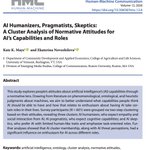
What do people think AI should be capable of and what roles it should play? In “AI Humanizers, Pragmatists, Skeptics: A Cluster Analysis of Normative Attitudes for AI’s Capabilities and Roles,” Kate Mays and Ekaterina Novozhilova map three distinct public orientations toward AI.

Using survey data and clustering, Mays and Novozhilova show how humanizers, pragmatists, and skeptics differ in expectations for empathy, cognition, and task roles, with implications for AI adoption and threat perceptions across everyday contexts.
stars.library.ucf.edu/hmc/vo…
New in Human-Machine Communication: Árni Már Einarsson & Ekaterina Pashevich examine naturally occurring student–chatbot interactions, showing how human–AI relations are communicatively constructed through patterns of activity and agency negotiation.
stars.library.ucf.edu/hmc/vo…

New article: “The Material Condition: A Practice Theory-Oriented Infrastructural Turn to the Ethics of Human-AI Communication” by Anne Mollen and Sigrid Kannengießer.
Read it here: stars.library.ucf.edu/hmc/vo…

Mollen and Kannengießer argue that AI ethics must be studied through socio-technical infrastructures and everyday practices shaping generative AI across developers, users, and global production chains. Check it out. #hmc

New in Volume 12 🌍📘
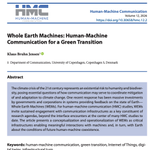
Klaus Bruhn Jensen’s "Whole Earth Machines: Human-Machine Communication for a Green Transition" examines how communication systems and Whole Earth Machines inform climate action and human–machine coexistence.
stars.library.ucf.edu/cgi/vi…
