
Associate Professor in ML at UIUC @UofIllinois. Previously Assistant Professor at @RutgersCS, Postdoc in MIT CSAIL. Scientist. MLer.
Urbana, IL
Joined October 2011
- Tweets303
- Following464
- Followers699
- Likes328
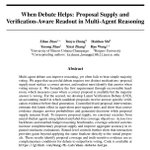


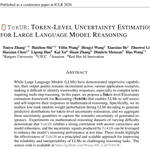


#NeurIPS2026 #MultiAgentSystems #LLM #BayesianDL #AgenticAI Can debate between LLM agents improve reasoning beyond majority voting? A central challenge is recovering correct answers that the majority overlooks:
1
4
610
Takeaway: Understanding both which answers agents supply and how they evaluate competing evidence provides a useful foundation for designing more effective multi-agent reasoning systems. Debate helps when recovery gains outweigh the errors introduced through interaction.
1
23
This joint work with Zihao Zhao, Tunyu Zhang, Haizhou Shi, Yusong Zhao, and Xinxi Zhang.
Paper: wanghao.in/paper/NIPS26_When…
Code: github.com/Wang-ML-Lab/when-…


110
Hao Wang retweeted
Why was Marin 535B-A23B the size it was? Why 8 of 384 experts? Why GatedNorm, sconv, XSA? Why linear learning rate? All of these factors were driven by tradeoffs between timelines, compute efficiency, MoE router stability, etc. Read about the rationale of each design decision:

Sharing the thought process behind the architecture for Marin 535B-A23B, which finished pretraining on 18T tokens last week: openathena.ai/blog/marin-535…
Earlier this year the Marin project had 6 full-time employees at Open Athena, a mix of AI veterans and people newer to the space, like me. I learned a lot from the team as an IC. Since then we got our B200 GPU stack running in a month, scaled up 300x on GPU to a 535 billion parameter model, publicly forecasted the run, live-streamed the entire thing, and made it through pretraining slightly better than predicted with zero instabilities.
In the blog I call out specific contributions on architecture- but the broader gratitude is to the ecosystem. 2 years ago this would have been inconceivable on a first large scale attempt. Now it’s possible, in large part due to published work from Llama, DeepSeek, Qwen, Gemma, Olmo, Cohere, Nemotron, Arcee, Inkling, Mistral, Microsoft AI, Kimi, Muse, academia, and many others. The recipes are out there. A small team with big dreams (and some funding) can train a big model. (And if you have doubts on that, you can copy our fully open recipe from data to code).
Of course, training a model does not produce a binary outcome. I am proud of how far we’ve come and optimistic about how much more there is to explore! The team has grown recently and will be taking the model through SFT and RL soon, sharing the findings along the way.


Hao Wang retweeted

It is difficult to know what to make of this take. You have identified the field with a subset of its work (in fairness, a culturally prominent subset), and you have decided that that view is too limiting. Perhaps you are exhorting people to branch out. That seems healthy, but did you check to see whether people had already branched out?
I think it is often healthy to criticize individual methods, but it's the underlying goals that matter most. For example, maybe influence functions aren't the right method, but solving the problem of data attribution would be absolutely transformative. Similarly, saliency maps are clearly not the right choice for problems that matter, but there is a whole world of feature attribution methods that are arguably significantly better.
#NeurIPS2026 #InterpretableAI #SparseAutoencoders #AISafety #MultimodalLLM #SAE++
Can we automatically discover the hierarchical concept structure inside an LLM and use them to interpret and control it?
1
1
906
💡 Takeaway: Learning how concepts are organized provides a useful foundation for interpreting and steering/controlling multimodal models.
This project is led by Yusong Zhao, with co-first author Hengyi Wang, in collaboration with Tanuja Ganu and Akshay Nambi.
1
1
78
Excited about this research collaboration between UIUC, Rutgers, and Microsoft Research!
📄 Paper: wanghao.in/paper/NIPS26_SAEp…
💻 Code: github.com/Wang-ML-Lab/sae-p…


66