



Pinned Tweet
New paper 🚨 #ICLR26
Most world models predict the future from a past trajectory. But neuroscience suggests that such inference can instead be made from temporally independent experiences.
We built the Episodic Spatial World Model (ESWM), a model that does exactly this:
#ICLR2026 I’m presenting this paper today Apr 24, at pavillon 3 poster 1612, 10am-1pm. Come by if you’re interested!
Links to poster and video: iclr.cc/virtual/2026/poster/…

New paper 🚨 #ICLR26
Most world models predict the future from a past trajectory. But neuroscience suggests that such inference can instead be made from temporally independent experiences.
We built the Episodic Spatial World Model (ESWM), a model that does exactly this:
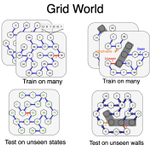
[7/8] Beyond Grid World, ESWM is scalable to the more complex MiniGrid (high-dimensional observation) and 3D indoor scenes ProcThor (realistic pixel observations).

1
2
69
[8/8] We believe ESWM points to a new generation of brain-inspired models—ones that reason over fragments, generalize across structure, and adapt efficiently to change.
👥W/ @MaximeMDaigle, @PouyaBashivan
Read the full paper: arxiv.org/abs/2505.13696

2
74
Herbie He retweeted

New paper 🚨
"Stable Deep Reinforcement Learning via Isotropic Gaussian Representations"
Deep RL suffers from unstable training, representation collapse, and neuron dormancy. We show that a simple geometric insight, isotropic Gaussian representations, can fix this. Here's how 👇


Herbie He retweeted

Humans and animals can rapidly learn in new environments. What computations support this? We study the mechanisms of in-context reinforcement learning in transformers, and propose how episodic memory can support rapid learning. Work w/ @KanakaRajanPhD: arxiv.org/abs/2506.19686

[11/12]
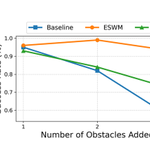
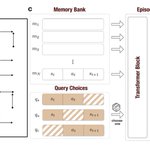
🔧 When environments change—say a new wall appears—ESWM adapts instantly. No retraining is needed. Just update the memory bank and the model replans.
This separation of memory and reasoning makes ESWM highly flexible.

1
3
142
[12/12]
We believe ESWM points to a new generation of brain-inspired models—ones that reason over fragments, generalize across structure, and adapt on the fly.
📄 arxiv.org/abs/2505.13696
👥: @MaximeMDaigle , @PouyaBashivan
4
171


[9/12]
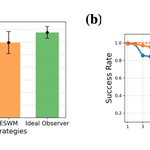
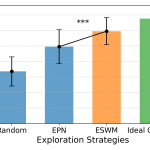
🚶 With no additional training, ESWM can explore novel environments efficiently by acting on uncertainty.

1
3
102
[8/12]
⚙️ How are these maps built?
We find that ESWM stitches together memories via overlapping states—merging local transitions into global structure.
Obstacles and boundaries serve as spatial anchors, guiding how memories are organized in latent space.

1
3
101
[7/12]
🏞️ How does ESWM solve the task?
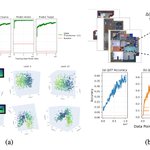
Using ISOMAP, we visualize its latent representations—beautifully organized spatial layouts emerge from its internal states, even when the model sees only a small part or out-of-distribution environments.

1
3
108
[6/12]
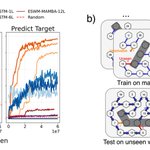
⚡️ Transformer-based ESWM models outperform LSTMs and Mamba, especially in settings where observations are compositional. Attention allows the model to flexibly bind relevant memories and generalize across structures.

1
4
106
[5/12]
To train ESWM, we use meta-learning across diverse environments. At test time, the model gets a minimal set of disjoint episodic memories (single transitions) and must predict a missing element in a new transition—without ever seeing the full map.


1
4
115
