

Economist and macroeconomic modeller, working mainly on climate change. Advocate of economic pluralism. #CambridgeTradition #Complexity
Cambridge, England
Joined October 2017
- Tweets1.8K
- Following239
- Followers1.7K
- Likes4.4K





Hector Pollitt retweeted

Time to make all the armchair yappers mad again...🖕
"Economics has always been preoccupied with equilibrium. That's like analyzing how a car works by studying a parked vehicle."
-Jay Forrester

Hector Pollitt retweeted
John Maynard Keynes spent much of his career trying to explain something economists still argue about today: how capitalism can be incredibly productive and still periodically fall apart. Nearly a century later, a lot of people attacking Keynes seem to be attacking a version of him that never existed.
The General Theory was not a blueprint for central planning or unlimited government spending. Keynes wanted to understand why millions of people could be looking for work while factories, machines, and other resources sat unused. He argued that cutting wages could make a slump worse by cutting incomes and spending. He also rejected the idea that saving automatically turns into investment. Businesses invest when they think future sales will justify it. When those expectations collapse, investment can collapse with them.
Somehow this has been reduced to Keynes saying the government should just spend more money.
Keynes certainly supported government spending when private demand collapsed. But he was not calling for the government to run the entire economy. He thought private enterprise should remain the foundation of the system. His point was that capitalism could work extremely well without always being able to pull itself quickly out of a major downturn.
This is also why bringing up the Soviet Union as a rebuttal to Keynes makes little sense. Keynes was not Oskar Lange. He wasn't trying to abolish private property or replace markets with government planning boards. The calculation debate between Mises, Hayek, Lange, and others was a different argument. The failure of Soviet planning does not somehow prove Keynes wrong about unemployment, investment, or recessions.
The claim that Keynes captured economics because governments wanted economists who would justify bigger government doesn't hold up very well either. Keynes became influential because the Great Depression happened. Investment collapsed, banks failed, businesses closed, and millions of people remained unemployed. Economists had to explain what they were watching.
And Keynesians hardly took permanent control of economics. Friedman and monetarism became enormously influential. Then came Lucas, rational expectations, New Classical economics, and eventually DSGE models. If governments were secretly paying economists to keep Keynesian economics dominant, they did a terrible job of it.
There is also some irony in blaming Keynes for economists building beautiful mathematical models that have little connection to the real economy. Keynes himself was skeptical of treating economics like physics. Expectations, institutions, history, and genuine uncertainty were central to how he thought about the economy. A lot of the highly formalized macroeconomics that came later looks nothing like Keynes.
There are plenty of legitimate reasons to disagree with Keynes. You can argue that fiscal policy works poorly, that governments waste money, or that markets recover faster than Keynes thought. But Keynes was not a socialist central planner trying to replace markets with government bureaucrats. He was trying to understand why capitalism could create enormous wealth and still leave millions of people unemployed and huge amounts of productive capacity unused.
You don't have to agree with Keynes. It would just help to argue against the Keynes who actually existed.

Hector Pollitt retweeted

At 35:00 in this @dwarkesh_sp podcast, they discuss the possibility that job losses from #AI could cause a recession. This is something I devoted an entire chapter to in #RiseoftheRobots, and @Citrini made a similar case in their viral scenario a few months ago.
The economist acknowledges that elevated unemployment is possible, but suggests there is little or no concern this could lead to negative economic growth. He almost seems to suggest that negative economic growth is somehow extraordinary. This seems very complacent. We have negative economic growth in every recession, and recessions occur every 6-7 years or so on average. A commonly used rule is that a recession is defined as two consecutive quarters of negative GDP growth.
Recessions can begin for many reasons, but rising unemployment along with falling consumer confidence are certainly among them.
Try asking your favorite AI model this question:
"If workers/consumers become worried that they might lose their jobs, could psychology alone cause a recession?"
The answer, of course, is Yes. In other words, you don't even necessarily need large numbers of actual job losses. Fear alone could generate a recession--a self-fulling prophesy.
It is also the case that a recession could begin as a result of something other than job losses from AI--for example, an energy shock if the Iran deal falls through and/or the popping of the AI investment bubble--and it will be during the downturn that businesses will have the greatest incentive to cut costs. They may lay workers off for economic reasons and then find that AI allows them to avoid rehiring those workers in the future.
This is exactly what happened with the permanent loss of many middle class jobs in the past. In "Rise of the Robots," I cite a 2012 paper by Jaimovich and Siu that points out that fully 92 percent of the job losses in
mid-range occupations have occurred within a year of a recession.
I don't think economists should just dismiss these concerns.

Economics of AGI episode w Alex Imas and Phil Trammell.
There's a bunch of important questions about how we deal with AI that only economics can answer.
What is the optimal way to tax and redistribute the wealth that will be generated? How should countries not in the AI supply chain index into the gains? Is there any world where inequality doesn't explode?
It might seem like these questions have obvious answers, but the first thing economics teaches you is that your intuitions can often be entirely wrong.
It was very helpful to chat through these things with Alex and Phil.
Look up Dwarkesh Podcast on Apple Podcasts, YouTube, or Spotify. Enjoy!
00:00:00 – Will capital share increase?
00:19:36 – Messy Middle scenario
00:25:57 – How to tax and redistribute AI wealth
00:30:02 – Why demand collapse is unlikely
00:39:26 – Human employees would be hard to integrate into the machine economy
00:43:08 – What if some humans (or AIs) value wealth accumulation intrinsically?
01:01:28 – What should developing countries do?
Hector Pollitt retweeted

Passionate about building Msia’s climate resilience? But ever wonder what should 🇲🇾 prioritize?
My colleagues crunched the numbers & found:
1. RoN95 reform & carbon pricing, by far, give the max benefit: 5 to 1
2. Mangroves & peatlands: 4 to 1
3. Ag & irrigation: 2.5 to 1

ALT Link to report: https://documents.worldbank.org/en/publication/documents-reports/documentdetail/099042326042519641

@yinshaoloong at a climate event in Putrajaya today made an important point that the “green jobs” narrative is oversold
I (broadly) concur. Once a solar panel factory is set up, you need minimal labor to run it. And as noted by Shao Loong, even the construction phase is getting increasingly automated. This can lead green tech to be *less* labor intensive, (EVs assembly, for example)
But looking at jobs in specific sectors can also be misleading. One has to look at *net* job creation & destruction in the economy
In that context, primary focus of climate policy (imho) ought to be on:
1. D-ecarbonization
2. A-dapting to a changing climate
3. M-anaging the transition
(Frankly my dear, I do give a dam..😅)
If in meeting these objectives, there is an overall increase in productivity, then net job creation can be still +ive, even if “green jobs” are fleeting & transient
And *this* is the correct metric to measure the impact of climate policy on jobs. Hope more politicians would see climate action & green jobs thru this more nuanced lens…
Hector Pollitt retweeted

Structural economic change as dynamic resource creation – in their OxREP paper, @DimitriZ, @HectorPollitt, Jean-François Mercure, and Frank W. Geels illustrate how innovation, networks and behaviour are adopted in the global economy.
doi.org/10.1093/oxrep/graf03…

Hector Pollitt retweeted

Our new OXREP paper is out. We argue that big shifts—clean energy, AI, biotech—don’t just reallocate resources; they create new ones. We call this “creation economics”: an economy shaped by feedbacks, tipping points and leaps. Models illustrate pathways & risk, not predict future

Finally, as always, it was a pleasure working with @DimitriZ @JFMercure and Frank Geels.


Hector Pollitt retweeted

People like to claim that banks lend the funds deposited with them. They don't. It is technically impossible for them to do so. In this post, I explain why that is the case and how banks really create the loans that they offer to their customers. taxresearch.org.uk/Blog/2025…

Hector Pollitt retweeted

Reupping my question given the new targets:
In a state like CT, where there's no coal-to-gas shifting and decisions on new carbon-free generation are based on state policy (and not RGGI prices), how is RGGI supposed to drive big emissions reductions?
Or, just a backstop?

Hector Pollitt retweeted

#EastAsiaPacific countries are highly vulnerable to global warming, yet they are also major CO₂ emitters.
The pace of emission reductions remains too slow, but hope lies in emerging #GreenTechnologies that could transform decarbonization.
Read more: wrld.bg/AlTU50WnHG5

Hector Pollitt retweeted

To all those who believe that moving some levies from electricity to gas is unfair remember:
1) For the average household nothing changes - same levies just paid differently.
2) Fuel poor households are 2x as likely to heat with electricity than others.

I’m in @theipaper today making the case for reforming levies on electricity bills to drive electrification.


Hector Pollitt retweeted
Solar hit 700GW in 2020—10x what was forecast in 2006.
Why? Feedback loops & non-linear change, not just tech swaps, drive clean energy.
Our new @CarbonBrief piece: Early policy support + smart market design + cross-sector links = faster decarb.
carbonbrief.org/guest-post-h…

Hector Pollitt retweeted

"Policymakers care about risk. Risk is the reason we have emergency services. Many countries build detailed scenarios of potential future crises & possible public responses. If changing weather patterns affect these scenarios, policymakers need to know. Cambodia is no different."
New post on the impacts of climate change, co-written with Migle Petrauskaite. We need to rethink our approach to estimating climate costs. We need to think more about risk.
blogs.worldbank.org/en/easta…

Hector Pollitt retweeted
Sigh. With so many things to push back on that actually matter, I can’t believe we're using scarce space for this this.
The price of scrapping the social cost of carbon is probably negative. We'd stop looking like fools pretending we can quantify the unquantifiable.

Hector Pollitt retweeted
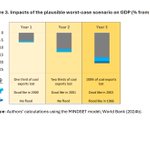
The paper by Hector and Migle shows that the seemingly intuitive understanding of a bad scenario as several low probability events coinciding is not quite right. Climate change is bumping up probabilities all along a plausible chain.

Let's move on from 'climate damages'.
Why we really worry about climate change: Risk and the potential for cascading impacts. An example of a plausible worst-case scenario for Cambodia.
documents.worldbank.org/en/p…

Hector Pollitt retweeted

Just coming across some text from IPCC AR6:
Most IAM scenarios do not consider equity, therefore regional results should be assessed with care... (in case that was not obvious)

Hector Pollitt retweeted
For the IPCC junkies out there...
We have 10 articles on improving the IPCC in our @ClimateActionSN Special Collection.
Get reading: nature.com/collections/gfcdg…

Hector Pollitt retweeted

Good to see this public recognition of the importance of Joan Robinson.
@monkeco
@cacrisalves
BBC News - Joan Robinson: Economist remembered with blue plaque in Notting Hill
bbc.co.uk/news/uk-england-lo…
Hector Pollitt retweeted

I argue that the mainstream discipline of economics needs to change drastically if it is to be of any use in confronting the pressing challenges we face in the world today.
imf.org/en/Publications/fand…

Hector Pollitt retweeted

The problem with economics -- too much maths, too little history larspsyll.wordpress.com/2024… via @LarsSyll