

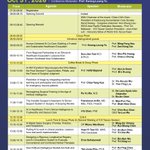






Tomorrow (Oct 31), I'm honored to speak at the International College of Surgeons:
"Reimagining Surgical Training in the Age of AI."
Every surgeon was trained hand in hand by those who came before. Now it's our turn to train the next generation.
I still remember how hard my nearly 10 years were: medical school, surgical residency, then chief resident in cardiovascular surgery.
In today's clinical practice, AI is already changing how we operate and what we can do. Can it also change how we train surgeons?
I'll answer three questions: what was missing in the past, where we stand now, and how we can do better in the future.


1
83

被美敦力主動脈支架廠商邀請分享過往的困難主動脈瘤手術案例
這些案例,都是腹主動脈瘤手術中的「魔王」,因為都有著文獻中定義的「Hostile Neck」(惡性頸部)。
現在有更佳的微創技術,叫做“Endosuture Aneurysm Repair”
在台灣去年(2024年9月)起,ESAR已正式納入健保給付!


1
70
嗯… 很好的靜脈曲張、靜脈功能不全的病例模型示範🤔
Hmm… a very good demonstration model for varicose veins and venous insufficiency 🤔

【話題】神に会うため「12年間絶対に座らない」苦行を続けるインドの修行僧、脚がとんでもない事態に
teapawt.net/c1li9/status/206559133…
■🇮🇳ダウラト( Maharaj )氏
・シヴァ神の姿を直接拝むため、過酷すぎる「直立苦行」をスタート
・座ることも横になることも一切せず、夜寝る時も首と上半身を縄で吊るして立ったまま過ごす
・現在5年目だが、重力で血液が下半身に溜まり続け、脚が木の幹のように黒く巨大化してしまう
→命に関わる超危険状態ながら、本人は12年の完遂を目指し現在も直立不動のまま
4,846
Obsidian 到底有多少用戶?
沒人知道
因為任何人都可以免費下載 並且不登入帳號就開始使用
obsidian 也沒有內建統計功能

No one knows how many users @obsdmd has
I think it's around 5-10 million people but I'm not sure?
Anyone can download the app and start using it without creating an account or talking to anyone, and there are no analytics built-in 🤷♂️
65


Openclaw 使用上幾個建議給跟我一樣的人(醫學研究工作者、非工程師不懂寫code、平時工作繁忙者)
1. 真的不要叫openclaw 自己修自己,浪費token之外,還修不好。建立一個claude code ,至少用sonnet 4.6 修openclaw
1
108
2. 讓 openclaw 使用api跟user id 連接 Zotero,直接得到一個好用的文獻資料庫(小心保護api)
3. 讓 openclaw 使用readwise token 連接 readwise,直接得到日常閱讀網頁網誌、書籍的好用資料庫(小心保護token)
1
70
Dr. PY Wu retweeted

New MMCTS tutorial: Carbon fibre-enforced stabilization system for ministernotomy resynthesis
📊 Skill Level: 3. Innovative
This video tutorial demonstrates the use of Stern Fix, a new device designed to reduce sternal dehiscence and retrosternal bleeding often associated with metal wires, thereby speeding postoperative recovery.
📹 Watch here: mmcts.org/tutorial/2105
@brunochiarello, @mcastellaMD

Deep research 現在可以輸出成PDF檔了!
輸出pdf 再利用,感覺實用性又更高了
感覺可以結合ChatGPT自己的project 或 NotebookLM來進一步 精煉

You can now export your deep research reports as well-formatted PDFs—complete with tables, images, linked citations, and sources.
Just click the share icon and select 'Download as PDF.' It works for both new and past reports.
1
110


Apple’s AI (Apple Intelligence) is really useful
After updating to version 18.1, switching the language to English allows it to function in English (it’s said that Traditional Chinese support will be available next April).
For text-based AI, these functionalities are probably the most practical and essential.
Apple is currently focusing on how to deeply integrate AI into its devices, targeting the general user base.
For me, it’s particularly helpful when reading English articles and research papers, eliminating the hassle of constantly switching between apps, enabling a more immersive reading and thinking experience.

Dr. PY Wu retweeted

File over app
File over app is a philosophy: if you want to create digital artifacts that last, they must be files you can control, in formats that are easy to retrieve and read. Use tools that give you this freedom.
File over app is an appeal to tool makers: accept that all software is ephemeral, and give people ownership over their data.
In the fullness of time, the files you create are more important than the tools you use to create them. Apps are ephemeral, but your files have a chance to last.
The pyramids of Egypt contain hieroglyphs that were chiseled in stone thousands of years ago. The ideas hieroglyphs convey are more important than the type of chisel that was used to carve them.
The world is filled with ideas from generations past, transmitted through many mediums, from clay tablets to manuscripts, paintings, sculptures, and tapestries. These artifacts are objects that you can touch, hold, own, store, preserve, and look at. To read something written on paper all you need is eyeballs.
Today, we are creating innumerable digital artifacts, but most of these artifacts are out of our control. They are stored on servers, in databases, gated behind an internet connection, and login to a cloud service. Even the files on your hard drive use proprietary formats that make them incompatible with older systems.
Paraphrasing something I wrote recently:
> If you want your writing to still be readable on a computer from the 2060s or 2160s, it’s important that your notes can be read on a computer from the 1960s.
You should want the files you create to be durable, not only for posterity, but also for your future self. You never know when you might want to go back to something you created years or decades ago. Don’t lock your data into a format you can’t retrieve.
These days I write using an app I help make called Obsidian (@obsdmd), but it’s a delusion to think it will last forever. The app will eventually become obsolete. It’s the plain text files I create that are designed to last. Who knows if anyone will want to read them besides me, but future me is enough of an audience to make it worthwhile.

