

Social & Marketing | Views are my own.
Mr Worldwide
Joined June 2024
- Tweets148
- Following59
- Followers359
- Likes138




linkedin deleting their ai writing assistant and then adding a report ai slop button is verrrrry interesting
27
Dan retweeted

About half a second. That's how long it takes on a live call before the silence gets awkward and customers lose trust that you're handling things right.
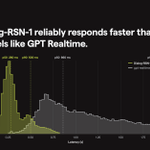
Dialog-RSN-1, our new model, is the solution to answering within that window without losing the audio information you need or the control over your voice output you want.
And as @nikola_mrksic shared with @Ronanchamberss & @lukeknight on @etnshow, it does so faster and at a higher quality than any other real-time-capable model.
A reply in 280ms keeps a phone call feeling human. Two seconds of silence? That gets you "hello? are you there?" and a prompt hang up.
Today @polyaivoice launched a model built around that fact. Meet Dialog-RSN-1.

Instead of reading a transcript of what you said, Dialog-RSN-1 listens to the call itself. It reasons through its answer and starts speaking faster than GPT Realtime can begin a reply, and it's already carrying real customer calls in production.
1
39
The launch blog from our VP of Research covers how it was built, the full benchmarks, and more: poly.ai/blog/PolyAI-dialog-r…

1
38
Dan retweeted
Most AI agents running in contact centers today are built on general-purpose models with defaults designed for long-form text and screen-based interactions.
On a live customer call, that means responses that are too long, phrased for a reader, and delivered at a pace that makes callers wonder if anyone's listening.
Raven is how we solved it. A model built specifically for customer service, trained on millions of real conversations, and designed for how people actually talk.
In our upcoming session, Matt Henderson and Jak Katterfield will walk through why we train Raven in-house, how we do it, and what it delivers on a live call.
Join us July 1st at 12 PM ET: poly.ai/webinars/not-all-ai-…

Dan retweeted
🇨🇦 PolyAI is coming to Toronto!
Toronto has one of the deepest concentrations of AI talent anywhere in the world, and our North American customers are growing fast. Being on the ground means we can move with them and recruit the teams who will define the next phase of our platform.
Our team there will be focused on agent design, deployment engineering, and business development.
Read about where we're headed next: poly.ai/blog/PolyAI-makes-fo…

Dan retweeted
Starting today, we're opening our Agentic Dialog Platform to every enterprise builder.
Our dialog agents have resolved 1 billion+ customer conversations for clients like FedEx, Unicredit, PG&E, Marriott, Foot Locker, and many more.
These aren't easy conversations. They solve problems like:
> A patient booking medical transport who needs insurance verified on the spot.
> A homeowner calling their utility company about a gas leak.
> A cardholder figuring out why their must-have purchase was declined.
Standard conversational AI was never built for this. It was designed for chat, adapted for voice later. It generates responses, but can't do what dialog requires: hold context under pressure, navigate ambiguity in real time, and actually resolve problems.
So we built a better model.
Our proprietary model Raven was built from the ground up specifically for dialog. Agent harness in the weights, not bolted on through prompts that drift under pressure. And in our platform, you can deploy Raven as your default or bring in GPT-5, Claude, Gemini, whatever model fits your use case or regulatory requirement.
Now that the Agentic Dialog Platform is open, any team can create, test, and deploy dialog agents on the same model and infrastructure the world’s top brands trust on their hardest days. This opens up the pool of builders across your entire enterprise. The person who knows customers best, who runs operations, who owns the customer journey: they're all builders now.
Two ways to build:
> Poly Agent Builder: Describe your use case in natural language, and it configures your agent, knowledge base, and conversation flows automatically. Production-ready in ten minutes.
> Agent Development Kit (ADK): Developers use this to build dialog agents the same way they build everything else. Use your own IDE, a coding assistant like Claude, version with Git, deploy from your terminal.
Get started now: studio.poly.ai/
Dan retweeted
Just in: the @FinancialTimes has ranked PolyAI the #1 fastest-growing AI company in Europe!
As we continue to expand globally, it’s especially meaningful to see this recognition coming out of our home base.
Enterprises don’t trust just anyone with their customer conversations. We’ve earned their trust by delivering better business outcomes across tens of millions of real interactions.
Out of the @FT 1000 companies, PolyAI ranked #32 overall, and #1 among enterprise AI providers. Get the full story here: poly.ai/blog/polyai-named-th…

Dan retweeted
When people talk about AI in healthcare, they jump straight to replacing roles. But right now, the most interesting work is simply about listening.
Some companies are already building voice AI that tracks speech patterns over time to detect changes linked to diabetes, mental health conditions, and even insomnia.
Nikola Mrkšić sat down with Alexandra Brown to talk about where AI is actually making an impact in healthcare today, and it's a lot closer than most people think.
Watch the full episode: youtube.com/watch?v=fAMqKfH3…
such a shame… all the talent in the world squandered by the colts again.

Breaking: The Colts have given quarterback Anthony Richardson Sr. permission to seek a trade, a league source told @HolderStephen.

42
Dan retweeted

I’ve never seen a customer agent being used in therapy centers.
But the way this AI handled the call is impressive
Voice shaky. Long pauses. Sentences trailing off. AI didn't rush or fill the silence.
That's something most humans can't even do well.
We keep talking about AI getting smarter. Better at code, images, reasoning. Nobody's talking about it getting emotionally intelligent.
Not "detecting sentiment" in a dashboard. Actually knowing when to shut up. Knowing that "Great!" is the wrong response when someone's having a rough day.
Most companies already deliver worse experiences with real agents who are overworked and burned out.
AI isn't competing with the best human on their best day. It's competing with the average Tuesday afternoon call. And it's winning.
The company that's closest to nailing this is @polyaivoice. They built the whole thing for phone calls from day one.
They already handle calls for Marriott, Gordon Ramsay's restaurants, and every major casino in Vegas.
This call is what made it click for me:

Dan retweeted

I quit Apple because I knew Siri would never make an actual dent in the world.
Not because the tech was bad.
But because the entire concept had to be rethought.
General-purpose AI assistants try to do everything, and end up doing nothing well.
When you optimize for breadth, you can't go deep enough to actually complete transactions.
Siri can tell you about restaurants but it can't book one, can't take payments, can't modify reservations, can't handle the messy back-and-forth that happens in real conversations.
It's a search interface, not a transaction engine.
When we started @polyaivoice, we made one decision: We only do customer service calls.
Yes! Just one single thing.
We wanted to answer your calls so your customers can talk to AI agents that actually know what they're doing.
And that focus is exactly why we handle 500M+ calls today.
This is what actually happens when you go narrow:
1️⃣ you can train on real data that matters.
We've trained on hundreds of millions of actual customer service calls across hospitality, banking, logistics, and healthcare.
And I'm not talking about web-scraped text, or synthetic conversations.
I'm talking about real calls with real edge cases, real accents, real background noise, real payment failures, and real angry customers.
Our model know what "I need to move my reservation" sounds like in 45 different languages because they've heard it millions of times.
2️⃣ you can integrate deeply into actual business systems.
PolyAI doesn't just talk; it pulls data from your CRM, checks availability in your booking system, processes payments through your payment gateway, updates your PMS, triggers workflows, and a lot more.
3️⃣ you can measure what actually matters to businesses.
We don't track "user engagement" or "daily active users".
We track containment rate, revenue per call, cost per contact, CSAT scores, after-hours bookings captured.
The Melting Pot generated $250K in six months from calls that would've gone to voicemail.
4️⃣ and this is the part that took me years to understand:
You can actually be held accountable.
When your AI is handling a business's main phone line, every failure is visible immediately.
A hallucination doesn't just annoy a user, it costs the business a customer.
So you build differently.
You build with guardrails, with fallbacks, with human handoff protocols, and with real-time monitoring.
You build like the business depends on it, because it does.
PolyAI Agent Studio will help every business have a customer service AI that works 24/7 and actually gets things done.
Excited to have it deployed across your business.

PolyAI has raised $200M from Nvidia, Khosla Ventures, and multiple top VCs.
We're one of the fastest-growing companies in the UK, and we handle 500M+ calls for:
• Marriott
• PG&E
• Gordon Ramsay's restaurants
• And 3,000 more real deployments
Which means that if you've ever called them, chances are you've talked to our voice agents.
Every restaurant we onboard books thousands in revenue within 30 days.
But how?
Because PolyAI works 24/7, answering every call in <2 seconds, and we also:
• switch between 45+ languages
• handle payments & cancellations
• verify identities
• and even upsell your services
If you want to try creating an agent with PolyAI, we built Agent Studio Lite to make it easy. Just enter any URL, and in 5 minutes it will analyze your website and build a working agent.
We're opening early access to a limited number of people. Comment "PolyAI" and we'll add you to the waitlist and give you 3 months for free!
Dan retweeted

We’re thrilled to announce that Dr. Nicholas Nadeau is joining NRN as an advisor.
A leading mind in robotics, AI, and hard-tech systems, Nicholas brings a rare blend of engineering rigor and builder experience—the kind of strategic insight that will accelerate our mission to redefine how embodied intelligence is built, benchmarked, and deployed.
Why Nicholas Fits Perfectly
• Co-Founder & CTO at Onix: Leads a Montréal-based AI company pioneering Personal Intelligence™—private, human-centered AI that empowers individuals rather than exploits their data.
• Former CTO at 1X: Helped pioneer humanoid robotics for human-robot collaboration and was instrumental in scaling the company with leading global investors, including OpenAI.
• Proven Deep-Tech Leader: Advises and co-founds ventures across AI and robotics, mentors startups through Creative Destruction Lab and Next AI, and bridges research, productization, and commercialization.
• Academic & Industry Authority: Holds a PhD in Robotics and AI, coupling frontier innovation with a pragmatic drive to bring ideas to life.
What This Means for NRN
• Technical Depth: Guiding our roadmap to build the global evaluation and reproducibility standard for embodied AI—across both simulation and real-world systems.
• Network Leverage: Opening access to leading labs, research hubs, and AI institutions driving the frontier of embodied intelligence.
• Credibility & Acceleration: Infusing veteran leadership to convert breakthrough concepts into real-world impact at scale.
From Dr. Nicholas Nadeau:
“I’m excited to support NRN’s mission to advance embodied intelligence through rigorous evaluation and reproducible progress. By building a trusted performance layer that connects simulation and the physical world, we’re setting the foundation for transparent benchmarking and measurable real-world advancement.”
Looking Ahead
Nicholas’s addition strengthens our core—deepening our technical bench and amplifying our reach as we shape the next era of embodied AI and robotics.
Stay tuned for upcoming announcements as we expand our advisory network and unveil the next phase of the roadmap.

Dan retweeted
Robots used to mimic code.
Now they can mimic you.
NRN V2S is coming soon.
@yellowpantherx - Thanks for the dance lessons.
Dan retweeted
When it comes to training robots, especially if we want the process to feel game-like, the first question is how much control to give the operator.
Ideally, a user presses a button, such as a "walk forward" button, and that high-level command is converted into low-level joint actions that move the robot.
Robots move using actuators, which are motors that drive each joint. Controlling them can happen at different levels. At the lowest level, you can send torque directly to actuators for maximum flexibility. A step up, you can specify joint angles or velocities and let the robot’s built-in controllers handle the torque. These low and mid-level approaches offer a lot of control, but they require deep robotics knowledge.
Our goal was to let users send simple commands like “walk forward” or “turn left” and have the system handle the complexity behind the scenes, translating those inputs into fluid, real-time motion.
The challenge with training:
Robotics is fragmented. There is no universal standard. Hardware and simulator capabilities vary across manufacturers.
We are using Unitree’s Go2 robots for our upcoming competitions. Their physical hardware supports high-level commands. But the simulator, which we rely on for browser-based control, only gives access to low-level control.
That meant we could not offer a smooth user interface out of the box.
One option was manual conversion. But that would require deep domain expertise in physics and kinematics, and a considerable amount of time. So we did what we do best: we trained reinforcement learning models.
For every high-level behavior we needed (like walking, turning, etc.) we built custom RL environments with tailored reward functions. Each model learned to generate the right low-level joint commands through training and repetition.
These models now serve as high-level wrappers.
When a user presses “forward” in the browser, the corresponding model activates and generates the required actuator commands in real time.
From the user’s perspective, it is just a simple click.
Under the hood, it is a cascade of learned behavior, encoded in a neural network and executed on demand.

ALT Diagram showing the ideal control flow. A user presses a button such as walk, f of x converts it into low and mid level joint commands, and the robot moves.

ALT Diagram showing how reinforcement learning models bridge the gap. The user input goes into f of x, then an RL wrapper chooses a model such as walk, turn or run, and that model produces low and mid level joint commands for the robot.
Dan retweeted

Gm - I wrote a very raw, unedited piece about why I started gaming.
Thank you to G3 and all my amazing team for giving me the platform, guidance and courage to post something like this and share my story.
If you have time to read and let me know your thoughts I would be immensely grateful.
Here’s How The Sims Changed My Life…
gam3s.gg/news/the-sims-chang…
