

SEO & AEO Consultant.
San Francisco
Joined February 2017
- Tweets30
- Following298
- Followers74
- Likes2.4K
Hugo Pegley retweeted

Now in beta: Businesses in ChatGPT.
Claim your business, manage your information, and get insights on how people engage with you.
Eligible businesses can also build a Business Agent to answer customers’ questions and help them explore what you offer.
openai.com/index/introducing…
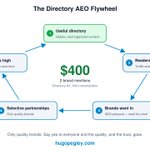
Directory #2 just got its first monetization: $400 for two brand mentions.
I started it 5 months ago. It's a big B2B niche I know well, but not an overly crowded one like enterprise software or productivity. I've been careful with its growth and content, and have not aggressively pursued monetization.
Most directories monetize through affiliate, which makes sense.
But as AI search tool usage grows, in-house teams and agencies are facing more pressure (and gettting more budget) for AI visibility. I know because I've been in that seat! They want useful placements and third-party credibility.
My rule: only quality brands. This one is a well-established B2B player whose software I know. Say yes to everybody knocking on your door and the quality drops, and that hurts you over time even if it feels good to make an easy buck.
That's why when this brand reached out directly to me over email, I was happy to have a conversation about content that would actually suit the site. We settled on an interesting topic/angle that hadn't been covered on the directory yet.
Win-win only works if readers win too.
Follow for more directory and SEO wins.

ALT The Directory AEO Flywheel
1
46
6 months ago I built a new directory from scratch, entirely with Claude Code. This week I just monetized it. Here's an overview:
Today it's at:
→ ~4,000 visits/month, heavily organic
→ ~2,000 ranking keywords, 150+ on page 1
→ 300 newsletter subscribers
→ First paying sponsor this September
No ads, no backlink campaign.
It's been a fun ride! Still a long way to go, but wanted to share some thoughts on what went well and what can be improved:
The Good
1. Picking the right niche. This is a hobby niche where the existing sites were superrr dated with poor UX, the data was public and fairly easy to gather, and visitors come with a clear purpose: they want to gather some information and learn more.
I am a hobbyist in this niche, and I knew if I would benefit from this cleaner directory, so would others!
2. Building pages around what people search for. Each page answers a specific search. It has proper schema and formatting, clear answers to common questions, and is reviewed and updated regularly.
3. Keeping the site lightweight. The site is not sexy or even that pretty. It's clean, straightforward, and easy to use.
4. Letting Claude Code handle the build. AI coding tools make sites like this easy (and cheap!) to build.
The Bad
1. The dwell time on many pages is low, with people just gathering their information and leaving. I'm continuing to work on retention.
2. There are new competitors investing in backlinks that are scaling faster.
3. There are some monetization angles in this niche, but it's by no means a highly lucrative one like finance, health, or SaaS.
Overall, I am enjoying this small project. There's real upside from here: most of our keywords still sit on pages 2–5. Every page that moves from position 15 to 5 adds traffic without writing anything new.
Next up: growing faster with new content and monetization, expanding partnerships, and starting on social.
If you're building a directory or thinking about one, let me know. Curious to hear how others are going as well!


3
3
238
I've worked with many local service acquirers on their SEO and Google Business Profiles, and I run a few local businesses myself. There's no guaranteed overnight trick to reaching top 3 in the Map Pack, but I wanted to share one relatively easy lever with high impact that I keep seeing underutilized when acquiring established businesses.
Take for example a 50-year-old home services company: well known locally, a few dozen reviews, 4.8 rating. They run out of a warehouse and operate in people's homes, and don’t have a physical office.
When they set up their Google Business Profile years ago, they were asked: Do you have a physical location or do you run a service-area business?
They said SAB, so Google never asked for nor verified a public address. They only ask you for the cities and counties you serve. There's nothing wrong with that. But it essentially tells Google "I serve this general area" instead of planting a flag on the ground in your core market. Google will have you input your home/warehouse address privately, hide it, and ask which cities and counties you serve. You can see this on the Google Map -- a lightly shaded map area will appear on a SAB listing across all the counties and cities you selected, instead of a location pin for a physical location business.
Here's the truth: it is extremely hard to rank well in the Google Map Pack as a SAB — businesses with physical addresses close to the querying user get huge preference. And Google Map Pack leads are the best potential channel for most service businesses.
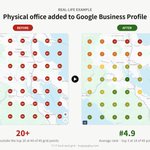
Because of this, I’ve seen acquired SAB listings go from zero/low visibility in the Google Map Pack, with few leads to show for it, to strong positions in their core service area with great organic lead flow, just by verifying an office through Google. I've shared a before & after below of a real example in the wild from a client of mine of this change.
To pass inspection with Google, it has to be a real office, staffed during posted hours and open to customers (an office manager or you working from it counts). Warehouses and virtual offices don't qualify, and Google's verification is rigorous when you submit the change.
But when possible, switching to a physical-location listing can make sense: the address shows on the map and will boost your rankings, and is a relatively straight-forward, high ROI change to make.
TLDR: Making a $500-600/mo investment in a small, but real, office to convert from a SAB to a physical location listing can can have huge ROI for established businesses that already have many of the other trust and ranking signals Google wants. What to do:
1. During diligence, confirm the Google Business Profile set up.
2. If it's a SAB, check current rankings using a map pack scanning tool to see if its struggling to rank highly despite good reviews and history.
3. Estimate market competitiveness to determine organic lead upside with a new physical office.
4. Find an affordable physical office, rent it, and staff it yourself or with your admin/office manager.
5. Submit the change to Google, pass inspection, and you're good to go!

2
3
228
Pretty incredible what converting an existing, well-reviewed GBP from a Service Area Business to a Physical Location will do. One of the most simple but high impact levers you can pull with immediate lead impact.
One client went from 20+ to top 1/2 in their core market overnight. That $600/mo on an office for verification gets paid back many, many times over!
2
1
70
Talked to over a dozen service business owners this week.
Not one of them needs another tool.
Every one of them is losing leads to slow response, dead quotes, and reviews they forgot to ask for.
That gap is the whole opportunity.
37
I've spent the last few weeks deep in the world of local service businesses, talking to operators in my network. Lifetime construction contractors. Cleaning company owners inspired by Walker Deibel & the Entrepreneurship through Acquisition route. Vending operators. The kind of businesses that don't post on LinkedIn.
It's clear that there are small or legacy companies still operating on pen and paper. This is of course a huge opportunity as these business owners begin to retire and pass down or sell their company.
But surprisingly, another pattern emerged from these conversations:
Most of these businesses are not under-tooled. Most have a CRM, a scheduling tool, maybe a quoting platform or other relevant SaaS. Many have a website, a Google Business Profile or Yelp listing, and have experimented with some form of SEO or ads, usually through an outside agency.
The software stack is fine, albeit often severely underutilized.
What they're missing is the connective tissue. Again and again, leads get slow responses, quotes go cold, and customers go quiet. Not because the tools are bad, but because nothing stitches them together. There's no system, no automation running in the background that understands the actual daily rhythms and workflows of the business.
The result?
The 8pm inbound website lead goes to a competitor by the time the office manager calls back at 11am the next day.
The quote gets sent out and is never followed up on.
The 5-star review never happens, because the happy customer was never asked.
Business owners are savvy, and they feel this deeply. Instead of focusing on the actual work, the owner and the team are stuck patching these gaps in whatever spare minutes they can find.
The good news? These are process problems disguised as software problems. The tools are there. The follow-through simply isn't.
Which is exactly what AI is for.
The biggest opportunity in this space isn't net-new software. It's being able to deploy the AI automation layer that connects the existing software with daily processes and goals into the business.
This is what I'm digging into right now. If you're a service business owner living this, or you're building in the space, let's connect.
2
67
Every day we bring AI closer to the native human interface: see, hear, speak. It is ironic but not surprising that our technological advancement will take us back to the mediums we have preferred for hundreds of thousands of years, and away from text on the computer screen.

in our ama two days ago i told the team: in the next 12 months, ai agents are going to flood every workspace. they’ll all need a way to communicate back to humans.
over 30 million people use heygen today. on top of that, the number of ai agents using heygen is growing incredibly fast.
@karpathy says “combine it with an llm model that has deep knowledge and personality.” that’s exactly right. we already see people creating digital twins on heygen that look and sound exactly like them. combine that with an llm finetuned on your knowledge and personality and you get something very close to the “brain upload” he’s describing. that part is real and it’s happening now.
but it goes beyond digital twins. the knowledge layer is evolving fast. people are building deep knowledge bases with obsidian, personal wikis, all kinds of data. with the progress in retrieval and knowledge architecture, your agent’s knowledge is going to span every context, every conversation, every workflow you’ve ever touched.
so then how do you actually consume all of that? i don’t think text is always the answer. sometimes you want to read the markdown yourself, go in and edit the knowledge base directly. totally. but for a lot of message-first stuff like research updates, task summaries, daily standups, text just doesn’t cut it. information density, visualization, presence. video is just better.
one workflow i’m personally obsessed with right now: i run my own openclaw setup that does a bunch of research on a topic overnight, summarizes everything, and turns it into a video. every morning i wake up and watch it. i created an identity for the agent. her name is beacon. every day depending on the context and topic the setting changes. sometimes she’s in an office, sometimes outside. but always the same identity, same voice, just different context. she talks to me through video every single day.
i’m obviously biased because i work on this. but i genuinely believe agents need a much better way to communicate back to humans. video is that format.
we’re shipping something very exciting on this topic on monday. please stay tuned.
What the team at @WisprFlow have built is an amazing unlock that accelerates speed from thought to reality, particularly when used with Claude and Codex
1
163

