

A leading Czech public research institution in the field of International relations and foreign policy. #ExpertiseToImpact
Nerudova 3, 11850 Praha 1
Joined November 2012
- Tweets6.8K
- Following840
- Followers5.9K
- Likes1.1K



Our third panel, Polarization, examined how political divisions are being shaped both by social and economic pressures and by deliberate political strategies.
Moderated by Martin Laryš, Deputy Research Director at the Institute of International Relations Prague, the discussion brought together three perspectives on the sources and consequences of polarisation across Europe.
🔷 Marlene Wind, PhD, Professor at the University of Copenhagen, focused on the geopolitical dimension of polarisation and argued that political leaders can actively deepen divisions in order to consolidate power. She also discussed growing tensions in transatlantic relations and their implications for European unity.
🔷 Jan Kovář, Research Director at the Institute of International Relations Prague, examined the different factors driving societal polarisation, including economic inequality, cultural divisions, attitudes towards the EU and changing expectations about the role of the state.
🔷 Bulcsú Hunyadi, Head of Programmes at Political Capital, used Hungary as an example of top-down polarisation, highlighting the role of media control, information manipulation and political communication in sustaining divisions within society.
With that, this year’s Czech Security Forum came to a close. A big thank you to everyone who accepted our invitation and joined us throughout the day, to all our speakers and moderators for sharing their expertise, to our partners and organisers for making the event possible, and to everyone in the audience for being part of the discussion! See you next year!


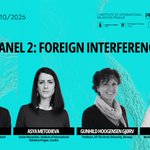
Our second panel, Foreign Interference, focused on how foreign information manipulation, digital platforms and domestic politics interact, and why the line between external influence and internal political dynamics is often difficult to draw.
Moderated by Elena Şimanschi, Researcher at the Peace Research Center Prague and the INTERFER project, the discussion brought together three perspectives on how interference works, why societies remain vulnerable to it and how Europe should respond.
🔷 Ian Garner, Assistant Professor at the Pilecki Institute, spoke about Russia’s use of what he described as emotional warfare, the growing role of AI-generated “slopaganda” and the danger of an information environment in which people increasingly struggle to distinguish what is real. He also stressed the responsibility of social media platforms and the importance of rebuilding face-to-face communities.
🔷 Asya Metodieva, Senior Researcher at the Institute of International Relations, Prague, focused on the blurred boundary between foreign interference and domestic politics, particularly during elections. She highlighted how FIMI adapts to different national contexts and raised the challenge of developing an effective European response without undermining democratic principles.
🔷 Gunhild Hoogensen Gjørv, Professor at UiT The Arctic University of Norway, emphasised the vulnerability of the civilian domain, our growing dependence on digital information and the need to understand how interference affects different societies in different ways. She also called for more localised approaches, greater European technological capacity and stronger societal resilience.


The Czech Security Forum 2026 has officially kicked off at Atrium Žižkov in Prague!
The day opened with Mats Braun , Director of the Institute of International Relations, Prague, who welcomed our guests and introduced the programme. The opening remarks continued with:
🔷 Snøfrid Byrløkken Emterud, Ambassador of the Kingdom of Norway to the Czech Republic, who reflected on the changing European security landscape, the importance of strong alliances and a rules-based international order,
🔷 Jörg Bergstermann, Director of Friedrich-Ebert-Stiftung Prague, who highlighted the ongoing transformation of the global order and asked how stable today’s alliances really are as they face an increasingly demanding geopolitical stress test.
Michal Smetana, Director of the Peace Research Center Prague, then picked up on these themes, asking how we should understand the return of great power politics and what the changing geopolitical landscape means for NATO.
The opening was followed by our keynote speaker, Brett Ashley Leeds, Professor at Rice University, who explored why military alliances continue to matter and what the United States itself gains from them. She stressed that alliances provide not only security, but also political influence and bargaining power, while declining trust in US commitments could push allies to seek alternative security arrangements.
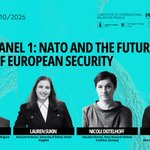
Michal Smetana then opened our first panel, NATO and the Future of European Security, bringing together:
🔷 Jim Stokes, former Director of Nuclear Policy at NATO, who spoke about Russia as the central threat shaping NATO’s current posture, the challenges of deterrence and escalation, and the need for Europe to think more seriously about its future security architecture and defence capabilities.
🔷 Lauren Sukin, Associate Professor at the University of Oxford, who focused on declining confidence in US security commitments, Europe’s growing need to strengthen its own capabilities and the importance of greater coordination among European and other middle powers.
🔷 Nicole Deitelhoff, Executive Director of the Peace Research Institute Frankfurt, is also contributing to the discussion on the future of NATO and European security.
We are only getting started! More discussions on foreign interference and political polarisation will follow throughout the day.


🏅 Naše výzkumnice prof. Veronika Bílková získala vyznamenání Pro Merito Rady Evropy za mimořádný přínos k ochraně lidských práv, demokracie a právního státu. Ocenění jí udělil generální tajemník Rady Evropy za její dlouholetou práci v Benátské komisi a další aktivity v oblasti lidských práv.
👏 Za celý Ústav mezinárodních vztahů paní profesorce srdečně gratulujeme k tomuto významnému úspěchu!
Více o samotném vyznamenání i odborné práci Veroniky Bílkové si můžete přečíst na našem webu: iir.cz/profesorka-veronika-b…

The Czech Security Forum 2026 is just over a week away! On 22 October at Atrium Žižkov in Prague, we will bring together leading experts to discuss some of the most pressing challenges facing European and transatlantic security.
In the third panel, we will focus on political polarisation and the ways in which deepening divisions within Western societies are reshaping European politics, international cooperation and the wider Western alliance. The discussion will feature expert insights from:
🔷 Marlene Wind, Professor at the University of Copenhagen, will bring her expertise on European integration, EU politics, democracy and the institutional development of the European Union.
🔷 Jan Kovář, Research Director at the Institute of International Relations Prague, will contribute his expertise on European integration, party politics, politicisation and political polarisation in Europe.
🔷 Bulcsú Hunyadi, Head of Programmes and Head of the Radicalisation and Extremism Programme at Political Capital, Hungary, will contribute his expertise on radicalisation, extremism, far-right actors and narratives, and international illiberal networks.
Together, they will discuss whether today’s polarisation represents a temporary political disruption or a more structural transformation of the Western political order.
The panel will be moderated by Martin Laryš, Deputy Research Director at the Institute of International Relations Prague.
🔗 iir.cz/czech-security-forum-…

Today at the IIR, Astrid Bastiaens from Maastricht University presented her research on behavioural warning signs and the prevention of planned terrorist attacks, in a public talk introduced and moderated by our Senior Researcher Asya Metodieva.
◆ A key point of the discussion was that radical ideas do not necessarily predict violent behaviour. Instead, threat assessment should pay closer attention to observable signs linked to attack planning.
◆ Astrid also introduced the LATERAN-IT instrument and discussed its first international validation in the case of the planned attack on a Taylor Swift concert in Vienna.
◆ The discussion with the audience then turned to the scope and limitations of the instrument, including its current focus and the need for broader international validation and comparison with other threat-assessment tools.
Thank you very much to everyone who joined us today and contributed to the discussion! 🙌


In the second panel of this year’s Czech Security Forum, we will turn our attention to foreign interference. How it works, how it exploits political divisions and digital ecosystems, and what it means for democratic resilience and European security. The discussion will feature expert insights from:
🔷 Ian Garner, Assistant Professor at the Pilecki Institute, will bring his expertise on propaganda, political radicalisation and the role of information environments in shaping conflict and public opinion.
🔷 Asya Metodieva, Senior Researcher at the Institute of International Relations Prague, will contribute her perspective on political networks, cross-border influence and the dynamics of political interference in Europe.
🔷 Gunhild Hoogensen Gjørv, Professor at UiT The Arctic University of Norway, will add her expertise on security, resilience and hybrid threats.
The panel will be moderated by Elena Simanschi, Researcher at the Peace Research Center Prague (@prcprague) and the INTERFER project.
Register here: iir.cz/czech-security-forum-…

We are pleased to welcome a new colleague to the Institute of International Relations Prague! In September, Zoltán Páll joined the IIR as a Senior Researcher at our Centre for the Study of Global Regions.
Zoltán’s research focuses on Islam, religious movements and transnational networks in the Middle East and Southeast Asia, with particular attention to Salafism, Islamic authority and religious education. He brings extensive international research experience, having previously worked at the National University of Singapore, the Austrian Academy of Sciences and Charles University, and conducted fieldwork across the Middle East and Southeast Asia.
We are very happy to have Zoltán on board and wish him every success in his work at the IIR!
You can learn more about Zoltán, his research interests and his work on our website: iir.cz/en/zoltan-pall


Are you interested in terrorism prevention, security, threat assessment or forensic psychology, whether as a student, researcher, practitioner or public-sector professional?
Join us at the Institute of International Relations Prague for a public talk with Astrid Bastiaens, PhD candidate at Maastricht University, who will introduce LATERAN-IT, a novel threat assessment instrument focused on behavioural signs of attack planning.
13 October 2026 | 14:30
Interested? Register for the event and join us 👇
iir.cz/using-behavioural-war…

Take a look at who we are bringing together for our first panel at Czech Security Forum 2026, called NATO and the Future of European Security:
🔷 Jim Stokes, former Director of Nuclear Policy at @NATO, will bring the perspective of someone with direct experience of alliance policy and nuclear deterrence.
🔷 Lauren Sukin, Associate Professor at the University of Oxford, will contribute an academic perspective on alliance politics and the security challenges facing NATO today.
🔷 Nicole Deitelhoff(@NDeitelhoff) , Executive Director of the PRIF Peace Research Institute Frankfurt, will add her expertise on international institutions, security and the changing foundations of cooperation within the Western alliance.
Together, they will discuss how NATO is being reshaped by growing political divisions, changing relations between allies and wider shifts in the European security environment, and what these developments could mean for the future of the Alliance.
The panel will be moderated by @MichalSmetana3 , Director of the Peace Research Center Prague @prcprague.
🔗 Registration is open and places are already filling up, so make sure to secure yours now: iir.cz/czech-security-forum-…

Institute of International Relations Prague retweeted

What are the most important trends shaping Syria, nearly two years after the fall of the Assad regime?
What are the future scenarios, and what should the EU do if they unfold?
We tried to provide some answers in our new study for the @Europarl_EN @tepsaeu @IIR_Prague
1/3

Jak reálně lze regulovat umělou inteligenci a kde jsou hranice její kontroly? 🤖 Náš expert Jan Švec pro Český rozhlas komentoval možnosti vytvoření institucionálního rámce pro regulaci AI v kontextu jednání Spojených států a Číny.
Vysvětlil, proč má smysl nastavovat pravidla například pro testování modelů před jejich nasazením nebo pro přístup AI agentů k jednotlivým systémům.
Pokud vás zajímá, jaké možnosti regulace AI dnes skutečně máme a kde naopak naráží na své limity, přečtěte si celý rozhovor. 👇

Jak velký náskok mají Spojené státy před Čínou? „Řekl bych několik let. Čína naopak vede v množství udělených patentů,“ přibližuje pro Český rozhlas Plus analytik Ústavu mezinárodních vztahů Jan Švec. irozhl.as/Dpd

Can the Visegrad Group develop a more coherent and strategic approach towards African countries? And what should drive future V4–Africa cooperation?
These questions were at the centre of last week’s discussion at the IIR, built around Darlington Tshuma’s policy paper The Making of a Visegrad–Africa Strategy: From Fragmented to Strategic Engagement?
Moderated by Asya Metodieva, the discussion also brought together Ondřej Horký-Hlucháň and Vilém Řehák and explored the opportunities and limitations of closer V4 engagement with Africa, from trade, investment and technology to multilateral cooperation and the interests of African countries themselves. The presentation was followed by a lively Q&A with the audience.
Thank you to everyone who joined us and contributed to the discussion!
iir.cz/what-could-drive-a-mo…


🗣️ Meet the keynote speaker of this year’s Czech Security Forum: Brett Ashley Leeds.
Brett Ashley Leeds, Radoslav Tsanoff Professor of Political Science at Rice University, is one of the leading scholars working on military alliances, foreign policy and the relationship between domestic politics and international security.
She will speak about the role of the United States in contemporary military alliances and how domestic political developments and foreign policy change can shape alliance relations and international security. Drawing on her extensive research on alliance politics, the keynote will also explore the broader implications of these developments for today’s security environment.
Join us on 22 October at Atrium Žižkov and also hear from other leading international experts discussing the future of NATO, European security, foreign interference and political polarisation.
iir.cz/czech-security-forum-…

Are we seeing the end of the “Western alliance”?
Join us to hear from leading experts in the field as they examine how deepening political divisions within and between Western states, cross-border ideological alignments and new forms of foreign interference are reshaping NATO, European security and the wider transatlantic order.
IIR Director Mats Braun and PRCP Director Michal Smetana invite you to register for the Czech Security Forum 2026, a forum where academic research meets security policy and practice.
🛡️ 22 October 2026, 9:00–15:00, Atrium Žižkov, Prague
Registration is still open, but places are filling up quickly. Take the opportunity to join us and register now on the IIR website: iir.cz/czech-security-forum-…
We are pleased to welcome Darlington Tshuma (@D_Tshuma1) , who has joined the Institute of International Relations Prague as a Think Visegrad Visiting Fellow! 👋
Darlington is a Senior Fellow – Africa at the Istituto Affari Internazionali in Rome and has previously worked with the United Nations Secretariat, Addis Ababa University and leading research institutions in South Africa and Italy. His research focuses on African politics and governance, development, human rights, democracy and Europe–Africa relations.
You can learn more about Darlington and his work on our website:
iir.cz/iir-welcomes-new-thin…
And if you are interested in V4–Africa relations and the future of cooperation between the two regions, join us on 17 September at 14:30 at the IIR Prague, where Darlington will present his policy paper on the future of V4–Africa relations and the potential for a more coherent, strategic and mutually beneficial partnership.
More information about the event and registration can be found here:
iir.cz/the-making-of-a-viseg…
🤖 Made with AI

With Viktor Orbán out of office and Aleksandar Vučić preparing for a new political role, what comes next for Hungary’s influence in the Western Balkans? 🇭🇺
In video, our Senior Researcher Asya Metodieva presents her policy paper exploring the political networks, economic ties and support for EU enlargement that have shaped Budapest’s role in the region, and what may change under Péter Magyar’s government.
📄 The policy paper is available to download from our website iir.cz
Are you interested in V4–Africa relations, development, trade and investment, global governance, or the changing role of African countries in international politics? Then this is an event you certainly should not miss!
We invite you to the presentation of the new policy paper “The Making of a Visegrad–Africa Strategy: From Fragmented to Strategic Engagement?” by our Think Visegrad Visiting Fellow, Darlington Tshuma.
The presentation will examine the opportunities and challenges shaping relations between the Visegrad countries and Africa, including the growing emphasis on trade, investment, technology and skills transfer, Africa’s expanding economic potential, and the scope for closer cooperation in areas such as international law, multilateralism and global governance.
📅 The event will take place on 17 September 2026 at 14:30 at the Institute of International Relations Prague and will be held in English.
Join us for the presentation and discussion and register for the event here: iir.cz/the-making-of-a-viseg…

🇸🇪 Ve Švédsku se blíží parlamentní volby a náš ředitel @MatsR_Braun pro Český rozhlas komentoval jejich možné výsledky, povolební scénáře i další politické směřování země.
Už 13. září budou Švédové rozhodovat o novém složení Riksdagu. Jaké jsou aktuální vyhlídky jednotlivých politických stran, jakou roli mohou po volbách sehrát Švédští demokraté a proč se zahraniční politika tentokrát dostává v předvolebních debatách spíše do pozadí?
Mats Braun se v rozhovoru věnuje také tomu, proč lze v otázkách evropské a zahraniční politiky očekávat spíše kontinuitu a kde naopak mohou volby přinést výraznější změny.
🎙️ Pokud vás zajímá švédská politika nebo další směřování země, doporučujeme celý rozhovor k poslechu.
radiozurnal.rozhlas.cz/svedo…
