





Pinned Tweet
#Thiamine in the ICU: 10 high-yield pearls
1. Unexplained lactate? Think thiamine.
Thiamine is required for pyruvate dehydrogenase. Deficiency blocks conversion of pyruvate to acetyl-CoA, shunting pyruvate toward lactate and impairing mitochondrial aerobic metabolism. Thus, thiamine deficiency belongs in the differential diagnosis for otherwise unexplained lactic acidosis.
2. Thiamine deficiency in the ICU is not rare.
~30-70% of critically ill patients are thiamine-deficient. Many arrive deficient; others develop deficiency during critical illness because of increased metabolic demand, inadequate intake, or losses.
3. The bedside phenotype is more important than waiting for a thiamine level.
High-risk situations include malnutrition, alcohol-related liver disease, bariatric surgery, renal replacement therapy, polyuria/DKA, chronic diuretic therapy, unexplained encephalopathy, unexplained lactate elevation, and sepsis.
4. Starting nutrition can unmask the deficiency.
Glucose administration increases carbohydrate metabolism and thiamine utilization. A malnourished patient may therefore develop rising lactate after initiation of enteral/parenteral nutrition. Refeeding syndrome is not simply a phosphorus/potassium problem; thiamine deficiency can be central to its pathophysiology.
5. Dialysis and polyuria are major clues.
Thiamine can be lost during continuous RRT, hemodialysis, and peritoneal dialysis. Renal losses also rise with polyuria, including the diuretic phase of AKI, post-transplant polyuria, DKA, and chronic diuretic therapy in heart failure.
6. Do not wait for the classic Wernicke's triad.
Altered mental status, ocular abnormalities, and gait ataxia are rarely all present together. I think I have seen it only a few times. In an at-risk ICU patient with otherwise unexplained encephalopathy, absence of the complete triad should not reassure you.
7. A plasma thiamine concentration is not a great “rule-out” test.
Testing is often unavailable and expensive, and blood concentration does not necessarily reflect tissue thiamine status. I don't even remember when I last ordered the test (if ever...). Erythrocyte transketolase activity is physiologically more informative, but its cutoffs are poorly defined. Just recognize the risk population and consider a therapeutic trial rather than wait for laboratory confirmation.
8. The sepsis data are more nuanced than “thiamine works” or “thiamine doesn't work.”
Thiamine is not expected to improve hard outcomes in the overall septic-shock population. Some subgroup analyses and meta-analyses suggest signals for improved lactate clearance and organ function, particularly renal outcomes. I don't consider it a magic drug...
9. Thiamine alone ≠ HAT (hydrocortisone + ascorbic acid +thiamine) therapy.
Do not interpret negative trials of HAT as proof that correcting thiamine deficiency is useless. Large HAT RCTs failed to demonstrate the dramatic clinical benefit initially claimed, and a VICTAS secondary analysis raised concerns about longer-term outcomes. That is a different question from replacing thiamine in a patient likely to be deficient.
10. The kidney may be an important target organ.
Renal tubular cells are highly energy dependent. Across secondary analyses, observational data, and meta-analytic evidence, thiamine supplementation -particularly in deficient patients- shows a signal toward less AKI progression, better renal recovery, and less need for RRT, although individual RCTs have not consistently demonstrated significant benefit in unselected populations.
Rule of thumb:
“⬆️ lactate + risk factor + no good explanation" → think B1 deficiency”
Especially think about it when you see malnutrition/refeeding, alcoholism/cirrhosis, dialysis, polyuria/DKA, chronic diuretics, unexplained encephalopathy, sepsis, or otherwise unexplained persistent hyperlactatemia.
I usually include it in the admission orders for most of my ICU patients along with DVT and GI prophylaxis...!
Thiamine deficiency behaves less like an obscure vitamin deficiency and more like a potentially reversible form of mitochondrial energy failure. Or that's how I like to think about it.
#foamed #foamcc #meded
My #ACLS recertification adventures continue…
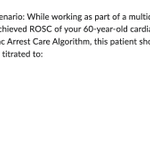
The “correct” course answer here is SpO₂ ≥94%.
But should post-ROSC oxygen really have a floor and no ceiling? 🤔
2025 AHA:
→ 100% FiO₂ until SpO₂/PaO₂ can be measured reliably
→ Then target SpO₂ 90–98% (PaO₂ 60–105 mmHg)
After ROSC, oxygen is a drug.
Avoid hypoxemia. Avoid hyperoxemia. Titrate.


#ACLS recertification journey continues…
We’ve achieved ROSC. Now comes the oxygen question.
Which target would I choose from these four options?
And would the answer change once I had a reliable pulse-ox reading?

A small #ACLS pearl from something I have actually seen done mistakenly during codes:
An advanced airway is in place and someone shouts: “Stop compressions; we need to give 2 breaths.”
Please don’t. 😅
Once an advanced airway is in place during cardiac arrest:
→ Continuous chest compressions
→ 100–120/min
→ 1 breath every 6 sec (10/min)
→ No more 30:2
An advanced airway should make interruptions in #CPR fewer, not create new ones.
Keep the blood moving!
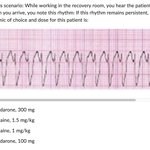
And here is the course's answer: amiodarone 300 mg
But wait… when did our patient go into cardiac arrest? 🤔
The question never tells us whether the patient has a pulse or whether #CPR is even in progress.
Yet the explanation suddenly says: “during CPR.”
That distinction matters:
Pulseless VT → CPR + defibrillation → -> amiodarone 300 mg for refractory VF/pVT
VT with a pulse → assess stability → synchronized cardioversion if unstable; if stable and amiodarone is used, 150 mg iv over 10 min
Treat the patient, not just the rhythm strip.
My #ACLS recertification adventures continue…
You hear the monitor alarm in the recovery room and find this rhythm.
The question asks for the antiarrhythmic of choice and dose.
What should I answer? 🤔


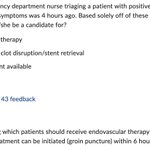
The course says mechanical thrombectomy because treatment can be initiated within 6 hours.
But at 4 hours, why isn't iv thrombolysis also a possible answer?
The 2026 AHA/ASA guidelines explicitly endorse alteplase or tenecteplase within the 4.5-hour thrombolysis window, while endovascular treatment eligibility depends on vascular anatomy and other selection criteria; selected patients can undergo EVT as late as 24 hours.


Since I won’t be around for the next one, here’s a fun fact:
Today is a Pythagorean Triple Day (10² + 24² = 26²). It’s the last one we’ll see this century. The next one isn't until March 4, 2105, which is great news because I plan on being safely decomposed by then…

Today is a mathematical date we won't see again for 78 years.
10/24/26
10² + 24² = 26²
It's called a Pythagorean Triple Day. There are infinitely many Pythagorean triples, but only 12 dates this century satisfy the equation.Today is the last.
Next one: March 4, 2105.

IMCrit retweeted

Praxis is live.
If you’re looking for the H&R26 recordings (and past HRs), this is now their home.
But Praxis is becoming much more than an archive: interactive clinical cases, AI Coaches, curated newsletters, live discussions, courses and 1-on-1 or group teaching from an international faculty — built around physiology, POCUS and how we actually reason at the bedside.
For Critical Care, Internal Medicine, Emergency Medicine, Anesthesia — and essentially anyone who takes care of sick patients.
praxis-project.com
#CriticalCare #InternalMedicine #POCUS #Hemodynamics #Anesthesia
Ping @TheEMNerd @icmteaching @khaycock2 @FTeranMD @emcrit @PulmCrit @jsemccm @TrinaAugustinMD @katiewiskar @G2Disrupt @Francofoam1 @ArgaizR @NephroP @heart_lung @FH_Verbrugge @IM_Crit_ @edu_kattan @AndromedaShock @TaweevatA @SaraCrager @chatterJ5 @emireles_c @intensivaev

IMCrit retweeted
Honoured to collab with the one and only @TrinaAugustinMD ! sciencedirect.com/science/ar… ping @emcrit @khaycock2 @TheEMNerd @icmteaching
IMCrit retweeted

I mean that’s just totally wrong. Unless they aren’t talking about land animals. But it’s way too low for dolphins, whales, purposes so 10 ml/kg is also wrong in the ocean.
I have a talk on this:


Nothing like kicking off the 6th annual NYU Langone Critical Care Cardiology Symposium with a deep dive into VT storm.
Always an exceptional meeting!
#CritCareCards26 @jameshorowitzmd


