

University of Glasgow Geology Masters
Joined June 2024
- Tweets58
- Following55
- Followers22
- Likes153


Wrapping your head round crystallography is a pain until you get to look at dogs and dinosaurs
1
2
18
Highlight of my Lisbon trip, visiting the Carmo Archaeological Museum. This 14th century gothic Church is in incredible condition for the fact it survived the 1755 earthquake that flattened most of the city
#Lisbon

55
Thought I'd share this lovely dyke I found the other day in the Inveraray area. These vertical magma intrusuions are one of my favourite geological features.

17
I love the small moments like this, finding the bottom of a lava flow. It helps contextualise the rocks around us
1
16


Have you ever seen a hill that looked out of place? Chances are it could have been a drumlin. Drumlin are teardrop shaped hills formed when glaciers pass through a landscape eroding everything but these areas of hard rock. Fun fact, @UofGlasgow is actually built on one
1
29
One of my favourite geological features are accretionary clasts. Made in a couple different settings, one of the most common are eruptions. Ash flung high into the atmosphere mingle with moisture and rock fragments, sticking together and forming little layered spheres of ash.

2
26
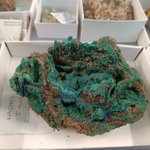
Such a cool looking specimen, the perfect cozy bed for a fairy. This is malachite with minor azurite from Cerro de Pasco in Peru

1
30
In Prague, you can find this spectacular dripstone wall in Wallenstein Palace gardens. Unfortunately this is a man made structure emulating stalactites. Real ones form from the gradual accumulation of precipitate when mineral rich water drips from ceilings of caves for example.

1
34
Moment of appreciation for this intraformationally folded siltstone with galena and interlayered sphalerite from Mount Isa, Queensland, Australia 👏👏

2
53
One of the funny things about being a geologist is if someone told me I needed to dress expensive for an event, I'd turn up in my field gear 🥾🎒🔨
2
38
Under the microscope, even rocks that look bland can be beautiful. And even thin sections that seem bland in plain polarised light can be fantastic in cross polarised light. ✨
4
100
These green spheres are tektite, a glass created in impact deposits. They can be found in this mudstone mines in Bristol (UK), but it is believed the crater related to these distal tektite deposits formed ~200 million years ago in Canada 🇨🇦🌠

1
44
when we want to know what the ground is made of, we drill down and pull out a core of the rock. Cores can be really long so we chop them into metre long sections. These are then cut lengthways: half is sent to a lab for testing and the other stays to be analysed visually
1
50