






Ivan Rocha retweeted

Halogen 0.20.0 is out for Strix Halo
• OvisOCR3 document parsing on the @AIatAMD NPU (your own weights)
• OCRBench 85.7 vs 85.3 upstream
• ROCm 10.1: ~9–15% less energy, same speed
• 2–6% faster prompt reading on Qwen3.8-Flash-Next
github.com/peonist-ai/haloge…

Ivan Rocha retweeted

This week we were blessed by:
1. @Nouamanetazi dropped MoE training handbook: huggingface.co/spaces/huggin…
2. @yb2698 started training harness adapters: huggingface.co/blog/harness-…
3. @joelniklaus released the harness leaderboard: huggingface.co/spaces/joelni…
Have a lovely weekend y'all. 🤗
Ivan Rocha retweeted

For all llama.cpp Qwen3.8-27B users !
With dspine release from @TencentHunyuan, 27b now runs even faster.
Especially for maths and code 🚀
Speed run result of Qwen3.8-27B-UD-Q4_K_M on my RTX 3090 with dflash2 and dspine!
dspine is the fastest at every context depth i tested🔥
dspine vs dflash2 vs no spec
- 8k: 35.6 vs 26.6 vs 28.1
- 32k: 31.1 vs 28.0 vs 23.8
- 64k: 35.5 vs 23.0 vs 19.5
- 128k: only no spec fits, 14.6
Also llama-benchy uses a novel as the text, which is the worst case for drafting. on code and math it's way better, ~125 tok/s, 4.5x over no spec
- code/math: ~125 tok/s (4.5x)
- mixed chat: 90 tok/s (3.2x)
Trade off is context, on my 3090, dspine fits 64k for kv q8_0, with n-max of 7 max context increases to 98k.
gguf: huggingface.co/aj9o9/Qwen3.8…
You need my llama.cpp branch for now: github.com/Ajay9o9/llama.cpp…


THIS IS HUGE !!
Now you can run Qwen3.8-27B even faster !!
@TencentHunyuan just released DSpine for Qwen3.8-27B and it beats DFlash2 really well.
I ported this to llama.cpp and have created ggufs for it,
find all my drafters in my hf link below.
Since it's not supported in upstream llama.cpp, you can clone my updated fork and give it a spin.
- Baseline: 28.2 tok/s
- DFlash2: 50.6 tok/s.
- DSpine: 94–132 tok/s
DSpine's lead over DFlash2 is about 1.75x either way.
DSpine predicts more tokens per verify step on math and code (7.3–7.6 vs 5.7–5.8), which is where its big wins come from.
github.com/Ajay9o9/llama.cpp…
All information is provided on model card.
huggingface.co/aj9o9/Qwen3.8…

Ivan Rocha retweeted

A good technical LLM interview question:
We replace a dense feed-forward layer with a top-2 MoE.
The profiler confirms that the MoE executes fewer FLOPs per token.
However, end-to-end inference latency has increased instead of decreasing.
Why did this happen?
A standard Transformer applies the same feed-forward network to every token in a layer.
An MoE layer replaces that network with multiple experts. Each expert is a feed-forward network with its own weights.
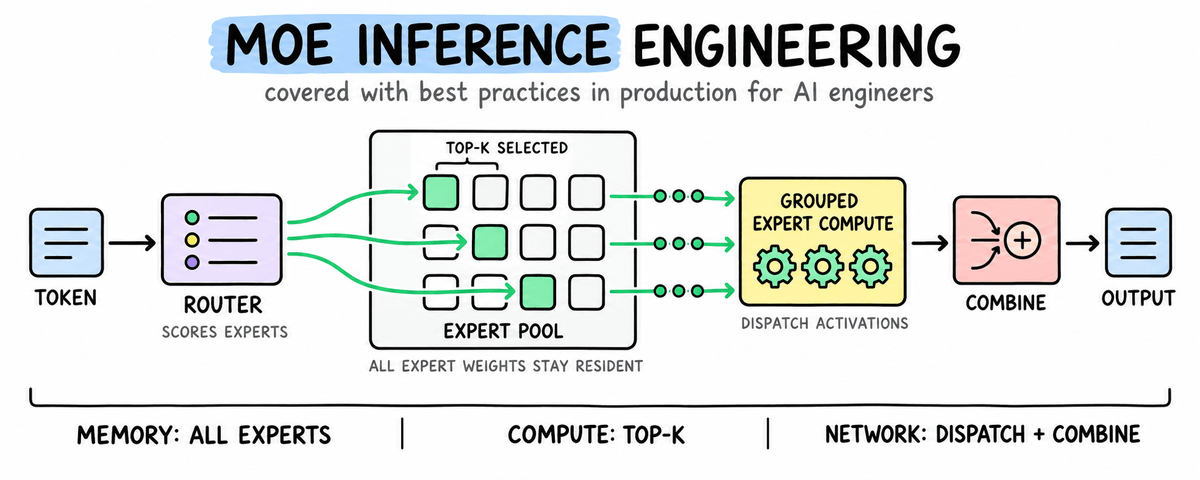
A router reads each token’s hidden-state vector, scores the available experts, and selects the top two. It also produces a routing weight for each selection.
Only those selected experts process the token. The model therefore contains many expert weights while executing only a small subset for each token.
The serving system must move activations when the selected experts are stored on different GPUs.
The visual follows a batch that begins on GPU 0.
The router returns two expert IDs and two routing weights per token. One selected path is shown for each example token to keep the diagram readable.
Token T1 selects E1 on GPU 0. Its activation remains in local GPU memory, where E1 processes it.
T2 selects E4 on GPU 1 in the same server. GPU 0 transfers the activation through NVLink, a high-bandwidth GPU-to-GPU connection. NVSwitch connects several GPUs through this fabric.
T3 selects E7 on GPU 2 in another server. Its activation crosses the cluster network through InfiniBand or Ethernet.
To be clear, the system transfers activation vectors, which are the numerical representations produced for a token by the preceding Transformer operations.
Each destination GPU runs its expert and returns the output to GPU 0.
GPU 0 multiplies both selected expert outputs by their routing weights, adds them together, and restores the original token order.
Different tokens can select different expert pairs. Across a batch, those assignments may involve every GPU storing experts.
Each GPU may therefore send activations to several GPUs while receiving activations for its own experts. This exchange is called all-to-all communication.
And there are several ways to optimize this.
For instance, keeping frequently selected experts within the same server reduces remote traffic.
Balanced routing prevents one GPU from delaying the layer.
Communication overlap allows local expert computation to continue while remote activations move.
In this setup, sparse routing reduces expert FLOPs, but token dispatch and network communication erase part of that saving.
If you want to dive deeper, we recently covered MoE inference engineering, including routing, expert placement, token dispatch, load balancing, communication overlap, memory, quantization, and offloading.
Read the article below.

Ivan Rocha retweeted

This is how you can connect four @NVIDIAAI DGX Sparks without a switch!
tldr; it's a closed-ring, but not the kind you think of 👇

Breakthrough inference speed for MiniMax H3 Reference-to-Video (Ref2VA / R2VA): Generate a full 5-second, 24 fps video conditioned on reference character images in ~72s (warm) / 95s (first run) on a single consumer NVIDIA GeForce RTX 4090 (24GB)
github.com/Kablex/ComfyUI-Re…

Ivan Rocha retweeted

Update for GLM 5.3 Flash for 2x DGX Sparks ✨
- Tool calling improvements: Tool eval bench hard mode score is now 93 with thinking on!
- Long agent sessions stay cached: a 380k-token chat resumes in 3s instead of 4min (!)
- Video input now work with WITH_VIDEO=1.
- Fixed a JSON bug where an ID came back with a digit missing.
Highly recommend you to update ASAP!
Get it here:
github.com/MiaAI-Lab/GLM-5.3…

Ivan Rocha retweeted

📖 The Ultimate MoE Training Handbook 📖
We spent 1/2M GPUh to optimize MoE training and wrote the most comprehensive blog about it. With 30k words and 50+ interactive figures it covers everything from profiling to large cluster training.
huggingface.co/spaces/huggin…

Ivan Rocha retweeted

⚡ 千问 4 代迟迟不发,日本极客干脆自己手搓出了“Qwen4 青春版”!
日本本地算力老炮 @_ryu15_(手头屯着两张 V100 32G)等不及官方发布,干脆把千问 4 代最核心的底层技术——QSA(微块稀疏注意力)提前逆向移植到了 Qwen3.8-27B 上,刚在 Hugging Face 放出了完全体 Qwen3.8-27B-QSA!
实测把 128K 超长上下文的卡顿彻底给秒了:
• 超长文 Prefill 速度狂飙近 2 倍 ➔ 过去 128K 预填充速度只有 1,598 tok/s,换上 QSA 算子后直接干到 3,114 tok/s(速度快出 1.95 倍!),连 64K 也从 2,900 飙到了 4,300+;
• 超长上下文解码几乎不掉速 ➔ 传统 27B 跑到 128K 深度时,解码吐字往往断崖式腰斩到 20 多帧,而这套魔改版在 128K 极限长度下依然死死焊在 45+ tok/s;
• 精度几乎完全贴合原版 ➔ 并非一刀切粗暴砍掉 KV,而是学习并压缩了 4-token 微块索引,绝大多数基准得分与原版 Dense 完全一致。
官方还有几天才揭晓 Qwen4,开源社区已经自己把 4 代的底层架构给提前跑通了。手头有卡跑长文本的,可以提前尝鲜这套 QSA。
📎 权重与运行库:huggingface.co/higa2515/Qwen…
原作者推文来自 @_ryu15_
#Qwen #Qwen4 #QSA #开源大模型 #本地大模型 #V100 #AI算力

Ivan Rocha retweeted

NEW: Apple is cutting employee AI spending budgets even as it pushes workers to use the technology more. Engineers have seen daily limits cut from $300 to $200, with further reductions to $100 planned. Other teams could see limits fall to $25. bloomberg.com/news/articles/…

Ivan Rocha retweeted

英国金融科技巨头 Revolut 把 2000 名程序员从 Claude Code 迁到自建中国开源模型 GLM,成本砍掉 90%,开发交付时间反而缩短了 70%
在纽约举办的 AI Engineer 大会上,欧洲估值最高的金融科技独角兽之一 Revolut 公开了一组内部架构迁移数据。公司 AI 运营与基础设施负责人 David Abitbol 透露,他们已经将旗下约 2000 名软件工程师的默认编程工具,从 Anthropic 的 Claude Code 和 OpenAI 的 Codex 切换到了自建服务器部署的智谱开源模型 GLM(从 GLM-5.1 升级至 GLM-5.3)。
这一刀切下去,Revolut 只用了 56 张英伟达 B200 显卡,就把内部综合推理成本压到了每百万 Token 约 0.30 美元,直接把付给 Anthropic 和 OpenAI 的账单砍掉了 90%。
【为什么放着顶级的 Claude 不用?】
Revolut 最早从 2025 年 2 月开始试用 Claude Code,并在 2026 年 1 月全员铺开,但很快撞上了残酷的经济账。当时部分重度使用的工程师每人每月要烧掉 1000 到 10000 美元的 API 费用,但公司整体研发效率并没有看到对等的产出。
为了止血,公司被迫给每位工程师设了每月 300 美元的严格额度上限。结果这引发了第二个尴尬的后遗症:因为怕额度不够用,程序员们开始像省粮票一样把 Token 攒着留给最难的代码硬骨头,平时顺手能用 AI 提效的杂活反而不敢用了。
Abitbol 在演讲中点出了一个被很多技术团队忽视的真相:“工程研发的瓶颈其实不在于纯写代码的速度。”真正拖慢程序员的,往往是淹没在收件箱、Jira 工单、Confluence 文档和上下文切换里的时间。换成固定成本的自建开源模型后,公司彻底取消了额度限制,工程师开始肆无忌惮地用 AI 处理周边杂活。从 4 月切到自建架构以来,Revolut 测算内部编码时间缩短了约 60%,从接单到合并代码的整体交付周期(Lead Time)缩短了 70%。
【56 张 B200 显卡是怎么调教出来的】
作为一家受严格监管的数字银行,使用中国团队开源的模型难免面临合规审视。Abitbol 对此的解法很直接:“中国开源权重,西方自有服务器”——只下载公开的模型权重,跑在 Revolut 自己位于美国的隔离基础设施上,完全不经过外部托管服务;遇到视觉图片任务则分流给 Gemini,而昂贵的 Claude Code 和 Codex 依然保留,但只作为攻克极少数顶尖难题的“特批武器”。
刚把模型权重塞进显卡时,开箱即用的推理体验非常糟糕,首字延迟(TTFT)高达 14.26 秒。团队没有盲目加显卡,而是花了四个月死磕底层推理优化:
• 将上下文窗口上限锁定在 256K Token,并保证代码场景下 90% 以上的缓存命中率(Cache Hit Rate)。
• 在 Blackwell 架构上采用 NVFP4 量化格式替代 FP8,在几乎不损失精度的前提下节省了约 40% 的显存占用。
调优完成后,在不增加一张显卡的情况下,系统每秒处理的请求量提升了 76%,首字响应时间从 14.26 秒直接压到了 1.68 秒。按市面租金估算,56 张 B200 显卡每月的租赁成本大约在 24.5 万到 32.7 万美元之间,平摊到 2000 名工程师头上,每人每月只需 120 到 165 美元左右,就能实现全员不限量的高速代码辅助。

Ivan Rocha retweeted

On appearance alone, GLM 5.3 flash seems to be just as fast as DeepSeek 4.1f for TPS.
I am doing a deep code review using DSf, GLMf and OhPiss 5.5 Once finished, I will ask OhPiss to judge them and then stick with whichever of the 2 scores the highest.
GLMf - github.com/MiaAI-Lab/GLM-5.3…
DSf - github.com/MiaAI-Lab/DeepSee…
I will report back with the findings.

Ivan Rocha retweeted

recipe update: 40 tok/s on glm-5.3 flash running on a single spark via Tensorfold
now the mtp layer drafts up to 3 tokens a round, and drafts less when its guesses stop landing.
1 draft → 3 drafts:
structured 33.91 → 40.24 tok/s (+18.6%)
math 32.78 → 35.67 (+8.8%)
code 32.67 → 33.46 (+2.4%)
prose 27.40 → 25.79 (-5.9%)
mean 31.69 → 33.79 (+6.6%)
recipe: github.com/sxuff/glm53-flash…

Ivan Rocha retweeted

One of the best open-weight models!
Beats DeepSeek V4.1 1017.
Tencent launched Hy4, and this is now a smarter and multimodal version of Hy4-preview.
The model can now see and operate computers. 👀
The new weights aren't available, as far as I can tell.
Tencent says they're coming in a few days.
This model has...
👁️ Native vision and visual reasoning
🖥️ GUI + terminal computer use
🎨 Blender and CAD workflows
🎮 Unreal Engine, Unity and Godot
🤖 Long-horizon agents
📚 Improved long-context reasoning
🔓 Open weights promised
And Tencent reports some interesting improvements over Hy4-preview.
🎮 GameDev → +19.1%
🧩 GameLogic → +9.8%
Internal hallucination rate:
12.95% → 7.2%
In a 579-task financial evaluation scored by 213 professionals
Hy4 → 3.04
DeepSeek V4.1 Flash → 2.97
Kimi K3.1 Pro → 2.68
GLM-5.3 → 2.68
These are Tencent's own evaluations, not independent results.
This is based on Hy4-preview with these stats
🧠 770B total / 49B active
📚 1M context
💾 4-bit raw weights → ~385GB
🔓 Apache 2.0
We don't have final Hy4 weight specifications yet, but if the architecture remains similar, this will be another monster for Localmaxxers to figure out how to run.
Tencent says Hy4 is already working with its Hyra 2.0 research-agent harness to optimize AI training infrastructure.
Link in ALT

Ivan Rocha retweeted

We’re releasing new Qwen3.8-Flash-Next GGUFs with 15% higher accuracy.
Unsloth Dynamic V3.1 outperforms others by >15% on Terminal Bench, DeepSWE & more benchmarks (256K context).
Run on 32GB+ RAM setups.
GGUF: huggingface.co/unsloth/Qwen3…
Blog: unsloth.ai/docs/models/qwen3…

Ivan Rocha retweeted

Highly recommended paper from NVIDIA.
(bookmark it)
There is a lot of debate about whether to use context compaction aggressively.
They show that with frequent compaction, frontier language models lose little to no accuracy on a broad range of long-horizon and long-input tasks while keeping their context short.
With one action per context, Claude Opus 4.5 scores 70.2 on SWE-bench Verified against 70.0 with the full history. Median peak context drops from 32K to 8K tokens.
The agent carries a short summary of its state between steps instead of the whole transcript. Simple compaction at the end of a conversation often does better than the full history, and Opus goes from 70.0 to 74.8 with it.
This also matters for cost. Later tokens cost more to generate than earlier ones, up to 7x on frontier open-weight models.
The pattern holds on Terminal-Bench, FRAMES, BFCLv3 and multilingual SWE-bench, with modest losses in some settings.
Before paying for million-token agent runs, it's worth testing aggressive compaction on your own tasks.
arxiv.org/abs/2611.05306
Chat with Paper: academy.dair.ai/papers/you-d…

Ivan Rocha retweeted
Run the NEW GLM 5.3 Flash recipe (1104) on your 2x NVIDIA DGX Sparks with ease ✨
Based on my RTX PRO 6000 recipe and ported to GB10. 93 of its patches are unchanged, and 12 are unique GB10 patches.
Your sessions will run smoother, feel snappier, and in general be a more pleasant experience from top to bottom.
Focused on uncompromising quality. Everything has been tested & verified, and the default settings are the best quality you can run.
Native 1M context, 8 streams, TensorFold.
Decode performance (non-greedy prose):
~ 48 tok/s single stream.
~ 87 tok/s at 4 concurrent streams.
- You will feel a noticeable difference vs the older recipe.
Prefill: ~1,700-1,800 tok/s, 4k-256k.
I ran all benchmarks with the GPU clock cap set to 2200. Support for 4x DGX Sparks is coming soon!
The link to the new recipe is below.

Ivan Rocha retweeted

We @huggingface reproduced this paper!!
It's built with ML Intern, an open-source harness to do AI research, train models, and more
Model: huggingface.co/ML-Intern-lab…
Demo: huggingface.co/spaces/ML-Int…


We asked GPT-6 Astra to edit Qwen3.5-0.8B weights to improve math.
It directly changed only 0.016% of weights, fixing 0.8B's reasoning loops & improving math up to 6x and even instruction following 3x, without gradients or training.
We call this Weight-Space Programming: frontier LLMs can now natively read/write neural network weights! 🧵
Blog: rikiyat.github.io/blog/weigh…

Readers added context they thought people might want to know
LLM was given weights explicitly as text in prompt and used code/forward passes (per authors' logs) to ablate Qwen looping direction, a known thinking-mode issue per model card. Primarily fixed repetition in that mode, not general 'natively' improving weights/math.
rikiyat.github.io/blog/weight-sp…
github.com/RikiyaT/lm_und…
huggingface.co/Qwen/Qwen3.5-0…
huggingface.co/RikiyaT/Qwen3.…
Ivan Rocha retweeted

We asked GPT-6 Astra to edit Qwen3.5-0.8B weights to improve math.
It directly changed only 0.016% of weights, fixing 0.8B's reasoning loops & improving math up to 6x and even instruction following 3x, without gradients or training.
We call this Weight-Space Programming: frontier LLMs can now natively read/write neural network weights! 🧵
Blog: rikiyat.github.io/blog/weigh…
Readers added context they thought people might want to know
LLM was given weights explicitly as text in prompt and used code/forward passes (per authors' logs) to ablate Qwen looping direction, a known thinking-mode issue per model card. Primarily fixed repetition in that mode, not general 'natively' improving weights/math.
rikiyat.github.io/blog/weight-sp…
github.com/RikiyaT/lm_und…
huggingface.co/Qwen/Qwen3.5-0…
huggingface.co/RikiyaT/Qwen3.…