








ابن محبوب retweeted

Before giving daʿwah, know who you're speaking to.
Travelling through Kenya and Uganda reminded me: the daʿwah that works in London or Dubai can't simply be copied and pasted into East Africa.
Islam taught this principle 1,400 years ago.


ابن محبوب retweeted

Sh Abdullah Ghunayman is one of the most senior scholars alive today. He is a direct heir of the older Najdi tradition of the likes of al-Sa'di, Muhammad Ibn Ibrahim, Ibn Qassim and more.
Ghulat Tajrih haven't even done a tenth of what he has in defending the creed of the Salaf.

ابن محبوب retweeted

Imam Ibn Nasir al-Din al-Dimashqi al-Shafi‘i (d. 842 AH) said regarding a group within the Sufi Tariqah “al-Rifa’iyyah”:
“May Allah not increase their number among creation!”
He then quotes at length from Shaykh al-Islam Ibn Taymiyyah’s student, Imam Ibn Shaykh al-Hazzamiyyin.


ابن محبوب retweeted

Abdullah b. Mesud'dan (r.a) rivayetle Resulullah (s.a.v) şöyle buyurdu:
"Kıyamet gününde bana en evla/yakın olacaklar bana en çok salavat getirenlerdir."
(Müsnedü'ş Şâşî, 391)


ابن محبوب retweeted
The eminent Hanbali scholar, Shaykh Ibn ’Aqil (d. 2011), spoke highly of the following scholars and cited their Fatawa in support of his position:
— Shaykh ’Abd al-Rahman al-Barrak
— Shaykh ’Abd Allah al-Sa’d
— Shaykh ’Abd al-’Aziz al-Tarifi


A lot of problems would be solved amongst Salafi’s and we would be united if we follow this advice. Any sincere Salafi would take this advice

A statement of someone who truly knew Allah and his Messenger ﷺ, al-Ārif billah, Shaykh al-Islam Ibn Taymiyyah رحمه الله:
“I do not wish for anyone to be held to account or punished on my behalf for having lied about me, or for having wronged me, or acted aggressively towards me;
I have granted a full pardon to every Muslim. I desire goodness for all Muslims, and I wish for every believer the same good that I wish for myself. As for those who have lied or committed wrongs, they are absolved of any claim from my side.
Regarding matters that pertain to the rights of God, if they repent, God will accept their repentance; otherwise, God's judgment shall take its course upon them.
Majmu' al-Fatawa

ابن محبوب retweeted

Ibn Hajar رحمه الله said:
"Do not let your low opinion of yourself or the multitude of your sins prevent you from calling upon your Lord."
[Fath al-Bari]
ابن محبوب retweeted

Where is Allah? — Imām Ibn Qutaybah al-Dīnawarī (d. 276 AH)
Ibn Qutaybah states:
“All nations, Arabs and non-Arabs alike, say that Allah, Exalted is He, is in heavens, so long as they remain upon their natural disposition and have not been taught otherwise.”
He then cited the ḥadīth of the slave-girl as evidence:
“In the ḥadīth, a man brought a non-Arab slave-girl to the Messenger of Allah ﷺ to free her. The Messenger of Allah ﷺ asked her: ‘Where is Allah, Exalted is He?’ She replied: ‘In heaven.’”


ابن محبوب retweeted

This zindīq Sulaymān Ahmad never fails to make a fool of himself. What he fails to realise is that his own statements and writings are precisely what expose him.
Abū ʿUbaydah (تقبله الله تعالى) was himself a Salafī, whom some would label a “Wahhābī.” While explaining the beliefs and methodology of Ḥamās, he stated:
“We are Salafīs, and our ʿaqīdah is that of al-Salaf al-Ṣāliḥ, the ʿaqīdah of Ahl al-Sunnah wa’l-Jamāʿah.” (See the clip below.)
He also authored a master’s thesis entitled الأرض المقدسة بين اليهودية والنصرانية والإسلام (The Holy Land Between Judaism, Christianity, and Islam), in which he:
●Warned against the veneration of graves and the excessive exaltation of awliyāʾ and righteous people in ways that befit Allah alone (سبحانه وتعالى).
●Discussed the various misguided groups that fall into such practices.
●Recommended reading the quintessential “Wahhābī” book Fatḥ al-Majīd, the explanation of the famous Kitāb al-Tawḥīd, authored by Imām Muḥammad ibn ʿAbd al-Wahhāb and explained by his grandson, Shaykh ʿAbd al-Raḥmān ibn Ḥasan Āl al-Shaykh (رحمهما الله تعالى).
Sounds pretty “Wahhābī” to me!
And if that were not enough, he also quoted, praised, and invoked Allah’s mercy upon scholars whom the so-called “Wahhābīs” revere and learn from, including:
●Shaykh al-Islām Ibn Taymiyyah.
●Imām Ibn al-Qayyim.
●Shaykh Ibn Bāz.
May Allah have mercy upon them all.
And here is the irony of the video below: Shaykh Tawfīq al-Ṣāʾigh, the second shaykh featured in the clip, was actually responding to the mockery of the first shameless individual. And guess what? He, too, is a “Wahhābī” Salafī scholar who has delivered numerous Friday khuṭbahs warning against the veneration of graves and the excessive exaltation of awliyāʾ and righteous people.
And the irony of it all as that this man has ridiculed and mocked the resistance in Palestine in the past and now he wants to act like he defends and suppeort them.


ابن محبوب retweeted
All praise belongs to Allah.
A four-volume Tafsir by the prominent Sunni scholar Imam Qiwam al-Sunnah al-Asbahani al-Shafi’i (d. 535 AH) has now been published for the first time.


ابن محبوب retweeted

🧵 Sulaiman Ahmed (@ShaykhSulaiman): The Grifting Heretic
Given the ongoing genocide of our Palestinian brothers and sisters in Gaza, social media has witnessed a wave of grifters and fraudsters who’ve sought to climb the fame ladder and speak on behalf of Islām and Muslims.
This thread will make one thing clear: This individual Sulaiman Ahmed has a track record of selling out the most well-known and established aspects of Islāmic law and does not in any way speak on behalf of Sunnī Islām nor Sunnī Muslims.
[1] Rejection of the age of ʿĀʾishah
[2] Ḥadīth rejection
[3] Rejecting early Islāmic conquests & offensive jihād
[4] Rejecting the punishment for apostates
[5] Rejecting the punishment for homosexuals
[6] Rejecting the niqāb
[7] Rejecting the Miʿrāj
[8] Borrowing interest-based loans
[9] Attacking the Palestinian Resistance

ابن محبوب retweeted

A Refutation of the Accusation That Imam al Bukhari Was a Lafẓī
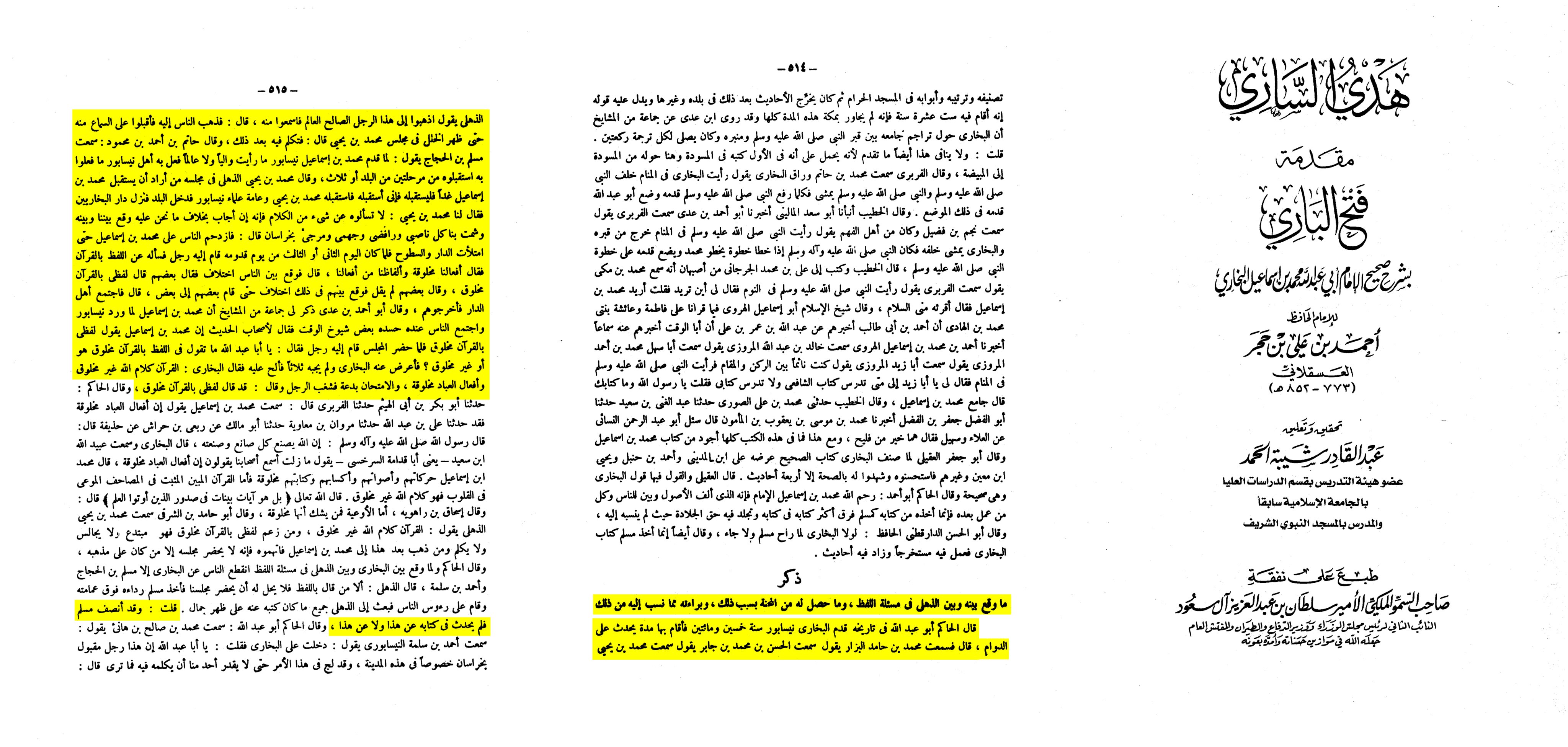
The accusation that Imam al Bukhari (d. 256 AH) was a Lafẓī (those who say our utterance of the Qur'an is created) arose from a disagreement between him and his teacher, Imam Muhammad ibn Yahya al Dhuhli (d. 258 AH), concerning the issue of the utterance of the Qur'an.
However, the historical reports transmitted by Ibn Hajar (d. 852 AH) demonstrate that the controversy was based on an ambiguous expression rather than an explicit declaration by al Bukhari that the Qur'an was created. His own statements clearly distinguish between the created actions of human beings and the uncreated speech of Allah.
The Historical Origins of the Accusation
Ibn Hajar, in his introduction to Fath al Bari, entitled Hady al Sari, introduces the disagreement between al Bukhari and al Dhuhli by discussing the ordeal al Bukhari endured concerning the issue of utterance and his innocence of what was attributed to him.
Al Hakim (d. 405 AH) relates in Tarikh Naysabur that al Bukhari arrived in Nishapur in 250 AH, where he received an extraordinary welcome. Al Dhuhli himself initially encouraged people to attend his gatherings, saying: "Go to this righteous man and listen to him." (Tarikh Baghdad, Al Tabari, 2/29)
However, al Dhuhli cautioned those attending against questioning al Bukhari concerning speculative theology, fearing that differences in expression would lead to disagreement between the scholars and provide an opportunity for opposing theological groups to rejoice over their division.
Despite this warning, a man stood during one of al Bukhari's gatherings and questioned him concerning the utterance of the Qur'an.
Al Bukhari replied: "Our actions are created, and our utterances are among our actions."
This response immediately caused disagreement among those present. Some claimed that al Bukhari had declared his utterance of the Qur'an created, while others denied that he had made such a statement. The disagreement intensified until those present confronted one another. (Hady al Sari, Ibn Hajar, pp. 514–515)
The significance of this report lies in the distinction between al Bukhari's actual statement and the interpretation attributed to him. He affirmed that human utterances belong to human actions, which are created. The controversy arose when this affirmation was understood as a declaration concerning the Qur'an itself.
Al Bukhari's Explicit Declaration That the Qur'an Is Uncreated
Another report transmitted by Ibn Adi (d. 365 AH) provides an even clearer account of al Bukhari's position.
Ibn Adi relates from a group of scholars that when al Bukhari arrived in Nishapur and people gathered around him, some scholars became envious of his standing and began telling students of hadith that he believed his utterance of the Qur'an was created.
During one of his gatherings, a man repeatedly questioned him: "Abu Abd Allah, what do you say about uttering the Qur'an? Is it created or uncreated?"
Al Bukhari initially turned away and declined to answer on three occasions. When the man continued questioning him, he finally replied:
"The Qur'an is Allah's speech and is uncreated. The actions of people are created, and putting people to this test is an innovation."
Despite this explicit response, the questioner immediately shouted: "He said my utterance of the Qur'an is created!" (Hady al Sari, Ibn Hajar, p. 515)
This report shows how the accusation arose despite al Bukhari's clear declaration of his actual belief. He affirmed that the Qur'an is kalām Allāh ghayr makhlūq (the uncreated speech of Allah), while also affirming that afʿāl al ʿibād (the actions of human beings) are created.
Furthermore, he described testing people through this disputed expression as a bidʿah (religious innovation).
The accusation therefore cannot be established merely by relying upon the questioner's interpretation. The report must be examined according to the words al Bukhari actually uttered, not the conclusion his opponent announced afterwards.
The Distinction Between al Lafẓ and al Malfūẓ
Al lafẓ (utterance), can carry two different meanings.
The first is the act of uttering, which is an action performed by a human being.
The second is al malfūẓ (that which is uttered), referring in this context to the Qur'an being recited.
These two meanings must be distinguished because they concern different matters.
The act of utterance belongs to the created human being, whereas the Qur'an being uttered is the uncreated speech of Allah.
When an expression carries multiple meanings, it is necessary to ask the speaker what he intends rather than impose upon his words an interpretation he did not mean.
This principle is important when examining theological disputes. An expression may be understood correctly in one sense and incorrectly in another. A person's belief cannot be established simply by selecting one possible interpretation while disregarding his intended meaning.
The error in the accusation against al Bukhari lies precisely here. His affirmation concerning created human actions was interpreted as though it necessarily included the Qur'an itself, even though his explicit statements distinguish the two.
Al Bukhari's Own Explanation of Created Actions
The distinction is further established through al Bukhari's statements concerning the creation of human actions, a subject he addressed in his well known work Khalq Afʿāl al ʿIbād (The Creation of the Actions of the Servants).
Al Bukhari transmitted from Hudhayfah رضي الله عنه that the Messenger of Allah ﷺ said: "Allah makes every craftsman and his craft." (Khalq Afʿāl al ʿIbād, al Bukhari, 1/26)
He also transmitted from Ubayd Allah ibn Said, known as Abu Qudamah al Sarakhsi, the statement: "I have always heard our companions say that people's actions are created."
More significantly, al Bukhari explicitly distinguished these actions from the Qur'an itself:
"Their movements, voices, acquisitions and writing are created. As for the clear Qur'an, recorded in written copies and preserved in hearts, it is Allah's uncreated speech." (Hady al Sari, Ibn Hajar, p. 515)
This statement establishes the meaning of his position without ambiguity.
Al Bukhari affirmed the creation of human movements, voices and writing while explicitly excluding the Qur'an itself from that description. The physical actions through which the Qur'an is recited, memorised or recorded belong to created human beings, but the Qur'an remains the speech of Allah.
He supported this distinction with the words of Allah:
"Rather, it is clear verses in the hearts of those who have been given knowledge." (Surah al Ankabut, 29:49)
Ishaq ibn Rahawayh (d. 238 AH) similarly stated: "As for the vessels, who doubts that they are created?" (Khalq Afʿāl al ʿIbād, al Bukhari, 1/26)
The vessels here refer to the chests of human beings in which the Qur'an is preserved. Although these vessels are created, their creation does not entail that the Qur'an preserved within them is created.
The same distinction applies to human voices and writing. The reciter's voice and the writer's actions are created, whereas the Qur'an being recited and written remains uncreated.
Thus, al Bukhari's statements establish a clear separation between the actions of the servant and the speech of the Creator.
Why al Dhuhli and the Early Scholars Opposed the Expression
The disagreement must also be understood in light of the concern expressed by al Dhuhli and other early scholars about introducing ambiguous theological expressions.
Abu Hamid ibn al Sharqi transmitted that he heard al Dhuhli say: "The Qur'an is Allah's speech, uncreated. Whoever claims his utterance of the Qur'an is created is an innovator." (Hady al Sari, Ibn Hajar, p. 515)
Al Dhuhli's objection concerned an expression that had not been used by the preceding generations of scholars and could lead to theological confusion.
Many early scholars discouraged entering into detailed discussions of such terminology. They believed that attempting to explain one ambiguous expression through additional expressions could produce further misunderstandings and lead a person into statements whose implications he had not anticipated.
Accordingly, the approach described as that of Ahl al Sunnah was to affirm that the Qur'an is Allah's uncreated speech, spoken with letters and sound, without introducing ambiguous expressions concerning one's own utterance.
The disagreement between al Bukhari and al Dhuhli must therefore be understood within this context. Al Dhuhli opposed the disputed formulation, while al Bukhari affirmed the creation of human actions without denying that the Qur'an is Allah's uncreated speech.
The rejection of an ambiguous expression must not be confused with evidence that everyone accused of using it believed the Qur'an itself was created.
The Consequences of the Disagreement
The controversy eventually resulted in many people abandoning al Bukhari's gatherings. Al Hakim relates that only Muslim ibn al Hajjaj (d. 261 AH) and Ahmad ibn Salamah remained with him.
Al Dhuhli declared that those who held the disputed position concerning utterance should no longer attend his gatherings. Upon hearing this, Imam Muslim publicly departed and subsequently returned the material he had recorded from al Dhuhli.
Ibn Hajar commented: "Muslim acted fairly. He narrated from neither man in his book." (Hady al Sari, Ibn Hajar, p. 515)
Nevertheless, al Bukhari continued transmitting narrations from al Dhuhli in his Sahih, although he did not always identify him by his complete name.
Al Dhuhli was an eminent Imam distinguished by his memorisation, precision and mastery of hadith. Al Bukhari therefore did not discard his narrations despite their disagreement.
The conduct of these scholars demonstrates the seriousness of the controversy, but the consequences of the dispute do not themselves establish the accusation. The question of al Bukhari's actual belief must still be answered through his statements rather than through the reactions of those who disagreed with him.
Conclusion
The historical reports presented by the Shaykh do not show that Imam al Bukhari believed the Qur'an to be created. Rather, they show that the accusation emerged from a disagreement over the meaning and use of an ambiguous expression.
Al Bukhari explicitly affirmed that the Qur'an is kalām Allāh ghayr makhlūq (the uncreated speech of Allah), while distinguishing it from the created actions of human beings. His statements concerning human movements, voices and writing establish that he understood the difference between the act performed by the servant and the divine speech being recited.
The accusation therefore depends upon attributing to him a meaning that his own explanations do not support.
The decisive distinction is between al lafẓ (the act of uttering) and al malfūẓ (that which is uttered). The creation of the former does not establish the creation of the latter.
Imam al Bukhari's affirmation that human actions are created cannot reasonably be treated as proof that he believed the Qur'an itself was created, particularly when he explicitly declared it to be the uncreated speech of Allah.
Imam Ibn Al Qayyim also has a detailed discussion on this matter, read this article for more depth – athari-archive.com/2026/10/1…


Two Retarded Shia’s.
What on earth will you debate?

Debate on Wednesday inshaAllah against Shii preacher who has challenged me.
youtube.com/live/KBRueCiMQS0

ابن محبوب retweeted
Here’s a chain of Hanbali Atharis, from Imam al-Mujaddid to Imam as-Sunnah, Ahmad ibn Hanbal
And obviously, Imam Ahmad has a million chains between him and the Prophet ﷺ
Bonus: in this chain is also Ibn Taymiyyah (ra)