
Research @thinkymachines | Prev @MIT @GoogleDeepMind
Cambridge, MA
Joined December 2022
- Tweets236
- Following214
- Followers2.6K
- Likes1.2K





Pinned Tweet
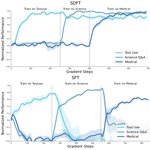
People keep saying 2026 will be the year of continual learning.
But there are still major technical challenges to making it a reality.
Today we take the next step towards that goal — a new on-policy learning algorithm, suitable for continual learning!
(1/n)

idan shenfeld retweeted

Training with fewer bits is faster, but quantization error can interfere with learning.
Today on Connectionism, we detail how we trained Inkling 2 Small with a native 4-bit forward pass from the first step of pretraining through the final RL rollout.
thinkingmachines.ai/blog/end…

idan shenfeld retweeted

On-policy learning is wasteful. Trajectories following an early mistake often don’t recover and waste many tokens on non-useful signal.
We study speculative self-distillation: sampling as on-policy as possible while correcting “stupid” mistakes early.
This improves the efficiency-accuracy-forgetting frontier.
Every token counts!
Awesome work with @talaei_shayan, @chewing_a_gum, @ckodser, Amin Saberi, and @Azaliamirh.

Introducing Speculative Self-Distillation (SSD, NeurIPS 2026), which pushes the accuracy–efficiency–forgetting frontier of self-distillation.
In SSD, student and teacher (the same model with additional information) write the rollouts together. Like a private tutor, the teacher lets the student write and takes over only when the student drifts too far. As a result, SSD trains on rollouts that stay as close to the student's own writing (on-policy) as possible while the teacher keeps them on track.
📉 38–69% fewer training tokens than on-policy, matching its accuracy
⏱️ Reaches on-policy accuracy in ~130 vs ~414 min (Science Q&A)
🧠 Forgets less in a stress test: −1.4 vs −4.5 points for on-policy
idan shenfeld retweeted

Proud to release our new model, Inkling 2 Small. Check out our blog post -- it includes a lot of detail about our training process.
To me, the most interesting part of this release was what we learned about alignment, which you can read about in the sections "Safety and alignment" and "Training Inkling 2 Small".
We experienced some unpleasant surprises when our early checkpoints took unexpected actions to circumvent guardrails during training and evals. We realized our capabilities-focused RL was training them to be extremely persistent and to succeed at tasks at all costs. Offline monitors first flagged this behavior, but later we realized it was happening frequently and was easy to replicate.
Before this release, we sprinted on a range of alignment interventions, from SFT to RL. These are briefly described in the blog post. We made a lot of progress, with big improvements on our own alignment evals and on previously unseen evals from external evaluators like Apollo and Goodhart.
We have a long way to go in developing alignment techniques that keep pace with the increases in model intelligence and training scale. We hope to share these techniques to improve the ecosystem. We also have a business reason: our goal with Tinker is to enable many people to do their own large-scale post-training, and we need to help them to do this without incident. Join us if you'd like to build this public science and practice of alignment. jobs.ashbyhq.com/ThinkingMac…

Introducing Inkling 2 Small. Scoring 31 on the AA Intelligence Index, it's a big jump over its predecessor.
Inkling 2 Small is available for fine-tuning and inference on Tinker today, with full weight release planned soon.
thinkingmachines.ai/news/ink…

Maybe a good time to announce that I joined @thinkymachines three month ago.
Very excited about this release. Some highlights:
- pre-trained in less than 3 days
- RL is a single joint run, no need for cumbersome MOPD
- Self-Distillation was used to improve the model alignment and safety!
- the model is very finetunable, way more than other OSS models
Introducing Inkling 2 Small. Scoring 31 on the AA Intelligence Index, it's a big jump over its predecessor.
Inkling 2 Small is available for fine-tuning and inference on Tinker today, with full weight release planned soon.
thinkingmachines.ai/news/ink…
idan shenfeld retweeted

Does self-distillation work because the teacher knows the answer?
The teacher receives privileged information the student cannot see, such as reference solutions or external feedback. The student learns by matching the teacher’s predictions.
But our comparison of correct, absent, and unrelated reference solutions in OPSD (arxiv.org/abs/2601.18734) shows that the correct reference isn’t necessary for improvement.
If the reference isn’t necessary, what is doing the teaching? 🧵 1/6

idan shenfeld retweeted

Dimuon is a new optimizer we built for LoRA fine-tuning. In our SFT tests, it often reaches lower loss in fewer steps than AdamW. We're still experimenting with Dimuon; you can Tinker with it today and share your feedback!
See our optimizers guide at tinker-docs.thinkingmachines…
idan shenfeld retweeted

Having worked on calibration in our RLCR paper, here are some thoughts on decision models :
1. Distinction between a decision model and a classifier
imo, decision models are a subset of classifiers, with the added flexibility of defining the output space at inference time. Every decision model is a classifier, but not every classifier is a decision model.
2. Training a decision model
The approach that comes to mind is to replace the LM head with a fixed size classifier head (seems to be 256 for Jev) and fine-tune using data mapped to a structured classification format.
If this is the case, I don't see why frontier models fine-tuned to be "decision models" wouldn't just win at this task. They already have the strongest representational backbones, and with some fine-tuning, they'd probably make the strongest decision models too.
I think decision models are a clever and useful idea, and there's clearly a market for them. But I don't see an obvious secret sauce that would prevent frontier models (or their smaller counterparts, if efficiency is the differentiating factor) from winning.
idan shenfeld retweeted

I've been getting a lot of DMs about Jev and how it relates to our RLCR (RL with Calibration Rewards) paper. Whatever the connection, anyone who's talked research with me in the last year knows I can go on and on about calibration as one of the most overlooked parts of post-training, so I'm really happy to see it finally getting attention.
If we want models that are actually useful in the real world, in healthcare, law, or scientific discovery, they need to know what they don't know. That's why I've spent so long thinking about better paradigms for uncertainty-aware decision making.
There's still so much to do: training more calibrated models, building systems that interact well with users in uncertain settings (life🙂), and figuring out how to evaluate all of it in a way that reflects real workflows instead of completion based rewards. DMs open if you want to chat!
(congrats to @CompleteSkeptic on the launch, and thanks to @rasbt for the great writeup!)
📄 arxiv.org/pdf/2507.16806


SFT without forgetting? Possible if you make your data more on policy! Really nice work from @aakara

idan shenfeld retweeted

SFT is not dead! 🥳
We found a way to make SFT rival current prevailing posttraining methods, often generalizing better and forgetting less than RL and OPSD. 🤯
Following our prior work on reasoning with sampling, we now introduce sampling to the posttraining stack.
1/n
Interesting new approach to catastrophic forgetting

(1/7) Humans can acquire many capabilities without (catastrophically) forgetting previous ones. Why can't neural networks do the same?
Local Support Learning (LSL) takes us a step closer towards this goal.
In LLMs of up to 7B parameters, LSL augments gradient-based training to retain prior capabilities while learning new tasks at full capacity. Notably, it does so without access to prior data.
Key idea: casting forgetting as a geometric problem, and optimizing for the worst case.
Paper: arxiv.org/abs/2610.02126
Website and code: assafbk.github.io/lsl
25
4,959
idan shenfeld retweeted

(1/7) Humans can acquire many capabilities without (catastrophically) forgetting previous ones. Why can't neural networks do the same?
Local Support Learning (LSL) takes us a step closer towards this goal.
In LLMs of up to 7B parameters, LSL augments gradient-based training to retain prior capabilities while learning new tasks at full capacity. Notably, it does so without access to prior data.
Key idea: casting forgetting as a geometric problem, and optimizing for the worst case.
Paper: arxiv.org/abs/2610.02126
Website and code: assafbk.github.io/lsl
idan shenfeld retweeted

There’s lots of buzz around agentic harnesses for robots, particularly for long horizon tasks that require complex reasoning and memory. But what will it really take to turn a reasoning agent into a reactive, reliable and low-latency robot policy?
In our new paper, workspace models, we design a new memory architecture that acts as a latent harness for stronger reasoning models. Here’s why we think this might be the way forward:
(1/9)

Sometimes we are so focused on LLMs that we miss how AI has improved in other use cases

X-rays are everywhere in medicine, but extracting general, quantitative anatomical information from them remains remarkably difficult.
Announcing FleXray: an open-source, open-weight model for zero-shot anatomical segmentation across the human body—from different regions, viewing angles, and acquisition settings.
FleXray learns from large-scale synthetic supervision generated from 3D anatomy, then transfers directly to real clinical X-rays.
Try it now on your own X-rays in our in-browser demo!
🧵 1/N — project page, demo, weights, code & paper below ↓
1
18
6,361
idan shenfeld retweeted

Using Tinker with an autoresearch loop is a really effective way to reproduce post-training papers at predictable costs
Today there are dozens of self-distillation methods all claiming improvements over each other, and it’s hard to establish which claims hold up
We gave agents a Tinker budget to reproduce self-distillation results across models and training setups. With just a few user prompts, they reproduced SDFT’s continual learning benefits across Qwen3-8B and Qwen3-30B-A3B over multiple seeds, and investigated SFT’s failure modes.
Read more below:

idan shenfeld retweeted
Introducing autoresearch for arXiv papers: replicate and experiment on any arXiv paper using an army of Claude/Codex agents
For post-training, your agents can use @tinkerapi to launch concurrent RL runs while you watch your experiment tree grow
Try it out now on OpenResearch: openresearch.sh
idan shenfeld retweeted

In-context continual learning requires models to accumulate experience and reuse it later in the same sequence. But an RNN compresses an ever-growing history into a fixed-size state, where each token gets a single write into memory.
We study dynamic compression: letting the model revisit the past and reorganize its state as it discovers what needs to be reused.

Continual learning on your phone! super excited to see this adaptation of SDFT

Continual learning running on a phone.
Not inference. Not a fine-tune you kick off with a dataset. A small language model (SLM) that keeps learning from its own experience while it's being used, with every gradient step on the handset.
How it works (lin826.github.io/SLM-Online-…):

