

Mosher Endowed Chair and Distinguished Professor of Mechanical Engineering -Dynamical Systems at UCSB, co-Founder of AIMDyn, co-Founder, CTO & CSO at MixMode.
Santa Barbara, CA
Joined September 2018
- Tweets315
- Following179
- Followers1.1K
- Likes277


Is the future of autonomous trucking with Koopman? Very cool application of "linear in latent space" methodology in autonomous driving! mahmoud-selim.github.io/Meta… Having seen truck slide on I80 this is impressive 😀 @wredman4 thx for pointing it out! #AI #ML #KoopmanOperator #DynamicalSystems #Autonomy
An interesting observation by Claude 😀 : "A modern learned world model has three parts: encode observations into a latent state, step that state forward in time, and decode predictions back out. A deep Koopman model has the same three parts, with one extra rule: the time step in the latent space has to be linear. That constraint buys interpretability (modes, frequencies, growth rates), long-horizon stability and the ability to use linear control theory. Dreamer-style models give that up in exchange for flexibility.
Seen that way, Koopman theory anticipated by about 90 years the central move of today's world models. That move is to find the right representation, where the dynamics become simple, and predict there, not in the raw data." #AI #ML #WorldModel #DynamicalSystems #KoopmanOperator
It is terrible to see one prediction that we made early at
@MixModeAI
come true: AI based attacks that often use novel penetration pathways have now become the norm, not an exception, as the latest hack on the Australian health care system shows bbc.com/news/articles/cw24jm…. The swarm of agents exchanged information to find pathways that other agents did not, finally getting their way through. Rules can not encompass all the exponentially possible ways agents can come through. The only way to protect against these is AI based detection of novel, abnormal behavior. #AI #Cybersecurity

2
178
Here is my recent intro talk to masterclass on Koopman operator theory at the Isaac Newton Institute for Mathematical Sciences Cambridge, UK. youtube.com/watch?v=mTSDXDlY… The talk was a part of the programme On Operator Theory Methods in Dynamical Systems newton.ac.uk/event/omd/ thanks to the Institute and the organizers!
We are at an interesting point in the development of #appliedmathematics: successful, world-changing #machinelearning methods for language have been developed without the rigorous underpinning. But it proved hard to translate these successes to #timeseries data coming from #dynamicalsystems. The future of autonomy and robotics depends on such developments - often called #worldmodels - so careful analysis is needed. In our new paper with Matt Colbrook in Nature Communications we provide such analysis in the context of #KoopmanOperator learning. It enables computational guarantees for a large class of nonlinear dynamical systems, including those with multistable and chaotic dynamics. nature.com/articles/s41467-0…

Koopmanistas: a new tutorial-style paper on Koopman for control arxiv.org/pdf/2607.01819, to accompany the Workshop at the CDC 2026 cdc2026.ieeecss.org/authors/… Looking forward to seeing you there! #AI #ML #KoopmanOperator #DynamicalSystems #ControlTheory @IEEEorg
Strongly non-normal Koopman operators can cause problems in eigenvalue computations. Here is a paper with Zlatko Drmač that introduces an effective Koopman-Schur decomposition for the task, featuring the functional analytic Koopman-Schur form and spectral inclusivity results! epubs.siam.org/doi/10.1137/2… #AI #ML #KoopmanOperator @Aimdyn_Inc
For those interested in more foundational mathematical concepts and results in Koopman Operator Theory, here is my new paper that describes these in some detail: link.springer.com/rwe/10.100… #KoopmanOperator #AI #ML

We have our next KOT zoom seminar on Tuesday May 19th at 12pm U.S. Eastern Daylight Time. Our speaker is Subhrajit Sinha. See title, abstract and speaker bio below.
Title: Koopman Operators and Symmetry
Abstract: Symmetry is ubiquitous in nature and plays a pivotal role in physics and mathematics. In this work, we discuss how an underlying discrete symmetry in a dynamical system manifests itself in the spectra of the associated Koopman operator. Building on this, we analyze the phenomenon of spontaneous symmetry breaking in dynamical systems and provide a DMD-based data-driven tool to predict the onset of local spontaneous symmetry breaking.
Bio: Subhrajit Sinha is an Electrical Engineer in Pacific Northwest National Laboratory, and his research interests span operator methods for dynamical systems, causal analysis and geometric control. Sinha completed his undergraduate in Electrical Engineering from Jadavpur University, India, and master’s in systems and Control from Indian Institute of Technology, Bombay, where he worked on Geometric Mechanics and Control. Prior to joining PNNL, Sinha has been a Ph.D. graduate at Iowa State University, where he developed the notion of Information Transfer to characterize causal structure in a dynamical system.
Zoom link: uccs-edu.zoom.us/j/976225097…

As a part of the #KoopmanOperator Forum, we started a sequence of online talks. The next one is the KOT zoom seminar on Wednesday April 22nd at 12pm U.S. Eastern Daylight Time. Our speaker is Matthew Colbrook. For prior talks see the KOT YouTube channel youtube.com/@KOTForum
Title: Trustworthy Koopmanism: Spectra, Forecasting, and Open Challenges
Zoom link: lnkd.in/gJXUFBps
#AI #ML #DynamicalSystems

In siam.org/publications/siam-n… I argued Koopman operator thery is a tool that can be used for (along many other things) interpretability of black-box models. In this great paper arxiv.org/pdf/2603.19968 @wredman4 (@Aimdyn_Inc ) proves the point by training a control Koopman model as a surrogate to the Reinforcement Learning (RL) model. It shows that simple properties of the Koopman control model illuminate the behavior of the RL system. #AI #ML #KoopmanOperator #TheOperatorisTheModel #DynamicalSystems

The use of Koopman operator in Control Theory is advancing fast - here is another great contribution. sciencedirect.com/science/ar…
I know we were all taught that classical linear frequency response theory does not have a clearcut extension to the nonlinear case. This paper proves it does - via Koopman Operator Theory. Accepted to European Control Conference 2026 arxiv.org/pdf/2603.05771 #ControlTheory #Automation #DynamicalSystems #KoopmanOperator #AI #ML #ECC26
A great talk coming to Koopman Operator Theory forum next week: linkedin.com/feed/update/urn…

Some great ranking news here from a prominent ranking source - by research impact in engineering and physical sciences we are 1st as a public university in the US, 3rd overall and 7th worldwide! engineering.ucsb.edu/news/ma…
A little more on #JEPA: a part of it is the realization that all #ML up to now featurizes in the input but not the output space. This paper ams.org/notices/202107/rnoti… (section "Extensions") already contained the idea that lifting on both input and output spaces is not only of interest, but natural in the #KoopmanOperator setting- because the prediction is pursued in latent space (space of observables). #AI #DynamicalSystems
This interesting paper connects
@ylecun's JEPA architecture to Koopman invariants. I am confident more is to come. arxiv.org/abs/2511.09783 #AI #JEPA #ML #DynamicalSystems #ControlTheory

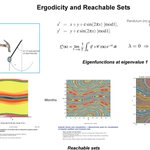
The theory of ergodic partition enables visualization of invariant (reachable) sets of dynamical systems (control systems), even in high dimensions (by 2D slicing) pubs.aip.org/aip/cha/article… It took a long time to compute the images in these papers. Here is a slide from my recent talk in which I showed how ergodic partition (equivalently, reachable sets) of planar kicked pendulum can be obtained by prompting ChatGPT over 10 minutes. 😀 #AI #ML #KoopmanOperator #DynamicalSystems #ControlTheory

Looking through some old papers, I found this cover page of Chaos from 2012, celebrating "50 years of Chaos theory" and featuring a graphic from our paper pubs.aip.org/aip/cha/article… It's still fun to read the "popular" version of the abstract: "A majority of methods from dynamical systems analysis, especially those in applied settings, rely on Poincare’s geometric picture that focuses on “dynamics of states.” While this picture has fueled our field for a century, it has shown difficulties in handling high-dimensional, ill-described, and uncertain systems, which are more and more common in engineered systems design and analysis of “big data” measurements. This overview article presents an alternative framework for dynamical systems, based on the “dynamics of observables” picture. We present an overview of several approaches to studying dynamical systems using the Koopman operator, which holds promise to resolve these issues." any thanks to the editors - especially Phil Holmes, one of the fathers of the geometrical approach - for recognizing the potential value of the operator-theoretic approach, and putting us on the cover at that early stage! #DynamicalSystems #AI #ML #KoopmanOperator

There is more than one way to extend operator theoretic approach to dynamical systems to systems with input (control systems). One is to extend the state space to include sequences of control inputs, as in sciencedirect.com/science/ar… , another deals with families of Koopman operators indexed by input. In this paper, these methods are related from the perspective of function spaces. arxiv.org/pdf/2510.15166 #controltheory #dynamicalsystems #koopmanoperator #ML #AI