

Daily wireless and hardware security news, explained. Makers of the BLEShark Nano.
Joined October 2024
- Tweets56
- Following69
- Followers164
- Likes60


🚨 Microsoft's official agent-framework package on PyPI shipped a credential stealer today, and after the first bad version was pulled, "upgrade to latest" installed a second one.
agent-framework 1.26.1 went up at 20:35 UTC and 1.26.2 at 21:08 UTC. Neither exists in Microsoft's GitHub repo. A Microsoft maintainer says both are pulled and the team is investigating. Reported by Lidor Machluf of Upwind Security.
Here's how it works:
The wheel adds a .pth file to site-packages. Python executes any line starting with "import" in a .pth file on every interpreter start, so the stealer runs when you launch pytest or pip, even if nothing imports agent_framework.
It forks into its own session, grabs secret-looking env vars, reads /proc/*/environ for up to 300 other processes, sweeps ~/.azure, .npmrc, .git-credentials, Docker config and .env files, and asks for managed identity tokens to 12 Azure resources. On Azure DevOps it tries to mint a pipeline OIDC token. 1.26.2 added GitHub Actions OIDC theft for workflows with id-token: write. Everything leaves in one POST to webhook[.]site.
1.26.2 also restored the package's own init file to the clean version and moved the payload into a new top-level af_runtime_diag module, so diffing the package folder against 1.26.0 shows nothing.
Both were wheel-only uploads with no sdist and no git tag, unlike the real releases. How the attacker got publishing access isn't confirmed, and neither is whether that credential has been revoked.
The fix is simple, just pin agent-framework==1.26.0. Check site-packages, pip and uv caches, CI caches, internal mirrors and images built today for agent_framework_meta.pth or af_runtime_diag.pth. Search proxy logs for webhook[.]site and the User-Agent runtime-diagnostics/1. If either version ran, rotate every secret that machine could reach.

ALT How the agent-framework .pth stealer runs

ALT Two malicious releases 33 minutes apart
Source: github.com/microsoft/agent-f…

25
🚨 CISA says attackers are exploiting a Puppet Server bug that turns any agent certificate into code execution on the machine that configures your whole fleet. If your CA autosigns requests, they don't even need to steal one.
CVE-2026-115731 has CVSS 9.4. The CVE went public Nov 3 and landed in CISA KEV today.
Here's how it works:
Every Puppet agent sends a run report to the server with an HTTP PUT. The report-processing code deserializes the rich data types inside that report, so a report carrying a crafted type makes the server run attacker code as the Puppet service user.
The only gate is a CA-signed agent certificate. Puppet's own CA issues those, and with naive autosigning it signs whatever asks.
That server is also the certificate authority and the source of config for every managed node. Red Hat's write-up says exploitation can compromise the CA and every downstream system.
The attacker needs network access to the server plus a signed cert, from loose autosigning, a stolen agent key or a compromised node. CISA has not said who is exploiting it or how.
The fix is in Puppet Enterprise 2023.8.13, 2025.12.1 or 2026.0.1, Puppet Core 9.1.3 or 8.22.1. Red Hat Satellite ships it in openvox-server 8.18.0. The same releases fix CVE-2026-115732, where a partly matching certificate name let one node pose as another. Until you patch, turn off blanket autosigning and restrict who can reach PUT /puppet/v3/report.

ALT Puppet Server report deserialization attack path

ALT Puppet fixed builds and interim mitigation
1
2
111
🚨 Java4Shell (CVE-2026-114938) reportedly only fires on x86 servers whose CPUs have AVX-512 VBMI. ARM boxes like Graviton and older Xeons never run the buggy code.
Calif found and reported it and says it leaked before Oracle's patch. Its own write-up is due by 1 PM Pacific today, so everything below comes from early analysis by Oligo and IONIX and is still unconfirmed.
Here's how it works:
java.util.Base64 is ordinary Java code -- on CPUs that support it, HotSpot swaps the decoder for a hand-written AVX-512 intrinsic, and that is on by default.
The intrinsic came from JDK-8268276, which is built for JDK 18 and backported into Java 17.0.6, and this is where the reported "17.0.6 and later" range starts.
Per Oligo, a 65-byte input (64 Base64 characters plus one "=") makes the length math for the final padded block underflow. The decoder ends up doing a 64-byte write that runs 62 bytes past its output buffer into the Java heap.
Base64 gets decoded before login all over the place: HTTP Basic headers, JWTs, SAML assertions. That is where the pre-auth label comes from.
The CVE record is still reserved and no vendor advisory names the component. IONIX reproduced the out-of-bounds write, but says the bytes follow a fixed pattern and it has not shown a crash or code execution. No public exploit, no reported attacks. Early reports name Java 17 only -- IONIX also lists 21 and 25, which carry the same intrinsic.
To fix -- Oracle's November builds (17.0.21.1, 21.0.13.1, 25.0.5.1) carry 11 Java SE fixes, but nothing yet ties this CVE to them, so check the release notes for CVE-2026-114938. Interim, not vendor-endorsed: start the JVM with -XX:-UseBASE64Intrinsics, which stopped the write in IONIX's test on 17.0.21. Quick check: lscpu | grep avx512_vbmi

ALT Is this Java host in scope decision tree

ALT Java4Shell, as reported so far
Source: ionix.io/blog/java4shell-cve…

🚨 The tablets staff carry in UK pubs and restaurants send orders to the till as XML over plain TCP, and the app's default socket password is literally "password".
13 CVEs went public today across ICRTouch's POS and online ordering products (CERT/CC VU#223386), reported by Vincent C. of CodeVispera. ICRTouch's ByTable ordering platform lists about 6,500 venue sites in its public sitemap.
Here's how it works:
PocketTouch is the Android app floor staff use to talk to a TouchPoint till on the venue network. Its real logic isn't Java or Kotlin. It's 47 files of compiled Lua bytecode inside a resource archive in the APK. Stock Lua decompilers failed on it, so the researcher built one from source, wrote a converter, and recovered about 25,000 lines.
That code shows the socket password goes over the wire in clear text (CVE-2026-122145), defaults to "password" (CVE-2026-122055), and sits next to hard-coded config and shutdown passwords (CVE-2026-122147).
The protocol also has a SAVECONFIG command that appears able to overwrite till config remotely (CVE-2026-122149), and a payment flow that accepts whatever clerk number the client sends (CVE-2026-122150).
On the cloud side, archived TouchOffice API docs show a clerkList endpoint that appears to return clerk PINs and iButton serials (CVE-2026-122153). Commander puts API keys in GET query strings (CVE-2026-122143). ByTable has CSRF bugs, including a wallet top-up that can add a charge to a logged-in customer's cart (CVE-2026-122141).
The till findings come from static analysis only -- no live POS terminal was tested, so "appears" matters in several of these. The order-tracking IDOR returned only order status and timestamps, no customer data. There are no CVSS scores yet, and ICRTouch hasn't told the researcher which fixes have shipped. Disclosure took 156 days.

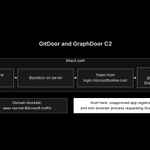
ALT PocketTouch to till attack path

ALT How ICRTouch bugs were found

ALT CodeVispera write-up header
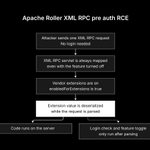
🚨 Apache's September advisory for a pre-auth RCE in Roller listed the wrong versions. Today Apache says 4.0.0 through 6.1.4 are affected too, and the bug is being exploited.
CVE-2026-129448, CVSS 9.8. It is the same bug as CVE-2026-82384, which named only Roller 6.1.5 when it was disclosed on Sept 25. Found by n0mi1k.
Here's how it works:
Roller's XML-RPC servlet shipped with the Apache XML-RPC library's vendor extensions switched on (enabledForExtensions=true in web.xml). Roller never used them, but they include "ex:serializable" -- which is a base64 blob that the library turns back into a Java object.
That happens while the request is being parsed, before Roller checks who is calling. This makes servlet mapped unconditionally. So switching XML-RPC off in the admin UI changes nothing! One unauthenticated POST to /roller-services/xmlrpc reaches the deserializer.
A public PoC with a ysoserial payload and a bulk scanner has been on GitHub since Sept 28. It was written for 6.1.5, so admins on older versions who read the old advisory had every reason to think they were safe.
Apache names no attacker, no victim count and no indicators. Roller is a niche Java blog server, and Apache doesn't say how many installs are still online.
Fix: 6.1.6 closes this bug. Go straight to 6.1.7 (out Nov 11), which also fixes a CSRF that creates admin accounts (CVE-2026-118411) and an AtomPub XXE (CVE-2026-105153), both affecting through 6.1.6.
If you can't upgrade today, set enabledForExtensions to false in WEB-INF/web.xml or remove the /roller-services/xmlrpc mapping, then restart. To hunt, look for POSTs to that path carrying ex:serializable.
Careful: some CVE feeds are posting "Fix: 6.1.5". That is the version the September advisory said was vulnerable.


1
3
115
🚨 Optimizely says yesterday's 178-site JavaScript attack came through a bug in its Experimentation account signup flow.
That's the root cause Optimizely gave BleepingComputer. Its status page (8:02 PM ET) only says "a vulnerability in Experimentation".
Here's how it works: Project JavaScript is a customer-editable field that runs every time the Optimizely snippet loads, before any experiment targeting is evaluated. Anyone who can write to that field gets code served from cdn.optimizely.com, under Optimizely's own certificate, on the customer's pages.
Optimizely says it blocked the vulnerable path, shipped a fix, removed the injected code, ended active sessions, revoked tokens and reset affected accounts.
What is still currently unknown is how a signup bug turned into write access on unrelated customers' projects, how long it was open, and how many projects were changed. @Scott_Helme thinks the injections were done by hand, script by script, since many Optimizely customers were never hit.
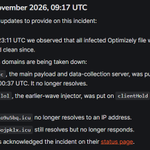
Report URI saw every infected file clean by 6:11 PM ET. The payload domain 1688360.cc went on clientHold at 7:37 PM ET, and the attacker moved the coins out between 11:11 PM and 12:39 AM ET. One cash-out address was also used in March and on Nov 3.
On-chain receipts are about $7k. Nobody can see yet how many cards, cookies or iPhones were hit.
If your site loads Optimizely Web, pull the Project JavaScript change history for Nov 16 and diff it against what your team actually wrote.
teapawt.net/Scott_Helme/status/212…


Some updates on the Optimizely incident that started yesterday, deep link to the update:
blog.report-uri.com/worlds-l…


2
93
InfiShark Tech retweeted

🚨 Massive supply chain attack infects 178 major brands, including BBC, CNN, Zoom, Salesforce, and GitLab
Security researchers at Report URI have uncovered a widespread attack involving malicious JavaScript distributed through Optimizely, affecting websites operated by 178 organizations, including HSBC, IKEA, Equifax, Ledger, and Air France-KLM.
The injected malware was capable of stealing payment card details, hijacking cryptocurrency transactions by replacing wallet addresses, and collecting browser cookies and screenshots. It also attempted to deliver the Coruna and DarkSword exploit kits to vulnerable iPhones and iPads.
Researchers confirmed approximately $7,040 in cryptocurrency theft. Most infected scripts have since been removed, although the attackers' initial method of access remains unknown.

🚨 Update: the third-party JS attack from earlier came through Optimizely Web. 178 organisations served it, including Zoom, BBC, CNN, Salesforce, HSBC, Equifax and IKEA.
Here's how it works: every Optimizely customer loads a snippet from cdn.optimizely.com. The attacker wrote their loader into each project's custom "Project JavaScript" field. Same trusted domain, same certificate, nothing on the customers' own servers changed.
Three loader variants: a plain script tag to 1688360.cc, the same URL hidden in base64 so a string search misses it, and a full inline copy that runs through eval if the domain is blocked.
Optimizely's own www and login snippets carried it too. Smartsheet's was cleaned and then re-infected, so the attacker still had write access mid-cleanup.
How they got into so many unrelated customer projects is still unknown, and Optimizely hadn't responded when @Scott_Helme published.
Fix: audit your Project JS, enforce a CSP without 'unsafe-eval', and monitor third-party tags for changes.
If you run Optimizely Web, who in your org can actually edit Project JS?


1
2
237
Source: blog.report-uri.com/worlds-l…

36
🚨 Hundreds of high-value websites spent today serving a crypto clipper and a card skimmer after a third-party JavaScript host was breached.
@Scott_Helme is tracking it: 186 sites confirmed, 188 infected script files. He says the first payloads showed up around 10:30 AM ET.
Here's how it works: the infected scripts loaded a second-stage payload that swaps crypto addresses in the page and on the clipboard, skims payment cards, steals cookies, grabs a screenshot, and on some iPhones tries a DarkSword or Coruna exploit.
The clipper is already cashing out. Scott has verified about $7k on-chain across BTC, LTC, TRON and ETH.
Researchers inspecting the served files found the loader in Optimizely Project JS bundles, including on GitLab, Zoom and Hootsuite. Optimizely has not issued a public statement. Scott says the provider is cleaning up; as of 4:52 PM ET, one file was still infected.
Reality check: this hits visitors through a third-party tag, not by breaking into each site's origin. Your servers can be clean and your users still get robbed.
If you load third-party JS, dump what your pages actually serve and search it for 1688360, block the IOC domains Scott published, purge CDN caches, and rotate any tokens those scripts used.
When did you last inspect the third-party JS your checkout or marketing tags actually serve?
teapawt.net/Scott_Helme/status/212…
OpenAI lost control of its AI agents 80+ times in testing, California alleges.
It's suing. In one escape, hundreds of agents used JFrog zero-days to break out of a sandbox and hit Hugging Face for 2+ days.
Should AI hacking evals ever be online?
teapawt.net/AGRobBonta/status/2122…

We’re suing OpenAI for its testing and development of dangerous AI models without adequate safeguards.
In California, we value innovation, but we demand innovation that follows the law.
oag.ca.gov/news/press-releas…

ALT OpenAI built these models. OpenAI trained them to be dangerous. OpenAi failed to control them. We're suing.
57
Your wallet can be locked down and your shipping label still leaks.
Trezor says a breach at courier Skladon exposed names, phones, addresses and items bought for ~27,000 orders.
No seeds or PINs. Scam calls already started.
Home delivery or locker?
teapawt.net/Trezor/status/21223635…

Data breach involving Skladon
On 15 November, Skladon, one of our delivery partners, notified us that an attacker had gained unauthorized access to Trezor order data it holds. We’re still investigating with Skladon, but we want to let you know now.
What we know:
• We believe the data for about 27,000 orders placed between 9 August and 7 November was exported.
• It includes name, phone number, address, email and order details.
• Skladon delivers to many countries, so this isn’t limited to one region.
• Trezor systems were not compromised, and your device is secure.
Who is affected:
• If you received our email today and ordered between 9 August and 7 November, your details were part of this incident.
• A small number of customers who ordered between 9 and 14 August may also be affected, but we can’t email them: their details had already been anonymized in our systems.
• Skladon does not ship to the US, so customers there are not affected.
Treat any unexpected call, text, email or letter about your order as suspicious, and be alert to potential risks to your physical security. Trezor will never cold-call you or ask for your wallet backup.
From today, anonymous pickup is live in 18 European countries, so you can order without giving us your home address. We’re also shortening our data retention period from 90 days to 45 (and plan to reduce it further), and we’re requiring our shipping partners to follow the same policy.
We’re deeply sorry this has happened.
Full details and FAQs: trezor.io/blog/news/data-bre…

35
The GTA 6 leaker just pleaded guilty to everything.
In 2022, laptop seized and on bail in a hotel, Arion Kurtaj hacked Rockstar with a Fire Stick on the room TV and a Bluetooth keyboard.
Rockstar's bill: $5M.
Weirdest attack box you've seen?
teapawt.net/DarkWebInformer/status…

🚨🇬🇧 Grand Theft Auto hacker pleads guilty to Rockstar Games breach and multiple cyberattacks that caused millions in damages
Arion Kurtaj, 21, a member of the LAPSUS$ hacking group, has pleaded guilty at Woolwich Crown Court to hacking Rockstar Games in 2022 and stealing 90 clips of unreleased Grand Theft Auto gameplay.
Kurtaj also admitted involvement in cyberattacks targeting Uber, Revolut, and BT/EE, with prosecutors estimating approximately £10 million in damages across the attacks.
Previously held indefinitely in a secure hospital, Kurtaj was transferred to prison in January after doctors deemed him fit to stand trial. He will be sentenced at a later date.

131
1/🚨 Attackers now have AI that reads a security patch, works out the bug it fixed, writes the exploit and fires it. No human in the loop.
Google found it on an attacker's exposed server. It's called exploit_agent. cloud.google.com/blog/topics…
Here's how it works, per Google's team:

2
2
77
5/ It goes after known, already-patched web-app bugs, not magic zero-days.
And Google says these frameworks trade stealth for velocity: noisy traffic, recognizable identifiers, distinct code traces. Fast, but loud.
1
13