

Evidence over ideology. Explaining science in context, exposing harmful misinformation, sharing references—and posting reminders the world is beautiful.
Joined August 2011
- Tweets114K
- Following6.4K
- Followers12.1K
- Likes108K




Pinned Tweet
Most people know Dr. Peter Hotez from his television appearances during COVID, his defense of vaccination, and the relentless attacks directed at him on social media.
I know Peter as a friend. And I want to tell you about another part of his life that rarely enters those arguments.
For more than four decades, Peter has devoted much of his scientific career to diseases that afflict some of the poorest people on Earth. Diseases that cause enormous suffering but attract relatively little commercial investment because the people who need treatment often cannot afford to pay for it.
Hookworm. Schistosomiasis. Chagas disease. Leishmaniasis.
These are hardly household names. Their victims rarely make headlines, and the scientists working on them seldom become celebrities.
Peter chose this field long before COVID, long before the cable news appearances, and long before strangers began calling him a pharmaceutical industry shill.
His career deserves a closer look.
Because the work tells a story that is almost entirely absent from the accusations made against him.

Apparently, one of the great dangers of COVID vaccination is standing too close to someone who’s been vaccinated.
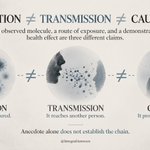
According to a remarkably persistent antivaccine myth, vaccinated people are “shedding” something that can make nearby unvaccinated people sick.
Spike proteins. Vaccine material. Mysterious airborne toxins. The details vary, depending on which meme you’ve encountered.
There’s just one problem: no credible evidence establishes this alleged form of person-to-person exposure and harm.
Meanwhile, there IS a well-established way to shed SARS-CoV-2 into your surroundings.
It’s called getting infected with SARS-CoV-2.
The irony deserves its own scientific investigation. 🧵

8/ The remarkable thing about the COVID vaccine-shedding myth is that it takes a genuine scientific concept, applies it to the wrong biological circumstances, and turns it into a reason to fear other people.
Meanwhile, actual respiratory viral shedding remains an entirely legitimate subject of infectious-disease research.
If you’re concerned about transmitting SARS-CoV-2, pay attention to infection, symptoms, testing when appropriate, ventilation, and precautions around vulnerable people.
If you’re concerned about somebody’s recent COVID vaccination somehow contaminating the air around them, the evidence does not support that fear.
Vaccinated people are not walking biohazard dispensers merely because they received an injection.
And perhaps the most amusing aspect of this entire controversy is that the one thing these shedding memes reliably distribute is misinformation.
Apparently, that really IS contagious.
@IntegralAnswers
For those interested in the science behind vaccine shedding, SARS-CoV-2 transmission, and the distinction between viral infection and vaccine antigen detection:
Children’s Hospital of Philadelphia — COVID vaccine shedding explained:
chop.edu/vaccine-education-c…
Ogata et al. — Vaccine antigen detected in plasma, Clinical Infectious Diseases:
pubmed.ncbi.nlm.nih.gov/3401…
Bansal et al. — Spike-bearing extracellular vesicles after vaccination, Journal of Immunology:
pubmed.ncbi.nlm.nih.gov/3465…
Singanayagam et al. — Household transmission and viral kinetics, The Lancet Infectious Diseases:
pubmed.ncbi.nlm.nih.gov/3475…
CDC — Viral shedding, PCR, antigen testing and viral culture:
cdc.gov/mmwr/volumes/73/wr/m…
WHO — How SARS-CoV-2 spreads:
who.int/news-room/questions-…
There is a part of the COVID-19 pandemic we haven’t talked about nearly enough.
The people who witnessed its worst moments, day after day, often with little time to process what they were experiencing.
Nurses, physicians, respiratory therapists, paramedics, nursing home staff, and countless others who cared for people struggling to breathe, watched patients deteriorate despite their best efforts, and sometimes stood beside people as they died without their families present.
While much of the world experienced the pandemic through news reports, restrictions, statistics, and political arguments, these workers experienced it at the bedside.
For some, those years left memories that have proved difficult to put behind them.
And for some, the suffering they witnessed was only part of what made the experience so painful.
This thread is about those people, what they endured, and what we might learn by listening to them.

For readers interested in the research behind this thread, here are selected, peer-reviewed studies and published clinical perspectives:
1. Moral injury, isolation, and betrayal among healthcare workers
Song et al. JAMA Network Open (2021). Qualitative accounts from 1,344 healthcare professionals.
doi.org/10.1001/jamanetworko…
2. Frontline clinicians’ experiences of COVID-19 care
BMJ Open (2021). Interviews documenting grief, uncertainty, exhaustion, and professional solidarity.
doi.org/10.1136/bmjopen-2021…
3. Nurses caring for dying patients without family present
Journal of Advanced Nursing (2022). Qualitative research on the emotional consequences of end-of-life care.
doi.org/10.1111/jan.15195
4. Healthcare worker mental health and workplace harassment
CDC, MMWR (2023). Working conditions and psychological health, 2018–2022.
cdc.gov/mmwr/volumes/72/wr/m…
5. Online harassment of physicians and biomedical scientists
JAMA Network Open (2023). Survey of social-media harassment during the pandemic.
doi.org/10.1001/jamanetworko…
6. Workplace violence and mental health among public health workers
American Journal of Preventive Medicine (2023). Survey findings on threats, bullying, stigma, and mental health.
pmc.ncbi.nlm.nih.gov/article…
7. When doctors are accused of faking COVID experiences
David Oliver, The BMJ (2021). A clinician’s published perspective on denial and public hostility.
doi.org/10.1136/bmj.n2473
These sources document important aspects of frontline experience, though individual experiences and long-term outcomes vary.

How good was Prince?
When Rock Stars were asked about Prince youtu.be/t1aBFKxNq3Y?si=Nz3h… via @YouTube

On a related note: I lived and worked in HK from 1997-2007.
During that period I became close to some of the best session musicians in that part of Asia. Through some of my connections I was able to direct some work to them.
Each year we’d put together a Christmas Party at one of the musicians home.
One year, we watched a video of Prince perforating…this video showcased his skill at playing many different instruments.
Invariably, each of these acclaimed musicians loved and greatly respected Princes almost singular genius or mastery on each instrument.
Professional entertainers recognized just how good Prince was.
Reminds me of the kind of respect that subject matter experts have for a particular physician/scientist who stands above the rest.