

Used to make Goldman Sachs richer 📈 | Equity Research & Portfolio Management
Research you can act on ⬇️
Joined May 2024
- Tweets25.7K
- Following50
- Followers5.3K
- Likes19.6K






Pinned Tweet
May, 2026
The market has significantly deviated from any rational sense of fundamental / business logic
It seems most have forgotten the law that governs all assets. From bonds to stocks and real estate.
- All investments are judged by the present value of all future cash flows
Cash flows are:
- Net operating profits after tax, adjusted by CapEx and other investments or acquisitions
Since 2023, the $SPY $QQQ have deviated from all factors responsible for delivering excess returns above the $TLT $SHY bond risk-free rate
Factors like momentum, quality, value, and growth.
The reason is that, since 2023, the market has been driven by one thing and one thing only:
$MAGS and AI being responsible for 80% of all stock market returns, not unlike previous extremes like 1929, 1999, 2007 etc.
So what's the problem? There isn't one, except for what we saw in 1Q'26.
$GOOGL $AMZN and other hyperscalers reported massive EPS beats on paper, though in reality 40% of these earnings came from non-cash items (accruals).
The problem with accruals is that they can be written off should the industry's underlying demand slow down.
Which directly impacts the net operating profit side of cash flows.
Then comes the CapEx and investment side of the equation:
~$700 billion in CapEx to be invested in 2026 toward AI, an area which currently returns less than 5% of its invested capital.
In other words, the market's biggest companies have pushed free cash flows out by 20 years on average.
Yet their valuations reflect a boost in immediate cash flows instead.
Two years ago, these companies traded at exuberant forward P/E ratios to reflect the expectations of growing profits and cash flows.
Let's take $NVDA for example.
Today, they have all been repriced lower as these expectations melt in real time.
These companies are taking longer to pay their accounts, and even longer to collect cash, hence the growth of accruals as a share of net income and EPS.
So I think the market is correct in repricing these multiples lower because:
- EPS are much weaker than they seem
- Cash flows are 90% lower than they were a year ago
- Cost of capital is rising as inflation pushes higher, and the $SPX expected returns fall to -2% / +2% for the next decade
You may say this time is different
You may say the CapEx outflows will 100x eventually
I ask how much of that is already priced in?
I ask what happens to expectations when cash flows to shareholders get cut by 90%?
Surely, accruals and intangible assets drive earnings more than ever before, so P/Es may not be as significant as they once were.
But, here's one thing that will NEVER change:
- How much equity do you buy with one unit of currency?
So I leave you with this chart, the $SPY / M2 Money Supply ratio.
1999 highs.


Everything you need to know about the China opportunity:
offsideresearch.com/p/what-i…


Here is where it all gets interesting, because productivity gains are what drive a nation’s (and its stock market) wealth
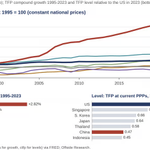
China’s total factor productivity (TFP) index carries the single most important bull case for the next decade
Let me explain:
- A 30-year CAGR of 2.82% versus the U.S. carrying 0.65%
- Still at 0.47 points versus the U.S. indexed at 1.00
The end result has been a 218% increase versus a 120% increase in productivity gains between China and the U.S
And here’s the best part
A 1% increase in productivity in the U.S. would take a much more significant effort from its population compared to China
Why? Population leverage
If the HCI is rising that fast for China’s 1.4 billion population, an indexed 1% raise would translate into 4% compared to the same 1% for the United States
This is why GDP per capita is trending higher much quicker, and why I believe this wealth will be carried onto the stock market
At the end of the day, a wealthier nation begins to invest in their future after their needs and discretionary spending is met
Now think about how much room China has to catch up from an indexed 0.47 level up to the peer average of ~0.72
Twice as much as many other countries
We now understand that China has effectively used these productivity gains to strengthen their global trade position, and keep them in a surplus year after year
However,
This is where things begin to turn sour as they have for every country in history that has managed to reach this stage
$BABA $BIDU $JD $PDD $MCHI $FXI $SPY $QQQ $VIX $NVDA $ANT $AMD

2
2
426
I was once a young lad
An aspiring trader thinking I knew markets
After Goldman Sachs I understood I knew nothing
After Citigroup it kicked in that the market is just one simple engine, a money flow chart
In my newsletter,
I hope you understand the same and make even bigger breakthroughs

The irony
Where are the $MU bulls now?
They sure were on my case when I called for shorts at $1,100 a month ago
Anyone?
I warned members of the $1,100 call wall that was present for $MU a few weeks back
Earnings demonstrated just how risky this company has become
More importantly...
Why the market is choosing to discount its future earnings
Stock is down this week along with the rest of $SMH $SOXX $DRAM
Neoclouds will feel the most pain $CRWV $ORCL $IREN $NBIS obviously
I will talk more about this in tonight's newsletter

2
8
888

Here is where it all gets interesting, because productivity gains are what drive a nation’s (and its stock market) wealth
China’s total factor productivity (TFP) index carries the single most important bull case for the next decade
Let me explain:
- A 30-year CAGR of 2.82% versus the U.S. carrying 0.65%
- Still at 0.47 points versus the U.S. indexed at 1.00
The end result has been a 218% increase versus a 120% increase in productivity gains between China and the U.S
And here’s the best part
A 1% increase in productivity in the U.S. would take a much more significant effort from its population compared to China
Why? Population leverage
If the HCI is rising that fast for China’s 1.4 billion population, an indexed 1% raise would translate into 4% compared to the same 1% for the United States
This is why GDP per capita is trending higher much quicker, and why I believe this wealth will be carried onto the stock market
At the end of the day, a wealthier nation begins to invest in their future after their needs and discretionary spending is met
Now think about how much room China has to catch up from an indexed 0.47 level up to the peer average of ~0.72
Twice as much as many other countries
We now understand that China has effectively used these productivity gains to strengthen their global trade position, and keep them in a surplus year after year
However,
This is where things begin to turn sour as they have for every country in history that has managed to reach this stage
$BABA $BIDU $JD $PDD $MCHI $FXI $SPY $QQQ $VIX $NVDA $ANT $AMD
China’s human capital index (HCI) is rising quickly while other developed nations fall behind
This index essentially measures education quality and returns on that education in the form of advancements and patent filing among other factors
China’s 30-year 0.9% CAGR falls second only to Singapore in the advanced-nation peer set, and only to Thailand in the emerging nation set
The U.S. sits last at 0.3%
And the results are very clear…
I bet you still think China copies the U.S. and makes a knockoff product and service for cheaper, as it used to do for many decades
Well,
This year, China introduced 49.1% of the world’s patents
For reference, they were granted 124,000 patents while the U.S. was only granted 4,570
If you go to Shenzhen, you will understand it is the world’s new Silicon Valley
$MCHI $BABA $FXI $BIDU $JD $PDD $NVDA $ANT $SPY $QQQ $VIX

2
348
If you want to understand the next decade of a nation’s economy, you need to understand a few things first:
- Education quality, which leads to better breakthroughs, leading to;
- Technology advancements, which leads to leverage and efficiency, leading to;
- Productivity gains, which makes the nation (and people) wealthier, leading to;
- Trade Surpluses which set up a low debt/high productivity nation; leading to;
- Military & Currency prowess to protect their technology and trade interests
We can argue all day, and neither you or I would be right on the claim I’m about to make…
I believe China is beating the U.S. at everything but Military & Currency prowess
Having been to China recently, and speaking to several subscribers who live there full time, I can honestly say it feels like being able to invest in U.S. companies at the beginning of the 1980s boom
Besides my personal opinion, the data demonstrates this to be more of a reality:
- 7.1% GDP per Capita CAGR over 30+ years in China
- 1.6% CAGR in the United States
While the United States does have the higher GDP per capita, it is growth that matters
Like Coca-Cola having the bigger revenue print against Monster Beverage over the past 20 years, but Monster rallying more than tenfold because of its sheer growth trajectory
I look at China the same way
$BABA $MCHI $FXI $PDD $BIDU $JD $SPY $QQQ $VIX $ANT $NVDA $CRWV $ORCL $AMD

1
340
Here’s a weird way to go broke in investing:
Buy what’s comfortable, popular, and logical
I am willing to bet nine out of ten investors will dismiss the idea of investing in anything outside the United States, AI, or the S&P 500
Sounds counterintuitive doesn’t it?
After all buying momentum and what’s already going up should, in theory, be what works to make you money while the riding is good
I’ve seen hundreds of investors and traders who could have squeezed so much more money by investing into the right story, but they couldn’t figure out this one key premise…
It doesn’t matter what you buy,
It’s how much you PAY
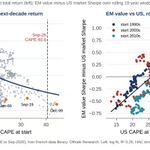
The S&P 500, and most stocks that make up 40-60% of the index, now trade at a CAPE ratio of close to 41.0x
We will get into why that matters in a bit, for now I just need you to understand:
Any time the S&P trades above a 25.0-30.0x CAPE, the next decade of returns average a yearly loss
So here’s my question to you: What if 2027 kicks off the S&P’s next lost decade?
Just like it did from 1920 to 1930, 1940 to 1950, 1970 to 1980, and 2000 to 2010
You now have two choices, both of which are just as uncomfortable:
- You pivot into what really works in the U.S. markets during lost decades (long/short trading and small/micro cap investing)
Or
- You expand your horizons into emerging markets
Here’s the reality though,
Not all emerging markets enjoy the same benefit while the S&P 500 grinds sideways
There’s a very specific formula that makes capital flow into these markets when the U.S. is falling behind
- Japan did it in the 1980s, ran up 500% the next decade
- South Korea did it in the 2000s, ran up 300% the next decade
- Now China is doing it in 2026
Will it be the same run? Nobody really knows
All I know is that China has the right economic, demographic, and valuation setup versus cash flow mix in the entire world right now
Contrary to what financial media wants you to think…
China is more investable than ever before, and there’s a $46.5 billion per month reason I am starting to like it above everything else
$BABA $FXI $MCHI $SPY $QQQ $ANT $NVDA $VIX $SMH $SOXX $CRWV $ORCL $PDD

2
365
Stanley Druckenmiller, legendary global macro investor and manager at Duquesne Capital, said this earlier in the year
And it lives in my head rent-free:
- We’re short bonds, long copper, and bullish cyclical equities
This week, he said his views are the complete opposite of what he said during that interview
It’s not that often these investing giants change their mind on where they are or want to be positioned
So when they do, and do it openly, you listen
If his language effectively means the literal opposite, then we could consider:
- Long bonds, short copper, and bullish defensive equities
Which is comforting to know one of the best and brightest minds in the business is indirectly confirming the views I’ve pushed to you through my GDP and PMI analysis this quarter
About the S&P…
It’s daily volatility relative to the VIX daily volatility is stretched to a cyclical limit, which means we are closer to the bottom than we are to the top (at least in the short term.)
Think about this and what Druckenmiller has said, then remember where capital is choosing to go during this selloff
If we do see the 10% off the highs in the S&P acting as a trigger for this recovery in bonds, defensives, and emerging markets…
You want to tune in later today, as I will release my full thesis on China, to be followed up by a proper watchlist over the weekend
$VIX $TLT $SPY $QQQ $NVDA $ANT $AMD $CRWV $ORCL $SMH $MU

5
759
Here’s a frustrating way to lose money:
Be right about the rebound
Own the wrong stocks
A market recovery doesn’t mean the previous leaders recover with it
That’s why I’m watching where capital holds its ground while the selling continues
Our portfolio is roughly 2% below its highs versus about 10% for the market
I’m focused on what deserves the next dollar
In today’s Offside Morning Digest:
• Why I think a short-term bottom could be approaching
• What would make me reconsider that view
• Why I bought HOOD during this week’s selloff
• The defensive and China opportunities I’m researching
My full China thesis follows later today
Premium members get the watchlist this weekend
The next opportunity may look very different from the last one
Read today’s digest:
offsideresearch.com/subscrib…
2
405
We are effectively entering the second part of the Phase III selloff in the AI trade and broader equity markets
I cannot say I’m sitting comfortable while all holdings, cyclicals and defensives, get hit in this huge market shift…
But,
Looking at it pragmatically, this is just the way the market is cleansing itself from the excess leverage and retail positioning across the AI trade
As more forced liquidations and broker asset dumping continues, most of the AI companies the world used to love this year are now in deep bear markets
Is there going to be some relief coming? Possibly.
Though it will likely come in the form of either a government intervention, as Trump has the Iran and Ukraine peace cards to pull
Or the big wild card most people are right now praying for:
- NVIDIA’s board accepting Jensen Huang’s return as CEO
The bull case exists, and it would stabilize the uncertainty around these GPU-backed loans suddenly blowing up
As the Anthropic IPO dragged markets into even lower levels, I believe now is the time to consider such an outcome to ease the pain
Markets want Jensen, otherwise there will be some pain ahead and a prolonged bear market
Now is the time to do so too, the S&P is reaching a correction (10% off the highs) and this is usually where such pivots tend to happen
And,
There’s one very important behavioral shift taking place as well, as there were two specific (and unexpected) areas of the financial markets that still managed to hold up their ground
That's $XLP defensives and emerging markets
$NVDA $SPY $QQQ $VIX $ANT $AMD $CRWV $ORCL $MU $DRAM $SMH $SOXX

1
7
8,855
Let it be known just a week ago I had called for a 10-15% drawdown on the $SPY $QQQ
We are on a divided house + Fed hiking cycle theme which aligns back to 2018
Now we have a few catalysts on the table
- $NVDA bringing Huang back
- Trump ending wars in Iran and/or Ukraine
- Government intervention from Bessent
$VIX at ~$30 is definitely a place to look for great buys
See you next week
Today’s market looks uncomfortably similar to two times in history:
2018 and 2006
One in an economic sense, and the other in a political sense
Figuring out what is likely to happen during the next 3-6 months is anyone’s guess, but I find comfort in keeping these analogs handy
Politics right now, Trump losing both chambers, represents a similar scenario to Bush losing both chambers in his second term in 2006
From a market perspective, however, the current economic and S&P structure rhymes more with the 2018 setup where:
Trump lost the House, and the Fed was on a hiking path
I cannot say it is exactly the same unless the Fed does hike for a second time in December, and also check where the PMI readings are by that point in time
But,
Given my previous study of the PMIs and inflation specifically, I have a hard time believing that 2027 won’t be a whole lot like 2018
Especially with the added concentration, AI financing, and geopolitical risks now present unlike 2018
$SPY $QQQ $VIX $DXY $GLD $USO $NVDA $AMD $MU $SOXX $SMH $DRAM

1
5
655
The $SPY is getting real close to a correction
Last one was the Iran war
Dip buying opportunity or we lose another 10% and begin the bear market?
3
8
2,387
What if you could buy the AI upside without paying for it?
That’s the setup I’m hunting:
A business priced attractively on its core operations
An AI opportunity that could add upside
The investment needs to work before the hype returns
One industrial name with that setup is already in our portfolio. We added exposure during this week’s selloff
Meanwhile, I’m building a China watchlist around automation, batteries, and advanced manufacturing
Different markets. Same question:
What am I paying for, and what could I be getting for free?
Today’s Offside Morning Digest covers:
• The industrial investment behind that thesis
• Why I’m looking beyond China’s consumer recovery
• My valuation concerns around Anthropic’s IPO
• What the market must reclaim before I trust the rebound
The China watchlist goes to Premium members this weekend
Read today’s digest:
offsideresearch.com/subscrib…
1
1
398
Reported earnings versus actual cash coming into the business were two very different things
That matters for you:
offsideresearch.com/p/before…

1
119
Let’s give credit where credit is due for $NVDA
Total revenues grew to $115.8 billion, 6.6% above the market consensus, 103% compared to last year
Earnings were $2.68 for another 8.4% beat above consensus, and 110% compared to last year
All this growth came mostly from two business segments
Hyperscale revenue reached $60.1 billion representing a net 23% jump compared to last quarter and 71% against last year
This is where their A-grade customers live, companies like $GOOGL, $MSFT, $AMZN and $META
All of this can act as confirmation that the wave of hyperscale capex isn’t slowing down just yet so keep that in mind
AI clouds, industrial & enterprise drove the rest of the quarter’s growth, reaching $47.5 billion in total for a quarterly jump of 18% and 195% on the year
How much did it cost to achieve this?
Less than the revenue growth, that’s for sure, NVIDIA reported a gross margin of 74.8% on the quarter compared to 73.4% for the same quarter last year
Operating margins also increased to 66.9% compared to 63.2% last year
There's just one problem with how the company achieved such a massive revenue jump
I'll explain it here ⬇️

1
2
519