

MIT Professor of Economics | Macro, International, Public, Monetary, Taxes, Finance | Boston + Argentina | no AI posting
Cambridge, MA
Joined April 2009
- Tweets24.7K
- Following2.7K
- Followers237K
- Likes37.2K




Ivan Werning retweeted

I love this and it has real "Messi at Inter Miami" vibes.

“Meet Wharton’s Newest Faculty”
youtube.com/shorts/Bq0hq1Fuq…

Ivan Werning retweeted

Congratulations to @ChristianKWolf, winner of the @sffed's Janet Yellen Award for Monetary Research, presented at our 3rd annual Conference on Macro-Finance Research. 🏆
His contributions to econometrics and macroeconomics are deeply impacting both monetary research and policy.

I signed up for the non AI part, Jason commentary.


Today: California billionaire wealth tax prop 40.
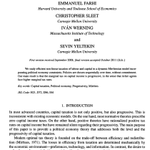
Throwback: One of the papers I most enjoyed writing some 15 years ago (with Farhi and later Sleet, Yeltekin) was on Wealth taxation, nonlinear in a political economy with no commitment.
Let me explain what we did. I am not trying to take political sides really or advocate one thing or another. Enough of that and it is good to think of the economic logic in a basic way. As you see, the paper is more subtle.
The paper modeled a situation where you (e.g., voters, on average) want to do a "one time" wealth tax and promise never to do it again. The incentive to do so is increasing in the amount of wealth inequality. You have nonlinear taxes on wealth and income, so you have rich tools. However, you can't bind future politics or policies. Every now and then you reevaluate (vote).
Sounds familiar? Indeed, various basics of the real world tradeoffs are present.
Obvious: this is a time-consistency problem that leads to a 3rd best (third world?) outcome (not your standard optimal tax one, where you assume you can commit). Well known and studied. At its most basic, the temptation is confiscation (slogans: robin hood, socialism), but the expectation of this happening in future is of course a problem (slogans: capitalism, property rights).
Less obvious: what it is the best you can do today if you with your tax tools, given the situation and constraints. AGAIN: you are not allowed to say "I promise never to tax again". ALSO NOTE: the options are also not necessarily just a choice between taxing wealth now or never doing so. (As the debate on this oversimplify.) Logically: taxing never may just not be feasible/credible. Equally important: you may come up with a different more intermediate plan. Let's see...
Indeed, the model spits out something subtle. You actually declare a more moderate but progressive nonlinear tax on wealth that will be in place permanently. It is progressive with rising marginal tax rates: indeed, you subsidize savings for the poor (!) but tax the rich. In fact, you want to promise this tax today for the future, even if inequality is zero today. Why?
The credibility problem depends on the amount of wealth inequality. That is what affects the incentive to renege on promises and tax away wealth. The solution tries to deal with this by creating an environment that will lower or keep inequality in check, to avoid a temptation to fall into the time inconsistency revision. A progressive tax goes in that direction both mechanically and in terms of saving incentives.
(BTW, the fact that the tax comes out progressive is very clean and surprising, given that the optimal tax literature rarely obtains such results.)
Insight: By keeping inequality in check, it makes policy more credible, avoiding falling into a much worse 3rd best.
At the time, we called it a "compassionate conservative" solution: even if you want zero taxes, you compromise and do some progressive taxation, to avoid more radical taxes later. Metaphorically, the best way to deal with a tide is not by ignoring it, denying it or swimming frantically, you may have to float with it, adapt and swim moderately finding the right moves.
Links: (older ungated): crei.cat/wp-content/uploads/…
published: academic.oup.com/restud/arti…
Footnote: We titled it capital taxation, but in reality it is more exactly about wealth taxation, e.g. it holds even in a world without capital, where people hold assets against each other etc.

Very interesting paper on causal effects of social media on polarization based on a randomized experiment during a presidential debate.
Finding: near zero or opposite effects!
Caveat (?): can short-run one-shot intervention work if social media effect is cumulative and set in?

Very happy to share that our paper with Rafael Di Tella and Ramiro Gálvez (@RamiroHGalvez) has recently landed in JEBO!
In this paper, we study whether varying access to Twitter/X during a presidential debate affects political polarization.


Ivan Werning retweeted

I’m not surprised that someone trying to ban a product & w/ little idea of what is taught at B-schools (never mind about academic freedom) had AI write their op-ed. There is a highly competitive market for students, driven by employer value if the tools students graduate with.


Ivan Werning retweeted

An honor to have @IvanWerning at Northwestern theory presenting his important work with @guido_lorenzoni on tâtonnement, a topic unwisely left for dead
Shows that returning to fundamental and thorny questions can be highly rewarding!


Had a great time back to back at the University of Chicago and Northwestern working on and presenting our Tâtonnement paper in two micro theory seminars. Not my typical venues. Fun and challenging.


Here is a previous thread on the paper... xitter.cf/IvanWerning/status/206…
Newer version of paper dropping soon.

Ivan Werning retweeted
Just as with recessions, I can predict Woodford will get it but I cannot predict when.
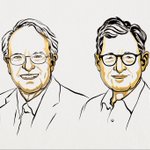
Economics Nobel: Bob Hall and Mike Woodford, congratulations!
I’ve always been a huge fan of both. Not an obvious matchup, but both richly deserved.


1. Some people took this post as saying papers had no influence and were not discussed in DC. That’s not it.
My point was we’d have the tariffs anyway without the papers.
2. Others arguing Trump perhaps would have lost election without these papers
😮 BIGGLY if true!
Jason doesn’t like something I didn’t say so he RT me and says he doesn’t like.. what I didn’t say! 🤣
The level of discourse has gone wild. ¯\_(ツ)_/¯
On "China Shock" research vs policy...
Important to debate research, but any suggestion that current US protectionism has anything to do with Autor-Dorn-Hanson's papers seems outlandish to me. Trump thinking on these issues is well documented and goes as far back into the 80s.
Ivan Werning retweeted

Here is the link to the conference on stability in GE by @IvanWerning
youtube.com/watch?v=fdSWpomw…

Excited to give this virtual talk tomorrow Thursday 11am ET with an update of our paper on the foundations for stability of General Equilibrium [older thread in reply].
The webinar has an interesting format with great panelists!
Link to join in the original RT'd VSET post...

❗️ VSET is back ❗️
We begin on Thursday, 1 Oct 2026, with Iván Werning (MIT) presenting "Tâtonnement and Price Setting in General Equilibrium" (with Guido Lorenzoni). Panellists: Felix Kubler, Karthik Sastry. @IvanWerning @guido_lorenzoni
Details at sites.google.com/view/vset

Here is a previous thread on the paper, to see what it's about… xitter.cf/IvanWerning/status/206…