
@IzioDev
🇫🇷Account based in
About this account
- Account based in
- France
- Connected via
- France Android App
Account-level information from X, not a live location or the device used for a specific post.
I'm not great, I'm not good, not even decent. But I'm trying, out of curiosity. Yet another human on earth, just like you. @Kaspa_KEF grantee since 12/15/2025
Joined October 2022
- Tweets1.6K
- Following450
- Followers1.8K
- Likes4.8K


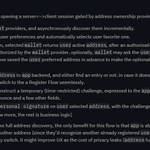



Kas the coin can also be 'tokenized' as a kcc-20.
the need may not be very clear to everyone, but basically: my L1 app may want to uniformly manage kcc-20 and Kas the coin, without extra 'custom code'.
@manyfest_ details one of the direct use-case.
i have been convinced that designing kas-20 correctly only gives benefit with no tradeoff.
is it possible to have such an atomic covenant transaction that:
1. convert Kas to kas-20
2. trade it for the Many kcc-20 token
(=without adding one extra conversion step)

Onwards!
KCC-20 lets us create tokens that work together through a shared interface. Native KAS is a fungible token as well, but it isn’t a KCC-20 token.
Imagine a DEX, for example. KCC-20 lets us write a generic pool covenant that supports any pair of KCC-20 tokens. But if one side of the pair is KAS, we’d need special logic to handle it.
Representing KAS as a KCC-20 token would let covenants handle KAS the same way they handle other KCC-20 tokens. There could be different implementations and deployments of a KAS-backed KCC-20 token, but it would be beneficial to agree on a single one to avoid fragmentation.
I'm proposing a simple implementation, KAS20. Join the discussion on Kas-Smiths:
kas-smiths.org/t/a-kas-backe…

Status final = beginning of a new era

Greetings $KAS. KCC-1, KCC-2 and KCC-20 are now Final, meaning they are ready for full adoption across the ecosystem.
We invite Kaspa builders to join the public KCC channel to ask questions, get support, discuss implementations and share what you build.
Come build with us.
IzioDev retweeted

Published KIP 22 to help Kaspa users better protect their funds from future quantum attackers by keeping public keys hidden until spending
github.com/kaspanet/kips/blo…

IzioDev retweeted

yes it's the era of a custom software
but you likely overestimate amount of people who have ever thought about making or fixing some software. Last 10 years people asking me how to become SWE (frankly very rarely they ask this nowadays 😭) - I always responded very simple:
"Just start making something. Take some problem that you want to implement, some software that you hate, or automation that is missing - and do it in any way"
you know what I have heard 98% of times? Something like "I don't know I don't need anything".
It takes time, experience, and taste to know that you can build something and you have to be brave enough to believe you can actually handle it
did you know that miners sometimes see their submitted block become a "chain block" on Kaspa?
when this happens, the block merges other blocks, called "merged blocks", and together they form a "merge set".
if it happens to merge red blocks, guess who wins the red pots? (reward that should have been allocated to the red merged block if it was blue instead of red)
IzioDev retweeted

not easily, no. a solana program has more capabilities and can be longer and more expressive. sophisticated designs can create a multi-contract argent app that executes complex behavior across partitioned state and over multiple transactions (that’s why i called these “mini programs”), like i did with chess, but then composition with other covenants/apps needs to be carefully designed, as does contention over shared variables/state.
in short, i cannot promise you yet that things will run smoothly and compose cleanly. we are not a solana vm by design, and hence i expect the created apps/systems to be shaped differently to match the inherent constraints. so i can’t promise how exactly this will evolve, but my strong hypothesis is that it enables significantly complicated systems.
(the answer above is all within pure covenants and does not talk about based zk apps, which are as fully expressive as a solana program but currently have limited L1 composability that depends on zk proof submission)
IzioDev retweeted

KCC-20 has advanced to Last Call:
github.com/kaspanet/kccs/blo…
A companion reference implementation by @manyfest_, written in Argent together with its pinned generated Silverscript, underwent an extensive manual review and AI-assisted audit by Michael Sutton, covering KCC-20 conformance, implementation correctness, and edge cases.
It is now open for final public battle testing. We encourage developers and security-minded reviewers to try to break it, probe edge cases, and report any implementation bugs or discrepancies with the spec.
Argent contracts:
github.com/argent-lang/kcc20…
Generated Silverscript:
github.com/argent-lang/kcc20…

IzioDev retweeted
The KCC Coordination Forum has reached an important milestone in the standardization process. The foundational KCC-1 and KCC-2 standards have now entered Last Call.
This opens a final 14-day review period. If no major issues are identified, both standards will be finalized and considered ready for ecosystem adoption.
We encourage anyone working with these standards to review them carefully and raise any remaining concerns during this period.
Max inviting devs to try a testnet vProg app in their browsers and then be curious on how it works, maybe even write their own prog?
i assume it will also help to identify bottlenecks, so let's congest there.

Tic-tac-toe is live on Kaspa testnet: the first vprog, a verifiable program with real execution and real settlement, running since yesterday.
You can play it here: vprogs-tt.izio.fr/
(Requires private key and some testnet funds)
We still need to review and merge a stack of PRs, however this is already a working POC. UI/UX was never a priority; the frontend can be enhanced or built separately
I'm gonna work on mdBook covering the parts of the system I consider meaningful and a workshop on vprogs and building apps on top
For Devs: this is the invitation. Play the game, read the code, build your own vprog.
Game code: github.com/biryukovmaxim/vpr…
vprogs framework: github.com/kaspanet/vprogs/t…
IzioDev retweeted
d'autres chercheurs veulent aussi apporter d'avantage de réactivité aux transactions, sans modifier le protocol.
xitter.cf/michaelsuttonil/status…

IzioDev retweeted
i used to think real-time execution was the one thing that couldn’t be faked on bitcoin L1.
i stand corrected.

covenant: deployment-time static metadata such as symbol name, image/logo, decimals and all.
While prototyping KCC-20 I got asked how should token symbols, descriptions, images, and other kind of metadata be defined.
On EVM systems, there is a single SC which represents a token, and holds both its balance state and global state.
On the UTXO model there is no global state, the token is split and held across holders, each one holds his specific token (UTXO/covenant).
This means that adding state fields for metadata would duplicate them across each UTXO, which is wasteful. Things such as representation, name, symbol or image are also not part of the SC logic, and should not be part of it.
A naive approach is to declare such metadata in the payload field of a tx, which is an "empty space" that can be used to write whatever information.
The issue is that Kaspa is prunable. Eventually, the block containing this tx would no longer be available for verification, so at some point the data would need to be trusted by off chain entity.
After drafting a few solutions, we came up with KCC-23, a convention for binding the metadata to the covenant ID itself.
Read more on Kas-Smiths:
kas-smiths.org/t/kcc-23-conv…
Or read the KCC draft:
github.com/kaspanet/kccs/pul…
here is how i evaluate the kcc-12 proposal in a second pass.
i sketch a user journey, observe flaws on existing web3 platform, see if my user journey fixes it, iterate.
once i have a viable sketch, i take kcc-12, see if it **enforce** this flow. if not, it needs changes.
kcc-12 should also be taken from a UX perspective, and we have a lot to learn from, lot of challenges to crack produce-wise.


this KIP-12 is superseded by KCC-12.
goal: dApp doesn't need to integrate browser wallet 1 by 1.
If you own a dApp (/want to), or you own a browser wallet, please read the proposal and add your thoughts (not LLM thoughts, we can do that on our own)


IzioDev retweeted

A bank in Tel Aviv was told twenty months ago to take a quantum plan to its board. A utility in Ohio has never been asked.
Same threat. (Almost) same NIST algorithms. Four very different PQC migration approaches globally. I tried to compare these PQC migration approaches, fresh from GISEC in Dubai and ahead of my related closing keynote at the PQC Summit in College Park on Tuesday.
Some of what I found:
Hong Kong's regulator scored its banks 2.3 out of 10 in July and set a target of 10 by 2030. FINMA surveyed 60 Swiss institutions, found 72% had taken no quantum-safe measures, and demanded board-backed roadmaps by mid-2027. The three NERC CIP standards shaping a US utility's 2026 compliance year say nothing about post-quantum cryptography. Not one.
Canada put PQC clauses into every new federal contract in April. The US equivalent is still a rulemaking.
Germany has recommended FrodoKEM and Classic McEliece alongside the NIST picks since 2020, and Europe got them into ISO in June. Chrome will accept only Merkle Tree Certificates in its quantum-resistant root store, while Europe's eIDAS trust lists are built on X.509. The post-quantum PKI can fork along a line that already exists in law.
And nobody, anywhere, has enforced a PQC requirement yet.
The full comparison, with a one-page table by jurisdiction and five things I think each migration could borrow from the others:
postquantum.com/post-quantum…
#PQC #PostQuantum #QuantumComputing #CyberSecurity #CISO #InfoSec #Regulation #CryptoAgility
