

✝ 🇰🇷 Seoul. Watching from the ground. Markets, money flows & life as I see it. Independent observations. No noise.
Seoul, Republic of Korea
Joined August 2025
- Tweets4.5K
- Following691
- Followers984
- Likes4.2K



Pinned Tweet
BREAKING: KOREA PREPARES MARKET STABILIZATION MEASURES AHEAD OF MONDAY
It's Sunday evening in Seoul.
Korean financial media are now reporting three measures:
• Preparations for immediate activation of the stock market stabilization fund
• Relaxation of daily corporate share buyback limits for three months
• Special monitoring of illegal short selling for three months
The stabilization fund is particularly interesting.
I'd like to see how much capital is actually available, when it could be deployed and whether it can absorb sustained selling pressure.
The government is preparing to intervene.
Tomorrow's trading will give us a better indication of whether these measures are enough to restore investor confidence.
Sources: News1, Korea Economic Daily, November 22, 2026.


87% OF NEW DRAM CAPACITY IN 2027 COULD GO TO HBM — SK SECURITIES
SK Securities' 2027 semiconductor outlook offers an interesting counterpoint to the recent selloff in Korean memory stocks.
The report estimates that #SamsungElectronics , $SKHY hynix, and $MU will collectively add 230,000 DRAM wafer starts per month in 2027.
But the allocation matters:
• HBM: 200,000 wafers/month (87%)
• Conventional DRAM: 30,000 wafers/month (13%)
In other words, nearly all the incremental capacity is expected to be absorbed by HBM.
That could leave conventional DRAM supply tight even as PC and smartphone demand weakens.
SK Securities also forecasts a 122% increase in the industry's blended HBM average selling price in 2027.
My takeaway: The market is questioning whether AI demand can sustain today's memory profits. SK Securities is arguing that supply constraints may matter just as much as demand.
The key question for 2027 may not be how high memory profits can go, but how long they can stay elevated.
Source: SK Securities Research Center, 2027 Annual Outlook, Nov. 23, 2026, pp. 9–12.


42
KOREA SEMICONDUCTORS: SHORT-SELLING TURNOVER FALLS 42% AFTER FRIDAY'S SELLOFF
Short-selling activity surged in Samsung Electronics and SK hynix during the November 20 market selloff.
November 20:
- SK hynix: ₩160.0B (2.94% of trading value)
- Samsung Electronics: ₩135.6B (2.57%)
November 23:
- SK hynix: ₩100.7B (1.50%)
- Samsung Electronics: ₩70.2B (1.22%)
Combined short-selling turnover fell from ₩295.6B to ₩170.9B, a 42.2% decline.
Both stocks finished lower on Monday, but short-selling activity declined sharply in both absolute and relative terms.
My read: Friday's aggressive short-selling activity did not persist at the same intensity on Monday.
That is worth watching, but it isn't evidence of short covering. We would need outstanding short-position data to establish whether bearish positions are being reduced.
Source: Kiwoom Securities, Nov. 23, 2026.


49
SK HYNIX: FOREIGN INVESTORS NET SELL ₩2.87 TRILLION ($1.98 BILLION) OVER EIGHT CONSECUTIVE SESSIONS
Foreign investors have been net sellers of $SKHY SK hynix every trading day from November 12 to November 23.
Cumulative net selling: ₩2.87 trillion (approximately $1.98 billion, assuming ₩1,450/USD).
Over the same period, SK hynix continued to lose ground, hitting an intraday low of ₩1,037,000 on November 23.
That's roughly 44% below its October 2 peak of ₩1,855,000.
What concerns me is the persistence of foreign selling, even after such a substantial correction.
TrendForce's latest supply-chain data still shows severe DRAM shortages, with lead times at 18 weeks versus a balanced level of 8 weeks.
Yet foreign investors continue to reduce their exposure to SK hynix.
Strong industry fundamentals and weak equity demand can coexist. Right now, the selling pressure is difficult to ignore.
Sources: Kiwoom Securities; TrendForce, November 23, 2026.


71
AI SUPPLY CHAINS REMAIN TIGHT — EVEN AS SEMICONDUCTOR STOCKS SELL OFF
TrendForce's November 23 supply-chain update shows shortages across seven major hardware components.
DRAM lead times have reached 18 weeks, compared with a balanced level of 8 weeks.
Enterprise SSDs: 16 weeks vs. 8 weeks.
But the more striking numbers are elsewhere:
• HDD: 50 weeks vs. 16 weeks
• ABF substrates: 48–56 weeks vs. 12 weeks
• MLCC: 40 weeks vs. 12 weeks
These are not minor supply constraints.
Meanwhile, Korean semiconductor stocks are under heavy selling pressure.
The contrast is worth examining. Supply-chain tightness tells us something about current hardware availability. Equity prices reflect expectations about what comes next.
Both signals matter, but they are not telling us the same thing.
Source: TrendForce, November 23, 2026.

69
76% OF KOREAN RETAIL INVESTORS' NET BUYING OCCURRED ABOVE KOSPI 7,000
According to iM Securities, Korean retail investors have made ₩100 trillion in net purchases this year. Of that, ₩76 trillion occurred when the KOSPI was above 7,000.
The breakdown:
- ₩39T at KOSPI 7,000–8,000
- ₩34T at 8,000–9,000
- ₩3T above 9,000
The KOSPI is now around 4,700.
This article explains a lot about Korea's stock market right now.
Many people I know bought Samsung Electronics above ₩300,000. That's a personal observation, not representative data, but it makes these numbers feel less abstract.
Today, retail investors sold a net ₩366.9 billion, exceeding foreign investors' net selling of ₩247.2 billion.
Retail investors have repeatedly stepped in to absorb foreign selling. But today's trading raises a different possibility: what if those buyers are now becoming sellers?
My concern is that retail selling pressure could become another obstacle to a sustained recovery.
Source: iM Securities, via Seoul Shinmun (Nov. 23, 2026).
m.seoul.co.kr/news/economy/s…

2
408
TWO MORE WALL STREET BANKS CUT SAMSUNG ELECTRONICS AND SK HYNIX PRICE TARGETS TODAY
Goldman Sachs and Citi both lowered their targets on November 23, following Morgan Stanley's cuts earlier this month.
Goldman Sachs (Nov. 23)
- Samsung Electronics: ₩500K → ₩350K (−30.0%)
- SK hynix: ₩3.50M → ₩2.00M (−42.9%)
Citi (Nov. 23)
- Samsung Electronics: ₩430K → ₩350K (−18.6%)
- SK hynix: ₩3.00M → ₩2.43M (−19.0%)
Morgan Stanley (Nov. 9)
- Samsung Electronics: ₩381K → ₩309K (−18.9%)
- SK hynix: ₩2.60M → ₩1.60M (−38.5%)
Three major Wall Street banks have now cut their price targets for both Korean memory chipmakers within two weeks.
The concern is shifting toward 2028: memory supply growth, pricing pressure, and whether today's elevated profitability can last.
These are substantial revisions, particularly Goldman Sachs' 42.9% cut for SK hynix.
The banks are not necessarily questioning near-term AI demand. They are reassessing how long the memory upcycle can sustain current earnings expectations.
Source: Brokerage target revisions reported by Korean financial media, Nov. 9–23, 2026.

SAMSUNG PLANS TO INCREASE V9 NAND CAPACITY AT ITS XI'AN FAB BY 5–6 TIMES
According to an exclusive report by Seoul Economic Daily, Samsung Electronics plans to expand monthly V9 NAND wafer capacity at its Xi'an X2 facility from approximately 10,000 to 50,000–60,000 wafers.
The expansion is aimed at enterprise SSDs used in AI data centers.
The plan includes a new production line and conversion of existing V6 capacity to V9.
Equipment installation is expected to begin in February 2027, with completion targeted for November.
The report also cites an industry source saying Samsung's V9 NAND yields have improved to the low-90% range.
One interesting detail: Samsung is planning additional V9 capacity in Pyeongtaek as well.
While Korean semiconductor shares face heavy selling pressure, Samsung appears to be moving ahead with investment in higher-density NAND.
The question is whether enterprise SSD demand and pricing will justify that additional capacity when it comes online.
Source: Seoul Economic Daily, November 23, 2026.
m.sedaily.com/article/201178…

Interesting that Chinese financial media are questioning South Korea's stabilization measures as well.
Wallstreetcn points to a fund that hasn't been deployed since 2008, limited additional buying capacity from the National Pension Service, and selling pressure tied to the global AI trade.
The question isn't whether Korea has a stabilization fund.
It's whether the government has the capacity and willingness to use it effectively in today's much larger market.
Source:
wallstreetcn.com/articles/37…
3
428
SOUTH KOREA'S MARKET STABILIZATION PLAN: THREE MEASURES, LITTLE SUBSTANCE...
Bloomberg reports that Korea's finance minister expects the latest measures to restore investor confidence. I'm struggling to see how.
1. ₩10.76 trillion stabilization fund
The fund assembled in 2020 was never deployed. Neither was it activated in 2022.
Now, amid another market crisis, the government is still preparing.
No deployment date. No committed amount.
2. Three months of intensified monitoring of illegal short selling
Enforcing existing rules is necessary. But how does additional monitoring address the current selling pressure?
Is there evidence that illegal short selling is driving the decline in Samsung Electronics or SK hynix?
3. Higher daily share buyback limits
SK hynix has recently been buying back shares well below its existing daily limit.
Raising a ceiling that isn't being reached accomplishes very little.
Meanwhile, November 23:
Taiwan: +2.35%
South Korea: −3.31%
A 5.66 percentage-point gap.
I'm not expecting the government to stop every market decline.
But I do expect it to explain how these measures will actually work.
A stabilization fund on standby is not market intervention. And announcing measures is not the same as restoring confidence.

South Korea’s finance minister said the government’s latest market-stabilization measures should help restore investor confidence, even as the benchmark Kospi slumped another 5% on Monday following last week’s selloff bloomberg.com/news/articles/…

BREAKING: SK GROUP CHAIRMAN OFFERS ₩944 BILLION TO END NINE-YEAR DIVORCE BATTLE - Reduced ownership uncertainty?
SK Group Chairman Chey Tae-won has asked South Korea's Supreme Court to facilitate a settlement with Roh So-young, offering to pay the full ₩944 billion ($944 billion in won terms) property division award.
The amount has changed substantially through the courts:
• First trial: ₩66.5 billion
• Second trial: ₩1.381 trillion
• July 2026 retrial: ₩944 billion
Chey had previously contested ₩244 billion of the latest ruling. He is now offering to pay the entire amount.
For investors, the question is whether a settlement could finally reduce the legal uncertainty surrounding SK Group's ownership structure.
One issue remains: how the payment would be financed, and whether any SK shares would need to be sold or pledged.
Roh has not yet accepted the proposal. The case is not over.
Source: Korea Economic Daily, November 23, 2026
hankyung.com/article/2026112…

4
576
KOSPI AT 4,206? NH INVESTMENT & SECURITIES MAPS OUT DEEPER DOWNSIDE
NH Investment & Securities released a 32-page emergency report today titled “Surviving the AI Leadership Battle Triggered by Nvidia.”
One section deserves particular attention: historical crisis scenarios for the KOSPI.
Using past maximum drawdowns, NH calculates the following index levels:
• IT bubble: 4,311
• Global financial crisis: 4,183
• Historical crisis average: 4,206
• Enron-related scenario: 3,955
• IMF crisis: 3,217
These are stress scenarios, not official index targets.
The report also examines Taiwan's stock market stabilization measures and suggests that Korean authorities may need to consider further intervention.
My concern is the gap between preparing to intervene and actually deploying capital.
Korea has announced preparations for a ₩10 trillion market stabilization fund. NOTE HAVEN'T BEEN DEPLOYED SINCE 2008...
I don't know where the bottom is. What interests me is that a major Korean brokerage is now explicitly modeling crisis-level downside while discussing the potential need for government intervention.
Source: NH Investment & Securities Research Center, November 23, 2026.


1
3
386
SAMSUNG ELECTRONICS AT 2.8× EARNINGS. SK HYNIX AT 2.4×.
SK Securities' November 23 update puts both Korean memory producers below 3× their estimated next-12-month earnings.
The comparison:
Samsung Electronics: 2.8×
SK hynix: 2.4×
$MU (Micron): 3.4×
CXMT: 9.5×
On November 3, Samsung traded at 3.6× and SK hynix at 3.2×, according to SK research team's estimates.
The compression has been substantial.
But a low forward P/E in a cyclical industry raises an important question.
SK Securities argues that supply constraints, AI memory demand, and longer-term supply agreements could make earnings more resilient than in previous cycles.
That is the argument investors will need to test against actual earnings.
I find the valuations remarkable. But the durability of those earnings matters more than the multiples themselves.
Source: SK Securities November 23, 2026.
Note: Korean company multiples use SK Securities estimates; Micron and CXMT use Bloomberg consensus.


SK HYNIX EXECUTIVE BUYS ₩1.62 BILLION IN SHARES AMID MARKET SELLOFF
The timing is interesting...
November 23, 2026
Yoon Poong-young, President and Head of SK hynix's Corporate Center, purchased 1,500 shares at an average price of ₩1,077,263.
Total investment: approximately ₩1.62 billion.
SK hynix fell 2.52% in regular trading today, with foreign investors selling a net ₩151.9 billion.
Meanwhile, a senior executive responsible for the company's corporate strategy has committed personal capital to its shares.
Source: Yonhap News, November 23, 2026.
yna.co.kr/view/AKR2026112312…

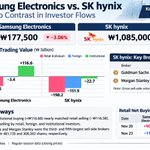
SAMSUNG ELECTRONICS VS. SK HYNIX: A SHARP CONTRAST IN INVESTOR FLOWS
November 23, 2026
Samsung Electronics fell 3.06% to ₩177,500, while SK hynix declined 2.52% to ₩1,085,000 in regular trading.
But their investor flows tell different stories.
#SamsungElectronics
- Retail: −₩116.5B
- Foreign: −₩3.4B
- Institutional: +₩116.6B
$SKHY #skhynix
- Retail: −₩198.2B
- Foreign: −₩151.9B
- Institutional: −₩22.7B
Institutional buying in Samsung Electronics nearly matched retail selling. Foreign net selling was relatively small.
SK hynix saw net selling across all three investor groups.
The broker rankings add another detail. Goldman Sachs and Morgan Stanley ranked third and fifth in SK hynix sell-side volume, executing 481,135 and 308,202 shares, respectively.
These are gross sell-side volumes, not net selling figures.
What's interesting is that SK hynix still outperformed Samsung Electronics in percentage terms, despite heavier foreign selling.
My read: Samsung attracted institutional buying today, while SK hynix faced broader selling pressure.
That doesn't necessarily tell us which stock is stronger in the future. But the divergence in investor participation is worth monitoring this week.
Source: Kiwoom Securities, November 23, 2026.


1
1
548
KOSPI CLOSES DOWN 3.31% — RETAIL INVESTORS TURN NET SELLERS
November 23, 2026
KOSPI closed at 4,708.54, down 3.31%.
The shift in investor flows is particularly interesting.
KOSPI net trading:
- Retail: −₩504.4B
- Foreign: −₩115.5B
- Institutional: +₩221.4B
Just one trading session ago, retail investors bought ₩900B of Samsung Electronics and ₩318B of SK hynix.
Today, they sold ₩116B and ₩198B, respectively.
There was also a notable difference between the two semiconductor stocks.
Samsung Electronics saw ₩116.6B in institutional net buying, nearly offsetting retail selling. Foreign net selling was only ₩3.4B.
SK hynix saw net selling from retail, foreign, and institutional investors.
My read: the change in retail behavior deserves close attention. Investors who were aggressively buying the dip are now selling into further weakness.
Source: Kiwoom Securities, November 23.


SK HYNIX IS USING JUST 23.5% OF ITS EXISTING DAILY BUYBACK LIMIT
South Korea is easing daily corporate buyback limits for three months starting Nov. 24 to stabilize the stock market.
So I checked $SKHY SK hynix's original buyback disclosure and Monday's purchase application.
• Existing buyback program: KRW 20 trillion
• Existing daily order limit: 1,492,000 shares
• Monday's purchase application: 350,000 shares
• Existing limit utilization: 23.5%
SK hynix could already more than quadruple its daily buyback orders under the existing rules.
That makes me wonder how effective the regulatory easing will be if the existing limit wasn't the constraint in the first place.
Removing a ceiling doesn't necessarily create additional buying.
I'll be watching SK hynix's daily buyback applications from Tuesday onward.
Sources: KRX KIND, SK hynix's Oct. 28 buyback disclosure.


Again disappointing...

KOREA'S MARKET STABILIZATION FUND HASN'T BEEN DEPLOYED SINCE 2008
The Korean government is preparing another ₩10 trillion market stabilization fund as stocks face renewed selling pressure.
But a historical table from NH Investment & Securities reveals something interesting.
The last actual deployment was during the 2008 global financial crisis.
Since then:
• March 2020 — ₩10.8T prepared, not deployed
• October 2022 — ₩10T prepared, not deployed
• December 2024 — ₩10T prepared, not deployed
• November 2026 — ₩10T prepared, not deployed as of the report
The earlier interventions also tell an interesting story.
Six months after deployment:
• 1990: −13.2%
• 2003: +32.0%
• 2008: +51.3%
One question!!!
If investors have repeatedly seen ₩10 trillion announced but never deployed, how much confidence can another announcement restore???
Source: NH Investment & Securities Research, November 23, 2026. (IFS, Bloomberg),


104
KOREA'S MARKET STABILIZATION FUND HASN'T BEEN DEPLOYED SINCE 2008
The Korean government is preparing another ₩10 trillion market stabilization fund as stocks face renewed selling pressure.
But a historical table from NH Investment & Securities reveals something interesting.
The last actual deployment was during the 2008 global financial crisis.
Since then:
• March 2020 — ₩10.8T prepared, not deployed
• October 2022 — ₩10T prepared, not deployed
• December 2024 — ₩10T prepared, not deployed
• November 2026 — ₩10T prepared, not deployed as of the report
The earlier interventions also tell an interesting story.
Six months after deployment:
• 1990: −13.2%
• 2003: +32.0%
• 2008: +51.3%
One question!!!
If investors have repeatedly seen ₩10 trillion announced but never deployed, how much confidence can another announcement restore???
Source: NH Investment & Securities Research, November 23, 2026. (IFS, Bloomberg),
KOSPI: ARE KOREAN RETAIL INVESTORS STARTING TO REALIZE HEAVY LOSSES?
I suspect some retail investors who spent weeks buying the dip may now be selling at substantial losses.
Here's why.
According to Edaily, retail investors bought a net ₩3.17 trillion of Samsung Electronics and SK hynix between November 1 and 20.
That accounted for roughly 90% of all retail net buying on the KOSPI.
Last week alone, retail investors bought a net ₩2.58 trillion across the KOSPI, even as the index fell 7.95%.
Today, the buying pattern has changed.
As of 3:04 PM KST, retail investors were net sellers of ₩565.3 billion across the KOSPI, with selling accelerating in the afternoon.
Meanwhile, investor deposits have fallen to ₩81.57 trillion, down 41.6% from their June peak.
We can't confirm realized losses from aggregate trading data. But after weeks of aggressive dip-buying, today's reversal raises an uncomfortable possibility: some investors may be cutting their positions at a loss rather than buying more.
Source: Edaily, Nov. 23; Kiwoom Securities.
n.news.naver.com/article/018…


[KOSPI UPDATE 5] — RETAIL SELLING DEEPENS AS SAMSUNG RECOVERS AND SK HYNIX STALLS
November 23 | 2:08 PM KST
KOSPI: 4,698.65 (−3.52%)
Samsung Electronics has recovered sharply from its intraday low of ₩171,500 to around ₩177,300.
SK hynix has also rebounded, but repeated attempts to break above ₩1.08 million have failed. The stock remains range-bound on its 3-minute chart.
Meanwhile, retail investors' cumulative net selling continues to deepen.
KOSPI cumulative net flows:
- Retail: −₩452.2 billion
- Foreign investors: −₩153.2 billion
- Institutions: +₩277.7 billion
What interests me is the divergence.
Samsung is showing a stronger intraday recovery, SK hynix is struggling to break resistance, and retail investors are selling increasingly heavily.
The next test is whether these rebounds can hold into the close.
Source: Kiwoom Securities, 2:08 PM KST.


[KOSPI UPDATE 4] DANGER SIGNAL: ₩203 BILLION IN ADDITIONAL FOREIGN NET SELLING IN JUST 59 MINUTES
12:15 PM in Seoul.
Foreign investors started the morning as net buyers of Korean stocks. That has reversed sharply.
At 11:16 AM, foreign net selling stood at ₩65.7 billion.
By 12:15 PM, it had reached ₩269.1 billion.
That's another ₩203.4 billion in net selling in just 59 minutes.
Meanwhile, the domestic flows are shifting:
• Retail: Net selling narrowed from ₩305.7B to ₩33.7B.
• Institutions: Net buying fell from ₩272.0B to ₩95.3B.
And the market kept falling.
KOSPI: −4.53%
Samsung Electronics: −4.97%
SK hynix: −4.94%
What concerns me is not simply the size of the decline. It's how quickly foreign net selling has increased while institutional buying support has weakened.
Retail investors are moving back toward buying, but so far, that hasn't been enough to stabilize the market.
I'm watching the afternoon session closely.
Source: Kiwoom Securities | November 23, 2026

