

🙏Be Happy🙏Soyez Heureux🙏 LA VIE Claire comme de l'eau de roche, Transparente & Pure A Journey of a Thousand Miles Begin With A First Step
Canada, Québec (Montréal area)
Joined July 2010
- Tweets25K
- Following1.7M
- Followers1.7M
- Likes615





Pinned Tweet
Life is a Gorgeous Rose
Life without thorns is not Life but Heaven on Earth
A Pure Mind
Strips the THORNS off Life

632- 🙏 ENG | Jiddu Krishnamurti
💛PUBLICATION : Version Française après la Version Anglaise💛
|❖ For OPTIMAL UNDERSTANDING Read the whole text with ATTENTION ❖|
Public Talk - Life Ahead/Face à la vie ☀ LIFE
☀ 17 PEACE
We have been examining the various factors that bring about deteriorate in our lives, in our activities, in our thoughts; and we have seen that conflict is one of the major factors of this deterioration. And is not peace also, as it is generally understood, a destructive factor? Can peace be brought about by the mind? If we have peace through the mind, does not that also lead to corruption, deterioration? If we are not very alert and observant, that word 'peace' becomes like a narrow window through which we look at the world and try to understand it. Through a narrow window we can see only part of the sky, and not the whole vastness, the magnificence of it.
THERE IS NO POSSIBILITY OF HAVING PEACE BY MERELY PURSUING PEACE, WHICH IS INEVITABLY A PROCESS OF THE MIND. IT MAY BE A LITTLE DIFFICULT TO UNDERSTAND THIS, BUT I SHALL TRY TO MAKE IT AS SIMPLE AND CLEAR AS I CAN. IF WE CAN UNDERSTAND WHAT IT MEANS TO BE PEACEFUL, THEN PERHAPS WE SHALL UNDERSTAND THE REAL SIGNIFICANCE OF LOVE.
We think that peace is something to be achieved through the mind, through reason; but is it? Can peace ever come about through any quieting through any control or domination of thought? We all want peace; and for most of us, peace means to be left alone, not to be disturbed or interfered with, so we build a wall around our own mind, a wall of ideas.
It is very important for you to understand this, for as you grow older you will be faced with the problems of war and peace. Is peace something to be pursued, caught and tamed by the mind? What most of us call peace is a process of stagnation, a slow decay. We think we shall find peace by clinging to a set of ideas, by inwardly building a wall of security, safety, a wall of habits, beliefs; we think that peace is a matter of pursuing a principle, of cultivating a particular tendency, a particular fancy, a particular wish.
We want to live without disturbance, so we find some corner of the universe, or of our own being, into which we crawl, and we live in the darkness of self-enclosure. That is what most of us seek in our relationship with the husband, with the wife, with parents, with friends. UNCONSCIOUSLY WE WANT PEACE AT ANY PRICE, AND SO WE PURSUE IT.
BUT CAN THE MIND EVER FIND PEACE? IS NOT THE MIND ITSELF A SOURCE OF DISTURBANCE? THE MIND CAN ONLY GATHER, ACCUMULATE, DENY, ASSERT, REMEMBER, PURSUE.
―☀―
TEXT-IMAGE
THE MIND - L’ESPRIT
PEACE - LA PAIX
Peace is absolutely essential, because without peace we cannot live creatively. But is peace something to be realized through the struggles, the denials, the sacrifices of the mind? Do you understand what I am talking about? We may be discontented while we are young, but as we grow older, unless we are very wise and watchful, that discontent will be canalized into some form of peaceful resignation to life.
The mind is everlastingly seeking a secluded habit, belief, desire, something in which it can live and be at peace with the world. But the mind cannot find peace, because it can think only in terms of time, in terms of the past, the present and the future: what it has been, what it is, and what it will be. It is constantly condemning, judging, weighing, comparing, pursuing its own vanities, its own habits, beliefs; and such a mind can never be peaceful.
It can delude itself into a state which it calls peace; but that is not peace. The mind can mesmerize itself by the repetition of words and phrases, by following somebody, or by accumulating knowledge; but it is not peaceful, because such a mind is itself the centre of disturbance, it is by its very nature the essence of time. So the mind with which we think, with which we calculate, with which we contrive and compare, is incapable of finding peace.
Peace is not the outcome of reason; and yet, as you will see if you observe them, the organized religions are caught up in this pursuit of peace through the mind. Real peace is as creative and as pure as war is destructive; and to find that peace, one must understand beauty. That is why it is important, while we are very young, to have beauty about us - the beauty of buildings that have proper proportions, the beauty of cleanliness, of quiet talk among the elders. In understanding what beauty is, we shall know love, for the understanding of beauty is the peace of the heart.
Peace is of the heart, not of the mind. To know peace you have to find out what beauty is. The way you talk, the words you use, the gestures you make - these things matter very much, for through them you will discover the refinement of your own heart.
☀More to come ☀ STAY TUNED ☀
🕊️ 🙏Sadhu ! Sadhu ! Sadhu ! 🙏 🕊️Among others it is used to express shared joy, moral approval, and spiritual agreement. Also means « excellent, well done, or it is good.» - «Amen or Hallelujah»
J.K. Krishnamurti |❖
Mindfulness • Self Mastery • Spirituality • Mental Clarity • Attachment Free ❖|
―🙏―
📖 VERSION FRANÇAISE 📖
🕊️On LinkedIn « New Post »
632- 🙏FR | Jiddu Krishnamurti
|❖ Pour une COMPRÉHENSION OPTIMALE, LIRE avec ATTENTION le texte au complet « du Début à la Fin » ❖|
Causerie - Face à la vie ☀ La vie
☀ 17 LA PAIX…
Nous avons parlé de la détérioration de la condition humaine et nous avons vu que la peur en est une des principales causes. Nous avons examiné plusieurs causes de la détérioration de nos vies, de nos activités, de nos pensées, et nous avons vu qu'une des principales d'entre elles est notre état permanent de conflit.
Mais la paix, telle qu'on l'envisage habituellement, n'est-elle pas aussi un facteur de destruction? Car peut-elle être instaurée par la pensée? Une paix produite par l'esprit ne conduit-elle pas à une corruption, à une détérioration? Si nous n'y prenons garde, le mot « paix » devient semblable à une fenêtre étroite à travers laquelle nous regarderions le monde et essayerions de le comprendre; mais nous ne verrions alors qu'une partie du ciel, non toute son ampleur et sa magnificence.
IL N'Y A AUCUNE POSSIBILITÉ D'OBTENIR LA PAIX SI ON LA POURSUIT, CAR CETTE POURSUITE EST INÉVITABLEMENT UN PROCESSUS DE LA PENSÉE. CE QUE J'AI À DIRE EST PEUT-ÊTRE UN PEU DIFFICILE, MAIS J'ESSAYERAI D'ÊTRE AUSSI SIMPLE ET CLAIR QUE POSSIBLE. SI NOUS POUVIONS COMPRENDRE CE QUE VEUT DIRE ÊTRE RÉELLEMENT PAISIBLE, PEUT-ÊTRE SAURIONS-NOUS CE QU'EST LE VRAI SENS DE L'AMOUR.
On pense que la paix s'obtient par la raison, par un travail de l'esprit. Mais peut-elle jamais être le résultat d'une pensée qui cherche à s'affirmer? Nous voulons tous la paix, et pour beaucoup d'entre nous cela veut dire que nous voulons qu'on nous laisse tranquilles, qu'on ne nous dérange pas, et nous construisons dans ce but un mur autour de notre esprit, un mur d'idées.
Il est très important que vous compreniez cette question, car lorsque vous serez plus âgés, vous aurez à faire face au problème de la guerre et de la paix. La paix peut-elle être poursuivie, saisie et apprivoisée par l'esprit? Ce que la plupart d'entre nous appellent paix est un processus de stagnation, une décomposition lente. Nous pensons trouver la paix en nous accrochant à un système idéologique, en construisant, pour notre sécurité intérieure, des murs d'habitudes et de croyances. Nous pensons que la paix se trouve dans des principes, qu'il s'agit de cultiver certaines tendances, certains désirs.
Nous voulons vivre sans être troublés, nous voudrions trouver un coin dans l'univers, ou en nous-mêmes, à l'intérieur duquel nous insérer pour vivre dans nos propres ténèbres. C'est ce que cherchent la plupart des personnes dans leurs rapports avec leurs familles, avec leurs amis. INCONSCIEMMENT ELLES VEULENT LA PAIX À TOUT PRIX ET ELLES LA POURSUIVENT. MAIS L'ESPRIT PEUT-IL JAMAIS TROUVER LA PAIX? N'EST-IL PAS LUI-MÊME L'ORIGINE DE SON PROPRE DÉSORDRE? IL NE PEUT QU'AMASSER, ACCUMULER, DÉNIER, AFFIRMER, SE SOUVENIR, POURSUIVRE.
💥💥💥
TEXTE-IMAGE
L’ESPRIT – THE MIND
LA PAIX - PEACE
La paix est absolument essentielle, car sans elle on ne peut vivre d'une façon créatrice, mais peut-on l'obtenir par des luttes, par des contraintes, par des sacrifices? Comprenez-vous ce dont je parle? On peut être insatisfait étant jeune, mais plus tard, à moins qu'on ait de la sagesse et qu'on soit sur le qui-vive, ce mécontentement est canalisé sous la forme d'une paisible résignation.
L'esprit est indéfiniment à la recherche d'un enclos fait d'habitudes, de croyances, de désirs, à l'intérieur duquel il veut vivre en paix avec le monde. Mais il ne peut pas trouver la paix, car il ne pense qu'en fonction d'une durée faite de passé, présent et futur, de ce qui a été, est et sera.
Il ne cesse de condamner, juger, soupeser, comparer, de poursuivre ses vanités, ses habitudes, ses croyances; il n'est jamais paisible. Il peut se donner l'illusion d'un état qu'il appelle paix mais qui ne l'est pas. Il peut s'hypnotiser par des répétitions de mots et de phrases, en devenant l'adepte de quelqu'un ou en accumulant des connaissances, mais il est son propre centre de désordre, il est de par sa nature même, l'essence du Temps.
L'esprit avec lequel nous pensons, avec lequel nous calculons, inventons et comparons, est incapable de trouver la paix. La paix n'est pas un produit de la raison; et pourtant si vous observez les religions organisées, vous pouvez voir qu'elles sont toutes embarquées dans sa poursuite, au moyen de la pensée. La paix réelle est aussi créative et pure que la guerre est destructive, et pour la comprendre, il faut comprendre la beauté. Voilà pourquoi il est important, lorsqu'on est jeune, d'avoir de la beauté autour de soi: la beauté d'édifices de bonnes proportions, la beauté de la propreté…
En comprenant ce qu'est la beauté, vous saurez ce qu'est l'amour. Comprendre la beauté est la paix du cœur. La paix est du cœur, non de l'esprit. Pour la connaître, cherchez à savoir ce qu'est la beauté. La façon dont vous Marchez, les mots que vous employez, les gestes que vous faites…, car c'est à travers elles que vous découvrirez le raffinement de vos cœurs.
☀ Suite à venir ☀ SOYEZ ATTENTIF ☀
🕊️ 🙏 Sadhu ! Sadhu ! Sadhu ! 🙏 🕊️ Utilisé entre autres pour exprimer une joie partagée de dévotion, une approbation des valeurs morales et spirituelles. Aussi une expression d’accord et d’éloge, signifiant « excellent, bien, bon » – « Amen » ou « Alléluia »
J.K. Krishnamurti |❖
Pleine Conscience • Maîtrise de Soi • Spiritualité • Clarté Mentale • Non-attachement ❖|


634- 🙏 ENG | Jiddu Krishnamurti💥
💛PUBLICATION : Version Française après la Version Anglaise💛
|❖ For OPTIMAL UNDERSTANDING Read the whole text with ATTENTION ❖|
Public Talk - Life Ahead ☀ LIFE
☀ 17 PEACE
―⁈ Q.: IS IT POSSIBLE TO HAVE PEACE IN OUR LIVES when at every moment we are struggling against our environment?
☀ K.: What is our environment? Our environment is society, the economic, religious, national and class environment of the country in which we grow up; and also the climate. Most of us are struggling to fit in, to adjust ourselves to our environment, because we hope to get a job from that environment, we hope to have the benefits of that particular society. But what is that society made up of? Have you ever thought about it? Have you ever looked closely at the society in which you are living and to which you are trying to adjust yourself?
That society is based on a set of beliefs and traditions which is called religion, and on certain economic values, is it not? You are part of that society, and you are struggling to adjust yourself to it. BUT THAT SOCIETY IS THE OUTCOME OF ACQUISITIVENESS, IT IS THE OUTCOME OF ENVY, FEAR, GREED, POSSESSIVE PURSUITS, WITH OCCASIONAL FLASHES OF LOVE. AND IF YOU WANT TO BE INTELLIGENT, FEARLESS, NON-ACQUISITIVE, CAN YOU ADJUST YOURSELF TO SUCH A SOCIETY? CAN YOU?
SURELY, YOU HAVE TO CREATE A NEW SOCIETY, which means that you as an individual have to be free of acquisitiveness of envy, of greed; you have to be free of nationalism, of patriotism, and of all narrowing down of religious thought. Only then is there a possibility of creating something new, a totally new society. But as long as you thoughtlessly struggle to adjust yourself to the present society, you are merely following the old pattern of envy, of power and prestige, of beliefs which are corruptive.
So it is very important, while you are young, to begin to understand these problems and bring about real freedom within yourself, for then you will create a new world, a new society, a new relationship between man and man. And to help you do this is surely the true function of education.
―⁈ Q.: WHY DO WE SUFFER? WHY CAN WE NOT BE FREE OF DISEASE AND DEATH?
☀ K.: Through sanitation, through proper living conditions and nutritious food, man is beginning to free himself from certain diseases. Through surgery and various forms of treatment, medical science is trying to find a cure for incurable diseases like cancer. A capable doctor does all he can to relieve and eliminate disease.
And is death conquerable? It is a most extraordinary thing that, at your age, you are so interested in death. Why are you so preoccupied with it? Is it because you see so much of death about you - the burning ghats the body being carried to the river?
To you, death is a familiar sight, it is so constantly with you; and there is the fear of death.
If you do not reflect and understand for yourself the implications of death, you will go endlessly from one preacher to another, from one hope to another, from one belief to another, trying to find a solution to this problem of death. Do you understand? Don't keep on asking somebody else, but try to find out for yourself the truth of the matter. To ask innumerable questions without ever trying to find out or discover, is characteristic of a petty mind.
YOU SEE, WE FEAR DEATH ONLY WHEN WE CLING TO LIFE. THE UNDERSTANDING OF THE WHOLE PROCESS OF LIVING IS ALSO THE UNDERSTANDING OF THE SIGNIFICANCE OF DYING. Death is merely the extinction of continuity, and we are afraid of not being able to continue; but what continues can never be creative. THINK IT OUT; DISCOVER FOR YOURSELF WHAT IS TRUE. IT IS TRUTH THAT LIBERATES YOU FROM THE FEAR OF DEATH, AND NOT YOUR RELIGIOUS THEORIES, NOR YOUR BELIEF IN REINCARNATION OR IN LIFE HEREAFTER. ☀
🕊️ 🙏 Sadhu ! Sadhu ! Sadhu ! 🙏 🕊️ Among others it is used to express shared joy, moral approval, and spiritual agreement. Also means « excellent, well done, or it is good.» - «Amen or Hallelujah»
J.K. Krishnamurti
|❖Mindfulness ¤ Self Mastery ¤ Spirituality ¤ Mental Clarity ¤ Attachment Free ❖|
―🙏―
📖 VERSION FRANÇAISE 📖
🕊️On LinkedIn « New Post »
634- 🙏FR | Jiddu Krishnamurti
|❖ Pour une COMPRÉHENSION OPTIMALE, LIRE avec ATTENTION le texte au complet « du Début à la Fin » ❖|
Causerie - Face à la vie ☀ La vie
☀ LA PAIX…☀
―⁈ Q.: EST-IL POSSIBLE D'AVOIR LA PAIX DANS NOS VIES lorsqu'à tout instant nous luttons contre notre milieu?
☀ K.: En quoi consiste ce milieu? C'est la Société, l'organisation économique, religieuse, nationale, les classes sociales du pays où vous êtes élevé, et aussi le climat. La plupart des personnes luttent pour s'adapter à leur milieu, dans l'espoir d'obtenir un emploi et de profiter des avantages que cette Société peut leur procurer. MAIS DE QUOI EST FAITE CETTE SOCIÉTÉ DANS LAQUELLE VOUS VIVEZ et à laquelle vous essayez de vous adapter?
Y avez-vous jamais pensé? ELLE EST ÉTABLIE SUR UN CERTAIN NOMBRE DE CROYANCES ET DE TRADITIONS QU'ON APPELLE RELIGION ET SUR UN CERTAIN SYSTÈME ÉCONOMIQUE. VOUS EN FAITES PARTIE, ET VOUS LUTTEZ POUR VOUS Y MAINTENIR EN BONNE PLACE. MAIS ELLE EST LE PRODUIT DE DÉSIRS D'ACQUISITION, DE POURSUITES POSSESSIVES, COMPORTANT DE L'ENVIE, DE LA PEUR, DE L'AVIDITÉ, AVEC, À L'OCCASION, QUELQUES ÉCLAIRS D'AMOUR. ET SI VOUS VOULEZ ÊTRE INTELLIGENT, SANS PEUR, SANS AVIDITÉ, POUVEZ-VOUS VOUS ADAPTER À UNE TELLE SOCIÉTÉ? LE POUVEZ-VOUS?
SI VOUS VOULEZ CRÉER UNE NOUVELLE SOCIÉTÉ, il faut que vous, en tant qu'individu, soyez exempt du sens d'acquisition, que vous n'éprouviez ni envie ni avidité, ni aucun sentiment nationaliste ou patriotique, et que votre pensée ne soit pas étroitement religieuse.
Mais tant que vous luttez sans intelligence pour vous ajuster à votre milieu, vous ne faites que vous conformer aux anciennes valeurs corrompues de l'ambition, du pouvoir, du prestige, des croyances. Il est très important de commencer jeunes à comprendre ces problèmes et à instaurer en soi une liberté réelle, afin de créer un monde nouveau, une Société nouvelle, de nouvelles relations humaines. La vraie fonction de l'éducation est de vous aider dans cette voie.
―⁈ Q.: POURQUOI SOUFFRONS-NOUS? POURQUOI NE POUVONS-NOUS PAS ÉVITER LES MALADIES ET LA MORT?
☀ K.: Avec de l'hygiène et de bonnes conditions de vie, l'homme commence à se délivrer de certains maux. Par la chirurgie et d'autres traitements, la médecine cherche à vaincre des maladies incurables, comme le cancer. Un bon médecin fait tout ce qu'il peut pour guérir les malades. Mais peut-on conquérir la mort? Il est vraiment extraordinaire que cette question vous intéresse tellement à votre âge. Pourquoi vous préoccupe-t-elle? Est-ce parce que vous la voyez tellement autour de vous? Les bûchers où brûlent les cadavres, les morts qu'on dépose au bord du fleuve? Pour vous, la mort est un spectacle familier et vous en avez peur.
Si vous n'y réfléchissez pas vous-même, si vous ne comprenez pas personnellement ses implications, vous irez indéfiniment d'un prédicateur à un autre, d'un espoir à un autre, d'une croyance à une autre, en quête d'une solution à ce problème. Cessez de poser des questions à ce sujet; tâchez de comprendre où est la vérité. Poser d'innombrables questions sans chercher à découvrir les choses par soi-même est le propre d'un esprit mesquin.
VOYEZ-VOUS, ON NE CRAINT LA MORT QUE LORSQU'ON S'ACCROCHE À LA VIE. COMPRENDRE LE PROCESSUS TOTAL DE LA VIE C'EST AUSSI COMPRENDRE LE SENS DE LA MORT. La mort n'est que l'extinction d'une continuité et nous avons peur de ne pas pouvoir nous prolonger; mais ce qui se perpétue ne peut jamais être créatif. PENSEZ-Y.
DÉCOUVREZ PAR VOUS-MÊME LA VÉRITÉ EN CETTE AFFAIRE. C'EST LA VÉRITÉ QUI DÉLIVRE DE LA PEUR DE LA MORT, NON VOS THÉORIES RELIGIEUSES, VOTRE CROYANCE EN LA RÉINCARNATION OU EN UN AU-DELÀ. ☀
🕊️ 🙏 Sadhu ! Sadhu ! Sadhu ! 🙏 🕊️ Utilisé entre autres pour exprimer une joie partagée de dévotion, une approbation des valeurs morales et spirituelles. Aussi une expression d’accord et d’éloge, signifiant « excellent, bien, bon » – « Amen » ou « Alléluia »
J.K. Krishnamurti
|❖ Pleine Conscience ¤ Maîtrise de Soi ¤ Spiritualité ¤ Clarté Mentale ¤ Non-attachement ❖|
633- 🙏 ENG | Jiddu Krishnamurti
💛PUBLICATION : Version Française après la Version Anglaise💛
|❖ For OPTIMAL UNDERSTANDING Read the whole text with ATTENTION ❖|
Public Talk - Life Ahead ☀ LIFE
☀ PEACE…
Beauty cannot be defined, it cannot be explained in words. It can be understood only when the mind is very quiet. So, while you are young and sensitive, it is essential that you - as well as those who are responsible for you - should create an atmosphere of beauty. The way you dress, the way you walk, the way you sit, the way you eat - all these things, and the things about you, are very important.
As you grow up you will meet the ugly things of life - ugly buildings, ugly people with their malice, envy, ambition, cruelty; and if in your heart there is not founded and established the perception of beauty, you will easily be swept away by the enormous current of the world. Then you will get caught in the endless struggle to find peace through the mind. The mind projects an idea of what peace is and tries to pursue it, thereby getting caught in the net of words in the net of fancies and illusions.
PEACE CAN COME ONLY WHEN THERE IS LOVE. If you have peace merely through security, financial or otherwise, or through certain dogmas, rituals, verbal repetitions, there is no creativeness; there is no urgency to bring about a fundamental revolution in the world. Such peace only leads to contentment and resignation. BUT WHEN IN YOU THERE IS THE UNDERSTANDING OF LOVE AND BEAUTY, THEN YOU WILL FIND THE PEACE THAT IS NOT A MERE PROJECTION OF THE MIND.
IT IS THIS PEACE THAT IS CREATIVE, THAT REMOVES CONFUSION AND BRINGS ORDER WITHIN ONESELF. BUT THIS PEACE DOES NOT COME THROUGH ANY EFFORT TO FIND IT. IT COMES WHEN YOU ARE CONSTANTLY WATCHING, WHEN YOU ARE SENSITIVE TO BOTH THE UGLY AND THE BEAUTIFUL, TO THE GOOD AND THE BAD, TO ALL THE FLUCTUATIONS OF LIFE. Peace is not something petty, created by the mind; it is enormously great, infinitely extensive, and it can be understood only when the heart is full.
―⁈ Q.: WHY DO WE FEEL INFERIOR BEFORE OUR SUPERIORS?
☀ K.: Whom do you consider your superiors? Those who know? Those who have titles, degrees? Those from whom you want something, some kind of reward or position. The moment you regard somebody as superior do you not regard somebody else as inferior?
Why do we have this division of the superior and the inferior? It exists only when we want something, does it not? I feel less intelligent than you are, I do not have as much money or capacity as you have, I am not as happy as you seem to be, or I want something from you; so I feel inferior to you. When I am envious of you, or when I am trying to imitate you, or when I want something from you, I immediately become your inferior, because I have put you on a pedestal, I have given you a superior value.
So, psychologically, inwardly, I create both the superior and the inferior; I create this sense of inequality between those who have and those who have not. Among human beings there is enormous inequality of capacity, is there not? There is the man who designs the jet plane, and the man who guides the plough.
These vast differences in capacity - intellectual, verbal, physical - are inevitable. But you see we give tremendous significance to certain functions. We consider the governor, the Prime minister, the inventor, the scientist, as being enormously more important than the servant; so function assumes status. As long as we give status to particular functions, there is bound to be a sense of inequality, and the gap between those who are capable and those who are not becomes unbridgeable. IF WE CAN KEEP FUNCTION STRIPPED OF STATUS, THEN THERE IS A POSSIBILITY OF BRINGING ABOUT A REAL FEELING OF EQUALITY.
BUT FOR THIS THERE MUST BE LOVE; BECAUSE IT IS LOVE THAT DESTROYS THE SENSE OF THE INFERIOR AND THE SUPERIOR.
The world is divided into those who have - the rich, the powerful, the capable, those who have everything - and those who have not.
And is it possible to bring about a world in which this division between the 'haves' and the 'have-nots' does not exist? Actually, what is happening is this: seeing the breach, this gulf between the rich and the poor, between the man of great capacity and the man of little or no capacity, the politicians and economists are trying to solve the problem through economic and social reform. That may be all right. BUT A REAL TRANSFORMATION CAN NEVER TAKE PLACE AS LONG AS WE DO NOT UNDERSTAND THE WHOLE PROCESS OF ANTAGONISM, ENVY, MALICE; FOR IT IS ONLY WHEN THIS PROCESS IS UNDERSTOOD AND COMES TO AN END THAT THERE CAN BE LOVE IN OUR HEARTS. ☀
🕊️ 🙏Sadhu ! Sadhu ! Sadhu ! 🙏 🕊️Among others it is used to express shared joy, moral approval, and spiritual agreement. Also means « excellent, well done, or it is good.» - «Amen or Hallelujah»
J.K. Krishnamurti
|❖Mindfulness ¤ Self Mastery ¤ Spirituality ¤ Mental Clarity ¤ Attachment Free ❖|
―🙏―
📖 VERSION FRANÇAISE 📖
🕊️On LinkedIn « New Post »
633-R 🙏FR | Jiddu Krishnamurti
|❖ Pour une COMPRÉHENSION OPTIMALE, LIRE avec ATTENTION le texte au complet « du Début à la Fin » ❖|
Causerie - Face à la vie ☀ La vie
☀ 17 LA PAIX… ☀
La beauté ne peut pas être définie, elle ne peut pas être expliquée avec des mots. Elle ne peut être comprise que lorsque l'esprit est très tranquille. Il est essentiel, pendant que vous êtes jeunes et avez de la sensibilité, que vous - et ceux qui sont responsables de votre éducation - créiez une atmosphère de beauté. Votre façon de vous habiller, de Marcher, de vous asseoir, de manger - tout cela et tout ce qui vous entoure est très important.
En grandissant, vous verrez les vilains aspects de la vie - des maisons sordides, des personnes qu'enlaidissent leur méchanceté, leur envie, leur ambition, leur cruauté, et si dans vos cœurs la perception de la beauté n'est pas instantanée et établie, vous serez facilement emportés par l'énorme courant du monde. Alors vous serez pris dans l'incessant combat que mène l'esprit à la recherche de la paix. Il projette l'idée de ce que la paix devrait être et en essayant d'atteindre cette idée, il tombe dans le piège des mots, dans le piège des fantaisies et des illusions.
LA PAIX NE PEUT S'INSTAURER QUE PAR L'AMOUR. Si on l'établit par des dispositifs de sécurité, ou par des moyens financiers, ou par la propagation de dogmes, de rituels, de répétitions verbales, ou autrement, il n'y a rien là de créateur et la nécessité urgente d'une révolution fondamentale dans le monde est perdue de vue. Une telle paix ne peut que produire de la satisfaction chez les uns et de la résignation chez les autres.
MAIS QUAND ON A EN SOI LA COMPRÉHENSION DE L'AMOUR ET DE LA BEAUTÉ, ON TROUVE UNE PAIX QUI N'EST PAS UNE SIMPLE PROJECTION DE L'ESPRIT, QUI N'EST PAS LE RÉSULTAT DE RECHERCHES LABORIEUSES; ELLE EST CRÉATRICE, ELLE ÉLIMINE LA CONFUSION ET MET DE L'ORDRE DANS LES ESPRITS, ELLE SURVIENT LORSQU'ON EST TOUT LE TEMPS DANS UN ÉTAT D'OBSERVATION, LORSQU'ON EST SENSIBLE À LA FOIS À LA LAIDEUR ET À LA BEAUTÉ, AU BIEN ET AU MAL, À TOUTES LES FLUCTUATIONS DE LA VIE. La paix n'est pas une chose mesquine, créée par la pensée; elle est immensément grande, infiniment étendue et ne peut être comprise que dans la plénitude du cœur.
―⁈ Q.: POURQUOI NOUS SENTONS-NOUS INFÉRIEURS DEVANT NOS SUPÉRIEURS?
☀ K.: Qui sont vos supérieurs? Ceux qui savent? Ceux qui ont des titres et des diplômes? Ceux de qui vous espérez quelque chose: une récompense ou une situation? Dès que vous considérez quelqu'un comme étant votre supérieur, ne considérez-vous pas d'autres personnes comme étant inférieures à vous? Pourquoi crée-t-on cette distinction de personnes supérieures et inférieures? Elle n'existe que lorsqu'on désire quelque chose. « Je me sens moins intelligent que vous, j'ai moins d'argent ou de capacités, je ne suis pas aussi heureux que vous semblez l'être, donc je me sens inférieur à vous ».
En d'autres termes, lorsqu'on est envieux, lorsqu'on essaye d'imiter quelqu'un ou que l'on voudrait obtenir quelque chose de cette personne, on devient immédiatement son inférieur, on le met sur un piédestal, on lui accorde une très grande valeur. Ainsi, psychologiquement, intérieurement, on crée le supérieur et l'inférieur, on crée ce sentiment d'inégalité entre ceux qui ont et ceux qui n'ont pas. Parmi les êtres humains, il y a une énorme inégalité de capacités. Il y a celui qui dessine l'avion à réaction et celui qui mène la charrue.
Ces très grandes différences de dons intellectuels ou physiques sont inévitables. Mais nous accordons une importance extraordinaire à certaines fonctions. Nous considérons que le gouverneur, le premier ministre, l'inventeur, le savant, sont infiniment plus importants que le domestique; ainsi la fonction devient un état social. Tant que nous attribuerons tel état social à telle fonction, il y aura nécessairement un sentiment d'inégalité, un fossé qui deviendra infranchissable entre les personnes capables et celles qui ne le seront pas. SI NOUS POUVONS DÉPOUILLER LA FONCTION DE L'ÉTAT SOCIAL QUI L'ACCOMPAGNE, NOUS CRÉERONS UN VRAI SENTIMENT D'ÉGALITÉ.
MAIS POUR CELA IL FAUT DE L'AMOUR; CAR C'EST L'AMOUR QUI DÉTRUIT LE SENS D'INFÉRIORITÉ ET DE SUPÉRIORITÉ. Le monde est divisé en ceux qui ont - les riches, les puissants, les capables, ceux qui ont tout - et ceux qui n'ont pas. Est-il possible de créer un monde dans lequel cette division n'existerait pas? Ce qui se produit en ce moment c'est que les politiciens et les économistes, voyant ce fossé entre les riches et les pauvres, les capables et les incapables, essayent de résoudre ce problème par des moyens économiques et des réformes sociales. Cela va bien jusqu'à un certain point. MAIS UNE RÉELLE TRANSFORMATION NE PEUT AVOIR LIEU TANT QUE NOUS NE COMPRENONS PAS LE PROCESSUS ENTIER DE L'ANTAGONISME, DE L'ENVIE, DE LA MALVEILLANCE. CE N'EST QUE LORSQUE CE PROCESSUS PREND FIN QU'IL PEUT Y AVOIR DE L'AMOUR DANS NOS CŒURS. ☀
🕊️ 🙏 Sadhu ! Sadhu ! Sadhu ! 🙏 🕊️ Utilisé entre autres pour exprimer une joie partagée de dévotion, une approbation des valeurs morales et spirituelles. Aussi une expression d’accord et d’éloge, signifiant « excellent, bien, bon » – « Amen » ou « Alléluia »
J.K. Krishnamurti
|❖ Pleine Conscience ¤ Maîtrise de Soi ¤ Spiritualité ¤ Clarté Mentale ¤ Non-attachement ❖|
|❖ INSIGHT ¤ PROFOUND VISION ¤ ONE TRUTH ❖|
#Buddha’s Teachings
Anguttara Nikaya
Numerical Discourses of the Buddha
The Jhanas
Jhana is a meditative state of profound stillness and concentration in which the mind becomes fully immersed and absorbed in the chosen object of attention. It is the cornerstone in the development of Right Concentration.
☀The definition (with similes)
[1st jhana]
"There is the case where a monk — quite withdrawn from sensuality, withdrawn from unskillful qualities — enters and remains in the first jhana: rapture and pleasure born from withdrawal, accompanied by directed thought and evaluation. He permeates and pervades, suffuses and fills this very body with the rapture and pleasure born from withdrawal. There is nothing of his entire body unpervaded by rapture and pleasure born from withdrawal.
"Just as if a skilled bathman or bathman's apprentice would pour bath powder into a brass basin and knead it together, sprinkling it again and again with water, so that his ball of bath powder — saturated, moisture-laden, permeated within and without — would nevertheless not drip; even so, the monk permeates, suffuses and fills this very body with the rapture and pleasure born of withdrawal. There is nothing of his entire body unpervaded by rapture and pleasure born from withdrawal...
[2nd jhana]
"Furthermore, with the stilling of directed thoughts & evaluations, he enters and remains in the second jhana: rapture and pleasure born of composure, unification of awareness free from directed thought and evaluation — internal assurance. He permeates and pervades, suffuses and fills this very body with the rapture and pleasure born of composure. There is nothing of his entire body unpervaded by rapture and pleasure born of composure.
"Just like a lake with spring-water welling up from within, having no inflow from east, west, north, or south, and with the skies periodically supplying abundant showers, so that the cool fount of water welling up from within the lake would permeate and pervade, suffuse and fill it with cool waters, there being no part of the lake unpervaded by the cool waters; even so, the monk permeates and pervades, suffuses and fills this very body with the rapture and pleasure born of composure. There is nothing of his entire body unpervaded by rapture and pleasure born of composure...
[3rd jhana]
"And furthermore, with the fading of rapture, he remains equanimous, mindful, & alert, and senses pleasure with the body. He enters & remains in the third jhana, of which the Noble Ones declare, 'Equanimous & mindful, he has a pleasant abiding.' He permeates and pervades, suffuses and fills this very body with the pleasure divested of rapture, so that there is nothing of his entire body unpervaded with pleasure divested of rapture.
"Just as in a blue-, white-, or red-lotus pond, there may be some of the blue, white, or red lotuses which, born and growing in the water, stay immersed in the water and flourish without standing up out of the water, so that they are permeated and pervaded, suffused and filled with cool water from their roots to their tips, and nothing of those blue, white, or red lotuses would be unpervaded with cool water; even so, the monk permeates and pervades, suffuses and fills this very body with the pleasure divested of rapture. There is nothing of his entire body unpervaded with pleasure divested of rapture...
[4th jhana]
"And furthermore, with the abandoning of pleasure and stress — as with the earlier disappearance of elation and distress — he enters and remains in the fourth jhana: purity of equanimity and mindfulness, neither-pleasure-nor-pain. He sits, permeating the body with a pure, bright awareness, so that there is nothing of his entire body unpervaded by pure, bright awareness.
"Just as if a man were sitting wrapped from head to foot with a white cloth so that there would be no part of his body to which the white cloth did not extend; even so, the monk sits, permeating his body with a pure, bright awareness. There is nothing of his entire body unpervaded by pure, bright awareness."
— AN 5. 28
―☀―
TEXT-IMAGE
THE JHANAS - MASTERY OF JHANA IS A MARK OF WISDOM
"I declare a person endowed with four qualities to be one of great discernment, a great man. Which four?
―☀ There is the case, brahman, where he practices for the welfare & happiness of many people and has established many people in the noble method, i.e., the rightness of what is admirable, the rightness of what is skillful.
―☀ He thinks any thought he wants to think, and doesn't think any thought he doesn't want to think. He wills any resolve he wants to will, and doesn't will any resolve he doesn't want to will. He has attained mastery of the mind with regard to the pathways of thought.
―☀ He attains — whenever he wants, without strain, without difficulty — the four jhanas that are heightened mental states, pleasant abidings in the here-&-now.
―☀ With the ending of mental fermentations — he remains in the fermentation-free awareness-release & discernment-release, having directly known & realized them for himself right in the here-&-now.
☀ ...I declare a person endowed with these four qualities to be one of great discernment, a great man." — AN 4. 35 ☀
―☀―
Jhana and insight, hand-in-hand
There's no jhana for one with no discernment,
no discernment for one with no jhana.
But one with both jhana & discernment:
he's on the verge of Unbinding.
Dhp 372
Cont.: ―☀The Book
of the Ones is finished.
The Book of the Twos ☀―
Tomorrow’s Post
Buddha
|❖ Mindfulness ¤ Self Mastery ¤ Spirituality
¤ Mental Clarity ¤ Attachment Free ❖|

#Buddha’s Teachings
The numerical Discourses of the Buddha
AṅguttaraNikāya AN 33
☀
The Book of the TWOS by Bhikkhu Bodhi
Homage to the Blessed One, the Arahant,
the Perfectly Enlightened One
―☀ SAME-MINDED ☀―
32 (1) “Bhikkhus, I will teach you the plane of the bad person and the plane of the good person. Listen and attend closely. I will speak.” “Yes, Bhante,” those bhikkhus replied. The Blessed One said this: “And what is the plane of the bad person? A bad person is ungrateful and unthankful. For ingratitude and unthankfulness are extolled by the bad. Ingratitude and unthankfulness belong entirely to the plane of the bad person. “And what is the plane of the good person? A good person is grateful and thankful. For gratitude and thankfulness are extolled by the good. Gratitude and thankfulness belong entirely to the plane of the good person.”
33 (2) “Bhikkhus, there are two persons that cannot easily be repaid. What two? One’s mother and father. “Even if one should carry about one’s mother on one shoulder and one’s father on the other, and [while doing so] should have a life span of a hundred years, live for a hundred years; and if one should attend to them by anointing them with balms, by massaging, bathing, and rubbing their limbs, and they even void their urine and excrement there, one still would not have done enough for one’s parents, nor would one have repaid them.
Even if one were to establish one’s parents as the supreme lords and rulers over this great earth abounding in the seven treasures, one still would not have done enough for one’s parents, nor would one have repaid them. For what reason? Parents are of great help to their children; they bring them up, feed them, and show them the world. “But, bhikkhus, if, when one’s parents lack faith, one encourages, settles, and establishes them in faith; if, when one’s parents are immoral, one encourages, settles, and establishes them in virtuous behavior; if, when one’s parents are miserly, one encourages, settles, and establishes them in generosity; if, when one’s parents are unwise, one encourages, settles, and establishes them in wisdom: in such a way, one has done enough for one’s parents, repaid them, and done more than enough for them.”
34 (3) Then a certain brahmin approached the Blessed One and … said : “What does Master Gotama assert, what does he declare?” “Brahmin, I assert a doctrine of deeds and a doctrine of nondoing.”( a doctrine that denied the validity of ethical distinctions) … “I assert non-doing with regard to bodily, verbal, and mental misconduct; I assert non-doing with regard to the numerous kinds of bad unwholesome qualities. I assert doing with regard to good bodily, verbal, and mental conduct; I assert doing with regard to the numerous kinds of wholesome qualities. It is in this way, brahmin, that I assert a doctrine of deeds and a doctrine of non-doing.” “Excellent, Master Gotama! Excellent, …
―☀☀―
35 (4) SAME-MINDED
Then the householder Anāthapiṇḍika
approached the Blessed One, paid homage to him,
sat down to one side, and said to him:
―☀ “Who in the world, Bhante, is worthy of offerings,
and where is a gift to be given?” ☀―
“There are, householder, two in the world worthy of offerings: the trainee and the one beyond training. These are the two in the world worthy of offerings and a gift is to be given to them.” … “In this world the trainee and one beyond training are worthy of the gifts of those practicing charity; upright in body, speech, and mind, they are the field for those practicing charity; what is given to them brings great fruit.”
36 (5) SAME-MINDED
Thus have I heard.
On one occasion the Blessed One was dwelling at Sāvatthī in Jeta’s Grove, Anāthapiṇḍika’s Park. Now on that occasion the Venerable Sāriputta was dwelling at Sāvatthī in Migāramātā’s Mansion in the Eastern Park.
There the Venerable Sāriputta addressed the bhikkhus: “Friends, bhikkhus!”
“Friends, I will teach you about the person fettered internally and the person fettered externally.(NOTE: “In this world there are two kinds of people. Which two? The person with an internal fetter, the non-returner, who does not come back to this world. And the person with an external fetter, one who is not a non-returner but comes back to this world” ) … Sāriputta said this: “And who, friends, is the person fettered internally?
Here, a bhikkhu is virtuous; he dwells restrained by the Pātimokkha, possessed of good conduct and resort, seeing danger in minute faults. Having undertaken the training rules, he trains in them. With the breakup of the body, after death, he is reborn in a certain order of devas. Passing away from there, he is a returner, one who returns to this state of being.
This is called the person fettered internally, who is a returner, one who returns to this state of being.
(NOTE: He returns to this state of the human five aggregates. Or else, he is not reborn in that heavenly realm or in some higher realm, but he comes back to a lower realm.)
Cont.: The Book of the Twos
―☀36 (5) SAME-MINDED☀―
Tomorrow’s Post
3/8 Texto ❖ English ❖ Français ❖ Español
ENG. - VISION « OSHO » JOY
The Happiness that comes from within
—Insights for a New Way of Living »
❖ JOY is spiritual. It is different, totally different from pleasure or happiness. It has nothing to do with the outside, with the other, it is an inner phenomenon.
❖ There is no other greater ecstasy, no other greater blissfulness, than to know who you are. To know the inner space is to know all. It is unlimited silence but not dead, it is alive with songs of its own, with dances of its own.
❖ Bliss means you have reached to the very innermost core of your being. It belongs to the ultimate depth of your being where even the ego is no more, where only silence prevails; you have disappeared. In joy you exist a little bit, but in bliss you are not. The ego has dissolved; it is a state of nonbeing.
―☀ AWARENESS ❖ More & more Aware ❖ Awareness is the greatest alchemy there is. Just go on becoming more and more aware you will find your life changing for the better in every possible dimension. It will bring great fulfilment. ☀―
―☀― FR.
VISION « OSHO » JOIE
« Le Bonheur qui vient de l'intérieur
—Insights pour un Nouveau Mode de Vie »
❖ La JOIE est spirituelle, elle ne dépend pas des circonstances, c'est un état de paix, de silence - un état méditatif Vous n'êtes ni heureux ni malheureux, totalement paisible, dans un équilibre absolu.
❖ Il n’existe aucune extase plus grande, aucune béatitude plus profonde, que de savoir qui tu es. Connaître l’espace intérieur, c’est connaître tout. C’est un silence illimité, mais non mort : c’est une vie, habitée par ses propres chants, par ses propres danses.
❖ La béatitude signifie que vous avez atteint le cœur même de votre être. Elle réside dans les profondeurs ultimes de votre être, là où l'ego lui-même n'existe plus, où seul le silence règne ; vous avez disparu. Dans la joie, vous existez encore un peu, mais dans la béatitude, vous n'êtes plus. L'ego s'est dissous ; c'est un état de non-être.
―☀ La CONSCIENCE ❖ De plus en plus Conscient ❖ La conscience est la plus grande alchimie qui soit. Elle te rend chaque fois plus conscient, et tu trouveras que ta vie change pour s’améliorer sur tous les points de vue possibles. Elle t’apportera une grande satisfaction. ☀―
―☀―ESP.
VISIÓN « OSHO » ALEGRÍA
« La Felicidad que surge del interior
—Claves para una Nueva Forma de Vivir »
❖ La ALEGRÍA es algo espiritual. Es algo distinto, completamente distinto del placer y de la felicidad. No tiene nada que ver con lo externo, con el otro; es un fenómeno interno.
❖ No hay otro éxtasis mayor, ni otra dicha mayor, que conocer quién eres. Conocer el espacio interior es conocerlo todo. Es un silencio ilimitado, pero no muerto: está vivo con sus propias canciones, con sus propias danzas.
❖ La dicha significa alcanzar el núcleo más profundo de tu ser. Se encuentra en las profundidades últimas de tu ser, donde ni siquiera el ego existe, donde reina el silencio: tú has desaparecido. En la alegría existes un poco, pero en la dicha dejas de existir. Se ha disuelto el ego; es un estado de no ser.
―☀ La CONCIENCIA ❖ Más y más Consciente ❖ La conciencia es la mayor alquimia que hay. Solo sigue haciéndote más y más consciente, y encontrarás que tu vida cambia para mejor en todas las dimensiones posibles. Te traerá una gran satisfacción. ☀―

625- 🙏 ENG | Jiddu Krishnamurti
💛PUBLICATION : Version Française après la Version Anglaise💛
|❖ For OPTIMAL UNDERSTANDING Read the whole text with ATTENTION ❖|
7e Public Talk ☀ The Network of Thought - Saanen 26 Juillet 1981
☀ ATTENTION ☀
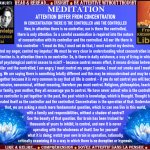
☀ K.: So then we begin to ask: what is meditation? FIRST OF ALL, MEDITATION DEMANDS ATTENTION, WHICH IS TO GIVE YOUR WHOLE CAPACITY, ENERGY, IN OBSERVATION. ATTENTION IS DIFFERENT FROM CONCENTRATION. Concentration is an effort made by thought to focus its capacity, its energy, on a particular subject. When you are in school you are trained to concentrate, that is to bring all your energy to a particular point.
In concentration you are not allowing any other kind of thoughts to interfere; concentration implies the controlling of thought, not allowing it to wander away but keeping it focused on a particular subject. It is the operation of thought which focuses attention, focuses energy, on that subject. In that operation of thought there is compulsion, control. So in concentration there is the controller and the controlled. Thought is wandering off; thought says it should not wander off, and I bring it back as the controller who says, 'I must concentrate on this.' So there is a controller and the controlled.
Who is the controller? The controller is part of thought and the controller is the past. ☀ The controller says, -I have learnt a great deal and it is important for me, the controller, to control thought.' That is: thought has divided itself as the controller and the controlled; it is a trick that thought is playing upon itself.
―☀―
TEXT–IMAGE
MEDITATION
ATTENTION DIFFER FROM CONCENTRATION
IN CONCENTRATION THERE IS THE CONTROLLER AND THE CONTROLLED
Now, in attention there is no controller, nor is there the controlled, there is only attention. So a careful examination is required into the nature of concentration with its controller and the controlled. All our life there is this controller - 'I must do this, I must not do that, I must control my desires, control my anger, control my impetus.' We must be very clear in understanding what concentration is and what attention is. In attention there is no controller.
So, is there in daily existence, a way of living in which every form of psychological control ceases to exist? - because control means effort, it means division between the controller and the controlled; I am angry, I must control my anger; I smoke, I must not smoke and I must resist smoking. We are saying there is something totally different and this may be misunderstood and may be rejected altogether because it is very common to say that all life is control - if you do not control you will become permissive, nonsensical, without meaning, therefore you must control. Religions, philosophies, teachers, your family, your mother, they all encourage you to control.
We have never asked: who is the controller? The controller is put together in the past, the past which is knowledge, which is thought. Thought has separated itself as the controller and the controlled. Concentration is the operation of that.
Understanding that, we are asking a much more fundamental question, which is: can one live in this world, with a family and responsibilities, without a shadow of control? See the beauty of that question. Our brain has been trained for thousands of years to inhibit, to control, and now it is never operating with the wholeness of itself. See for yourself what it is doing; watch your own brain in operation, rationally, critically examining it in a way in which there is no deception or hypnosis. ☀
🕊️ 🙏Sadhu ! Sadhu ! Sadhu ! 🙏 🕊️Among others it is used to express shared joy, moral approval, and spiritual agreement. Also means « excellent, well done, or it is good.» - «Amen or Hallelujah»
J.K. Krishnamurti
|❖Mindfulness ¤ Self Mastery ¤ Spirituality ¤ Mental Clarity ¤ Attachment Free ❖|
―🙏―
📖 VERSION FRANÇAISE 📖
🕊️On LinkedIn « New Post »
625- 🙏 FR | Jiddu Krishnamurti
|❖ Pour une COMPRÉHENSION OPTIMALE, LIRE avec ATTENTION le texte au complet « du Début à la Fin » ❖|
7e Public Talk ☀ Le Réseau de la Pensée Saanen 26 July 1981
☀ ATTENTION ☀
☀ K.: Nous commençons alors à poser cette Question qu’est-ce que la méditation ? TOUT D’ABORD, LA MÉDITATION REQUIERT DE L’ATTENTION, C’EST-À-DIRE QUE VOUS DEVEZ CONSACRER TOUTES VOS CAPACITÉS, TOUTE VOTRE ÉNERGIE À L’OBSERVATION. L’ATTENTION DIFFÈRE DE LA CONCENTRATION. La concentration est un effort réalisé par la pensée pour focaliser ses capacités, son énergie sur un sujet particulier. Quand vous êtes à l’école, vous êtes entraînés à vous concentrer, c’est-à-dire à amener toute votre énergie à un certain point. Dans la concentration, vous ne permettez pas à toute autre pensée d’intervenir.
La concentration implique le contrôle de la pensée, en ne lui permettant pas de s’égarer mais en la maintenant fixée sur un certain sujet. C’est l’opération de la pensée qui concentre l’attention, qui concentre l’énergie sur ce sujet. Dans cette opération de la pensée, il y a contrainte, contrôle. Dans la concentration, il y a ainsi le contrôleur et ce qu’il contrôle. La pensée vagabonde, la pensée dit qu’elle ne devrait pas vagabonder et je la fais revenir au moment où le contrôleur dit : “je dois me concentrer sur cela”. Il y a donc un contrôleur et ce qu’il contrôle.
Qui est le contrôleur ? Le contrôleur fait partie de la pensée et le contrôleur est le passé. ☀ Le contrôleur dit : “j’ai appris beaucoup de choses et il est important pour moi, le contrôleur, de contrôler la pensée”. Ce qui veut dire que la pensée s’est divisée entre le contrôleur et le contrôlé. C’est un tour que la pensée se joue à elle-même.
―☀―
TEXTE-IMAGE
MÉDITATION
ATTENTION DIFFÈRE DE LA CONCENTRATION
DANS LA CONCENTRATION, IL Y A LE CONTRÔLEUR ET CE QU’IL CONTRÔLE.
Or, dans l’Attention, il n’y a ni contrôleur, ni contrôlé, il y a seulement Attention. Il est donc nécessaire d’examiner attentivement la nature de la concentration avec son contrôleur et ce qu’il contrôle. Pendant toute notre vie, il y a ce contrôleur - “je dois faire ceci, je ne dois pas faire cela, je dois contrôler mes désirs, contrôler ma colère, contrôler mes impulsions”. Nous devons comprendre très clairement ce que sont la concentration et l’attention.
Dans l’attention, il n’y a pas de contrôleur. Y a-t-il donc dans l’existence quotidienne une façon de vivre dans laquelle toute forme de contrôle psychologique cesse d’exister ? - car contrôle signifie effort, cela signifie division entre le contrôleur et ce qu’il contrôle ; je suis en colère, je dois contrôler ma colère ; je fume, je ne dois pas fumer et je dois m’empêcher de fumer. Nous disons qu’il existe quelque chose de totalement différent, ce qui peut être mal compris et à la fois rejeté car il est très courant de dire que toute vie est contrôle. Si vous ne contrôlez pas, vous allez devenir laxiste, absurde, insensé, donc vous devez contrôler. Les religions, les philosophies, les maîtres, votre famille, votre mère, tous vous incitent à contrôler. Nous ne nous demandons jamais qui est le contrôleur ? Le contrôleur est créé dans le passé, le passé qui est savoir, qui est pensée.
La pensée s’est scindée en deux, le contrôleur et le contrôlé. La concentration est le résultat de cette scission ; le comprenant, nous posons une question bien plus fondamentale qui est celle-ci : peut-on vivre dans ce monde avec une famille et des responsabilités, sans le moindre contrôle ? Voyez la beauté de cette question. Depuis des milliers d’années, notre cerveau est entraîné à inhiber, à contrôler et maintenant il ne fonctionne jamais dans sa totalité. Voyez vous-même ce qu’il fait, observez votre propre cerveau à l’œuvre, en l’examinant rationnellement avec un esprit critique pour éviter toute illusion, toute hypnose. ☀
🕊️ 🙏 Sadhu ! Sadhu ! Sadhu ! 🙏 🕊️ Utilisé entre autres pour exprimer une joie partagée de dévotion, une approbation des valeurs morales et spirituelles. Aussi une expression d’accord et d’éloge, signifiant « excellent, bien, bon » – « Amen » ou « Alléluia »
J.K. Krishnamurti
|❖ Pleine Conscience ¤ Maîtrise de Soi ¤ Spiritualité ¤ Clarté Mentale ¤ Non-attachement ❖|


631- 🙏 ENG | Jiddu Krishnamurti
💛PUBLICATION : Version Française après la Version Anglaise💛
|❖ For OPTIMAL UNDERSTANDING Read the whole text with ATTENTION ❖|
Public Talk - Life Ahead ☀ LIFE
☀ THE TRUTH ☀
―⁈ Q.: WHAT IS KARMA.
☀ K.: KARMA IS ONE OF THE PECULIAR WORDS WE USE, it is one of those words in which our thought is caught. The poor man has to accept life in terms of a theory. He has to accept misery, starvation, squalor, because he is underfed and has not the energy to break away and create a revolution. He has to accept what life gives him, and so he says, "It is my karma to be like this; and the politicians, the big ones, encourage him to accept his misery. You do not want him to revolt against all that do you? But when you pay the poor man so little while you have so much, that is very likely to happen; so you use that word karma to encourage his passive acceptance of the misery in his life.
The educated man, the man who has achieved, who has inherited, who has come to the top of things, the man who has power, position and the means of corruption - he also says, "It is my karma. I have done well in a previous life and now I am reaping the reward of my past action".
But is that the meaning of karma - to accept things as they are? Do you understand? Does karma mean accepting things as they are without question, without a spark of revolt - which is the attitude many of us have? So you see how easily certain words become a net in which we get caught, because we are not really alive. THE TRUE SIGNIFICANCE OF THAT WORD KARMA CANNOT BE UNDERSTOOD AS A THEORY; IT CANNOT BE UNDERSTOOD IF YOU SAY, "THAT IS WHAT THE BHAGAVAD-GITA SAYS".
You know, the comparative mind is the most stupid mind of all, because it does not think; it merely says, "I have read such-and-such a book, and what you say is like it". When you say this, you have stopped thinking; when you compare, you are no longer investigating to find out what is true, irrespective of what any particular book or guru has said. So what is important is to throw off all authorities and investigate, find out, and not compare. Comparison is the worship of authority, it is imitation, thoughtlessness.
To compare is the very nature of a mind that is not awake to discover what is true. You say, "That is so, it is like what was said by the Buddha", and you think you have thereby solved your problems. BUT REALLY TO DISCOVER THE TRUTH OF ANYTHING, YOU HAVE TO BE EXTREMELY ACTIVE, VIGOROUS, SELF-RELIANT; AND YOU CANNOT HAVE SELF-RELIANCE AS LONG AS YOU ARE THINKING COMPARATIVELY. PLEASE LISTEN TO THIS. IF THERE IS NO SELF-RELIANCE, YOU LOSE ALL POWER TO INVESTIGATE AND FIND OUT WHAT IS TRUE. Self-reliance brings a certain freedom in which you discover; and that freedom is denied to you when you are comparing.
―⁈ Q.: Is there an element of fear in respect?
☀ K.: What do you say? When you show respect to your teacher, to your parents, to your guru, and respect to your servant; when you kick the people who are not important to you, and lick the boots of those who are above you, the officials, the politicians, the big ones - is there not an element of fear in this? From the big ones, from the teacher, the examiner, the professor, from your parents, from the politician or the bank manager, you hope to get something; therefore you are respectful.
But what can the poor people give you? So the poor you disregard, you treat them with contempt, you do not even know they are there when they pass you in the street. You do not look at them, it does not concern you that they shiver in the cold, that they are dirty and hungry. But you will give to the big ones, to the great of the land, even when you have very little, in order to receive more of their favours. In this there is definitely an element of fear, is there not? There is no love.
IF YOU HAD LOVE IN YOUR HEART, YOU WOULD SHOW RESPECT TO THOSE WHO HAVE NOTHING AND ALSO TO THOSE WHO HAVE EVERYTHING; YOU WOULD NEITHER BE AFRAID OF THOSE WHO HAVE, NOR DISREGARD THOSE WHO HAVE NOT. RESPECT IN THE HOPE OF REWARD IS THE OUTCOME OF FEAR. IN LOVE THERE IS NO FEAR. ☀
🕊️ 🙏Sadhu ! Sadhu ! Sadhu ! 🙏 🕊️Among others it is used to express shared joy, moral approval, and spiritual agreement. Also means « excellent, well done, or it is good.» - «Amen or Hallelujah»
J.K. Krishnamurti
|❖Mindfulness ¤ Self Mastery ¤ Spirituality ¤ Mental Clarity ¤ Attachment Free ❖|
―🙏―
📖 VERSION FRANÇAISE 📖
🕊️On LinkedIn « New Post »
631- 🙏FR | Jiddu Krishnamurti
|❖ Pour une COMPRÉHENSION OPTIMALE, LIRE avec ATTENTION le texte au complet « du Début à la Fin » ❖|
Causerie - Face à la vie ☀ La vie
☀ 16 LA VÉRITÉ ☀
Q.: QU'EST-CE QUE C'EST QUE LE KARMA? (Notion brahmanique de causes et effets dans une succession de réincarnations, n.d.t.)
☀ K.: KARMA EST UN DE CES MOTS CURIEUX QUE L'ON EMPLOIE, un de ces mots où l'esprit se laisse prendre. Les pauvres gens sont obligés d'accepter la vie en termes de définitions théoriques. Ils subissent leur misère, leur faim, leur existence sordide, et parce qu'ils ne sont pas assez nourris, ils n'ont pas l'énergie de briser cet état de choses par une révolution. Alors ils disent: « c'est notre Karma d'être ainsi », et les politiciens, les gros personnages, les encouragent à accepter cette misère.
Vous ne voudriez pas qu'ils se révoltent contre vous n'est-ce pas? Pourtant, lorsque vous payez les pauvres si peu, alors que vous possédez tellement, il est probable que c'est ce qui se produira; alors vous vous servez du mot Karma pour les encourager à accepter passivement leur misère.
L'homme instruit, l'homme qui a hérité, qui est parvenu au sommet, l'homme qui exerce le pouvoir, qui par sa situation dispose des moyens de corruption, lui aussi dit: « c'est mon Karma, j'ai été vertueux dans une vie antérieure et je reçois aujourd'hui la récompense de mes actions passées ». Mais est-ce cela le sens de Karma? Accepter les choses telles qu'elles sont? Sans se poser de questions?
Sans une étincelle de révolte? C'est l'état d'esprit de la plupart d'entre vous, et vous voyez ainsi comment les mots vous captent du fait que vous n'êtes pas réellement vivants. LA VRAIE SIGNIFICATION DE CE MOT KARMA NE PEUT PAS ÊTRE COMPRISE THÉORIQUEMENT; ELLE NE PEUT PAS ÊTRE COMPRISE SI ON DIT: « CELA SE TROUVE DANS LA BHAGAVAD GITA ».
L'esprit qui compare est le plus inintelligent qui soit parce qu'il ne pense pas. Il se borne à dire: « ce que vous dites n'est pas nouveau, je l'ai lu dans tel ou tel livre ». Lorsqu'il dit cela, il a déjà cessé de penser. Dès que l'on compare, on cesse de s'interroger, de s'enquérir de la vérité indépendamment de ce que pourrait dire n'importe quel livre ou gourou. Et ce qui est important c'est de rejeter toutes les autorités, de chercher, d'explorer, non de comparer.
Comparer c'est vénérer l'autorité, le conformisme, l'irréflexion. Il est dans la nature même d'un esprit non éveillé à la découverte, de dire: « tels mots sont vrais, parce qu'ils sont semblables à ceux du Bouddha », et de penser que les problèmes sont ainsi résolus. MAIS POUR DÉCOUVRIR LA VÉRITÉ À PROPOS DE N'IMPORTE QUOI, ON DOIT ÊTRE TRÈS ACTIF, VIGOUREUX, NE COMPTER QUE SUR SOI, CE QUI EST ÉVIDEMMENT IMPOSSIBLE LORSQU'ON PENSE PAR COMPARAISONS. ÉCOUTEZ BIEN CECI: VOUS NE DEVEZ VOUS APPUYER QUE SUR VOUS-MÊMES, FAUTE DE QUOI VOUS PERDREZ TOUT POUVOIR DE DÉCOUVRIR CE QUI EST VRAI.
Ne compter que sur soi-même donne un sens de liberté qui est nié lorsque l'on compare.
Q.: Le respect comporte-t-il un élément de crainte?
☀ K.: Qu'en pensez-vous? Lorsque vous témoignez du respect à vos parents, à votre gourou et que vous êtes irrespectueux envers des domestiques; lorsque vous donnez des coups de pied à ceux qui, pour vous, n'ont aucune importance, et que vous léchez les bottes de ceux qui sont au-dessus de vous, aux personnages officiels, aux grands de ce monde, n'y a-t-il pas là un élément de peur? Vous espérez obtenir quelque chose des grands, des professeurs, des examinateurs, des parents, d'un politicien ou d'un banquier, donc vous êtes respectueux à leur égard. Mais que peut vous donner un pauvre? Rien. Donc vous le traitez avec insolence et mépris. Vous ne le voyez même pas lorsque vous le croisez dans la rue. Qu'il grelotte de froid, qu'il soit sale, qu'il ait faim, cela ne vous concerne pas du tout. Mais vous offrirez aux puissants du peu que vous avez, dans l'espoir d'obtenir leur faveur. En cela il y a très certainement un élément de peur, et aucun amour.
SI VOUS AVIEZ DE L'AMOUR DANS VOTRE CŒUR, VOUS TÉMOIGNERIEZ DU RESPECT À CEUX QUI N'ONT RIEN ET AUSSI À CEUX QUI ONT TOUT; VOUS NE CRAINDRIEZ PAS CEUX QUI ONT, ET NE DÉDAIGNERIEZ PAS CEUX QUI N'ONT PAS. RESPECTER DANS L'ESPOIR D'UNE RÉCOMPENSE EST LE FAIT DE LA PEUR. DANS L'AMOUR, IL N'Y A PAS DE PEUR. ☀
🕊️ 🙏 Sadhu ! Sadhu ! Sadhu ! 🙏 🕊️ Utilisé entre autres pour exprimer une joie partagée de dévotion, une approbation des valeurs morales et spirituelles. Aussi une expression d’accord et d’éloge, signifiant « excellent, bien, bon » – « Amen » ou « Alléluia »
J.K. Krishnamurti
|❖ Pleine Conscience ¤ Maîtrise de Soi ¤ Spiritualité ¤ Clarté Mentale ¤ Non-attachement ❖|
2/8 Text ❖ English ❖ Français ❖ Español
« Swami Vivekananda 1863-1902, was an Indian monk, philosopher, author, religious teacher, and has introduce the Vedanta and Yoga to the Western world. »
―☀ ❖ The awakening of the soul to its bondage and its effort to stand up and assert itself –This is called life ☀―
❖ A perfect life is a contradiction in terms.
Life itself is a state of continuous struggle between ourselves and everything outside.
Every moment we are fighting actually with external nature, and if we are defeated, our life has to go. It is, for instance, a continuous struggle for food and air. If food or air fails, we die. Life is not a simple and smoothly flowing thing, but it is a compound effect. This complex struggle between something inside and the external world is what we call life. So it is clear that when this struggle ceases, there will be an end of life.
❖ If in this hell of a world one can bring a little joy and peace —even for a day— into the heart of a single person, that much alone is true; this I have learnt after suffering all my life; all else is mere moonshine.
―☀―
« Swami Vivekananda - moine hindou, philosophe et maître spirituel indien, célèbre pour avoir introduit la philosophie du Vedanta et du yoga en Occident. »
―☀❖L'éveil de l'âme à son esclavage et ses efforts pour se lever et s'affirmer —C'est ce qu'on appelle la vie. ☀―
❖ Une vie parfaite est une contradiction dans les termes.
La vie elle-même est un état de lutte continue entre nous et tout ce qui est au dehors.
À chaque instant, nous combattons en réalité la nature extérieure ; et si nous sommes vaincus, notre vie doit s’en aller. C’est, par exemple, une lutte continue pour la nourriture et l’air. Si la nourriture ou l’air manquent, nous mourons. La vie n’est pas une chose simple et qui coule harmonieusement : c’est un effet composé. Cette lutte complexe entre quelque chose en nous et le monde extérieur, c’est ce que nous appelons la vie. Ainsi, il est clair que lorsque cette lutte cesse, il y aura une fin de la vie. ❖Si, dans ce monde qui est un véritable enfer, on parvient à apporter un peu de joie et de paix —ne serait-ce que pour une journée— au cœur d’une seule personne, alors cela seul est vrai ; c’est ce que j’ai appris après avoir souffert toute ma vie. Tout le reste n’est que pure illusion.
―☀―
« Swami Vivekananda, uno de los más grandes pensadores y líderes espirituales de la India, es reconocido por su papel en la introducción del hinduismo y la filosofía Vedanta al mundo occidental. »
―☀ ❖ El despertar del alma de su esclavitud y su esfuerzo por ponerse de pie y afirmarse: —Esto se llama vida ☀―
❖ Una vida perfecta es una contradicción en los términos.
La vida, en sí misma, es un estado de lucha continua entre nosotros y todo lo que nos rodea.
En cada instante, estamos, de hecho, luchando contra la naturaleza externa; y si somos derrotados, nuestra vida llega a su fin. Se trata, por ejemplo, de una lucha constante por obtener alimento y aire. Si faltan el alimento o el aire, morimos. La vida no es algo sencillo que fluye de manera armoniosa; es, más bien, un fenómeno compuesto. Esta compleja lucha entre algo que reside en nuestro interior y el mundo exterior es lo que llamamos vida. Por tanto, resulta evidente que, cuando esta lucha cesa, la vida llega a su fin. ❖ Si en este infierno de mundo uno puede traer un poco de alegría y paz, aunque sea por un día, al corazón de una sola persona, sólo eso es verdad; esto lo he aprendido después de sufrir toda mi vida; todo lo demás es mera luz de luna.

630- 🙏 ENG | Jiddu Krishnamurti
💛PUBLICATION : Version Française après la Version Anglaise💛
|❖ For OPTIMAL UNDERSTANDING Read the whole text with ATTENTION ❖|
Public Talk - Life Ahead ☀ LIFE
☀ THE TRUTH ☀
You can kill with a word as well as with an action; and killing other human beings has never solved any of our problems. War has never cured any of our economic or social ills, nor has it brought about mutual understanding in human relationship; and yet the whole world is everlastingly preparing for war. Many reasons are put forward as to why it is necessary to kill people; and there are also many reasons for not killing. But do not be swept away by any reasoning; because today you may have a good reason for not killing and tomorrow you may have a much stronger reason for killing.
First see the truth of it, feel how essential it is not to kill. REGARDLESS OF WHAT MAY BE SAID BY OTHERS, FROM THE HIGHEST AUTHORITY TO THE LOWEST, FIND OUT FOR YOURSELF THE TRUTH OF THE MATTER; AND WHEN YOU ARE INWARDLY CLEAR ABOUT THAT, THEN YOU CAN REASON OUT THE DETAILS. But do not start with a reason, because every reason can be met by a counter-reason and you will be caught in the net of reasoning.
The important thing is to see directly for yourself what the truth is; and then you can begin to use reason. When you perceive for yourself what is true; when you know that to kill another is not love; when you inwardly feel the truth that there must be no enmity in your relationship with another, then no amount of reasoning can destroy that truth. Then no politician, no priest, no parent can sacrifice you for an idea or for his own safety.
The old have always sacrificed the young; and will you in your turn, as you grow older, also sacrifice the young? Do you not want to put an end to this sacrifice? Because it is the most destructive way of living, it is one of the greatest factors of human deterioration. To put an end to it, you as an individual have to find out the truth for yourself.
WITHOUT BELONGING TO ANY GROUP OR ORGANIZATION, YOU HAVE TO DISCOVER THE TRUTH OF NOT KILLING OF FEELING LOVE, OF HAVING NO ENMITY. THEN NO AMOUNT OF WORDS, NO CUNNING REASONS CAN EVER PERSUADE YOU TO KILL OR TO SACRIFICE ANOTHER.
SO IT IS VERY IMPORTANT, WHILE YOU ARE YOUNG, TO THINK OUT, TO FEEL OUT THESE THINGS FOR YOURSELF, AND THEREBY LAY THE FOUNDATION FOR THE DISCOVERY OF TRUTH.
―⁈ Q.: WHAT IS THE PURPOSE OF CREATION?
☀ K.: Are you really interested in that? What do you mean by 'creation'? What is the purpose of living? Why do you exist, read, study, pass examinations? What is the purpose of relationship - the relationship of parents and children, of husband and wife? What is life? Is that what you mean when you ask this question, "What is the purpose of creation?" When do you ask such a question? When inwardly you do not see clearly, when you are confused, miserable, in the dark, when you do not perceive or feel the truth of the matter for yourself, then you want to know what is the purpose of life.
Now, there are many people who will tell you the purpose of life; they will tell you what the sacred books say. Clever people will go on inventing various purposes of life. The political group will have one purpose, the religious group will have another, and so on and on. And how are you to find out what is the purpose of life when you yourself are confused? Surely, as long as you are confused, you can only receive an answer which is also confused. If your mind is disturbed, if it is not really quiet, whatever answer you receive will be through this screen of confusion, anxiety, fear; therefore the answer will be perverted.
SO THE IMPORTANT THING IS NOT TO ASK WHAT IS THE PURPOSE OF LIFE, BUT TO CLEAR AWAY THE CONFUSION THAT IS WITHIN YOU. It is like a blind man asking, "What is light?" If I try to tell him what light is, he will listen according to his blindness, according to his darkness; but from the moment he is able to see, he will never ask what is light. It is there. Similarly, IF YOU CAN CLARIFY THE CONFUSION WITHIN YOURSELF, THEN YOU WILL FIND OUT WHAT THE PURPOSE OF LIFE IS; you will not have to ask, you will not have to look for it.
To be free of confusion you have to see and understand the causes which bring about confusion; and the causes of confusion are very clear. They are rooted in the 'me' that is constantly wanting to expand itself through possessing, through becoming, through success, THROUGH IMITATION; AND THE SYMPTOMS ARE JEALOUSY, ENVY, GREED, FEAR. AS LONG AS THERE IS THIS INWARD CONFUSION, YOU ARE ALWAYS SEEKING OUTWARD ANSWERS; BUT WHEN THE INWARD CONFUSION IS CLEARED AWAY, THEN YOU WILL KNOW THE SIGNIFICANCE OF LIFE. ☀
🕊️ 🙏Sadhu ! Sadhu ! Sadhu ! 🙏 🕊️Among others it is used to express shared joy, moral approval, and spiritual agreement. Also means « excellent, well done, or it is good.» - «Amen or Hallelujah»
J.K. Krishnamurti
|❖Mindfulness ¤ Self Mastery ¤ Spirituality ¤ Mental Clarity ¤ Attachment Free ❖|
―🙏―
📖 VERSION FRANÇAISE 📖
🕊️On LinkedIn « New Post »
630- 🙏FR | Jiddu Krishnamurti
|❖ Pour une COMPRÉHENSION OPTIMALE, LIRE avec ATTENTION le texte au complet « du Début à la Fin » ❖|
Causerie - Face à la vie ☀ La vie
☀ 16 LA VÉRITÉ ☀
On peut tuer d'un mot aussi bien que physiquement, et là n'a jamais résolu aucun problème.
La guerre n'a jamais guéri nos maux économiques ou sociaux, ni a-t-elle jamais amené une compréhension mutuelle dans les relations humaines; et pourtant le monde entier se prépare à la guerre, depuis longtemps, sans arrêt. Certaines personnes donnent à cela beaucoup de raisons, d'autres avancent des raisons contraires pour ne pas tuer, mais ne vous laissez pas entraîner à des discussions sur ce sujet, car vous pourriez aujourd'hui vous convaincre par des arguments qu'il ne faut pas tuer et demain vous persuader par des arguments contraires que la guerre est nécessaire.
Voyez plutôt la vérité, sentez combien il est essentiel de ne pas tuer, NE TENEZ AUCUN COMPTE DE CE QU'EN DISENT LES PLUS HAUTES AUTORITÉS OU LES PLUS PETITES. LORSQUE VOUS VERREZ CLAIREMENT LA VÉRITÉ, VOUS POURREZ ALORS EN DISCUTER LES DÉTAILS. Mais ne commencez pas par argumenter, parce que tout raisonnement peut être contredit par un raisonnement inverse et vous vous égareriez dans cette argumentation.
Si vous savez que tuer ne comporte aucun amour; si vous sentez qu'il ne faut aucune inimitié dans les relations humaines; alors aucun raisonnement ne pourra détruire cette perception, aucun politicien, aucun prêtre, aucun parent ne pourra vous sacrifier pour une idée ou pour sa sécurité.
Les vieux ont toujours sacrifié les jeunes; et à votre tour, en ferez-vous autant, plus tard? Ne voulez-vous pas mettre fin à ces sacrifices? Car c'est le mode de vie le plus destructeur, c'est un des plus grands facteurs de détérioration. Il faut y mettre fin. CHACUN DE VOUS, EN TANT QU'INDIVIDU NON AFFILIÉ À UN GROUPE OU À UNE ORGANISATION, DOIT VOIR PERSONNELLEMENT CE QU'IL Y A DE VRAI DANS LE FAIT DE NE PAS TUER, D'AIMER, DE N'AVOIR PAS D'INIMITIÉS. ALORS AUCUN DISCOURS, AUCUN RAISONNEMENT NE POURRONT JAMAIS VOUS INCITER À TUER OU À SACRIFIER QUI QUE CE SOIT.
IL EST IMPORTANT QUE VOUS PENSIEZ À TOUT CELA ÉTANT JEUNES, ET QUE VOUS ÉTABLISSIEZ AINSI LES BASES DE LA DÉCOUVERTE DE LA VÉRITÉ.
Q.: QUEL EST LE BUT DE LA CRÉATION?
☀ K.: Cela vous intéresse vraiment? Que voulez-vous dire par « création »? Vous voulez savoir quel est le but de la vie? Pourquoi vous existez? Pourquoi vous étudiez et passez des examens? Quel est le but des relations humaines? Ce qu'est la vie? Est-ce à cela que vous pensez lorsque vous demandez quel est le but de la Création? On pose une pareille question lorsqu'on ne voit pas soi-même la vérité en cette affaire, lorsqu'on est dans un état de confusion, lorsqu'on est dans les ténèbres.
Vous trouverez beaucoup de personnes pour vous dire quel est le but de la vie; elles citeront des livres sacrés, ou inventeront des explications.
Des groupes politiques vous diront ce qu'ils en pensent, des groupes religieux défendront d'autres principes, et ainsi de suite. Et comment apprendrez-vous quel est le but de la vie? Tant que vous serez dans un état de confusion, vous ne pourrez concevoir que des raisons confuses. Si votre esprit est agité, s'il n'est pas vraiment silencieux, vous recevrez toutes les réponses que l'on vous donnera à travers l'écran de votre angoisse et de votre peur; cette réponse sera donc pervertie.
L'IMPORTANT N'EST PAS DE DEMANDER QUEL EST LE BUT DE LA VIE, MAIS DE DÉBLAYER LA CONFUSION QUI EST EN VOUS. Si un aveugle vous demandait ce qu'est la lumière, il traduirait votre réponse en termes de cécité, selon ses ténèbres; mais s'il voyait soudain, il ne poserait pas la question; la lumière serait là. De même, si vous sortiez de votre état de confusion, vous ne demanderiez pas quel est le but de la vie. POUR EN SORTIR, IL VOUS FAUT DÉCOUVRIR ET COMPRENDRE LES CAUSES DE CETTE CONFUSION. EN FAIT, ELLES SONT TRÈS VISIBLES.
Elles sont enracinées dans le « moi » qui cherche toujours à s'amplifier dans un « devenir », au moyen de possessions, de réussites, de conformismes.
ET LEURS SYMPTÔMES SONT LA JALOUSIE, L'ENVIE, L'AVIDITÉ, LA PEUR. TANT QU'EXISTE CETTE CONFUSION INTÉRIEURE, ON CHERCHE DES RÉPONSES À L'EXTÉRIEUR. ÉLIMINEZ-LA ET VOUS SAUREZ LE SENS QU'A LA VIE. ☀
🕊️ 🙏 Sadhu ! Sadhu ! Sadhu ! 🙏 🕊️ Utilisé entre autres pour exprimer une joie partagée de dévotion, une approbation des valeurs morales et spirituelles. Aussi une expression d’accord et d’éloge, signifiant « excellent, bien, bon » – « Amen » ou « Alléluia »
J.K. Krishnamurti
|❖ Pleine Conscience ¤ Maîtrise de Soi ¤ Spiritualité ¤ Clarté Mentale ¤ Non-attachement ❖|
629- 🙏 ENG | Jiddu Krishnamurti
💛PUBLICATION : Version Française après la Version Anglaise💛
|❖ For OPTIMAL UNDERSTANDING Read the whole text with ATTENTION ❖|
Public Talk - Life Ahead ☀ LIFE
☀ THE TRUTH ☀
WE HAVE BEEN TALKING ABOUT THE DETERIORATING FACTORS IN HUMAN EXISTENCE, AND WE SAID THAT FEAR IS ONE OF THE FUNDAMENTAL CAUSES OF THIS DETERIORATION. WE ALSO SAID THAT THE FOLLOWING OF AUTHORITY IN ANY FORM, WHETHER SELF-IMPOSED OR ESTABLISHED FROM OUTSIDE, AS WELL AS ANY FORM OF IMITATION, COPYING, IS DESTRUCTIVE OF INCENTIVE, OF CREATIVENESS, AND THAT IT BLOCKS THE DISCOVERY OF WHAT IS TRUE.
TRUTH IS NOT SOMETHING THAT CAN BE FOLLOWED; IT HAS TO BE DISCOVERED. You cannot find truth through any book or through any accumulation of experience. As we discussed the other day, when experience becomes a remembrance, that remembrance destroys creative understanding. Any feeling of malice or envy, however slight it may be, is also destructive of this creative understanding without which there is no happiness. Happiness is not to be bought, nor does it come when you go after it; but it is there when there is no conflict.
Now, is it not very important, especially while we are still in school, to begin to understand the significance of words? The word, the symbol has become an extraordinarily destructive thing for most of us, and of this we are unaware. Do you know what I mean by the symbol? The symbol is the shadow of truth. The gramophone record, for example, is not the real voice; but the voice has been put on the record, and to this we listen.
The word, the symbol, the image, the idea is not the truth; but we worship the image, we revere the symbol, we give great significance to the word, and all this is very destructive; because then the word, the symbol, the image becomes all-important. That is how temples, churches, and the various organized religions with their symbols, beliefs and dogmas, become factors which prevent the mind from going beyond and discovering the truth. So do not be caught up in words, in symbols, which automatically cultivate habit. Habit is a most destructive factor, because when you want to think creatively, habit comes in the way.
Perhaps you do not understand the whole significance of what I am saying; but you will, if you think about it. Go for a walk by yourself occasionally and think out these things. Find out what is meant by words like 'life', 'God', 'duty', 'cooperation' - all those extraordinary words which we use so freely.
Have you ever asked yourself what 'duty' means? Duty to what? To the aged, to what tradition says: that you must sacrifice yourself for your parents, for your country, for your gods. That word 'duty' has become extraordinarily significant to you, has it not? It is pregnant with a lot of meaning which is imposed upon you. You are taught that you have a duty to your country, to your gods, to your neighbour; but what is much more important than the word 'duty' is to find out for yourself what the truth is.
Your parents and society use that word 'duty' as a means of moulding you, shaping you according to their particular idiosyncrasies, their habits of thought, their likes and dislikes, hoping thereby to guarantee their own safety. So take time, be patient, analyze, go into all this and find out for yourself what is true. Do not merely accept the word 'duty', for where there is 'duty', there is no love.
Similarly, take the word 'co-operation. The State wants you to co-operate with it. If you co-operate with something without understanding, you are merely imitating, copying. But if you understand, if you find out the truth of something, then in co-operating you are living with it, moving with it; it is part of you.
So it is very necessary to be aware of the words, the symbols, the images that are crippling your thinking. To be aware of them and to find out whether you can go beyond them is essential if you are to live creatively, without disintegrating. You know, we allow the word 'duty' to kill us. The idea that you have a duty to parents, to relations, to the country, sacrifices you. It makes you go out to fight, to kill, and to be killed or maimed.
The politician, the leader says it is necessary to destroy others in order to protect the community, the country, the ideology or way of life; so killing becomes part of your duty, and you are soon drawn into the military spirit. The military spirit makes you obedient, it makes you physically very disciplined; but inwardly your mind is gradually destroyed because you are imitating, following, copying. You become a mere tool of the older people, of the politician, an instrument of propaganda. You come to accept killing to protect your country as inevitable because somebody says it is necessary. But no matter who says it is necessary, should you not think it out very clearly for yourself?
To kill is obviously the most destructive and corrupt action in life, especially to kill another human being; because when you kill, you are full of hatred, however much you may rationalize it, and you also create antagonism in others. ☀
🕊️ 🙏 Sadhu ! Sadhu ! Sadhu ! 🙏 🕊️ Among others it is used to express shared joy, moral approval, and spiritual agreement. Also means « excellent, well done, or it is good.» - «Amen or Hallelujah»
J.K. Krishnamurti
|❖ Mindfulness ¤ Self Mastery ¤ Spirituality ¤ Mental Clarity ¤ Attachment Free ❖|
―🙏―
📖 VERSION FRANÇAISE 📖
🕊️On LinkedIn « New Post »
629- 🙏FR | Jiddu Krishnamurti
|❖ Pour une COMPRÉHENSION OPTIMALE, LIRE avec ATTENTION le texte au complet « du Début à la Fin » ❖|
Causerie - Face à la vie ☀ La vie
☀ 16 LA VÉRITÉ ☀
NOUS AVONS PARLÉ DE LA DÉTÉRIORATION DE LA CONDITION HUMAINE ET NOUS AVONS VU QUE LA PEUR EN EST UNE DES PRINCIPALES CAUSES. NOUS AVONS DIT AUSSI QUE SE SOUMETTRE À UNE AUTORITÉ - IMPOSÉE PAR SOI-MÊME OU AGISSANT DE L'EXTÉRIEUR - DE MÊME QU'IMITER, COPIER, DÉTRUIT LE SENS CRÉATEUR ET BLOQUE LA DÉCOUVERTE DE CE QUI EST VRAI.
LA VÉRITÉ NE PEUT PAS AVOIR DE DISCIPLINES; ELLE DOIT ÊTRE DÉCOUVERTE; on ne la trouve ni dans des livres ni au moyen d'une accumulation d'expériences. Ainsi que nous l'avons vu l'autre jour, lorsque l'expérience devient une mémoire, elle détruit la compréhension créatrice. Tout sentiment de malveillance ou d'envie, quelque léger qu'il soit, détruit aussi cette compréhension créatrice sans laquelle il n'y a pas de bonheur. Le bonheur ne peut pas être acheté et ne se présente pas lorsqu'on le poursuit; mais il est là lorsqu'on n'a pas de conflits intérieurs.
Lorsqu'on parle de vérité et de compréhension, il est très important de commencer par comprendre la signification réelle des mots. Les mots, les symboles sont destructeurs pour la plupart des esprits, bien qu'on ne s'en rende pas compte. Un symbole n'est jamais que l'ombre de la vérité. De même qu'un disque de gramophone n'est pas la voix elle-même qui a été enregistrée, le mot, le symbole, l'image, l'idée, ne sont pas la vérité. Mais nous adorons l'image, nous vénérons le symbole, nous accordons une très grande valeur au mot, et cette importance que nous leur attribuons s'amplifie jusqu'à nous détruire. C'est ainsi que les temples et les églises et toutes les religions organisées, avec leurs symboles, leurs croyances et leurs dogmes, empêchent l'esprit d'aller plus loin et de découvrir la vérité.
Ne vous laissez donc pas prendre par des mots et des symboles: automatiquement, ils font tomber dans des habitudes et les habitudes sont des facteurs de grande destruction, car elles font obstacle à toute pensée créatrice. Peut-être ne comprenez-vous pas toute la portée de ce que je dis. Mais vous le comprendrez si vous y pensez.
Allez parfois vous promener solitairement et tâchez de penser à ce que veulent dire certains mots extraordinaires tels que Vie, Dieu, Devoir, Collaboration, qu'on emploie si facilement. Vous êtes-vous jamais demandé ce que veut dire « devoir »? Devoir envers qui? Envers les vieillards et la tradition? Cela veut dire que vous devez vous sacrifier pour vos parents, votre pays, vos dieux. Ce mot « devoir » est devenu très important pour vous; il est lourd de significations qui vous sont imposées. Mais ce qui serait plus important serait que vous découvriez la vérité qui se cache dans ce sentiment.
Vos parents et la Société vous enseignent vos « devoirs » envers vos dieux ou vos voisins dans le but de vous former, de vous façonner conformément à leurs tempéraments, à leur façon de penser, à leurs goûts individuels. Ils espèrent ainsi garantir leur propre sécurité. Preniez donc le temps qu'il faut, soyez patients, analysez cette question, pénétrez-la et voyez par vous-même où est la vérité. Ne vous contentez pas d'accepter le mot « devoir ». Où est le devoir, il n'y a pas d'amour. De même, considérez le mot « collaboration ». L'État vous demande de « collaborer » avec lui.
Or collaborer sans comprendre c'est imiter, copier, mais comprendre c'est trouver la vérité de l'action qu'on engage, donc vivre avec elle, se mouvoir avec elle, et cette action devient une partie de soi-même. Il est donc très important d'être conscient des mots, des symboles, des images qui mutilent la pensée. En être conscient et savoir si on peut les transcender est essentiel si on veut vivre d'une vie créatrice, sans se désintégrer. Nous permettons au mot « devoir » de nous tuer.
Vos idées concernant vos devoirs envers vos parents, votre nation, votre pays, vous sacrifient, vous envoient vous battre. Pour elles, vous tuez et vous vous faites tuer. Les politiciens, les chefs de partis, proclament que c'est nécessaire pour protéger la communauté, le pays, une idéologie ou un mode de vie. À cet effet on vous inculque l'esprit militaire. Cette discipline vous détruit car elle vous habitue à copier, à imiter. Vous n'êtes plus que des instruments obéissants entre les mains des personnes âgées, pour appuyer leurs propagandes.
Vous en venez à penser que tuer pour votre pays est inévitable, parce que d'autres le disent. Mais qu'importe la personne qui le dit ! Ne devriez-vous pas penser par vous-mêmes? Tuer est, manifestement, l'action la plus destructrice et corrompue qui soit, surtout s'il s'agit d'êtres humains. Lorsqu'on tue, on est plein de haine, même si on la rationalise, et on suscite un antagonisme chez les autres. ☀
🕊️ 🙏 Sadhu ! Sadhu ! Sadhu ! 🙏 🕊️ Utilisé entre autres pour exprimer une joie partagée de dévotion, une approbation des valeurs morales et spirituelles. Aussi une expression d’accord et d’éloge, signifiant « excellent, bien, bon » – « Amen » ou « Alléluia »
J.K. Krishnamurti
|❖ Pleine Conscience ¤ Maîtrise de Soi ¤ Spiritualité ¤ Clarté Mentale ¤ Non-attachement ❖|
|❖ INSIGHT ¤ PROFOUND VISION ¤ ONE TRUTH ❖|
#Buddha’s Teachings
Homage to the Blessed One, the Arahant,
the Perfectly Enlightened One
Anguttara Nikaya Discourses of the Buddha
☀
The numerical Discourses of the Buddha
AṅguttaraNikaya AN 33
The Book of the Ones by Bhikkhu Bodhi
―☀ XX. The Deathless ☀―
616 (1) “Bhikkhus, they do not partake of the deathless who do not partake of mindfulness directed to the body. They partake of the deathless who partake of mindfulness directed to the body.”
617 (2) “Bhikkhus, the deathless has not been partaken of by those who have not partaken of mindfulness directed to the body. The deathless has been partaken of by those who have partaken of mindfulness directed to the body.”
618 (3) “Bhikkhus, they have fallen away from the deathless who have fallen away from mindfulness directed to the body. They have not fallen away from the deathless who have not fallen away from mindfulness directed to the body.”
―☀―
TEXT-IMAGE
―☀ The Book of the Ones - THE DEATHLESS ☀―
Cont. 619 (4) “Bhikkhus, they have neglected the deathless who have neglected mindfulness directed to the body. They have undertaken the deathless who have undertaken mindfulness directed to the body.”
620 (5) “Bhikkhus, they are heedless about the deathless who are heedless about mindfulness directed to the body. They are not heedless about the deathless who are not heedless about mindfulness directed to the body.”
621 (6) “Bhikkhus, they have forgotten the deathless who have forgotten mindfulness directed to the body. They have not forgotten the deathless who have not forgotten mindfulness directed to the body.”
622 (7) “Bhikkhus, they have not pursued the deathless who have not pursued mindfulness directed to the body. They have pursued the deathless who have pursued mindfulness directed to the body.”
623 (8) “Bhikkhus, they have not developed the deathless who have not developed mindfulness directed to the body. They have developed the deathless who have developed mindfulness directed to the body.”
624 (9) “Bhikkhus, they have not cultivated the deathless who have not cultivated mindfulness directed to the body. They have cultivated the deathless who have cultivated mindfulness directed to the body.”
625 (10) “Bhikkhus, they have not directly known the deathless who have not directly known mindfulness directed to the body. They have directly known the deathless who have directly known mindfulness directed to the body.”
626 (11) “Bhikkhus, they have not fully understood the deathless who have not fully understood mindfulness directed to the body. They have fully understood the deathless who have fully understood mindfulness directed to the body.”
627 (12) “Bhikkhus, they have not realized the deathless who have not realized mindfulness directed to the body. They have realized the deathless who have realized mindfulness directed to the body.”
The Book of the Ones is finished.
Cont.: ―☀The Book
of the Ones is finished. ☀―
An EXTRA Post on Jhanas
Tomorrow’s Post
Buddha
|❖ Mindfulness ¤ Self Mastery ¤ Spirituality
¤ Mental Clarity ¤ Attachment Free ❖|

1/8 INTRO : Texte ❖ Anglais ❖Français ❖ Espagnol
❖ Quotes on Joy ❖ Citations sur la Joie ❖ Citas sobre la Alegría
« Elisabeth Kübler-Ross - Scribner, 1997 »
❖
Eng. ❖ The Wheel of Life: A Memoir of Living and Dying.
This life of mine, which began Halfway around the world, has been many things — but never easy.
That is a fact, not a complaint. I have learned there is no joy without hardship. There is no pleasure without pain. Would we know the comfort of peace without the distress of war? If not for AIDS, would we notice our humanity is in jeopardy? If not for death, would we appreciate life? If not for hate, would we know the ultimate goal is love?
―☀―
TEXT-IMAGE
Eng. ❖ The most beautiful people we have
known are those who have known
defeat, known suffering, known
struggle, known loss, and have
found their way out of the depths.
These persons have an appreciation,
a sensitivity, and an understanding
of life that fills them with compassion,
gentleness, and a deep loving concern.
Beautiful people do not just happen.
« There is no Joy without hardship. »
❖❖❖❖
Fr. ❖ La Roue de la vie : Mémoires sur la vie et la mort.
Ma vie, qui a commencé à l’autre bout du monde, a été particulièrement riche, mais jamais facile. C'est une constatation, je ne m'en plains pas.
J'ai appris que l’on ne peut connaître de bonheur sans traverser des périodes difficiles. Il n’y a pas de plaisir sans souffrance. Pourrait-on concevoir le bonheur de la paix sans la détresse de la guerre ? Sans le sida, aurait-on compris que l’humanité est en danger? Sans la mort, pourrait-on apprécier la vie? Sans la haine, aurions-nous compris que le but suprême est l'amour?
―☀―
TEXTE-IMAGE
Fr. ❖ Les personnes les plus formidables
sont celles qui ont connu l'échec,
la souffrance, le combat intérieur,
la perte et qui ont surmonté leur
détresse. Ces personnes ont une
sensibilité, une compréhension de
la vie qui les remplit de compassion,
de douceur et d'amour. La bonté
ne vient jamais de nulle part...
« Il n'y a pas de Joie sans épreuves. »
❖❖❖❖
Esp. ❖ La rueda de la vida: Memorias sobre la vida y la muerte.
Esta vida mía, que comenzara a muchos miles de kilómetros, ha sido muchas cosas, pero jamás fácil.
Esto es una realidad, no una queja. He aprendido que no hay dicha sin contratiempos. No hay placer sin dolor. ¿Conoceríamos el goce de la paz sin la angustia de la guerra? Si no fuera por el sida, ¿nos daríamos cuenta de que el mundo está en peligro? Si no fuera por la muerte, ¿valoraríamos la vida? Si no fuera por el odio, ¿sabríamos que el objetivo último es el amor?
―☀―
TEXTO-IMAGEN
Esp. ❖ Las personas más bellas que hemos conocido
son aquellas que han conocido la derrota, el sufrimiento,
la lucha, la pérdida, y han encontrado el camino para
salir de las profundidades. Estas personas tienen
un aprecio, una sensibilidad y una comprensión
de la vida que les llena de compasión, dulzura
y una profunda preocupación amorosa.
Las personas bellas no surgen de la nada.
« No hay Alegría sin dificultades. »

Etienne Arsenault retweeted

You're welcome Etienne and merci for your very kind words 🙇
Jiddu was right. As for the questions of...
"When you label, is the feeling different from the label? Or does the label awaken the feeling?"
To the 1st question:
Thoughts are comprised of different subtle energy than feelings/emotions, so yes, the label/thought feels different than the emotion.
To the 2nd question:
The label typically manifests or activates emotions due to subjective thoughts about whatever the label refers to. Such thoughts are what the old, conditioned mind is comprised of.
As for Buddha's wise words, yes, the mind needs to be trained. So long as there are conditioned/subjective thoughts in the mind, including those one isn't conscious of, feelings/emotions can and will arise. It's what happens when people experience an emotions but do not know why.
I've used this in the past to get at the thoughts that manifested the emotions for they're intrinsically connected. This is also why we can come to KNow the thoughts that manifested them when we end the separation Jiddu spoke of by having a quiet mind and being fully attentive. The noisier/messier one's mind is the harder this is to do.
However, Buddha knew that energy follows attention so when we do as he suggested by the below quote we are actually retraining our non-conscious/subconscious mind:
"'I will develop and cultivate the liberation of the mind by compassion the liberation of the mind by altruistic joy . . . the liberation of the mind by equanimity, make it a vehicle and basis, carry it out, consolidate it, and properly undertake it. Thus should you train yourself."
Thank you my friend, I am enjoying every moment and may you as well 😊🙏
🙏 Metta 🙏
628- 🙏 ENG | Jiddu Krishnamurti
💛PUBLICATION : Version Française après la Version Anglaise💛
|❖ For OPTIMAL UNDERSTANDING Read the whole text with ATTENTION ❖|
Public Talk - Life Ahead ☀ LIFE
☀ UNDERSTANDING FREES THE MIND ☀
―⁈ Q.: CAN WE NOT CULTIVATE UNDERSTANDING? When we constantly try to understand, does it not mean that we are practicing understanding?
☀ K.: Is understanding cultivable? Is it something to be practised as you practice tennis, or the piano, or singing, or dancing? You can read a book over and over again till you are thoroughly familiar with it. Is understanding like that, something to be learned through constant repetition, which is really the cultivation of memory? Is not understanding from moment to moment, and therefore something that cannot be practised?
WHEN DO YOU UNDERSTAND? WHAT IS THE STATE OF YOUR MIND AND HEART WHEN THERE IS UNDERSTANDING? When you hear me say something very true about jealousy - that jealousy is destructive, that envy is a major factor in the deterioration of human relationship - , how do you respond to it? Do you see the truth of it immediately? Or do you begin to think about jealousy, to talk about it, rationalize it, analyze it? Is understanding a process of either rationalization or slow analysis? Can understanding be cultivated as you cultivate your garden to produce fruits or flowers? SURELY, TO UNDERSTAND IS TO SEE THE TRUTH OF SOMETHING DIRECTLY, WITHOUT ANY BARRIER OF WORDS, PREJUDICES OR MOTIVES.
―⁈ Q.: IS THE POWER OF UNDERSTANDING THE SAME IN ALL PERSONS?
☀ K.: Suppose something true is presented to you and you see the truth of it very quickly; your understanding is immediate because you have no barriers. YOU ARE NOT FULL OF YOUR OWN IMPORTANCE, YOU ARE EAGER TO FIND OUT, SO YOU PERCEIVE IMMEDIATELY. But I HAVE MANY BARRIERS, many prejudices. I am jealous torn by conflicts based upon envy, full of my own importance. I have accumulated many things in life, and I really do not want to see; therefore I DO NOT SEE, I DO NOT UNDERSTAND.
―⁈ Q.: CAN'T ONE REMOVE THE BARRIERS SLOWLY BY CONSTANTLY TRYING TO UNDERSTAND?
☀ K.: NO. I CAN REMOVE THE BARRIERS, NOT BY TRYING TO UNDERSTAND, BUT ONLY WHEN I REALLY FEEL THE IMPORTANCE OF NOT HAVING BARRIERS - which means that I must be willing to see the barriers. Suppose you and I hear someone say that envy is destructive. You listen and understand the significance, the truth of it, and you are free of that feeling of envy, of jealousy. But I do not want to see the truth of it, because if I did it would destroy my whole structure of life.
―⁈ Q.: I FEEL THE NECESSITY OF REMOVING THE BARRIERS.
☀ K.: Why do you feel that? Do you want to remove the barriers because of circumstances? Do you want to remove them because somebody has told you that you should? Surely, the barriers are removed only when you see for yourself that to have barriers of any kind creates a mind which is in a state of slow decay. And when do you see this? When you suffer? But does suffering necessarily awaken you to the importance of removing all barriers? Or does it, on the contrary, lead you to create more barriers?
YOU WILL FIND THAT ALL BARRIERS DROP AWAY WHEN YOU YOURSELF ARE BEGINNING TO LISTEN, TO OBSERVE, TO FIND OUT. There is no reason for removing the barriers; and the moment you bring in a reason, you are not removing them. The miracle, the greatest blessing is to give your own inward perception an opportunity to remove the barriers. But when you say that the barriers must be removed and then practice removing them, that is the work of the mind; and the mind cannot remove the barriers. You must see that no attempt on your part can remove them. Then the mind becomes very quiet, very still; and in this stillness you discover that which is true. ☀
🕊️ 🙏Sadhu ! Sadhu ! Sadhu ! 🙏 🕊️Among others it is used to express shared joy, moral approval, and spiritual agreement. Also means « excellent, well done, or it is good.»- «Amen or Hallelujah»
J.K. Krishnamurti
|❖Mindfulness ¤ Self Mastery ¤ Spirituality ¤ Mental Clarity ¤ Attachment Free ❖|
―🙏―
📖 VERSION FRANÇAISE 📖
🕊️On LinkedIn « New Post »
628- 🙏FR | Jiddu Krishnamurti
|❖ Pour une COMPRÉHENSION OPTIMALE, LIRE avec ATTENTION le texte au complet « du Début à la Fin » ❖|
Causerie - Face à la vie ☀ La vie
☀ 15 LA COMPRÉHENSION EST CRÉATRICE☀
Q.: PEUT-ON CULTIVER L'INTELLIGENCE? Lorsqu'on s'efforce tout le temps de comprendre, n'est-on pas déjà intelligent?
☀ K.: L'intelligence peut-elle se cultiver? Peut-on s'y exercer comme on s'exerce au tennis, au piano ou à la danse? On peut lire un livre un grand nombre de fois, jusqu'à le connaître par cœur. Peut-on, de la même façon, s'exercer à comprendre, ou la répétition ne développe-t-elle pas simplement la mémoire? Comprendre n'est-ce pas un acte qui se produit d'instant en instant et auquel, par conséquent, on ne peut pas s'exercer?
LORSQUE SE PRODUIT L'ACTE DE COMPRÉHENSION, DANS QUEL ÉTAT D'ESPRIT EST-ON? Lorsque vous m'entendez dire une vérité au sujet de l'envie: qu'elle détruit, qu'elle est un des principaux facteurs de détérioration dans les rapports humains, quelles sont vos réactions? Voyez-vous cette vérité immédiatement, ou commencez-vous à disserter sur la jalousie, à la rationaliser, à l'analyser? Pensez-vous cultiver ainsi la compréhension, à la façon dont on cultive un jardin?
COMPRENDRE C'EST VOIR UNE VÉRITÉ DIRECTEMENT, SANS AUCUNE BARRIÈRE DE MOTS, DE PRÉJUGÉS, DE MOTIFS.
Q.: LA CAPACITÉ DE COMPRENDRE EST-ELLE LA MÊME POUR TOUT LE MONDE?
☀ K.: Supposez qu'on vous présente une vérité et que VOUS LA VOYIEZ IMMÉDIATEMENT PARCE QU'IL N'Y A PAS DE BARRIÈRES EN VOUS: vous n'êtes pas imbu de votre importance, vous voulez réellement comprendre. Mais SUPPOSEZ QUE J'AIE, MOI, DES BARRIÈRES TELLES QUE DES PRÉJUGÉS, que je sois jaloux, déchiré par les conflits de l'envie et le sens de mon importance: ayant beaucoup accumulé au cours de mon existence, JE NE VEUX PAS « VOIR », DONC JE NE VOIS PAS, JE NE COMPRENDS PAS.
Q.: NE PEUT-ON PAS ÉLIMINER LES BARRIÈRES GRADUELLEMENT, EN ESSAYANT DE COMPRENDRE?
☀ K.: Non. CE N'EST PAS EN ESSAYANT DE COMPRENDRE QUE JE PEUX ÉLIMINER MES BARRIÈRES, MAIS EN VOYANT L'IMPORTANCE DE NE PAS EN AVOIR, ce qui veut dire que je dois être disposé à les « voir ». Il se peut qu'en entendant dire que l'envie est destructive, vous compreniez la vérité et l'importance de cette affirmation, et que vous soyez aussitôt libéré de ce sentiment, mais qu'un autre ne veuille pas voir cette vérité, car s'il la voyait, elle détruirait toute la structure de son existence.
Q.: JE SENS LA NÉCESSITÉ D'ÉLIMINER CES BARRIÈRES.
☀ K.: Pourquoi sentez-vous cela? Parce que vous venez d'en entendre parler? Parce que vous souffrez? Mais les barrières ne s'éliminent que lorsqu'on voit directement, soi-même, qu'elles produisent dans l'esprit un état de décomposition lente. Et quand voit-on cela? Quand on souffre? La souffrance éveille-t-elle la nécessité d'éliminer les barrières de l'esprit ou n'incite-t-elle pas, au contraire, à en créer de nouvelles?
VOUS VERREZ QU'ELLES TOMBERONT D'ELLES-MÊMES LORSQUE VOUS COMMENCEREZ À VOUS OBSERVER RÉELLEMENT. Tant que vous vous donnez des raisons de les démolir, vous les maintenez. Le miracle, la vraie bénédiction consiste à donner à votre perception intérieure l'occasion de les faire disparaître. Mais dès que vous pensez qu'il est nécessaire de les éliminer, c'est votre pensée qui cherche à le faire, et elle n'y arrivera jamais. Vous devez donc voir qu'aucune tentative de votre part ne pourra réussir. Alors votre esprit se calmera, deviendra silencieux, et dans ce silence vous découvrirez ce qui est vrai. ☀
🕊️ 🙏 Sadhu ! Sadhu ! Sadhu ! 🙏 🕊️ Utilisé entre autres pour exprimer une joie partagée de dévotion, une approbation des valeurs morales et spirituelles. Aussi une expression d’accord et d’éloge, signifiant « excellent, bien, bon » – « Amen » ou « Alléluia »
J.K. Krishnamurti
|❖ Pleine Conscience ¤ Maîtrise de Soi ¤ Spiritualité ¤ Clarté Mentale ¤ Non-attachement ❖|
627- 🙏 ENG | Jiddu Krishnamurti
💛PUBLICATION : Version Française après la Version Anglaise💛
|❖ For OPTIMAL UNDERSTANDING Read the whole text with ATTENTION ❖|
Public Talk - Life Ahead ☀ LIFE
☀ 15 UNDERSTANDING FREES THE MIND☀
―⁈ Q.: Does intelligence build character?
☀ K.: WHAT DO WE MEAN BY 'CHARACTER'? AND WHAT DO WE MEAN BY 'INTELLIGENCE'?
Every politician - whether the Delhi variety, or your own local tub-thumper - continually uses such words as 'character', 'ideal', 'intelligence', 'religion', 'God'. We listen to these words with rapt attention, because they seem very important. Most of us live on words; and the more elaborate, the more exquisite the words, the more satisfied we feel. So, LET US FIND OUT WHAT WE MEAN BY 'INTELLIGENCE' AND WHAT WE MEAN BY 'CHARACTER'. DON'T SAY I AM NOT ANSWERING YOU DEFINITELY. TO SEEK DEFINITIONS, CONCLUSIONS, IS ONE OF THE TRICKS OF THE MIND, AND IT MEANS THAT YOU DON'T WANT TO INVESTIGATE AND UNDERSTAND, YOU JUST WANT TO FOLLOW WORDS.
What is intelligence? If a man is frightened, anxious, envious, greedy, if his mind is copying, imitating, filled with other people's experiences and knowledge; if his thinking is limited, shaped by society, by environment - is such a man intelligent. He is not, is he? And can a man who is frightened, unintelligent, have character - character being something original, not the mere repeating of traditional do's and don'ts? Is character respectability?
Do you understand what that word 'respectability' means? You are respectable when you are looked up to, respected by a majority of the people around you. And what do the majority of people respect - the people of the family, the people of the mass? They respect the things which they themselves want and which they have projected as a goal or an ideal; they respect that which they see to be in contrast with their own more lowly state.
If you are rich and powerful, or have a big name politically, or have written successful books, you are respected by the majority. What you say may be utter nonsense, but when you talk, people listen because they regard you as a great man. And when you have thus won the respect of the many, the following of the multitude, it gives you a sense of respectability a feeling of having arrived. But the so-called sinner is nearer to God than the respectable man, because the respectable man is clothed in hypocrisy.
Is character the outcome of imitation, of being controlled by the fear of what people will say or won't say? Is character the mere strengthening of one's own tendencies, prejudices? Is it an upholding of the tradition, whether of India, of Europe or America? That is generally called having character - being a strong person who supports the local tradition and so is respected by the many. But when you are prejudiced, imitative, bound by tradition, or when you are frightened, is there intelligence, is there character? Imitating, following, worshipping, having ideas - that way leads to respectability, but not to understanding.
A man of ideals is respectable; but he will never be near God, he will never know what it is to love, because his ideals are a means of covering up his fear, his imitation, his loneliness.
So, without understanding yourself, without being aware of all that is operating in your own mind - how you think, whether you are copying, imitating, whether you are frightened, whether you are seeking power - , there cannot be intelligence. And IT IS INTELLIGENCE THAT CREATES CHARACTER, not hero worship or the pursuit of an ideal. THE UNDERSTANDING OF ONESELF, OF ONE'S OWN EXTRAORDINARILY COMPLICATED SELF, IS THE BEGINNING OF INTELLIGENCE, WHICH REVEALS CHARACTER. ☀
🕊️ 🙏Sadhu ! Sadhu ! Sadhu ! 🙏 🕊️Among others it is used to express shared joy, moral approval, and spiritual agreement. Also means « excellent, well done, or it is good.» - «Amen or Hallelujah»
J.K. Krishnamurti
|❖Mindfulness ¤ Self Mastery ¤ Spirituality ¤ Mental Clarity ¤ Attachment Free ❖|
―🙏―
📖 VERSION FRANÇAISE 📖
🕊️On LinkedIn « New Post »
627- 🙏FR | Jiddu Krishnamurti
|❖ Pour une COMPRÉHENSION OPTIMALE, LIRE avec ATTENTION le texte au complet « du Début à la Fin » ❖|
Causerie - Face à la vie ☀ La vie
☀ 15 LA COMPRÉHENSION EST CRÉATRICE☀
Q.: Est-ce l'intelligence qui construit le caractère?
☀ K.: QU'ENTENDEZ-VOUS PAR « CARACTÈRE » ET PAR « INTELLIGENCE »?
Tous les politiciens, depuis ceux de New Delhi jusqu'à l'amateur du coin, parlent de caractère, d'idéal, d'intelligence, de Dieu. On les écoute avec admiration, parce que ce sont des gens soi-disant importants. On vit de mots, et l'on s'en satisfait d'autant plus qu'ils sont savants et compliqués. COMPRENEZ DONC QUE CE QUE VOUS VOULEZ DIRE PAR « INTELLIGENCE » ET « CARACTÈRE », ET NE ME REPROCHEZ PAS DE NE PAS VOUS RÉPONDRE DIRECTEMENT. VOULOIR DES DÉFINITIONS, DES CONCLUSIONS, EST UN ARTIFICE DE LA PENSÉE QUI RÉVÈLE QUE VOUS NE CHERCHEZ PAS À COMPRENDRE, MAIS QUE VOUS DÉSIREZ VOUS ATTACHER À DES MOTS. Qu'est-ce que c'est que l'intelligence?
Si on est effrayé, angoissé, envieux, avide; si on a l'esprit rempli de l'expérience et des connaissances d'autrui et une pensée limitée, façonnée par la Société et le milieu; si on copie et on imite, est-on intelligent?... Et si on est craintif et inintelligent, peut-on avoir du caractère, peut-on être original, peut-on être affranchi des morales traditionnelles? Avoir du caractère est-ce que cela veut dire être respectable? Être respectable, c'est être hautement considéré et respecté par le milieu où l'on se trouve et par la foule.
Or la plupart des gens respectent ce qui contraste avec leur situation moins privilégiée: la richesse, le pouvoir politique, le succès littéraire, etc. L'homme « arrivé » peut dire des sottises sans cesser pour autant d'être admiré par la plupart des personnes; et ayant acquis le respect de la multitude, il a le sentiment d'être respectable, d'être un grand personnage. Mais le soi-disant pécheur est plus près de Dieu que l'homme respectable, parce que ce dernier est revêtu d'hypocrisie.
Avoir du caractère est-ce se laisser guider par la crainte du qu'en dira-t-on? Est-ce développer ses propres tendances et renforcer ses préjugés? Est-ce défendre une tradition? Ce qu'on appelle en général avoir du caractère, c'est être l'énergique défenseur de la tradition locale et de ce fait, être respecté. Mais se conformer à des coutumes, être limité par des préjugés, adopter un mode collectif de pensée, comporte toujours une certaine peur et n'est pas le fait d'une personne intelligente. Cette personne peut devenir très respectable, mais elle n'a pas de compréhension; elle peut avoir un idéal mais elle ne trouvera jamais Dieu; elle ne saura jamais ce qu'est l'amour car son idéal n'est qu'un camouflage de sa peur, de son conformisme, de sa solitude.
Si ce qui vous empêche de vous comprendre vous-même et d'être conscient du fonctionnement de votre esprit, est le fait que vous avez peur, que vous vous réfugiez dans un conformisme ou que vous ambitionnez le pouvoir, vous n'avez pas d'intelligence. Et SEULE L'INTELLIGENCE CRÉE LE CARACTÈRE; ELLE LE RÉVÈLE DÈS QUE L'ON COMMENCE À COMPRENDRE LES COMPLICATIONS EXTRAORDINAIRES DU MOI. ☀
🕊️ 🙏 Sadhu ! Sadhu ! Sadhu ! 🙏 🕊️ Utilisé entre autres pour exprimer une joie partagée de dévotion, une approbation des valeurs morales et spirituelles. Aussi une expression d’accord et d’éloge, signifiant « excellent, bien, bon » – « Amen » ou « Alléluia »
J.K. Krishnamurti
|❖ Pleine Conscience ¤ Maîtrise de Soi ¤ Spiritualité ¤ Clarté Mentale ¤ Non-attachement ❖|
Etienne Arsenault retweeted
You are most welcome my friend 🙇
Yes, it's difficult because our senses exist for sensations. It is their whole reason for being.
Wherever we are there is...
something to see
something to hear
something to smell
something to touch
something to know
something to feel
something...
We let sensations, all these somethings, guide us as we react to them with thoughts about them and our thoughts manifest or activate emotions about and for them.
The more we create the more we get lost in them and the stronger the old mind becomes. It wraps its arms tightly around us and has us believing it is necessary to Be. This is source/cause of the separation Jiddu spoke about.
While I greatly appreciate Descartes statement of "I think therefore I am" it, mostly unknowingly to us, establishes and perpetuates the notion that because I can see, hear, smell and think etc. I exist.
The result of this is we end up defining ourselves and this reality within which we exist by our reactions to what we perceive.
Buddha explored this thoroughly through his Doctrine of Dependent Origination... when all the sensations and any thoughts about them cease to be I do not cease to Be.
We do not exist for sensations for something
We do not exist because we can think or have feelings about something, we simply exist...
To me the more accurate statement is:
I am therefore I can think...
...but I can also choose to not think about any or all of these somethings. I can choose to just Be
This brings in what you mentioned in your post, which everyone should read, regarding Being WITHOUT ANY MOVEMENT OF MIND and all of Jiddu's wise words about it.
As you rightly stated:
All this, just to say… the key for understanding and «insights» is to read & reread with an Attentive Mind, One will then notice « HOW » clear💥Easier & Easier everything becomes.
And thank you Etienne, I will have a wonderful day and may you enjoy the same 👍😊🙏
🙏 Metta 🙏
|❖ INSIGH#buddhabang |❖ INSIGHT ¤ PROFOUND VISION ¤ ONE TRUTH ❖|
#Buddha’s Teachings
The numerical Discourses of the Buddha
AṅguttaraNikāya AN 33
☀
The Book of the Ones by Bhikkhu Bodhi
Homage to the Blessed One,
the Arahant, the Fully Enlightened One
Aṅguttara Nikāya I.
The Chapter of the Ones 1.
MINDFULNESS DIRECTED TO THE BODY 575-627
I. Even as one who encompasses with his mind the mighty ocean includes thereby all the rivulets that run into the ocean; just so, O monks, whoever develops and cultivates mindfulness directed to the body includes thereby all the wholesome states that partake of supreme knowledge.11 One thing, O monks, if developed and cultivated, leads to a strong sense of urgency; to great benefit; to great security from bondage; to mindfulness and clear comprehension; to the attainment of vision and knowledge; to a pleasant dwelling in this very life; to the realisation of the fruit of knowledge and liberation. What is that one thing? It is mindfulness directed to the body…. If one thing, O monks, is developed and cultivated, the body is calmed, the mind is calmed, discursive thoughts are quietened, and all wholesome states that partake of supreme knowledge reach fullness of development. What is that one thing? It is mindfulness directed to the body…. If one thing, O monks, is developed and cultivated, ignorance is abandoned, supreme knowledge arises, delusion of self is given up, the underlying tendencies are eliminated, and the fetters are discarded.12 What is that one thing? It is mindfulness directed to the body.
NOTE : “Mindfulness directed to the body” (kāyagatā-sati) comprises all fourteen exercises described under contemplation of the body in the Kāyagatā-sati Sutta (MN 119) and the Satipaṭṭhāna Sutta (DN 22, MN 10): mindfulness of breathing, attention to the postures, clear comprehension of activities, reflection on foulness (on the thirty-one parts of the body), analysis into the four elements, and the nine cemetery contemplations (on decaying corpses). The great stress laid on contemplation of the body derives from the fact that meditative comprehension of the impermanent, painful, and selfless nature of bodily processes forms the indispensable basis for a corresponding comprehension of mental processes; and it is only the comprehension of both that will lead to liberating insight and the noble path.
If one thing, O monks, is developed and cultivated, ignorance is abandoned, supreme knowledge arises, delusion of self is given up, the underlying tendencies are eliminated, and the fetters are discarded.12 What is that one thing? It is mindfulness directed to the body.
Note: 12 The three fetters (saṃyojana) eliminated by the stream-enterer are: personality view, i.e. the view of a self in relation to the five aggregates; doubt about the Buddha, his Teaching and the path of training; and clinging to rules and vows, i.e. penitential and ritualistic practices adopted in the belief that they are conducive to liberation.
The non-returner breaks all five lower fetters (orambhāgiyāni saṃyojanāni)—the first three fetters (see preceding paragraph) as well as the next two fetters, sensual desire and ill will. Since these fetters bind beings to the sensual realm of becoming (see Text 33), the non-returner can never again be reborn in the sense sphere but takes rebirth in the form realm (generally in one of the Pure Abodes), where he attains final Nibbāna. The arahant destroys the five “higher fetters” (uddhambhāgiyāni saṃyojanāni): desire for the form realm, desire for the formless realm, conceit, restlessness, and ignorance. The fetters partly overlap with the taints (āsava): the first two are included under the taint of desire for becoming; the last is identical with the taint of ignorance. The underlying tendencies (anusaya) are seven mental defilements deeply engrained in the mind through past habituation: sensual desire, aversion, conceit, views, doubt, attachment to becoming and ignorance.
Views and doubt are eliminated at the stage of stream-entry; sensual desire and aversion, at the stage of non-returning; conceit, attachment to becoming and ignorance only at the stage of arahantship.
―☀―
TEXT-IMAGE
☀ Homage to the Blessed One, ☀
the Arahant, the Fully Enlightened One
Aṅguttara Nikāya I.
The Chapter of the Ones 1.
II. Mindfulness Directed to the Body
« They do not partake of the Deathless who do not partake of mindfulness directed to the body.
They partake of the Deathless who partake of mindfulness directed to the body. »
« The Deathless is lost to those who have lost mindfulness directed to the body. Not lost is the Deathless to those who have not lost mindfulness directed to the body. »
« They will fail to reach the Deathless who fail in mindfulness directed to the body. They gain the Deathless who gain mindfulness directed to the body. »
« They neglect the quest for the Deathless who neglect mindfulness directed to the body. They do not neglect the quest for the Deathless who do not neglect mindfulness directed to the body. »
« They forget the Deathless who forget mindfulness directed to the body.
They do not forget the Deathless who do not forget mindfulness directed to the body. »
«They are undeveloped in the quest for the Deathless who are undeveloped in mindfulness directed to the body. They are developed in the quest for the Deathless who are developed in mindfulness directed to the body.»
« They have not comprehended the Deathless who have not comprehended mindfulness directed to the body. They have comprehended the Deathless who have comprehended mindfulness directed to the body. »
« They have not realised the Deathless who have not realised mindfulness directed to the body.
They have realised the Deathless who have realised mindfulness directed to the body. »
―☀―
Cont
The Book of the Ones
―☀XIX. MINDFULNESS
DIRECTED TO THE BODY ☀―
Tomorrow’s Post
Buddha
|❖ Mindfulness ¤ Self Mastery ¤ Spirituality
¤ Mental Clarity ¤ Attachment Free ❖|

626- 🙏 ENG | Jiddu Krishnamurti
💛PUBLICATION : Version Française après la Version Anglaise💛
|❖ For OPTIMAL UNDERSTANDING Read the whole text with ATTENTION ❖|
Public Talk - Life Ahead ☀ LIFE
☀ UNDERSTANDING FREES THE MIND ☀
Most of us are so burdened with authority, with what other people have said, with the Bhagavad-Gita, with ideas, that our lives have become very dull. These are all memories, remembrances; they are not things that we have understood, they are not living. There is no new thing as long as we are burdened with memories; and life being everlastingly new, we cannot understand it. Therefore our living is very tedious; we become lethargic, we grow mentally and physically fat and ugly. It is very important to understand this.
Simplicity is freedom of the mind from experience, from the burden of memory. We think that simplicity is a matter of having but few clothes and a begging bowl; we think that a simple life consists in possessing very little externally. That may be all right. But real simplicity is freedom from knowledge, freedom from remembering or accumulating experience. Have you not noticed the people who make a point of having very little and who think they are very simple? Have you not listened to them? Though they may have only a loincloth and a staff, they are full of ideals. Inwardly they are very complex, battling against themselves, struggling to follow their own projections, their own beliefs. Inwardly they are not simple; they are full of what they have gathered from books, full of ideals, dogmas, fears. Outwardly they may have only a staff and a few clothes.
BUT REAL SIMPLICITY OF LIFE IS TO BE INWARDLY EMPTY, INNOCENT, WITHOUT THE ACCUMULATION OF KNOWLEDGE, WITHOUT BELIEFS, DOGMAS WITHOUT THE FEAR OF AUTHORITY; AND THAT STATE OF INWARD SIMPLICITY CAN COME INTO BEING ONLY WHEN YOU REALLY UNDERSTAND EVERY EXPERIENCE FROM MOMENT TO MOMENT. IF YOU HAVE UNDERSTOOD AN EXPERIENCE, THEN THAT EXPERIENCE IS OVER, IT LEAVES NO RESIDUE.
It is because we do not understand experience, because we remember the pleasure or the pain of it, that we are never inwardly simple. Those who are religiously inclined pursue the things that make for outward simplicity; but inwardly they are chaotic, confused, burdened with innumerable longings, desires, knowledge; they are frightened of living, of experiencing.
If you look at envy, you will see that it is a deep-rooted form of remembering which is a very destructive, a very deteriorating factor in our lives; and so likewise is experience. This does not mean that you must forget everyday facts, or avoid experience. You can't. But the man who is full of experience is not necessarily a wise man. The man who has an experience and just clings to that experience is not a wise man; he is like any schoolboy who reads and accumulates information from books.
A WISE MAN IS INNOCENT, FREE OF EXPERIENCE; HE IS INWARDLY SIMPLE, THOUGH OUTWARDLY HE MAY HAVE ALL THE THINGS OF THE EARTH - OR VERY LITTLE.
―⁈ Q.: Why does a man feel disturbed when another person looks at him intently.
K.: Do you feel nervous when someone looks at you?
When a servant, a villager - someone whom you consider inferior - looks at you, you do not even know he is there, you just pass him by; you have no regard for him.
But when your father, your mother, or your teacher looks at you, you feel somewhat anxious because they know more than you do, and they may find out things about you. Going a little higher, if a government official or some other prominent visitor takes notice of you, you are pleased, because you hope to get something from him, a job or some kind of reward. And if a man looks at you from whom you do not want anything, you are quite indifferent, are you not? So it is important to find out what is operating in your own mind when people look at you, because how you inwardly respond to a look or a smile means a great deal.
Unfortunately, most of us are utterly unaware of all these things. We never notice the beggar, or the villager carrying his heavy burden, or the flying parrot. We are so occupied with our own sorrows, longings, fears, with our pleasures and rituals that we are unaware of many significant things in life. ☀
🕊️ 🙏Sadhu ! Sadhu ! Sadhu ! 🙏 🕊️Among others it is used to express shared joy, moral approval, and spiritual agreement. Also means « excellent, well done, or it is good.» - «Amen or Hallelujah»
J.K. Krishnamurti
|❖Mindfulness ¤ Self Mastery ¤ Spirituality ¤ Mental Clarity ¤ Attachment Free ❖|
―🙏―
📖 VERSION FRANÇAISE 📖
🕊️On LinkedIn « New Post »
626-R 🙏FR | Jiddu Krishnamurti
|❖ Pour une COMPRÉHENSION OPTIMALE, LIRE avec ATTENTION le texte au complet « du Début à la Fin » ❖|
Causerie - Face à LA VIE ☀
☀ 15 LA COMPRÉHENSION EST CRÉATRICE☀
La plupart d'entre nous sont si appesantis par l'autorité, par les paroles d'autrui, par ce que dit la Bhagavad Gita ou quelque autre écrit, que nos vies sont devenues très médiocres. Toutes ces mémoires ne sont rien que nous ayons compris, rien de vivant et tant qu'elles nous encombreront, il n'y aura rien de neuf en nous.
La vie, elle, est toujours neuve, et nous ne la comprendrons pas; nos existences deviendront mornes, nous tomberons dans une sorte de léthargie, nous deviendrons physiquement et mentalement gras et laids. La simplicité est un état de liberté par rapport au fardeau de l'expérience et de la mémoire. On pense que la simplicité consiste à n'avoir que peu de vêtements et un bol de mendiant; que la vie simple consiste à posséder peu. Cela pourrait être vrai, mais la vraie simplicité consiste à se libérer des connaissances et de l'accumulation de l'expérience.
N'avez-vous pas observé des personnes qui se donnent comme but de n'avoir pas de possessions et qui s'imaginent ainsi se dépouiller? Les avez-vous écoutées? Peut-être ne possèdent-elles qu'un pagne et un bâton, mais elles sont remplies d'idéaux, d'idées, de dogmes, de craintes et de ce qu'elles ont ramassé dans des livres. Elles sont complexes, toujours en train de batailler contre elles-mêmes, de courir derrière leurs projections et leurs croyances. Elles ne sont pas simples.
LA VRAIE SIMPLICITÉ CONSISTE À AVOIR L'ESPRIT INNOCENT, VIDÉ DE CETTE ACCUMULATION, DE CES CROYANCES, DE CETTE CRAINTE DE L'AUTORITÉ, ET CET ÉTAT NE PEUT SE PRODUIRE QUE LORSQUE L'ON COMPREND RÉELLEMENT CHAQUE EXPÉRIENCE D'INSTANT EN INSTANT. SI ON EN COMPREND UNE, ELLE DISPARAÎT SANS LAISSER DE RÉSIDU. Mais on se souvient du plaisir ou de la douleur que l'on a ressenti et cela empêche d'être simple.
Les personnes d'esprit religieux cherchent une simplicité extérieure, mais sont encombrées de désirs, d'aspirations, de connaissances; elles sont dans un état de chaos et de confusion et ont peur d'affronter directement la vie. Examinez bien l'envie, et vous verrez que c'est une forme de mémoire très profondément enracinée, qui nous détériore et, ainsi que l'expérience, finit par nous détruire. Je ne veux pas dire qu'il faut oublier les faits quotidiens et éviter de vivre des expériences.
C'est impossible. Je veux dire que l'homme d'expérience n'est pas nécessairement un sage. S'il s'accroche à son expérience, il n'a aucune sagesse: il est semblable à n'importe quel écolier qui accumule des connaissances. LE SAGE EST INNOCENT D'ESPRIT, LIBRE DE TOUTE EXPÉRIENCE; IL EST SIMPLE, INTÉRIEUREMENT, BIEN QU'EXTÉRIEUREMENT IL PUISSE AVOIR TOUT CE QU'ON PEUT AVOIR AU MONDE - OU À PEU PRÈS RIEN.
Q.: Pourquoi est-on troublé lorsqu'on est dévisagé avec insistance?
☀ K.: Cela vous énerve qu'on vous regarde?
Lorsqu'un villageois, un domestique, quelqu'un que vous considérez inférieur vous observe, vous ne vous en rendez même pas compte. Mais lorsqu'il s'agit de vos parents ou de vos professeurs, cela vous trouble, parce qu'ils vous dominent et pourraient porter certains jugements sur vous. Allant plus haut, si un personnage officiel vous remarque, cela vous fait plaisir parce que vous espérez qu'il vous procurera un avantage quelconque. Si une personne dont vous n'attendez rien vous regarde, cela vous laisse indifférent.
L'important est donc de savoir ce qui se passe dans votre esprit lorsqu'on vous regarde, car la façon dont vous réagissez à un regard, à un sourire, a une grande signification. Malheureusement, nous ne sommes pas conscients de nos réactions. Nous ne remarquons ni le mendiant, ni le paysan qui porte un lourd fardeau, ni l'oiseau qui vole. Nous sommes si absorbés par nos chagrins, nos espoirs, nos craintes, nos plaisirs, nos rituels, que nous ne percevons pas les choses essentielles. ☀
🕊️ 🙏 Sadhu ! Sadhu ! Sadhu ! 🙏 🕊️ Utilisé entre autres pour exprimer une joie partagée de dévotion, une approbation des valeurs morales et spirituelles. Aussi une expression d’accord et d’éloge, signifiant « excellent, bien, bon » – « Amen » ou « Alléluia »
J.K. Krishnamurti
|❖ Pleine Conscience ¤ Maîtrise de Soi ¤ Spiritualité ¤ Clarté Mentale ¤ Non-attachement ❖|
Etienne Arsenault retweeted
💥🗝️☀️🙏
NOTE: read the quoted post before my comments
What Jiddu spoke of in this excerpt regarding feeling and labels is wise even if it can be very difficult to get one’s head around what he was speaking about let alone do it. To start with, it’s quite challenging to find a way to explain what he was talking about because it involves the ineffable, which can only be spoken of using metaphors or allegories etc., though he did so very well.
A key is found in the first part of the excerpt:
“WHEN THE MIND IS REALLY QUIET, THEN THE FEELINGS WHICH ARISE CAN BE DEALT WITH IMMEDIATELY. It is only when we give names to feelings and thereby strengthen them that the feelings have continuity; they are stored up in the center, from which we give further labels, either to strengthen or to communicate them.”
When it comes to the importance of a quiet mind and what the how and why of how it affects our conscious ‘perception’ is not some magical trick. It’s tied to the minds Perception Process that I’ve explained in several posts including in the Additional Readings at the end my comments on excerpt #181 xitter.cf/TheTwinPowers/status/2…).
By quieting the mind we interrupt the process between the first and second steps. In doing so, we also gain access to aspects of our true/non-self which allows us to end the separation between the observer and the observed and do what he mentioned in the above quote. Jiddu got into the shift in our conscious awareness in the rest of this excerpt. However, at the same time, what he spoke of can be confusing to those who’ve not experienced ‘true Being beyond mind – perceiving without thoughts/words getting in our way.
It’s why I’ve taken a couple days to contemplate and meditate on what he said and on how to speak to or about it in a way that will be helpful rather than making it even more confusing. It comes down to the difference between being conscious through/via the ephemeral mundane mind and its constructs and that of our true/non-self.
Our true/non-self is aware beyond anything the mind can even begin to comprehend; however, it doesn’t have a mind or thoughts as we know them. I tend to use different terms to differentiate between the mind, with its mental constructs, and that of our true/non-self, which doesn’t have them, by the terms knowledge and what I simply refer to as KNowing.
The former is comprised of and uses labels; the latter doesn't have labels to use. This makes it virtually impossible to describe KNowing without constructs/labels of any kind.
Paul Foster Case gave a pretty good ‘description’ of KNowings in his book The Tarot in reference to his explanation of the symbolism of Key 0, The Fool. In this case superconsciousness can equated to the consciousness of our true/non-self:
“…although superconsciousness has no actual experience of those facts and events which are the warp and woof of human knowledge, it’s inherent awareness of the principles of its own nature far transcend the limits of human wisdom.”
When we are conscious beyond mind, or even have sufficiently quietened it, we are also conscious with an aspect or aspects of our true/non-self. Figuratively speaking, between our permanent and non-permanent aspects there’s a sort of boundary layer between them where both are ‘present’.
In this state of Being we can ‘be with any thing’ be it external or an internal feeling or even thought, and in so doing we all the mind’s labels/words and the limitations that come with them:
“You never remain with any feeling, pure and simple, but always surround it with the paraphernalia of words. The word distorts it; thought, whirling round it, throws it into shadow, overpowers it with mountainous fears and longings. You never remain with a feeling, and with nothing else: with hate, or with that strange feeling of beauty. When the feeling of hate arises, you say how bad it is; there is the compulsion, the struggle to overcome it, the turmoil of thought about it...”
After the above Jiddu spoke of the difficulty of staying with a feeling:
“Since you have the feeling of hate, of wanting to hurt somebody with a gesture or a burning word, see if you can stay with that feeling. Can you? Have you ever tried? Try to remain with a feeling, and see what happens. You will find it amazingly difficult. Your mind will not leave the feeling alone; it comes rushing in with its remembrances, its associations, its do’s and don’ts, its everlasting chatter.”
How we ‘stay with a feeling’ is by the same method as that of end the separation between the observer and the observed, which he spoke of frequently. We do it by quieting our mind and being fully attentive as this suspends the Perception Process between the first two steps … and keep the old mind quiet – we experience the ‘feeling without the word’:
“...AN YOU LOOK WITHOUT THE MOVEMENT OF THE MIND? CAN YOU LIVE WITH THE FEELING BEHIND THE WORD, WITHOUT THE FEELING THAT THE WORD BUILDS UP? IF YOU CAN, THEN YOU WILL DISCOVER AN EXTRAORDINARY THING, a movement beyond the measure of time, a spring that knows no summer.”
We can realize the extraordinary thing Jiddu spoke of by reading, contemplating and meditating on this and all the excerpts of his talks and writings Etienne’s been sharing with us as often as it takes.
All we need do is be serious and persistent in what I mentioned and, of course, quiet our minds and be as fully attentive as possible for this is the way to it.
As always, time is not an issue. We just take one 👣 and then another 👣and keep going…
.
👣🧘👣🧘☀️🕊️🙏

197- #JidduKrishnamurti #PublicTalk
#Krishnamurti - The Book of Life
/Le Livre de la Méditation et de la Vie
#Dialogue #Question #Answer !
―☀ WORDS ☀―
☀ DO NOT NAME A FEELING ☀
WHAT HAPPENS WHEN YOU DO NOT NAME? You look at an emotion, at a sensation, more directly and therefore have quite a different relationship to it, just as you have to a flower when you do not name it. You are forced to look at it anew. WHEN YOU DO NOT NAME A GROUP OF PEOPLE, YOU ARE COMPELLED TO LOOK AT EACH INDIVIDUAL FACE AND NOT TREAT THEM ALL AS A MASS. Therefore you are much more alert, much more observing, more understanding; you have a deeper sense of pity, love; but if you treat them all as the mass, it is over. If you do not label, you have to regard every feeling as it arises. When you label, is the feeling different from the label? Or does the label awaken the feeling?... If I do not name a feeling, that is to say if thought is not functioning merely because of words or if I do not think in terms of words, images or symbols, which most of us do— then what happens? Surely the mind then is not merely the observer. When the mind is not thinking in terms of words, symbols, images, there is no thinker separate from the thought, which is the word. Then the mind is quiet, is it not? Not made quiet, it is quiet. WHEN THE MIND IS REALLY QUIET, THEN THE FEELINGS WHICH ARISE CAN BE DEALT WITH IMMEDIATELY. It is only when we give names to feelings and thereby strengthen them that the feelings have continuity; they are stored up in the center, from which we give further labels, either to strengthen or to communicate them.
―☀―
REMAIN WITH A FEELING AND SEE WHAT HAPPENS ☀―
You never remain with any feeling, pure and simple, but always surround it with the paraphernalia of words. The word distorts it; thought, whirling round it, throws it into shadow, overpowers it with mountainous fears and longings. You never remain with a feeling, and with nothing else: with hate, or with that strange feeling of beauty. When the feeling of hate arises, you say how bad it is; there is the compulsion, the struggle to overcome it, the turmoil of thought about it... Try remaining with the feeling of hate, with the feeling of envy, jealousy, with the venom of ambition; for after all, that’s what you have in daily life, though you may want to live with love, or with the word `love’. Since you have the feeling of hate, of wanting to hurt somebody with a gesture or a burning word, see if you can stay with that feeling. Can you? Have you ever tried? Try to remain with a feeling, and see what happens. You will find it amazingly difficult. Your mind will not leave the feeling alone; it comes rushing in with its remembrances, its associations, its do’s and don’ts, its everlasting chatter. Pick up a piece of shell. 💥/ 💥Can you look at it, wonder at its delicate beauty, without saying how pretty it is, or what animal made it? CAN YOU LOOK WITHOUT THE MOVEMENT OF THE MIND? CAN YOU LIVE WITH THE FEELING BEHIND THE WORD, WITHOUT THE FEELING THAT THE WORD BUILDS UP? IF YOU CAN, THEN YOU WILL DISCOVER AN EXTRAORDINARY THING, a movement beyond the measure of time, a spring that knows no summer.
#JKrishnamurti #Mindfulness
#Wisdom #Wise #Life /