
Shipping financier / founder of Cavalier Shipping / author of Freight + Fortune
USA
Joined March 2012
- Tweets78
- Following61
- Followers3.5K
- Likes63





The supply of ships is observable, simply seeing ships on the water and being built, however the demand for shipping — the exploitation of geographic pricing differences between cargoes — is not.
The people with the best understanding of geographical arbitrages for various cargoes should have the most accurate picture of what the true demand for shipping is at any given time.
Commodity traders are the ones in the business of gauging this invisible demand for shipping.
So, what should we make of the fact that one of the world’s largest commodity traders, Trafigura, decided to sell 47% of the shares of a fleet of their VLCCs (very large crude carriers, or supertankers) in their $500 million initial public offering of Volare Tankers (Euronext Growth Oslo: VLCC)?
cavaliershipping.substack.co…

James Lightbourn retweeted

Ships don't start in the shipyard. They start with the people who design them.
In his latest @substack Freight + Fortune piece, @JLightbourn makes a point we talk about every day at Webb: the conversation about U.S. shipbuilding usually focuses on how many ships we build, but the real foundation is human capital - the naval architects and marine engineers behind every hull.
The numbers are striking. The U.S. graduates roughly 450 naval architects and marine engineers a year across institutions like Webb, USMMA, and the University of Michigan. A single shipbuilding college in China graduates about the same number on its own, with thousands more coming from other Chinese universities.
Revitalizing America's maritime industrial base means investing in the engineers first. That's been Webb's mission since 1889: every student studies naval architecture and marine engineering, every student completes paid winter work terms in industry, and every student graduates ready to go to work.
Thank you, James, for including Webb in this important conversation. 🔗 Read the full piece in the link below.
cavaliershipping.substack.co…
P.S. The vessels pictured in this post are designed in 2020 by Webbies (Webb alumni). It’s proof of what this Webb pipeline produces. ⚓
#Shipbuilding #NavalArchitecture #MarineEngineering #MaritimeWorkforce #WebbInstitute


Naval architects and marine engineers are critical for the U.S. to bolster its shipbuilding capabilities and drive innovation.
The U.S. shipbuilding sector’s relative decline is mostly articulated as the number of ships built each year in the U.S. as measured against how many ships China produces. The staggering disparity between the two countries’ shipbuilding capacities, with China’s ability to build 200x more ships than the U.S., is a factoid repeated so many times in the public domain that you’re likely to hear it in casual conversation with folks who don’t even work in the maritime sector.
However, measuring success in ships built per year obscures the prior investments that the U.S. must make in order for our shipbuilding sector to be on the rise again. One critical investment: human capital; specifically, the naval architects and marine engineers who design vessels.
The U.S. graduates ~450 naval architects and marine engineers per year from pedigreed higher educational institutions like the Webb Institute, the U.S. Merchant Marine Academy, and the University of Michigan.
Meanwhile, a single college in China — the Harbin Engineering University's College of Shipbuilding Engineering — graduates ~450 of these professionals each year. Not to mention the additional 3,000 naval architects and marine engineers graduating from other universities in China.
For those who have read @danwwang’s “Breakneck: China’s Quest to Engineer the Future,” which describes the difference between China’s “engineering society” and the U.S. “lawyerly society,” this probably doesn’t come as much of a surprise. (For those who have not read the book, I highly recommend it.)
The largest shipbuilding company in China is China State Shipbuilding Corporation (CSSC), led by Chairman Xu Peng. Xu graduated from Zhejiang University with a degree in Thermal Power Engineering.
The largest shipbuilding company in the U.S. is Huntington Ingalls Industries (HII), led by President & CEO Chris Kastner. Kastner graduated from University of California Santa Barbara with a degree in political science and later received his MBA from Pepperdine.
The U.S. needs more naval architects and marine engineers if we are to truly revitalize the nation’s maritime industrial base. We are not going to financially engineer our way to the technological innovation necessary to bring the U.S. back to the leading edge of the maritime sector — a position that we proudly hold when it comes to many other fields of technology.
If you are one of those proud few naval architects and marine engineers that wants to help us use the ocean to scale nuclear power, we are hiring at @OceanAtomics, where I’m helping build the maritime economy of the future as Chief Financial Officer (disclosure: a little bit of financial engineering is involved).
jobs.ashbyhq.com/ocean-atomi…


Earlier this year, I spoke on the U.S. Investments in Shipping panel at the Annual @NACCUSA Shipping Conference.
Fellow panelists included Mickey Belgrod, First Citizens' Maritime Finance; Jeremy Borkowski, Auxilior Capital Partners, Inc.; and Kevin O'Hara, Fearnley Securities, Inc.; with Brian P. Devine, Norton Rose Fulbright LLP as moderator.
We covered a lot of ground in our 30+ minute discussion, and I spoke to two topics that might be of particular interest to Freight + Fortune readers: 1) the debt vs. equity disconnect (9:20) and 2) the nuclear maritime renaissance (20:30).
youtu.be/7wHHwc3tQAo?si=TUL5…

Not long ago, the ongoing Jones Act waiver (effective March 17, 2026) would have impacted a handful of publicly-listed shipping companies rather than only one: Kirby (NYSE: KEX).
Kirby released its 2026 Q2 earnings report in July, offering a rare glimpse into the dollars and cents impact of the Trump administration’s controversial waiver of the country’s controversial Jones Act cabotage law.
Kirby, the largest owner and operator of tank barges in the U.S., has a fleet of 1,124 inland tank barges and 27 coastal tank barges.
Unlike its inland barges, Kirby’s coastal fleet is susceptible to possible displacement by foreign vessels during the Jones Act waiver.
So was there any difference between how Kirby’s coastal fleet performed in Q1 (before the waiver took effect, excepting March’s final two weeks) vs. Q2 (entirely within the waiver’s effective and ongoing window)?
cavaliershipping.substack.co…

[Media Feature: Riviera] Listed shipowners post record Q2 earnings as geopolitics fuel a prolonged bull market
August 12, 2026 Riviera Maritime Media (@rivieramaritime) article excerpts, featuring Freight + Fortune insights. Written by Georgios Georgiou (@geogeorgiou1) in Greece.
--
Asked whether the recent boom constitutes a supercycle for publicly listed owners, shipping financier James Lightbourn said that, while the term is loaded, there is no question that “we are witnessing a prolonged bull market in shipping which has translated into the performance of listed shipping companies.”
Mr. Lightbourn, who serves as chief financial officer of Ocean Atomics and is also the author of the Freight + Fortune newsletter, emphasized that this is a geopolitics-driven boom rather than one based on shipping market fundamentals.

Public shipping company CEOs tend to fit into one of two buckets.
(1) The “shipowners” who leveraged their family fleet (or fortune) to form (or inherit) their company.
(2) The “shipping execs” who climbed the ranks of management over the course of their careers and, perhaps with a lucky break or two along the way, were promoted to the top job.
The distinction between these two archetypes has been on stark display during Diana Shipping’s attempted takeover of Genco Shipping.
cavaliershipping.substack.co…

James Lightbourn retweeted

We're hiring broadly across nuclear and maritime disciplines at Ocean Atomics. If you've got the skills and want a challenging, fun, and impactful change, hit us up. The untapped potential of civil nuclear-powered ships and other maritime infrastructure is a thrill. Job board below
Posidonia is the ultimate celebration of Greek shipowners, with their larger-than-life personalities, yachtside meetings by day, and over-the-top parties by night. Alongside celebrations and connections, major transaction announcements take place at Posidonia. However, the biggest shipping deal that week didn’t happen in Athens, but rather, Brussels.
@Kpler — the Brussels-based maritime and commodity data analytics firm — raised more than $1 billion from California-based, globally renowned alternative asset investment firm Sixth Street, with $130 billion in capital management. This latest funding round valued Kpler at more than $3.7 billion.
The Kpler/Sixth Street deal illustrates how shipping can attract large, deep-pocketed institutional investors.
cavaliershipping.substack.co…

[Media Feature: Bloomberg] Maritime Jones Act Fight Escalates With New Lobbying Push
I don’t know that I truly earned the title of “former ship broker” but it was an incredible way to learn how the business of shipping really works — especially if you’re lucky enough to have a mentor like Tom Roberts of Compass Maritime Services, LLC.
...
June 10, 2026 @Bloomberg article excerpts, featuring Cavalier Shipping insights. Written by @ZachReports in Washington, D.C.
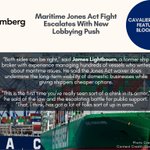
“Both sides can be right,” said James Lightbourn, a former ship broker with experience managing hundreds of vessels who writes about maritime issues. He said the Jones Act waiver does undermine the long-term viability of domestic businesses while giving shippers cheaper options.
“This is the first time you’ve really seen sort of a chink in its armor,” he said of the law and the escalating battle for public support. “That, I think, has got a lot of folks sort of up in arms.”

America’s edge is innovation. Even in maritime, as history shows. For the first time in 70 years, America is positioned to lead a maritime revolution — this time with nuclear power. cavaliershipping.substack.co…

Everyone Is Right About The Jones Act Waiver
And that’s the problem.
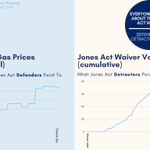
Whether you’re for or against the Jones Act, the waiver enacted during the past three months provided new data points to validate your prior belief. So far, it doesn’t seem as if we’re any closer to a widely-accepted stance on the Jones Act.
Did the Jones Act waiver lower gas prices? No.
Did the Jones Act waiver displace American jobs? No.
Did the Jones Act waiver demonstrate that the Jones Act constrains U.S. maritime trade? Yes.
Did the waiver allow a Chinese state-owned vessel to move what would have otherwise been a Jones Act cargo? Yes.
Where do we go from here?
If we’ve learned anything from the Jones Act waiver, it should be that working in worlds of absolutes, when it comes to the Jones Act, has very real trade-offs. Maritime trade within the U.S. is not at its full potential under the current legislation. However, a blanket waiver can result in vessels controlled by our economic adversaries moving what would have otherwise been protected cargoes.
The answer isn’t to end the waiver. The answer also isn’t to fully repeal the Jones Act.
A framework that prioritizes vessels based on their investment in the U.S. maritime sector — ownership, flag, crew, build — isn’t complicated to imagine.
America first. Allied nations second. State-owned vessels from economic adversaries: not at all.
cavaliershipping.substack.co…

One VLCC, five charter contracts, and huge amounts of money changing hands.
The DHT Puma and its web of commercial contracts is a complex case study on how skyrocketing supertanker rates after U.S. and Israeli attacks on Iran (February 28, 2026) produced unprecedented winners and losers.
To follow the money, we need to untangle the web of commercial contracts that lead back to the 2016-built Very Large Crude Carrier (VLCC) at the center of this story: the DHT Puma.
cavaliershipping.substack.co…

Running a profitable ship finance business is becoming harder and harder.
The interest rate margins for shipowners borrowing money from banks, funds, and leasing houses have decreased by as much 1.5-2.0% in recent years. Great news for shipowners who are already enjoying a booming market stoked by geopolitical disruptions; not-so-great news for ship finance providers who are feeling the pinch in their profitability.
A quick primer (or refresher) on vessel financings:
(1) Vessel financings are typically quoted at an interest rate margin above the prevailing risk-free rate.
(2) Shipowners pay a total interest rate on the borrowed funds equal to the risk-free rate plus the quoted interest rate margin.
(3) Ship finance providers set and negotiate the margin so they can be suitably rewarded for the added risk of lending out their money, instead of investing it into other safer instruments such as U.S. Treasury bills.
A capital provider must be compensated with a higher return — in the case of ship finance providers, higher margins — for taking on increased risk.
One of the simplest ways to estimate risk is by looking at a transaction’s loan-to-value (LTV) ratio. LTV is the loan amount divided by the value of the collateral (in our case, a vessel) securing the loan. The more money one lends against the collateral/a vessel, the more money that vessel will need to make to pay off the loan. If the vessel doesn’t make enough earnings to repay the loan, it may be more challenging to sell the vessel to pay off the outstanding debt.
In recent years, as interest rate margins decreased, did the risk in ship finance transactions decrease as well? Let’s examine a bank’s net interest margin in relation to its portfolio to find out.
Continued on Freight + Fortune: cavaliershipping.substack.co…

USD fuels today’s shipping market; CNY aims to overtake it.
The international shipping market runs on U.S. dollars — even if none of the companies involved in a voyage are American — reminding us daily of the fact that the dollar remains the world’s reserve currency. China is actively working to change this reality.
Global container ship lessor Costamare signed a contract with CSSC (Hong Kong) Shipping Company Limited’s subsidiary Dalian Shipbuilding Industry Co for 16 newbuilding vessels (12 with 9,200 TEU capacity and 4 with 3,100 TEU capacity) to be delivered between the fourth quarter of 2027 and the second quarter of 2030. The order is worth USD 1.3 billion, or rather CNY 9 billion, because the payment will be in Chinese Renminbi — not U.S. dollars.
Costamare, an Athens-based and NYSE-listed company, is the second large Western container ship lessor to enter into a large CNY-denominated newbuilding vessel order with China's state-owned shipping complex CSSC. Seaspan, the world's largest container ship lessor, already procured a total of 18 containerships from CSSC across orders in 2024 and 2025 — all with payment in yuan.
Full post: cavaliershipping.substack.co…

Join me at the @tradewindsnews Shipowners Forum USA 2026 on May 5 in Houston. At the day-long forum, participants will assess the energy shipping outlook and delve into the debates driving U.S. policy forward. The day begins at 10am and I’ll be on a panel at 4:15pm during the ship finance session.
Titled “Financing Energy Shipping in a High-Risk World”, my panel will touch on rising geopolitical tensions, lender and investor risk calculation factors, and how capital providers are navigating the current environment.
Joe Brady (TradeWinds) will moderate, and my fellow panelists are Omar Nokta (@Clarksons_CRSL), Evan Cohen (@firstcitizens), and David Herman (SSY).
Together we’ll discuss financing energy shipping and I look forward to talking about investing in nuclear power as the future “energy” of shipping.
Please reach out if you plan on attending TradeWinds Shipowners Forum USA 2026. I hope to see you in Houston on May 5!

Who’s cashing Uncle Sam’s Maritime Security Program (MSP) checks?
Of the 60 ships in the MSP fleet, 46 (77%) are operated by U.S. subsidiaries of four European shipping conglomerates and the remaining 14 (23%) are U.S.-owned.
U.S. shipping companies collect only $81.2 million of the $348 million paid annually by MSP.
Read on Freight + Fortune why this matters beyond the math: cavaliershipping.substack.co…

[In-Person Event] CMA Shipping Annual Meeting Lunch | April 23 at Noon
This year’s CMA Annual Meeting Lunch on April 23 in Darien, Connecticut features Keynote Speaker Josh Shapiro, President & CEO of Liberty Maritime, the New York-based commercial shipping company specializing in global logistics and providing transport services for military and commercial cargo.
Shapiro oversees Liberty Maritime Corporation’s business operation and executes the company’s strategic business activities. Prior to joining Liberty, he obtained his Master’s Degree in Shipping, Trade and Finance at the Cass Business School of City University in London and has worked with various commercial shipping brokerage firms in London in addition to his government experience as a Personal Aide and Legislative Policy Advisor to a Congressman.
Shapiro is an elected member of the American Bureau of Shipping (ABS) and an associate member of the Association of Shipbrokers and Agents (ASBA).
The CMA Annual Meeting Lunch opens at 12pm at The Water’s Edge at Giovanni’s and is free for all Connecticut Maritime Association (CMA) members in good standing.
RSVP to LParsons (at) MarineMoney (dot) com by April 21 to join us.
I hope to connect with you at the CMA Annual Meeting Lunch at noon on Thursday, April 23!

The Jones Act debate often centers on domestic versus foreign vessels, but that framing misses the true existential threat to oil-carrying tankers in the Jones Act fleet: oil pipelines carrying refined liquids over long distances, from the production site to the consumption site.
The Colonial Pipeline moves more than 100 million gallons of fuel per day between the U.S. Gulf coast and the Northeast. Moving fuel across the Colonial Pipeline’s full length—from Houston, TX to Linden, NJ (just outside of New York City)—costs 7.6 cents per gallon.
A Jones Act MR product tanker transporting fuel from Houston to New York harbor has recently been quoted as high as 14.5 cents per gallon, according to Overseas Shipholding Group CEO Sam Norton.
One of the Jones Act tankers’ largest markets is fuel delivery to Florida, a state with 23 million people but no refineries and no pipeline connectivity. Without any pipelines in place, the cheapest option to get fuel into Florida is transport by tanker.
The current 60-day Jones Act waiver expires in May. The prospect for pipeline expansion might be just getting started.
