


J. M. Sterling retweeted

It is structural. The logic of the American Revolution led to the Civil War. America takes sovereign power through revolution and later the President imposes unity through force. Cronos castrates his father and then devours his children.

J. M. Sterling retweeted
Filiation and love are better than will to power. Memory and continuity are better than revolution. The Son is loved by the Father and the Son does the will of his Father who then gives his Son the throne. This is the ideal we should strive towards. The freudian oedipal structure and the nietzschian ubermensch are not primordial, but fallen.
J. M. Sterling retweeted

We are delighted to announce that "Hoarded Gold: A Book of Old English Wisdom" by Eleanor Parker (@ClerkofOxford) is now published and available worldwide!
To read more about the book, visit: uppsalabooks.com/hoarded-gol…

J. M. Sterling retweeted

My favorite fun fact about the Old Testament is that the Leviathan is the most powerful and feared monster in the whole cosmos. Even the pagans agreed. The Leviathan was mentioned in most ancient religions. It symbolized chaos and destruction, and no mortal man could comprehend it. But according to the Hebrews, it did have one weakness: a small worm that attached itself to its gills and stole its oxygen. Coincidentally, when Christ was on the Cross, He quoted Psalm 22, which says “But I am a worm and not a man…”

J. M. Sterling retweeted

Your annual reminder that Hallowe’en isn’t really about ghosts anyway (they’re more of a Christmas thing) and it’s really about FAIRIES spectator.com/article/hallow… 🧚♀️


J. M. Sterling retweeted

"Yet Alfred is no fairy tale;
His days as our days ran,
He also looked forth for an hour
On peopled plains and skies that lower,
From those few windows in the tower
That is the head of a man."
- G.K. Chesterton

Today is the anniversary of the death of Alfred the Great, who died in 899. Famous for defending his kingdom against Viking invasion, Alfred also strove to rebuild learning and education among the English - to restore both their 'wealth and wisdom': aclerkofoxford.blogspot.com/…

J. M. Sterling retweeted

A few days ago, in the South West of our great British Isles, an elusive and extremely rare White Stag was spotted.
It may not be obvious…
But there will be signs.

J. M. Sterling retweeted

Wait. I think I realized something. That many (most?) people take David vs Goliath to be an underdog story.
David wasn’t the underdog. To those who could not see reality clearly he looked not only to be an underdog but an absurd, unserious, joke. Like a child challenging Mike Tyson to eight rounds.
But for those with eyes to see, David was hands of God. If you could see reality clearly the matchup was as absurd in the other direction. Like Hulk Hogan challenging a hurricane to a wrestling match.
This is not a story about gritty or virtuous underdogs (or cocky, over confident or unworthy bullies), it is a story about the nature of reality.
J. M. Sterling retweeted

We so desperately want to have a plan, but for the future facing us now, there is no plan. There can be no plan; there can only be faithfulness.
J. M. Sterling retweeted

My goal when I started trying crowdfunding to produce historically-styled editions of great texts (like Beowulf and the Poetic Edda shown here) was to tap into the spirit and aesthetic energy of the ages that produced these works initially. For too long these kinds of heroic epics and wonder-tales have been printed according to the bland tastes of academics, but these are stories meant to stir heroic longing and inspire will and imagination! When I heard such tales as a young man, they resounded in my mind with the gilded and cunningly-wrought fury of the North Sea adventurers and chivalric paladins. I want to pass on the tales with the same kind of grandeur.
I know many of you missed the opportunity to reserve one of the Beowulf or Edda books when I was doing the crowdfunding for those; this is one of the downsides to crowdfunding limited-run printing like this. I always get some extras, but there's never enough for the folks who find out about it down the road. I do hope to be able to print some more of these in 2027, but please don't miss the chance for the illuminated Gawain books now, and please share the campaign around so others folks won't miss the chance either!


Good morning! The illuminated Gawain and the Green Knight project is live on Kickstarter!
kickstarter.com/projects/tam…
J. M. Sterling retweeted

I'm glad we've abandoned the pseudoscientific notion that a choleric temperament comes from excess "yellow bile." The idea of irritability, rashness, and stress all deriving from your organs producing an overabundance of some magic fluid is absurd
*retweets high cortisol meme*
J. M. Sterling retweeted
I am a Christian because I believe the ancient myths of the nations are true. I believe that at a point in time the Creator entered into the Creation, and mythology entered into history. He showed us the whole point of everything here, which is the hero's passage through the Far Country as prodigals so that we may return to the fullness of Divine Sonship. He showed us, with His very own life-blood, that sacrifice is the measure of love, and love is the beating heart of the Creator Himself, which lives within us to whatever degree we allow it to.

1. The core of the human experience is orientation to theosis, becoming divine. Any approach to life that aims lower than this can only be a step on the way; it will not ultimately fulfill our final cause. "Is it not written in your Law, ‘I said, you are gods’?" - Jn. 10:34
2. This ascent occurs through extreme love, selfless abandon, heroic virtue. The ancient mythologies point to this, vaguely but consistently. Sacrifice of self is the measure of love.
3. Christ entered into the world, perfectly demonstrating this and inviting participation with Him. He brought mythology into history, gave divine sonship a name and face for all to see. He gave the tasks, conditions, and standards by which human nature can approach its final and total purpose; following Him and becoming like Him is the Way by which we become sons of God in the fullest sense.
J. M. Sterling retweeted

If you want to be a knight enter into realm of fairy and return with a tale. For examples see smith of wootton major and the novices of sais. Your tale will reveal your name.

J. M. Sterling retweeted

"If you do but consider the whol Universe as one united Body, and Man an Epitomy of this Body, it will seem strange to none but Mad-men and Fools that the Stars should have influence upon the Body of Man, considering he being an Epitomy of the Creation, must needs have a Celestial World within himself; for to wind the strings a little higher, If there be a Trinity in the Deity (which is denied, but by none but Ranters) then must there be a Trinity also in all his Works, if there be a Unity in the God-head, there must needs be a Unity in all his Works." ~ Nicholas Culpepper

J. M. Sterling retweeted

The Transmission Problem.
Every civilization faces the same final question. Not the barbarian at the gate – that can be fought. Not the economic collapse – that can be recovered from. The question that cannot be survived if answered wrongly: did you pass it forward?
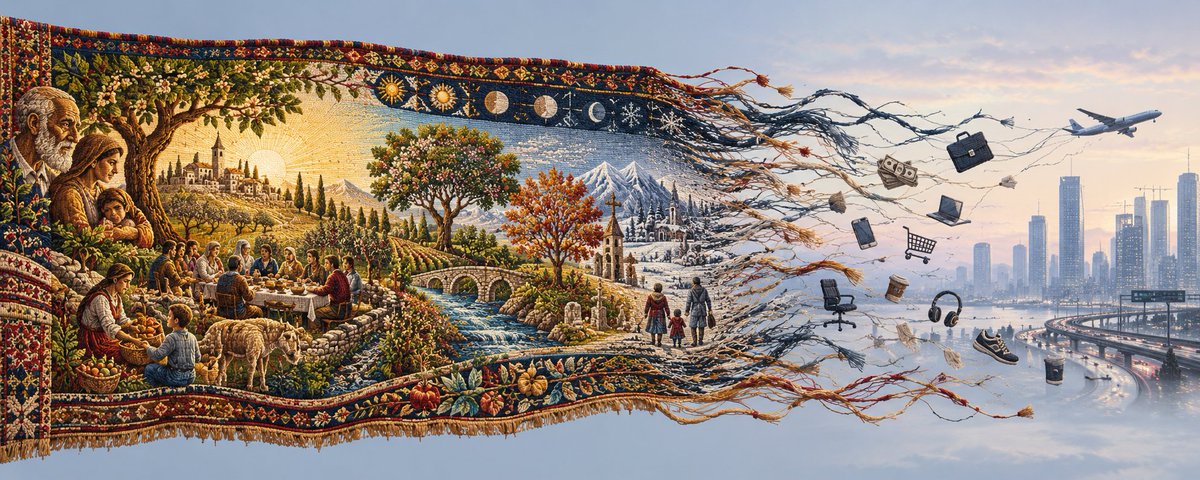
The torch changes hands or it doesn’t. The light doesn’t go out dramatically. It goes out quietly, generation by generation, when the transmission fails – when what was built is not explained, when what was defended is not named, when what was beautiful is not shown to the child who would have loved it if someone had taken the time.
1. The transmission mechanism is the most important institution in any civilization – and the least visible. Not the army, not the economy, not the government. The father who takes his son to the edge of the kingdom at dawn and says: everything the light touches is our kingdom, and one day you will stand here with your own son. The teacher who hands the student a book and says: this will change how you see everything, and it changed how I see everything, and someone handed it to me. The civilization that knows what it is and says so, clearly, to the next person in the chain. The torch doesn’t pass itself. Someone has to carry it, deliberately, to the next set of hands.
2. The long march understood this before the West did. Gramsci’s insight was precisely about transmission – the ruling class maintains power not through force but through controlling what the next generation is taught to think is natural. Capture the school, the university, the media – the transmission mechanisms – and the cultural hegemony reproduces itself automatically, without enforcement, because the next generation never learns that it could think otherwise. The march didn’t attack the civilization directly. It attacked the transmission. Which is more efficient and more permanent – because a civilization that has lost the ability to transmit itself is defeated without ever being confronted.
3. The family is the primary transmission mechanism – and therefore the primary target. Not because the family is politically significant in itself but because it is where the first transmission happens: the values, the stories, the sense of what is worth admiring and what is worth fighting for. The child who grows up in a family that knows what it is and says so becomes a person who knows what they are. The child who grows up in a family that has been taught that its own values are suspect, its own history shameful, its own civilization merely one option among many – that child is already a partial transmission failure. Multiply across a generation and you have what we are currently living through.
4. The school is the secondary transmission mechanism – and the most completely captured. The curriculum that replaced the canon with the critique of the canon. The teacher replaced by the facilitator. The examination replaced by the self-expression. The standard replaced by the affirmation. This is not incompetence – it is the long march’s most successful operation. Deconstructing a civilization’s transmission mechanism produces, reliably and by design, a generation with nothing to transmit. That was the point. The generation that cannot read the primary sources cannot assess the argument that the primary sources are oppressive. It simply accepts the conclusion, because it has no access to the evidence that would allow it to disagree.
5. The culture is the tertiary transmission mechanism – the stories, images, music, and beauty that transmit the civilization’s values below the level of argument. Homer transmitted Greek civilization for centuries before anyone theorized about what Greek civilization was. Shakespeare transmitted the English-speaking world’s understanding of human nature for four hundred years. The fairy tale transmitted the moral grammar of European civilization to children too young for philosophy. The long march captured this too – Hollywood, the prize committees, the arts funding, the music industry – and replaced the transmission with its own content. The child who grows up on a cultural diet produced by the captured mechanism is being transmitted to. The question is what is being transmitted.
6. This series is an act of transmission. Not primarily an argument – an attempt to pass forward the vocabulary, the framework, the sense of what the civilization is and what it is worth, in the format that reaches the person who will not read the primary sources but who will read this. The secondhand dealer in ideas, in Hayek’s formulation – making thinkable for millions what the primary producer made possible. Every piece is a link in the chain. The chain runs from Homer to Aristotle to Cicero to Augustine to Aquinas to Montesquieu to Burke to Tocqueville to Hayek to this feed to the person reading it now. The chain is only as strong as its weakest link. The weakest links are the ones the long march attacked. This is an attempt at repair.
7. The transmission problem has one solution and it is not institutional – it is personal. You cannot transmit a civilization through a policy. You can only transmit it through a person who has received it and passes it forward deliberately, to a specific other person, in the full knowledge that the chain depends on this act. The father and the son at the edge of the kingdom. The teacher and the student with the book. The writer and the reader with the vocabulary. Every act of genuine transmission is an act of civilizational resistance – because the managed reality depends on the chain being broken, on each generation starting fresh without the inheritance, on the past being made inaccessible so that the present can be managed. Break the managed access to the past. Pass it forward. To your children first. Then to everyone else.
The torch changes hands or it doesn’t.
You are holding it now.


Is Poland Saving Western Civilization? 🇵🇱🏛️🗽
A US Senator asked the question. It deserves a serious answer.
The short answer is: we are trying. We have done it before. We know what it costs.
The longer answer requires understanding why the view from Warsaw is the clearest available – and why the diagnosis of what is happening to the West keeps coming from the East.
1. Poland has been at the intersection of the two great totalitarianisms of the twentieth century. Not as an observer – as the primary victim. The Nazi-Soviet Pact of 1939 was not an alliance between opposites. It was a cooperation between variants of the same system – two collectivisms dividing between them the country that stood in the way. We lost six million people. We lost Warsaw, rebuilt stone by stone from memory. We lost forty-five years to Soviet occupation. And then, in 1989, we did something nobody thought possible: we got out. Not through revolution – through the slow, patient, organized accumulation of resistance that the system could not finally contain. The word for what we learned in that process is zakłamanie – the systematic societal lie that the system requires to function. We know it from the inside. We know its smell, its texture, its specific weight in a room. When we see it operating in Western institutions, we recognize it immediately. The West is still learning the vocabulary. We have been living inside it.
2. This is not the first time Poland has stood at the hinge of Western history.
Vienna 1683 – Sobieski rode down the hill with the Polish Winged Hussars cavalry when the Ottoman army was at the gates of Europe and everyone else was calculating the cost of resistance. He didn’t calculate. He rode.
1920 – the Battle of Warsaw stopped the Red Army from reaching Western Europe. Lord D’Abernon called it the eighteenth decisive battle of world history. If Warsaw had fallen, the revolution would have probably reached Germany, France, the West – before it had produced the antidotes. The course of the twentieth century would have been different. It didn’t fall.
1980 – Solidarity cracked the Iron Curtain when cracking it seemed impossible.
1989 – Poland again – the Round Table agreement that began the democratic domino effect across Eastern Europe started in Warsaw.
The pattern is not coincidence. It is geography, history, and the specific formation that comes from being the country that cannot afford to be wrong about power.
3. The wound produces the clarity. This is the key mechanism. Poland has been processed by both totalitarianisms – has lived inside the systematic lie, has learned what it costs to name it and what it costs not to, has developed the cultural antibodies that the West is now discovering it needs and does not have. The smile that doesn’t come easily. The directness that sounds harsh to ears trained on managed reality. The instinct to name what is happening before the naming becomes dangerous – because we have lived in the world where it becomes dangerous, and we know how fast that transition occurs. The West looks at Eastern Europe and sees countries that haven’t quite caught up. Eastern Europe looks at the West and sees countries that are catching down – toward something we recognize, something we spent decades trying to escape, something we would very much prefer not to return to.
4. The vocabulary is the contribution. Zakłamanie – systemic societal lying, the managed reality that corrupts categories of thought. Obłuda – performative hypocrisy, the mask of falsehood worn so long it becomes the face. The Systemic Lie – not individual dishonesty but the institutionalized replacement of truth with the appearance of truth across every surface simultaneously. These are not theoretical concepts. They are survival tools, developed by a civilization that needed them to survive. When this series uses them to describe what is happening in Brussels, in Paris, in the captured universities and the content moderation departments and the fact-checking organizations – it is not importing foreign concepts. It is returning concepts to the civilization that produced the conditions requiring them, with the precision that comes from having had to use them in earnest.
5. The series you are reading is one answer to the Senator’s question. Not the only answer. The most important answer is Poland itself: the country that has maintained its civilizational vitality while Western Europe collapses, that has built a functioning economy while its neighbors stagnate, that has maintained its identity while the managed reality tries to dissolve it, that has said no to the mechanisms of the long march with a clarity that comes from knowing exactly what those mechanisms lead to. Poland is not perfect. No country is. But it is one of the few places in the Western world where the question "what are we for?" has a clear answer – and where that answer is transmitted, generation to generation, in the family, the church, the school, the culture, with the urgency of people who know what happens when the transmission fails.
6. Musk reposts. Milei reposts. A US Senator asks the question. European politicians stay silent. This distribution of attention is itself diagnostic. The people who are fighting the managed reality recognize the vocabulary because they need it. The people who are maintaining it stay silent because they recognize it for what it is – a threat to the system that produced them and that they are producing in turn. The silence of European institutions is not ignorance. It is acknowledgment. They know what is being said. They know it is true. They know that engaging with it on its own terms would require admitting things that the system cannot admit and remain the system.
7. Is Poland saving Western civilization? The question assumes that saving is something one country does for another. It is not. It is something a civilization does for itself – through the specific people and places that have maintained the clearest view of what the civilization is, what threatens it, and what it costs to defend it. Poland is one of those places. The wound is real. The clarity it produces is real. The vocabulary it generates is being used, right now, by people on every continent who are trying to name what is happening to their countries and find the courage to say so.
There is a Polish motto that captures this precisely – one that has accompanied every Polish fight for freedom since the nineteenth century: Za wolność naszą i waszą. For your freedom and ours. It was the motto of the Polish officers who fought in the uprisings against the partitioning powers and in every war where Poles went to fight for someone else’s freedom because they understood, instinctively, that freedom is indivisible – that the freedom lost in Warsaw is eventually lost in Paris, and the freedom defended in Vienna is eventually defended everywhere.
The Winged Hussars rode down the hill at Vienna in 1683 not because Vienna was Poland – but because the civilization was one thing, and what threatened it threatened everything. Za wolność naszą i waszą. The motto is more durable than any alliance. It is the specific Polish understanding that you cannot defend your own freedom while remaining indifferent to someone else’s.
Tell the truth. Have courage. And build. We learned this the hard way. We are passing it forward. That is what civilizations do when they intend to survive.
Za wolność naszą i waszą used to be the motto of our fight.
It still is. 🇵🇱🗽
J. M. Sterling retweeted
Gold and green, illumination and binding worthy of the strangest Christmas feast in Arthurian legend.
Sir Gawain’s year-and-a-day is coming. Don’t let the campaign slip past you; sign up for the launch notification now for when we go live in October!
kickstarter.com/projects/tam…