

Views are my own. Not investment advice. On here mostly quoting Bruce Lee and Walt Longmire.
Joined January 2021
- Tweets36.7K
- Following3.4K
- Followers18.6K
- Likes236K


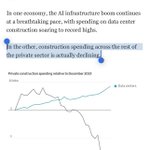


“I think the level of underlying rates is going to be higher for longer. The fact that $500 billion of Ai issuance is taking place this year is crowding out…the statement that something in the private sector is so large that it would actually crowd out Treasuries has never happened before, but it’s that big.” - @realsteveeisman Oct 2026

John Rotonti Jr retweeted

EMERGENCY ANTHROPIC S-1 PODCAST $ANT
- Better financials than we thought?
- Missing competitive advantages
- Governance issues galore
- What price would we buy it at?
Listen wherever you get your podcasts
YouTube: youtube.com/watch?v=AvWVKi6N…
Spotify: open.spotify.com/episode/3lZ…
Apple: podcasts.apple.com/us/podcas…
I think deserves to be shared again. Enjoy...

This slide is from Antero Peak's (part of Artisan Partners) Q2:2026 update. I appreciate how they have an investing process based on (1) change in ROIC, (2) earnings revisions, and (3) EPS growth...as well as how they show the three-year expected change in ROIC and EPS growth for the Antero Peak portfolio compared to the S&P 500. This is not an investment recommendation...

John Rotonti Jr retweeted

1/ Rollins has been one of the great compounders of the last 30 years but the stock is down ~50% in 12 months.
Most people now ask themselves if its cheap. I think the better question is one almost nobody asked before: what does it cost Rollins to stand still?

"The 10-year Treasury has “taken a backseat” to other opportunities in fixed income, Rieder added. Even with its yield above 5%, Rieder views the benchmark increasingly less as a core investment and more as a market barometer, often for equities. Instead, investors can earn about 7% in short-dated, single-A-rated portfolios while avoiding the duration risk associated with longer-term government debt, he said. “I’ve spent much of my career waiting for 7% yields,” he said." - Rick Rieder

“I’ve never seen anything like it in terms of the size of the financing that’s coming in both debt markets, equity markets.” - Rick Rieder
bloomberg.com/news/articles/…
From the GOAT @ptj_official on CNBC today...
“We are literally exactly like 1999 in the sense that we have a two-speed economy.”
“2027 is going to be really, really challenging for the stock market because if I look at the flows, which is what I look at the most, you've probably got the most negative flow picture for the U.S. stock market that we’ve had, say, since 2002.”
“certainly the most negative flow picture since 2009.”
John Rotonti Jr retweeted

Vincent Deluard (@VincentDeluard) on where the VIX would be with normal correlations:
“What’s been extraordinary really since the summer is that this correlation matrix basically is zero. We have about a third of US stocks trading at negative beta.”
“The average stock correlation with indexes is around 5%. This is unprecedented. It probably has to do with pair trades by pod shops, the AI trade and great earnings.”
“I’ve actually recalculated where the VIX would be if we had a normal correlation between stocks. By normal, I mean 50-60%. The VIX would be around 40.”
"We’re electrifying the world for many reasons, chief among them the so-called energy transition. The original driving force of the transition, led by the Carter administration, wasn’t the need to adopt clean energy with climate change in mind; it was driven by an urgent need for energy security in response to the oil shocks of the 1970s. We’re seeing a repeat today: the crisis in the Strait of Hormuz and bottlenecks elsewhere, impacting our ability to source and transport hydrocarbons, is forcing states to turn to electrification."

Higher for longer - that was the core message in my discussion with @CNBC Squawk Box Europe this morning.
Everyone is focused on the spot price of oil. But look further out: calendar 2027 Brent is holding around $97 a barrel. That’s close to $100 priced in for an entire year, not simply a short-term spike. That has implications for everything from industrial and agriculture production to transportation costs and inflation in the months ahead.
Now look at energy equities. The Munificent 7 are hitting all-time highs as the back end of the oil curve approaches $100. This is looking increasingly structural, not transient. It's the Revenge of the Old Economy in action.
The old economy is short-duration, asset-heavy and benefiting from higher commodity prices, whereas the new economy is long-duration, asset-light and increasingly exposed to higher interest rates and inflation.
The irony in all this is that the old economy is fuelling the new economy. AI needs electricity, transformers, copper, high-voltage cables and critical minerals. None of that exists without the physical world.
‘Generalists’ in the market are beginning to recognise what specialists across the physical economy has been telling us for some time: higher for longer isn't just centred on bottlenecks and disruption to the flow of hydrocarbons out of the Strait of Hormuz. Instead, it’s a structural shift that is likely here to stay.
We’re electrifying the world for many reasons, chief among them the so-called energy transition. The original driving force of the transition, led by the Carter administration, wasn’t the need to adopt clean energy with climate change in mind; it was driven by an urgent need for energy security in response to the oil shocks of the 1970s.
We’re seeing a repeat today: the crisis in the Strait of Hormuz and bottlenecks elsewhere, impacting our ability to source and transport hydrocarbons, is forcing states to turn to electrification.
Great discussion with @cnbcKaren and Steve Sedgwick - thank you for having me on.
"The irony in all this is that the old economy is fuelling the new economy. AI needs electricity, transformers, copper, high-voltage cables and critical minerals. None of that exists without the physical world."
Higher for longer - that was the core message in my discussion with @CNBC Squawk Box Europe this morning.
Everyone is focused on the spot price of oil. But look further out: calendar 2027 Brent is holding around $97 a barrel. That’s close to $100 priced in for an entire year, not simply a short-term spike. That has implications for everything from industrial and agriculture production to transportation costs and inflation in the months ahead.
Now look at energy equities. The Munificent 7 are hitting all-time highs as the back end of the oil curve approaches $100. This is looking increasingly structural, not transient. It's the Revenge of the Old Economy in action.
The old economy is short-duration, asset-heavy and benefiting from higher commodity prices, whereas the new economy is long-duration, asset-light and increasingly exposed to higher interest rates and inflation.
The irony in all this is that the old economy is fuelling the new economy. AI needs electricity, transformers, copper, high-voltage cables and critical minerals. None of that exists without the physical world.
‘Generalists’ in the market are beginning to recognise what specialists across the physical economy has been telling us for some time: higher for longer isn't just centred on bottlenecks and disruption to the flow of hydrocarbons out of the Strait of Hormuz. Instead, it’s a structural shift that is likely here to stay.
We’re electrifying the world for many reasons, chief among them the so-called energy transition. The original driving force of the transition, led by the Carter administration, wasn’t the need to adopt clean energy with climate change in mind; it was driven by an urgent need for energy security in response to the oil shocks of the 1970s.
We’re seeing a repeat today: the crisis in the Strait of Hormuz and bottlenecks elsewhere, impacting our ability to source and transport hydrocarbons, is forcing states to turn to electrification.
Great discussion with @cnbcKaren and Steve Sedgwick - thank you for having me on.
John Rotonti Jr retweeted

It’s kinda crazy to me that we melt sand down, clean it to 99.99999% purity, literal wizards have to draw it slowly into an ingot, we cut it, inscribe a hundred billion little on/off switches on it, and when you run electric current through it you can do basic arithmetic, which when you do enough of it can do any math on the planet, and which describes reality well enough that we can teach it the ontological meaning of words and their distance from each other on a high-dimensional space, and if you ask, it can tell you what word comes next and that apparently is powerful enough that if you do it a hundred billion times it’s the smartest thing to ever exist
oh yeah and we use this primarily for email
“Inflation adjusted, the proceeds from every US IPO in 1999 totaled $133 bn. SpaceX and Anthropic alone will raise around $180 bn this year.” - @DataTrekMB Oct 26, 2026
“The larger question is productivity. For all the discussion about AI transforming the economy, we still have not seen a decisive AI-driven productivity acceleration in the aggregate statistics. That remains one of the most important missing pieces of the AI story.” - Professor Jeremy Siegel Oct 26, 2026
John Rotonti Jr retweeted

I grew up with the Fool when @TMFOtter anchored the morning show along with @JRogrow and @JimPGillies as a regular. Bill's take this morning re the debt markets, while a macro take, is essential viewing.
I'm not sure anyone investing today has seen growth of this magnitude. And then I think: what if the Ai (and larger reindustrialization) buildout is just getting started?!!
(Not investment advice).
"Our ability to predict on a three-year basis — it’s low. On a five-year basis — it’s impossible.” - Pablo Salame, Citadel co-CIO (alongside Ken Griffin)
bloomberg.com/news/articles/…
