

AI Native Services for Founders | 20+ yrs | 20+ Exits From IPOs To Acquisitions | JTBD | Category Design
Revenue Scaling Blueprint
Joined May 2007
- Tweets5.9K
- Following2.1K
- Followers3.8K
- Likes2.7K



Most claims on B2B software homepages have nothing beside them. Klype checked 600 across 104 sites. About three in four showed no source.
Buyers check. In one AI Revenue Institute survey, most run sales claims past an AI.
A number with nobody's name on it reads like a guess.
An AI interviewer averaged 31 questions per half-hour chat. Humans averaged 14.
University of Copenhagen researchers found the AI drew 65% more text. Answers got no more specific, and only its participants hit skip.
Extra questions are cheap. Specific answers are the work.
Sellers usually blame a loss on price, features or committee politics.
Buyers told Corporate Visions something else. In 150,000 B2B decisions, they said the losing seller could have won more than half the deals that went to a rival.
Blame price, and nobody has to fix a thing.
The Specificity Test is everywhere: one detail only you could write, or the post fails.
Lived detail helps. It still leaves the market claim empty. Buyers get a better anecdote in the same founder feed.
So I work with founders to nail their category first. Then the detail has something to prove.
De-slop products pitch a one-pass cleanup so you can skip rereading 1,400 words.
They fix tells and readability scores. A wrong idea and an empty market claim still sail through.
READ the draft. Comprehension is the check that tools cannot replace.
One reread catches what a fast paste hides. A history professor hid "Madagascar" in white text inside a midterm prompt. Of 35 students, 32 turned in answers with it dropped in at random.
The paste took seconds. Nobody reread it.
Reading what your AI gave you is the job now. Do your damn job, please.
Ask ChatGPT for the best CRM and you get one list. Ask for the best CRM for a 20-person team on Google Workspace and you get another.
Empact Partners ran that test in 30 software categories on Oct. 14. The top pick changed in 21 of them.
Your buyers type the second question.
Nobody can check a 20-year cost-benefit estimate over lunch. Anyone can check a footnote.
Deloitte's report on merging three Perth universities cited wrong authors and links. It said professionals reviewed its AI work.
Footnotes are where readers decide whether to trust you.
For most managers, the job shifted from making the work to checking what an AI made.
A new Wharton and GBK Collective survey put it at 72% of managers and above. For vice presidents and up, it was 82%.
So promote the managers who catch what the draft got wrong.
A live interview costs about five times what an AI one does. That sets how many customers you hear.
On equal budgets in a September study, AI interviews found more than twice as many customer needs.
The customer you never interviewed can't tell you what you got wrong.
“Being inoffensive, and being offended, are now the twin addictions of the culture.”
— Martin Amis
via the 5-Bullet Friday newsletter (tim.blog/fbf) from @tferriss

Trust puts more vendors on shortlists than outreach does.
In a Reality Department survey of 250 UK B2B buyers, half said a peer's recommendation or a name they knew put the winner on the list. Outreach did it for 19%.
So get known for one problem before anyone shops for a fix.
Reps redo marketing's content when the buyer is fuzzy.
In Science of Scaling's surveys of more than 300 sales leaders, 7% said it fits a live deal as is. For 10%, the teams define the buyer differently.
If the teams can't describe the same buyer, the content won't reach one.
Strip the names off CRM taglines and buyers barely tell them apart. Wynter tested five on 100 marketing leaders. They matched 1.86 of 5. Guessing scores 1.
Same study: 57% picked their last vendor on ease, trust or price.
Generic copy leaves buyers nothing to choose you for.
Leaders are guessing whether their people know the strategy. In an OKRs Tool survey of 180 strategy and operations leaders, 64% said half or fewer could name the top priorities.
Each number is a guess.
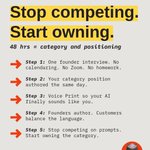
I trained Carter to ask each person, no calendaring. Then you read their words.
A polished AI draft can still get the facts wrong. Templafy asked 2,000 U.S. and U.K. workers: 60% called the first draft usable with minimal edits. Accuracy topped the list of fixes at 40%.
Smooth sentences invite skimming. Read every claim as if a stranger wrote it.
Buyers can tell when nobody asked them anything. Arcade surveyed 600 B2B software buyers this year: for 48%, feeling understood shaped the decision.
AI lists the pains every vendor lists. The specific one comes from your customers.
So I ask about the week they started looking.
A new category's hard part is naming what's missing. "The Category Creation Formula" calls it context plus missing plus innovation.
AI can write the context and the product. The missing part takes years hearing what buyers can't get.
Founders know it. My interviews get it out.
A lot of AI output gets used without a real read. Resume Now polled 1,012 U.S. workers. Thirty-five percent rarely or only occasionally review AI output before using it. Eighteen percent usually trust it as is.
The tool did its job. The unread draft is yours.