

こんにちは! Japanese language coach 🎓 I introduce some topics related to Japanese. Let's explore various aspects of Japanese language and culture together 🎌
Joined December 2019
- Tweets960
- Following1.8K
- Followers3.4K
- Likes704




Pinned Tweet
Learning Japanese from zero? Start with Hiragana! 🇯🇵
Here are two free beginner-friendly resources you can use today:
1️⃣ Hiragana introduction article
🔗 japanologyclub.wixsite.com/m…
2️⃣ Free Hiragana chart + writing practice worksheet
🔗 ko-fi.com/s/8c44577420
Enjoy your journey!

【🚶 Japanese Onomatopoeia: Movement & Actions】
💡 Japanese onomatopoeia can describe not just sounds, but also how people and things move!
🚶 うろうろ /urouro/
: wandering around / moving about aimlessly
🐢 のろのろ /noronoro/
: moving very slowly / sluggishly
🚶♂️ すたすた /sutasuta/
: walking briskly and confidently
🌀 ぐるぐる /guruguru/
: going round and round / spinning
🏃 ばたばた /batabata/
: rushing around / moving about frantically
🤫 こっそり /kossori/
: secretly / without being noticed
🦘 ぴょんぴょん /pyonpyon/
: hopping / jumping repeatedly
🚶 とぼとぼ /tobotobo/
: walking slowly with a dejected or tired air
📌 Form:
- Onomatopoeia + V
- Onomatopoeia + と + V
- Onomatopoeia + する (for certain expressions)
🧩 Examples:
① 駅(えき)の周(まわ)りをうろうろしました。
/Eki no mawari o urouro shimashita./
➡️ I wandered around the station.
② 彼(かれ)はすたすた歩(ある)いていきました。
/Kare wa sutasuta aruite ikimashita./
➡️ He walked off briskly.
③ 子供(こども)たちがぴょんぴょん跳(と)んでいます。
/Kodomo-tachi ga pyonpyon tonde imasu./
➡️ The children are hopping up and down.
🔎 Points:
• These expressions describe the manner of movement, not simply the action itself.
• Some expressions can be used with する, while others naturally modify a verb.
• と is optional with some expressions but required or preferred with others.
• こっそり describes doing something discreetly, not a particular physical movement.
⭐ :
Use Japanese onomatopoeia to make descriptions of movement more vivid and natural!
#Japanese #JLPT #日本語

【🔊 Japanese Onomatopoeia: Sounds】
🌧️ ざあざあ /zāzā/
: pouring / heavy rain falling
🌬️ びゅうびゅう /byūbyū/
: wind howling / blowing strongly
🚪 どんどん /dondon/
: repeated loud banging or pounding
🪟 がたがた /gatagata/
: rattling / clattering
👏 ぱちぱち /pachipachi/
: clapping / crackling
🔔 ちりんちりん /chirinchirin/
: light, repeated ringing
🐱 にゃあにゃあ /nyānyā/
: meowing
🐦 ちゅんちゅん /chunchun/
: chirping (small birds)
💡 Usage:
Sound onomatopoeia often describe how something sounds and can be used with verbs such as 降(ふ)る /furu/ (to fall, for rain), 鳴(な)る /naru/ (to ring or sound), and 鳴(な)く /naku/ (to make an animal sound).
📌 Form:
- Onomatopoeia + と + V
- Onomatopoeia + V (without と, depending on the expression)
🧩 Examples:
① 雨(あめ)がざあざあ降(ふ)っています。
/Ame ga zāzā futte imasu./
➡️ It's raining heavily.
② ドアをどんどんたたいています。
/Doa o dondon tataite imasu./
➡️ Someone is banging repeatedly on the door.
③ 猫(ねこ)がにゃあにゃあ鳴(な)いています。
/Neko ga nyānyā naite imasu./
➡️ The cat is meowing repeatedly.
🔎 Points:
• Repeated sounds often express continuous or repeated noises.
• Some expressions also have non-sound meanings. For example, どんどん can mean “rapidly” or “one after another.”
• と is not always required; the natural pattern depends on the expression and verb.
#Japanese #JLPT #日本語

【💓 Japanese Onomatopoeia: Feelings】
✨ わくわく /wakuwaku/
: excited / looking forward to something
💓 どきどき /dokidoki/
: heart pounding (excitement or nervousness)
😤 いらいら /iraira/
: irritated / frustrated
😰 そわそわ /sowasowa/
: restless / unable to settle down
😟 もやもや /moyamoya/
: feeling unsettled / mentally unclear
😌 ほっと /hotto/
: relieved / feeling at ease
😞 がっかり /gakkari/
: disappointed / let down
😊 にこにこ /nikoniko/
: smiling happily
💡 Usage:
These expressions often combine with する to describe feelings or reactions.
🧩 Examples:
① 明日(あした)の旅行(りょこう)にわくわくしています。
/Ashita no ryokō ni wakuwaku shite imasu./
➡️ I'm excited about tomorrow's trip.
② 試験(しけん)の前(まえ)はどきどきします。
/Shiken no mae wa dokidoki shimasu./
➡️ I get nervous before exams.
③ 話(はなし)を聞(き)いて、ほっとしました。
/Hanashi o kiite, hotto shimashita./
➡️ I felt relieved after hearing the news.
#Japanese #JLPT #日本語

【🔍 Similar Japanese: そう vs らしい vs みたい】
💡 Meaning:
👀 ~そう /sō/
: looks / seems
→ A judgment based on appearance or immediate signs.
📰 ~らしい /rashii/
: apparently / I hear that
→ An inference often based on reported information or indirect evidence.
💭 ~みたい /mitai/
: seems / looks like
→ A conversational expression for an impression or inference based on available clues.
📌 Form:
① ~そう (appearance)
- Vます-stem + そう
- い-adj (without い) + そう
- な-adj (stem) + そう
② ~らしい
- V (plain form) + らしい
- い-adj (plain form) + らしい
- な-adj (stem) + らしい
- N + らしい
③ ~みたい
- V (plain form) + みたい
- い-adj (plain form) + みたい
- な-adj (stem) + みたい
- N + みたい
🧩 Examples:
① このケーキはおいしそうです。
/Kono kēki wa oishisō desu./
➡️ This cake looks delicious.
② あの店(みせ)はおいしいらしいです。
/Ano mise wa oishii rashii desu./
➡️ Apparently, that restaurant has good food.
③ あの店(みせ)は休(やす)みみたいです。
/Ano mise wa yasumi mitai desu./
➡️ It looks like that restaurant is closed.
🔎 Points:
• ~そう (appearance) describes what something looks or seems like, often based on immediate evidence.
• ~らしい often relies on reported information or other indirect evidence.
• ~みたい is conversational and can express an inference based on direct or indirect evidence.
• ⚠️ いい → よさそう / ない → なさそう.
• ⚠️ ~そう also expresses hearsay with a different form: plain form + そう (N / な-adj: だ + そう). Example: おいしいそうです = I hear it's delicious.
⭐ Summary:
そう = appearance; らしい = often information-based inference; みたい = conversational inference.
#Japanese #JLPT #日本語


【🔍 Similar Japanese: ある vs いる】
💡 Meaning:
📦 ある /aru/
: to exist / there is / to have
→ Used for things, plants, and events.
🐱 いる /iru/
: to exist / there is / to have
→ Used for people and animals.
🧩 Examples:
① 机(つくえ)の上(うえ)に本(ほん)があります。
/Tsukue no ue ni hon ga arimasu./
➡️ There is a book on the desk.
② 公園(こうえん)に猫(ねこ)がいます。
/Kōen ni neko ga imasu./
➡️ There is a cat in the park.
③ 庭(にわ)に木(き)があります。
/Niwa ni ki ga arimasu./
➡️ There is a tree in the garden.
④ 教室(きょうしつ)に学生(がくせい)がいます。
/Kyōshitsu ni gakusei ga imasu./
➡️ There are students in the classroom.
🔎 Points:
• Both commonly use the pattern: Place + に + Noun + が + あります / います.
• ある is used for plants, even though they are living things.
• For existence, the negative forms are ない (ある) and いない (いる).
⭐ Summary:
ある = things, plants, and events; いる = people and animals.
#Japanese #JLPT #日本語
【🔍 Similar Japanese: 知る vs 分かる】
💡 Meaning:
🧠 知(し)る /shiru/
: to learn / to find out / to come to know
→ Gaining information or becoming aware of something.
💡 分(わ)かる /wakaru/
: to understand / to know
→ Understanding information, meaning, or how something works.
🧩 Examples:
① そのニュースを知(し)っています。
/Sono nyūsu o shitte imasu./
➡️ I know about that news.
② この言葉(ことば)の意味(いみ)が分(わ)かります。
/Kono kotoba no imi ga wakarimasu./
➡️ I understand the meaning of this word.
③ 彼(かれ)の名前(なまえ)を知(し)っていますか。
/Kare no namae o shitte imasu ka?/
➡️ Do you know his name?
④ この問題(もんだい)の答(こた)えが分(わ)かりますか。
/Kono mondai no kotae ga wakarimasu ka?/
➡️ Do you know the answer to this question?
🔎 Points:
• 知る usually takes を, while 分かる usually takes が.
• To express an existing state of knowledge, use 知っています, not 知ります.
• 知りません = I don't know; 分かりません = I don't know / I don't understand. Their meanings can overlap, but they are not always interchangeable.
⭐: 知る focuses on acquiring or possessing knowledge; 分かる focuses on understanding.
#Japanese #JLPT #日本語

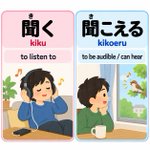
【🔍 Similar Japanese: 聞く vs 聞こえる】
💡 Meaning:
👂 聞(き)く /kiku/
: to listen to / to hear / to ask
→ Directing your attention to a sound, or asking for information.
🔊 聞(き)こえる /kikoeru/
: to be audible / can hear
→ A sound is audible to you without necessarily trying to listen.
🧩 Examples:
① 音楽(おんがく)を聞(き)きます。
/Ongaku o kikimasu./
➡️ I listen to music.
② 外(そと)から鳥(とり)の声(こえ)が聞(き)こえます。
/Soto kara tori no koe ga kikoemasu./
➡️ I can hear birds chirping outside.
③ 先生(せんせい)に質問(しつもん)を聞(き)きます。
/Sensei ni shitsumon o kikimasu./
➡️ I ask the teacher a question.
🔎 Points:
• 聞く usually takes を for sounds or に for the person you ask.
• 聞こえる usually takes が to mark the sound that is audible.
• 聞こえる describes audibility, while 聞ける can express the ability or opportunity to listen.
⭐ Summary:
聞く = listening or asking; 聞こえる = being audible.
#Japanese #JLPT #日本語
【🔍 Similar Japanese: 見る vs 見える】
💡 Meaning:
👀 見(み)る /miru/
: to look at / to watch / to see
→ Directing your attention toward something to see it.
✨ 見(み)える /mieru/
: to be visible / can see
→ Something is visible to you, without necessarily trying to look at it.
🧩 Examples:
① テレビを見(み)ます。
/Terebi o mimasu./
➡️ I watch TV.
② 窓(まど)から海(うみ)が見(み)えます。
/Mado kara umi ga miemasu./
➡️ I can see the ocean from the window.
③ あの山(やま)が見(み)えますか。
/Ano yama ga miemasu ka?/
➡️ Can you see that mountain?
🔎 Points:
• 見る usually takes を; 見える usually takes が.
• 見える expresses visibility, while 見られる can express the ability or opportunity to see something.
⭐ Summary:
見る = looking or watching; 見える = being visible.
#Japanese #JLPT #日本語
【💼 Useful Japanese: At Work】
In formal business situations, we have a lot of important phrases and greetings that are sometimes hard to translate literally. It's good to understand the nuances and concepts behind those phrases!
👋 お疲(つか)れ様(さま)です。 /Otsukaresama desu./
: A common workplace greeting used to acknowledge coworkers.
🚪 お先(さき)に失礼(しつれい)します。 /Osaki ni shitsurei shimasu./
: Excuse me for leaving before you.
🤝 よろしくお願(ねが)いします。 /Yoroshiku onegai shimasu./
: I look forward to working with you.
✅ 承知(しょうち)しました。 /Shōchi shimashita./
: Understood. (polite/formal)
🙏 お世話(せわ)になっております。 /Osewa ni natte orimasu./
: A standard greeting in business emails and professional communication.
📢 お疲(つか)れ様(さま)でした。 /Otsukaresama deshita./
: A common expression after work or a completed task.
💬 少々(しょうしょう)お待(ま)ちください。 /Shōshō omachi kudasai./
: Please wait a moment.
🙇 申(もう)し訳(わけ)ありません。 /Mōshiwake arimasen./
: I'm very sorry. (formal apology)
#Japanese #JLPT #日本語

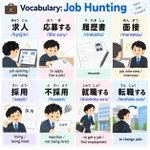
【💼 Vocabulary: Job Hunting】
Are you planning on job hunting in Japan? Knowing these words might help!
🔎 求人(きゅうじん) /kyūjin/
: job opening / job listing
📝 応募(おうぼ)する /ōbo suru/
: to apply (for a job)
📄 履歴書(りれきしょ) /rirekisho/
: résumé
🗣️ 面接(めんせつ) /mensetsu/
: job interview / interview
🏢 採用(さいよう) /saiyō/
: hiring / being hired
❌ 不採用(ふさいよう) /fusaiyō/
: rejection / not being hired
💼 就職(しゅうしょく)する /shūshoku suru/
: to get a job / find employment
🔄 転職(てんしょく)する /tenshoku suru/
: to change jobs
#Japanese #JLPT #日本語
【💼 Vocabulary: Office & Work Tasks】
🗣️ 会議(かいぎ) /kaigi/
: meeting
📄 資料(しりょう) /shiryō/
: documents / materials
📧 メール /mēru/
: email
📅 予定(よてい) /yotei/
: schedule / plans
📢 報告(ほうこく) /hōkoku/
: report / reporting
📞 連絡(れんらく) /renraku/
: contact / communication
💬 相談(そうだん) /sōdan/
: consultation / discussion
⏳ 締(し)め切(き)り /shimekiri/
: deadline
#Japanese #JLPT #日本語
【💼 Vocabulary: Working Conditions】
You may see these words when you're looking for an opportunity in a Japanese company!
💴 給料(きゅうりょう) /kyūryō/
: salary / pay
⏱️ 時給(じきゅう) /jikyū/
: hourly wage
🕐 勤務時間(きんむじかん) /kinmu jikan/
: working hours
☕ 休憩時間(きゅうけいじかん) /kyūkei jikan/
: break time
📅 休日(きゅうじつ) /kyūjitsu/
: day off / holiday
🏖️ 有給休暇(ゆうきゅうきゅうか) /yūkyū kyūka/
: paid leave
🌙 残業(ざんぎょう) /zangyō/
: overtime
🚃 通勤(つうきん) /tsūkin/
: commuting / commute
#Japanese #JLPT #日本語
【💼 Vocabulary: Employment & Job Types】
👔 正社員(せいしゃいん) /seishain/
: full-time permanent employee
📄 契約社員(けいやくしゃいん) /keiyaku shain/
: contract employee
🏢 派遣社員(はけんしゃいん) /haken shain/
: temporary agency worker
🧑💼 パート /pāto/
: part-time worker
🛍️ アルバイト /arubaito/
: part-time / casual worker
💻 フリーランス /furīransu/
: freelancer
🏠 自営業(じえいぎょう) /jieigyō/
: self-employed / self-employment
🎓 インターン /intān/
: intern
#JLPT #Japanese #日本語
【💼 Vocabulary: Work Actions】
💻 働(はたら)く /hataraku/
: to work
🏢 出勤(しゅっきん)する /shukkin suru/
: to go to work
☕ 休憩(きゅうけい)する /kyūkei suru/
: to take a break
⏰ 遅刻(ちこく)する /chikoku suru/
: to be late
🚪 早退(そうたい)する /sōtai suru/
: to leave work early
🌙 残業(ざんぎょう)する /zangyō suru/
: to work overtime
🏠 退勤(たいきん)する /taikin suru/
: to leave work / clock out
😴 休(やす)む /yasumu/
: to take time off / be absent
#Japanese #JLPT #日本語
【💼 Vocabulary: Workplace Basics】
Are you planning on working for or with Japanese companies? Here are some common words that are often used at workplace!
🏢 会社(かいしゃ) /kaisha/
: company
💼 仕事(しごと) /shigoto/
: work / job
🏬 職場(しょくば) /shokuba/
: workplace
👔 社員(しゃいん) /shain/
: company employee
👨💼 上司(じょうし) /jōshi/
: boss / supervisor
🤝 同僚(どうりょう) /dōryō/
: coworker / colleague
👤 部下(ぶか) /buka/
: subordinate
🏢 部署(ぶしょ) /busho/
: department
#Japanese #JLPT #日本語
【🥗 Vocabulary: Nutrition】
🍚 炭水化物(たんすいかぶつ) /tansuikabutsu/
: carbohydrates
🍗 たんぱく質(しつ) /tanpakushitsu/
: protein
🥑 脂質(ししつ) /shishitsu/
: fat
🥦 食物繊維(しょくもつせんい) /shokumotsu sen'i/
: dietary fiber
🍊 ビタミン /bitamin/
: vitamin
🥛 ミネラル /mineraru/
: minerals
🧂 塩分(えんぶん) /enbun/
: salt / sodium content
🔥 カロリー /karorī/
: calories
#Japanese #JLPT #日本語

【🔄 Vocabulary: Negative Prefixes (不/fu/・非/hi/・未/mi/)】
① ❌ 不(ふ) /fu/
: not / un-
(Negates a quality or state.)
✅ 可能(かのう) /kanō/
: possible
↔️
❌ 不可能(ふかのう) /fukanō/
: impossible
🌿 自然(しぜん) /shizen/
: natural
↔️
⚠️ 不自然(ふしぜん) /fushizen/
: unnatural
⚖️ 安定(あんてい) /antei/
: stable
↔️
〰️ 不安定(ふあんてい) /fuantei/
: unstable
━━━━━━━━━━━━
② 🚫 非(ひ) /hi/
: non-
(Not belonging to a category or status.)
🔓 公開(こうかい) /kōkai/
: public / open
↔️
🔒 非公開(ひこうかい) /hikōkai/
: private / not public
✅ 公式(こうしき) /kōshiki/
: official
↔️
❓ 非公式(ひこうしき) /hikōshiki/
: unofficial
━━━━━━━━━━━━
③ ⏳ 未(み) /mi/
: not yet
(Not completed or not happened yet.)
✅ 完成(かんせい) /kansei/
: complete
↔️
🚧 未完成(みかんせい) /mikansei/
: incomplete / unfinished
✅ 解決(かいけつ) /kaiketsu/
: solved / resolved
↔️
❓ 未解決(みかいけつ) /mikaiketsu/
: unsolved / unresolved
🧑 成年(せいねん) /seinen/
: legal adult
↔️
🧒 未成年(みせいねん) /miseinen/
: minor
#Japanese #JLPT #日本語

【🛠️ Grammar: Verb Stem + 方(かた)】
💡 Meaning: Verb stem + 方(かた)
: how to do something / the way to do something
書(か)きます → 書(か)き方(かた) /kakimasu → kakikata/ : how to write
食(た)べます → 食(た)べ方(かた) /tabemasu → tabekata/ : how to eat
します → し方(かた) /shimasu → shikata/ : how to do
来(き)ます → 来(き)方(かた) /kimasu → kikata/ : how to come
✅ e.g. この漢字(かんじ)の読(よ)み方(かた)を教(おし)えてください。
/Kono kanji no yomikata o oshiete kudasai./
➡️ Please teach me how to read this kanji.
この料理(りょうり)の作(つく)り方(かた)を知(し)っていますか。
/Kono ryōri no tsukurikata o shitte imasu ka?/
➡️ Do you know how to make this dish?
駅(えき)への行(い)き方(かた)が分(わ)かりません。
/Eki e no ikikata ga wakarimasen./
➡️ I don't know how to get to the station.
💡 Points:
🟢 方(かた) turns an action into a noun meaning "how to..." or "the way to...".
🟢 A noun usually connects to ~方(かた) with の.
漢字(かんじ)の読(よ)み方(かた) : how to read a kanji
料理(りょうり)の作(つく)り方(かた) : how to make a dish
#Japanese #JLPT #日本語

【🎐 Japanese Culture: Obon (お盆(ぼん) /Obon/)】
🤔 What if your ancestors were believed to come home once a year?
That idea is at the heart of お盆(ぼん), one of Japan’s major traditional summer observances.
💡 What is it?
お盆(ぼん) is a time for families to remember and honor deceased relatives and ancestors. Traditionally, their spirits are believed to return to visit their families for a short time.
📅 When is it?
In many parts of Japan, Obon is observed around August 13–16, although the dates vary by region and some areas celebrate it in July.
🏠 What do people do?
Many families visit graves, make offerings, and spend time remembering their ancestors. Some also light 迎(むか)え火(び) /mukaebi/ to welcome the spirits and 送(おく)り火(び) /okuribi/ to see them off.
🎋 Fun Fact:
盆踊(ぼんおど)り /Bon Odori/ began as a dance connected with Buddhist memorial traditions. Today, it is also a lively community event where people gather and dance together.
⭐:
Obon brings together family, remembrance, and community - a summer tradition for honoring those who came before.
💭 Have you ever practiced Obon or something like that? Do you have similar traditions in your country??
#Japanese #Japan #Japaneseculture #日本文化


【🗺️ Vocabulary: Directions】
⬆️ まっすぐ /massugu/
: straight
↩️ 左(ひだり)に曲(ま)がる /hidari ni magaru/
: turn left
↪️ 右(みぎ)に曲(ま)がる /migi ni magaru/
: turn right
🚶 道(みち)を渡(わた)る /michi o wataru/
: cross the road / street
🚦 信号(しんごう) /shingō/
: traffic light
📍 角(かど) /kado/
: corner
⬅️ 左側(ひだりがわ) /hidarigawa/
: left side
➡️ 右側(みぎがわ) /migigawa/
: right side
✅ e.g.
まっすぐ行(い)って、信号(しんごう)で右(みぎ)に曲(ま)がってください。
/Massugu itte, shingō de migi ni magatte kudasai./
➡️ Go straight and turn right at the traffic light.
道(みち)を渡(わた)って、左(ひだり)に曲(ま)がってください。
/Michi o watatte, hidari ni magatte kudasai./
➡️ Cross the street and turn left.
駅(えき)は道(みち)の右側(みぎがわ)にあります。
/Eki wa michi no migigawa ni arimasu./
➡️ The station is on the right side of the street.
#Japanese #JLPT #日本語
