



Pinned Tweet
🚀 Global Launch: Jarvix, Your Context OS is now live!
Meet the next generation of personalized AI built around your context, your taste, and your way of thinking.
#JarvixOS transforms how you work with AI by understanding your patterns, carrying your context across agents, and helping you move from ideas to action.
Step into a new era of AI collaboration:
• Discover your AI-native archetype
• Build your personal AI model from your evolving AI interactions
• Never start from zero - your context moves with you across sessions
• Coordinate Codex, Claude Code, Gemini, Hermes, OpenClaw, and more as one connected AI team.
• Turn insights into your next move, with you always in control
Instead of adapting yourself to every agent, @Jarvixdotlive carries the context you choose, helps you understand what it reveals, and brings the right agents together when you decide to act.
Your AI tools shouldn’t work like separate assistants.
They should work like one team.
That’s the future of AI:
Not more agents. One shared context. One Jarvix.
The next competitive advantage in an AI-powered world might be knowing what not to create.
When everyone can generate a hundred ideas, write ten versions, or create something in seconds, producing more is no longer the hard part.
The harder questions become:
Which idea is worth pursuing? Which version feels right? And what should be left behind?
AI can generate the options. But choosing well still requires an understanding of what matters.
And that understanding develops over time.
Through the things you explore, the ideas you reject, the details you refine, and the decisions you make.
Maybe the next evolution of personal AI isn't just understanding what you ask for.
It's learning what good looks like to you.

We think one of the most underrated abilities of personal AI will be knowing when not to interrupt.
Not every insight needs to become a notification.
Not every unfinished task needs a reminder.
Not every possible improvement deserves a suggestion.
Sometimes, the most useful thing AI can do is recognize that you're focused, that something can wait, or that it doesn't have enough context to make a meaningful recommendation.
Because being proactive isn't about saying something all the time.
It's about knowing when something is worth bringing to your attention.
The future of personal AI shouldn't be measured by how often it speaks.
It should be measured by how relevant its timing is.
Less noise. Better judgment.
Try Jarvix and experience what happens when AI understands not just what you're asking, but when you actually need it.
Jarvix.live

Giving five AI agents five different tasks doesn't automatically give you a team.
One agent researches. Another writes. Another builds. Another reviews.
But what happens when the research never reaches the builder? When the writer works with outdated information? When nobody knows what the other agents have completed?
You don't have an AI team.
You have five separate workflows that still need you to connect the dots.
The real challenge of multi-agent AI isn't parallel execution.
It's shared context, clear responsibilities, meaningful handoffs, and coordinated progress.
That's what turns individual agents into a team.
And it's a much harder problem than simply running more agents.
What do you think matters most when building a reliable AI team: more agents or better coordination?

Understanding yourself is valuable.
But understanding without action can become another form of procrastination.
You recognize that you keep postponing difficult decisions.
You notice that you're spending time on work that doesn't move your goals forward.
You realize you've been repeating an approach that hasn't worked.
The question is: what do you do with that understanding?
Real progress begins when what you learn about yourself starts changing the decisions you make.
Not every insight needs to become a task.
But the important ones should influence your next move.
Because self-awareness shows you what needs to change.
Your decisions determine whether it actually changes.

One of the hardest things about personal growth is recognizing the patterns you're repeating while you're still caught up in them.
You keep returning to the same problems.
You explore new ideas but often fall back on familiar approaches.
You make decisions, change direction, and sometimes repeat mistakes you thought you'd already learned from.
The difficult part?
Most of us remember what we did. We rarely stop to examine why we keep doing it.
That's where self-reflection becomes valuable.
Not to judge your decisions or put you into a category, but to recognize recurring patterns in how you think, work, respond to challenges, and make choices.
Because you can't meaningfully change a pattern you haven't noticed.
And sometimes, the next stage of growth isn't doing more.
It's understanding yourself better.
Trustworthy AI recommendations need more than a good language model.
They need a reliable process:
1. Context retrieval: Understand the user's actual goals, priorities, and previous attempts.
2. Evidence grounding: Connect recommendations to relevant information, not assumptions.
3. Reasoning transparency: Explain why a particular action is being suggested.
4. Human approval: Let the user review, approve, or dismiss the recommendation.
Without these layers, AI can produce convincing suggestions that have little relevance to the user's actual situation.
The real challenge isn't generating the next move.
It's generating a next move that's worth taking.

AI promised to save us time.
And it did.
Now we have more drafts to review, more ideas to compare, more outputs to verify, and more decisions to make.
The work got faster.
Somehow, keeping up with the work got harder. 😭
Maybe the next challenge isn't getting AI to do more.
It's making all that AI-generated work useful, connected, and actionable.

AI can help you write, research, build, and solve problems. But what happens to everything you learn along the way?
Jarvix brings your chosen context together.
Home makes your context visible.
Search helps you find what you've explored.
Self Reflection reveals patterns in how you think and work.
Radio surfaces content around your evolving interests. Next Move suggests what deserves your attention.
And Agent Team Mode brings your chosen AI agents together around one approved objective.
You can interact through voice or text, while staying in control of what happens next.
The bigger idea isn't having more AI tools.
It's having AI that understands your work, helps you make sense of it, and moves things forward with your approval.
That's Jarvix.
Try it: Jarvix.live

One underrated skill in the age of AI is knowing when NOT to use the answer.
AI can generate ten strategies, compare twenty ideas, and give you a convincing explanation for almost anything.
But a convincing answer isn't automatically a good decision.
You still need to question the assumptions, check the evidence, consider the trade-offs, and decide whether the recommendation actually makes sense.
The goal shouldn't be to let AI make every decision.
It should be to use AI to make better-informed decisions.
Because having more answers doesn't always mean having more clarity.
Sometimes, the most valuable thing you can do is question the answer you just received.
Jarvix.live helps AI move beyond answers to better-informed decisions.

You know what’s interesting about your AI conversations?
You might think you're just asking questions.
But look a little closer:
The topics you keep exploring.
The ideas you keep coming back to.
The problems you spend time solving.
The decisions you're trying to figure out.
They can reveal interesting patterns about how you think.
That's what makes a J-Card interesting. 👀
It's not just a summary of your chats. It's a way to explore what your chosen AI context might reveal about you.
So, what would yours say?
Create your J-Card with Jarvix: Jarvix.live

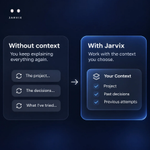
When your AI remembers the conversation but somehow forgets the context behind it.
You explain the project.
You explain the decisions.
You explain what you've already tried.
And somehow, you're back to explaining everything again.
Maybe the problem was never just AI memory.
It's understanding what all that context actually means.
That's why AI needs more than conversation history. It needs context.
Try Jarvix.live and experience the difference context makes.

We asked what would make people trust multiple AI agents working together.
43.8% chose approving the plan first.
That says something important.
People aren't necessarily uncomfortable with AI agents working together. They want to understand what the agents are going to do before giving them the green light.
Trust isn't just about how capable AI is.
It's also about transparency, control, and knowing you can step in when needed.
We think that's an important principle for the future of agent coordination:
AI can prepare the plan. You should decide when it moves forward.
You can spend weeks working, making decisions, exploring ideas, and solving problems without stopping to ask yourself one important question:
Are you actually moving in the right direction?
Being busy doesn't always mean you're making progress.
Sometimes, you need to understand your patterns before you can decide what to do next.
That's where two experiences become important:
1. Self Reflection: Understand how you think.
Look beyond completed tasks.
Notice the interests you keep returning to, how you approach problems, what influences your decisions, and how your thinking evolves over time.
Without recognizing these patterns, it's easy to repeat the same mistakes without understanding why.
2. Next Move: Understand what deserves your attention.
Knowing where you've been is useful. Knowing what might be worth doing next is just as important.
Next Move uses your context to suggest meaningful actions, explain why they matter, and help you decide whether they're worth pursuing.
Together, these two experiences connect two important questions:
Am I understanding my progress?
And what should I do with that understanding?
Most tools help you manage what you're doing. We think personal AI should also help you understand how you work and make better decisions about what comes next.
Understand your patterns. Make your next move count.
Try Jarvix and see what changes when AI understands more about how you think.
Jarvix.live

A reminder from Jarvix for everyone building something:
Progress doesn't always look like progress.
Some days, everything moves forward.
Some days, nothing seems to work.
Some days, you question whether you're even on the right path.
But one difficult phase doesn't define the entire journey.
Keep learning. Keep adjusting. Keep showing up.
The results often take longer than the effort.
Trust the process, but don't stop improving it.

One thing we think personal AI needs to understand better:
Not everything it learns about you stays relevant forever.
Think about it.
You might be working toward a particular goal today. That goal could change next month.
You might prefer a certain way of working on one project, but approach the next one completely differently.
Some things reveal who you are. Others simply describe what you're doing right now.
Treating both as permanent facts creates a problem.
AI might remember what you said six months ago and still misunderstand what you need today.
We think useful context has different layers:
1. Long-term context: Your recurring interests, working preferences, and patterns.
2. Active context: What you're currently building, learning, or trying to achieve.
3. Historical context: Previous decisions, experiments, mistakes, and lessons that explain how you got here.
The real challenge isn't collecting as much information as possible.
It's understanding what remains relevant, what has changed, and what should influence the next interaction.
Because understanding someone also means understanding how they evolve.
Personal AI shouldn't just learn who you were.
It should keep up with who you're becoming.

just a quick reminder:
motivation gets you started.
consistency keeps you building when the excitement wears off.
some days you'll have new ideas.
some days you'll question everything.
some days progress will feel invisible.
keep showing up anyway.
the things worth building take time.

Here's something worth thinking about:
Not every preference you express to AI is a permanent part of who you are.
You might prefer short answers when you're busy, detailed explanations when you're learning, and completely different approaches when solving a complex problem.
The mistake is treating every interaction as a fixed preference.
Good personalization needs to understand the difference between what you want right now and what consistently matters to you.
Because understanding someone isn't just about remembering what they said. It's about recognizing the context behind it.