

Professor and Chair, Dept Microbiology Cornell Ithaca. Interested in genome evolution and mobile DNA, especially Tn7 and CRISPR-Cas transposition systems
Ithaca, NY
Joined October 2017
- Tweets460
- Following344
- Followers889
- Likes987




Joseph E. Peters retweeted

Here is a link to a new preprint from the lab, a collaborative effort between our lab and Michelle Wang's lab here at Cornell.
biorxiv.org/cgi/content/shor…
Joseph E. Peters retweeted

A family of linear plasmid phages that detect a quorum-sensing autoinducer exists in multiple bacterial species biorxiv.org/content/10.1101/… #biorxiv_micrbio

Joseph E. Peters retweeted

Very cool story lead by @JoePetersLab reveals another level of how transposons battle with their hosts. Grateful to have had a chance to participate with Popo @PopoMicro, Joe and the team!
Joseph E. Peters retweeted

Transposons, or “jumping genes” – DNA segments that can move from one part of the genome to another – are key to bacterial evolution and the development of antibiotic resistance.
Cornell researchers have discovered a new mechanism these genes use to survive and propagate in bacteria with linear DNA, with applications in biotechnology and drug development.
“This is a big part of their biology,” said senior author Joseph Peters, professor of microbiology in @CornellCALS. “Bacteria are like these little tinkerers. They’re always collecting these mobile DNA pieces, and they’re making new functions all the time – everything in antibiotic resistance is really about mobile genetic elements and almost always transposons that can move between bacteria.”
With some technologies not available even five years ago, the researchers identified several families of transposons in cyanobacteria and Streptomyces that, using different mechanisms, can find and insert themselves at the telomere, with benefits for the transposon and their bacterial host.
For one, inserting at the end of the chromosome helps the transposon avoid genes for the cell’s core functioning, which reside in the middle of the chromosomes; transposons that can target the ends are less likely to disrupt an essential function or cause cell death.
More at news.cornell.edu/stories/202….

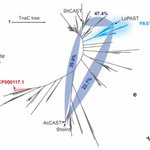
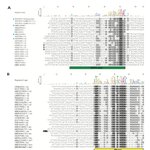
ALT An illustration using figures called “similarity trees,” used to infer the evolution of enzyme components essential to transposons, or “jumping genes,” functioning.
Joseph E. Peters retweeted

Researchers @CornellCALS and colleagues have discovered a new method that “jumping genes,” or transposons, use to survive and propagate in bacteria with linear DNA, with applications in biotechnology and drug development. @ScienceMagazine @JoePetersLab news.cornell.edu/stories/202…

Joseph E. Peters retweeted

🧬 Thrilled to share our latest research on Retrons—a new chapter in this fascinating field! 🌟In this @MolecularCell paper, we reveal how Retron-Eco1 defends against phages.
bit.ly/3WOlbsY
Check the 🧵below! (1/20)

Joseph E. Peters retweeted

#CRISPR revolutionized medicine, but where did its RNA-guided mechanisms come from?
Using #AI, we unearthed new Cas13s and found they evolved from toxin-antitoxins, revealing how nature created these amazing reprogrammable molecules.
Discover the recipe: doi.org/10.1016/j.cell.2025.…

Joseph E. Peters retweeted

9/ Shout-out to Koonin's lab for bioinformatically identifying several phage crlRNAs and predicting their inhibitory activity via matches to bacterial cas promoters! 🔎🧠
🔗:academic.oup.com/nar/article…

Joseph E. Peters retweeted

Our timely contribution to the growing body of YebC2/TACO1 literature 🤩! YebC2 is a third factor that prevents ribosome stalling at prolines. Associates with 70S and important for fitness in absence of EF-P and YfmR.
biorxiv.org/content/10.1101/…

Joseph E. Peters retweeted

Some bacteria have linear chromosomes and therefore telomeres. As in eukaryotes, a variety of transposons have evolved to occupy bacterial telomeres and establish addiction mechanisms! 🤯🤯🤯 Amazing story by @JoePetersLab at #cshlTE24 and fantastic work by @PopoMicro

Joseph E. Peters retweeted
Latest preprint from our lab led by grad student @cassidyprints and her undergrad mentee @IsabellaNLin. She examines conservation and features of the programmed ribosomal frameshift in prfB. Presented by Cassidy at #GRC stress!
biorxiv.org/content/10.1101/…
Joseph E. Peters retweeted

Our new paper out in @PLOSPathogens today: dx.plos.org/10.1371/journal.… We find that resistance/tolerance to antimicrobial peptides is slightly more complex and dynamic than your "average" antibiotic resistance. Nice work by @AndyMurtha et al.!
Joseph E. Peters retweeted

Happy to share that our last story on Tn7 is finally out. Another example of @shen_yao10 talent and a great collaboration with @JoePetersLab @MikePetassi
Assembly of the Tn7 targeting complex by a regulated stepwise process sciencedirect.com/science/ar…
Joseph E. Peters retweeted

Check out our latest work on #CRISPR-associated #transposons (CAST) published in @MolecularCell! 🤩
authors.elsevier.com/c/1jCED…
(1/21)

We want to thank the generous funding from @ERC_Research and @novonordiskfond
and that allowed us to complete this work
Have a look at the follow-up twetorial by @proteofrankie explaining the findings
#crispr #genomeediting #CryoEM #HorizonEU
Joseph E. Peters retweeted
Congrats to @CornellMicrobio grad students Hye-Rim Hong, Bixi He, @ManuelaAlv95, Anthony Bui, Jordan Rede, Katie Herr, and Viviana Sanchez!

Joseph E. Peters retweeted

Do you like small proteins? Perhaps you need a general overview of their function. If so, check out our review (@RileeZeinert @storzlab) - annualreviews.org/content/jo…

Joseph E. Peters retweeted
What an honor for @cassidyprints and @CornellMicrobio to host Dr. @Nancy_Craig777 for our distinguished Portraits of a Microbiologist series. Thanks for returning to Wing Hall for such a moving and inspiring visit!


Joseph E. Peters retweeted
@FeagaHeather taking a picture of Portrait of a scientist organizer @cassidyprints and recipient Nancy Craig today! @CornellMicrobio @JoePetersLab

Joseph E. Peters retweeted

Happy #DNADay! In 1952, the famous Hershey-Chase experiment determined that genes are made of #DNA, not protein. cshl.edu/blending-history-an…

Joseph E. Peters retweeted

A structure of gyrase with chirally wrapped DNA from myself & @HeddleLab. This requires some history dive to explain...(🧵)
biorxiv.org/content/10.1101/…