

Postdoc @CornellBirds using genomic tools to study adaptation and evolution in songbirds.
Joined September 2020
- Tweets143
- Following395
- Followers187
- Likes1.4K



Pinned Tweet
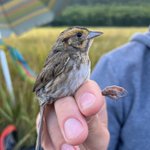
The results of my masters research at @ESPMasonU on population genetics of the Atlantic Song Sparrow are out in Evolution! #openaccess
Large beaked, heavily streaked, and gray, these coastal birds aren't your typical backyard Song Sparrow.
Link: tinyurl.com/f5we3n82


Jon Clark 🧬🐥🏳️🌈 retweeted

Why is it ‘cancelled’ in the U.K. but ‘canceled’ in the U.S.?
Because we gave them that L in 1776.
Jon Clark 🧬🐥🏳️🌈 retweeted

Winsome Earl-Sears every time it’s Abigail Spanberger’s time to answer a question #VAGovDebate #VApolitics
Jon Clark 🧬🐥🏳️🌈 retweeted

Does adaptive evolution repeat itself? Our new paper (many years in the making) now out in @ScienceAdvances shows evidence that yes! (1/13)
science.org/doi/10.1126/scia…

Jon Clark 🧬🐥🏳️🌈 retweeted

The biggest hummingbird in the world is a new species.
Now out in @PNASNews and 8 years in the making, here's how we figured it out with mini tracking devices, genomics, and a century and a half of museum specimens.👇
pnas.org/doi/10.1073/pnas.23…
🧵1/


Jon Clark 🧬🐥🏳️🌈 retweeted

Peek an early look at our @journal_evo paper on temperature-dependent gene regulatory evolution in Atlantic silversides 🐟 lead by @fishyomics with @ntherk, as well as @t_annina and others! academic.oup.com/evolut/arti…

Jon Clark 🧬🐥🏳️🌈 retweeted

No matter where you live, you likely enjoy the companionship of one of the world’s most ubiquitous birds: the sparrow. For World Sparrow Day, we’d like to highlight a Sparrow you’re likely less familiar with. Meet the Sierra Madre Sparrow! 🇲🇽 🐦
bit.ly/3TIGcmP
Omg, first time I’ve had a paper posted on @Jente_O page. 🤪

Ecological characteristics explain neutral genetic variation of three coastal sparrow species | Molecular Ecology
onlinelibrary.wiley.com/doi/…
#ornithology

Jon Clark 🧬🐥🏳️🌈 retweeted

1/13 🚨🚨 I am so excited to present our new paper, six years in the making. Here, we provide the first strong evidence that there is a molecular mechanism behind the origins of living fossil lineages! #biology #science #paleontology academic.oup.com/evolut/adva…


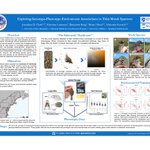
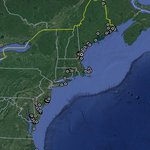
Just out in @molecology! We used RADseq to characterize the population structures of 3 at-risk coastal sparrows.
Species' distributions and other habitat factors drive population structures, not degree of ecological specialization.
Read it: onlinelibrary-wiley-com.unh.…

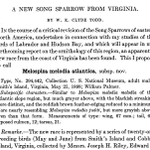
Happy centennial to—the official description of—one of my favorite birds, the Atlantic Song Sparrow!
In 1924, ornithologist W.E.C. Todd published this coastal sbsp. description based on specimens collected from Cobb & Smith (VA), Pea (NC), and Long (NY) islands.


Jon Clark 🧬🐥🏳️🌈 retweeted

Periodic reminder that there aren't 'local' Short-eared Owls!

This quoted post is unavailable.
When @RonDeSantis does that thing with his tongue, this is all I see. 👅🦎
#GOPDebate
Jon Clark 🧬🐥🏳️🌈 retweeted

End of an era: Packed up my life in Washington DC and now back in Singapore.
It was a wonderful time, and I'm glad for the experiences, everyone I've met in the course of my time there, and again before leaving.
Now to adjust to the heat, humidity, and ice cream prices.


Jon Clark 🧬🐥🏳️🌈 retweeted

Every year, too many Americans are injured or killed in crashes involving cars and wildlife, especially in rural areas—we're tackling this challenge with first-of-its-kind funding. The projects we’re funding today will reduce collisions between drivers & wildlife.

Every year, vehicle collisions with large animals kill 200 people and injure almost 26,000.
Today, we're announcing major funding to improve wildlife crossings across the country—strengthening roadway safety and saving lives.

ALT Land bridge over two tunnels on divided highway with cars driving through and lots of green trees and tall streetlights in Tulsa Oklahoma USA.

ALT An aerial view of a wildlife Bridge in Nevada.

ALT An aerial view of a bridge which also contains landscaping to encourage a wildlife corridor. This bridge was intentionally made large than necessary for the road in order to have plantings. This bridge is located on Mercer Island in Washington State.

ALT Wildlife Overpass I-90 Freeway Snoqualmie Pass Washington State Drone Aerial View
Jon Clark 🧬🐥🏳️🌈 retweeted

New Open Access Paper! (link.springer.com/article/10…) We examined the evolutionary and demographic history of @TheSaltyMouse using whole mitochondrial genomes. We correlated divergence events with changes in predicted marsh distribution over the past 10,000 years. 1/

