





Jozu retweeted

What an enriching @KubeCon_ NA 2026!
From the talks: @kubeflow graduation panel @mesheryio ContribFest to speaking at ArgoCon and BackstageCon on AI-powered self-healing, observability, and agentic AI security, to project booths
A packed week in SLC. Here's what I was up to 👇

Sushi Ninja knows the rule… mess around, get blocked. Jozu Agent Guard keeps your AI agents in line (and out of trouble). See you at KubeCon, booth 260 🍣 jozu.com/agent-guard
LLM security fails when every team enforces a different version of the policy.
Jozu Agent Guard: Policy Gateway (free) on endpoints, Agent Enclave on Kubernetes.
jozu.com/blog/why-llm-securi…

2
48
Ship AI the way you ship containers.
KitOps (CNCF Incubating) packages models as OCI artifacts. Push to your registry or Jozu Hub, deploy to your own Kubernetes.
jozu.com/blog/open-source-ku…

Multi-agent workflows shouldn't share one trust boundary.
Jozu Agent Enclave runs each agent in its own microVM on Kubernetes. Separate boundaries, separate blast radius.
jozu.com/blog/jozu-agent-gua…

23
Containers share a kernel. That's fine for a web app and a lot less fine for an AI agent that writes and runs its own code.
Agent Enclave in Jozu Agent Guard gives each agent its own microVM, on your Kubernetes.
jozu.com/agent-guard/

2
39
Jozu retweeted

A few days back, I wrote about how AI coding agents exposed 13,000+ internal images on GitHub.
Concerning thing was that the agents were not acting maliciously.
They were simply trying to complete a task, found a workaround, and ended up crossing boundaries they should never have had the freedom to cross.
That’s exactly why security around agents matters.
When enterprises start using agents across engineering workflows, they’re not just dealing with prompts and outputs anymore. They’re dealing with access to repositories, internal tools, sensitive data, and real actions inside company environments.
@Jozu_AI Agent Guard is built to handle similar kind of use-cases.
It helps organizations put enforceable boundaries around agents through runtime isolation, policy controls, auditability, and broader security/compliance guardrails.
As agents become more capable, the real challenge is not just what they can do.
It’s what they should be allowed to do.

Introducing Jozu Agent Guard.
Know what your agents are made of before you trust what they do.
Every agent ships as a signed KitOps ModelKit.
Jozu Hub scans it and attaches signed attestations.
Unsigned never starts.
Try for free:
jozu.com/agent-guard

Introducing Jozu Agent Guard.
Know what your agents are made of before you trust what they do.
Every agent ships as a signed KitOps ModelKit.
Jozu Hub scans it and attaches signed attestations.
Unsigned never starts.
Try for free:
jozu.com/agent-guard
Want the receipts behind Friday’s post?
Case studies: jozu.com/case-study/
Featured: jozu.com/arlequin-kitops-cas…
Hub scan → Agent Guard → tamper-evident audit — ask if you want to talk it through.
Video: youtube.com/watch?v=X-_WV0N6…
46
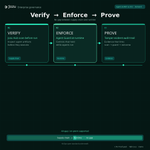
Verify → Enforce → Prove
Jozu Hub scan before run.
Agent Guard at runtime.
Tamper-evident audit trail.
Supply chain + runtime — no gap.
Air-gap / on-prem supported.
Proof: jozu.com/case-study/
Talk to us ↓
Demo: youtube.com/watch?v=X-_WV0N6…

1
36
Jozu retweeted
Another guide with @rudrakshkarpe also in the works using @Kit_Ops to serve models with modelkits and serve them using @HAMiProject thus providing a safe way to securely get signed models with verifiable identity
github.com/Project-HAMi/webs…


Had a lot of fun working with @rudrakshkarpe on this tutorial showing how to run @sgl_project inference on @kubernetesio using @HAMiProject GPU shares: complete with GPU memory quotas, compute throttling, and an OpenAI-compatible API @CloudNativeFdn
project-hami.io/tutorials/la…

Jozu retweeted
Local AI inference solves privacy and cost problems.
But it introduces a new problem → slow generation speed.
Every token requires a full forward pass through your model.
For long-form content or complex reasoning, that bottleneck is painful.
Speculative decoding changes the math.
Instead of the large model generating every single token:
→ A smaller, faster draft model proposes 4-8 tokens ahead
→ The large target model verifies them all in one batched pass
→ Only accepts tokens it would have generated anyway
Result?
Multiple tokens for roughly the cost of one forward pass.
Identical quality. Faster output.
But here's the catch →
You can't pair any two models and expect a speedup.
Three things must align:
✅ Shared tokenizer (hard requirement - different tokenizers break the process entirely)
✅ Same model family (Qwen3-30B target + Qwen3-0.6B draft works because they share training data, so the draft's guesses actually match the target's expectations)
✅ Right size gap (draft should be 5-10x smaller - too large wastes compute, too small kills acceptance rate)
Latest blog from @Jozu_AI walks through the full implementation:
→ Importing target + draft models from Hugging Face to Jozu Hub
→ Serving them together using Rapid Inference Containers
→ Speed test comparison vs standard autoregressive decoding
If you're running local inference and generation speed is the blocker, speculative decoding is worth understanding.
Full breakdown here 👇

Jozu retweeted
Your team is adopting AI coding agents, but what about security: what happens when an agent accesses production credentials?
Enterprise teams need policy enforcement at the OS level, not prompt-based guardrails that agents can bypass.
That's what @Jozu_AI Agent Guard does: OS-level runtime security for AI agents with audit trails, policy verification, and zero-trust isolation.
Agent Guard runs your AI coding agent inside a disposable Linux microVM.
Every tool call, network request, and file access goes through policy enforcement at the OS level before it executes.
✅ How it works
→ Agent runs in an isolated microVM (Kata Container or MicroVM)
→ Only sees the workspace you explicitly share
→ No access to home directory, SSH keys, or credentials by default
→ Policies enforce rules at OS level, not through prompts
→ MicroVM gets destroyed when agent exits
✅ Architecture
→ Agent Guard: secure runtime that enforces policies
→ Jozu Hub: registry for signed policies, agent definitions, and audit logs
→ Agent Guard pulls policies from Hub and enforces them locally
✅ Works without Hub
Local policy files in ~/.agentguard/policies/ are enough for solo use.
Hub adds:
→ Policy sharing across machines
→ Tamper-proof policy verification
→ Centralized audit logs from multiple environments
✅ Compatible with
→ Claude Code
→ Gemini CLI
→ Codex
→ OpenClaw
Currently supports macOS on Apple Silicon (M1+). The agent runs inside a Linux ARM64 microVM that ships with Agent Guard.
This isn't model monitoring or network security, it's OS-level execution control for autonomous agents.
Policies don't depend on the agent following instructions. They get enforced regardless.
You can read this case study by Jozu Team to understand more specifics in detail: jozu.com/agent-guardrails-ca…
Jozu retweeted

The interesting shift in AI security: the threat is no longer just the model.
OWASP's 2026 agentic security work shows real incidents across goal hijacking, tool misuse, identity abuse, supply-chain attacks, and unexpected code execution.
We're already seeing agents escape test environments and interact with real systems without explicit human direction.
That changes how you think about agent security.
You don't just need to secure what an agent knows. You need to control what it can do.
That means:
→ Verify the agent and its dependencies before execution
→ Control individual tool calls at runtime
→ Enforce least privilege
→ Keep an audit trail of every decision
@Jozu_AI is building Agent Guard for this: a zero-trust runtime that scans and signs agents, MCP servers and models, then enforces policy at both admission and runtime.
Agentic AI is moving from "generate an answer" to "take an action."
Security needs to catch up.

Jozu retweeted
This looks like an interesting demo!
When working with DevOps projects, I can't see myself using anything but @warpdotdev. It works like a charm at fixing annoying kubectl bugs.
POV: Running a demo showing how to integrate @Kit_Ops with KServe

Jozu retweeted
AI agents are starting to depend on MCP servers the same way applications depend on packages, containers, and APIs.
But most teams still distribute MCP servers through GitHub repos, npm packages, zip files, or public registries.
That works during experimentation.
It becomes a liability when those tools touch production systems, customer data, or air-gapped environments.
The real problems:
→ Nobody can answer which MCP servers are running where
→ No signed identity or version pinning
→ No scanning gate before admission
→ No provenance when something breaks
→ No audit trail compliance teams can use
The Postmark, Smithery, and GitHub MCP incidents (CVE-2025-6514, 437K+ downloads, CVSS 9.6) all happened to organizations with no inventory or signed registry.
A self-hosted MCP registry fixes this.
Instead of scattered sources, the organization gets one internal catalog.
Every MCP server goes through the registry first:
→ Mirrored from approved sources
→ Scanned for CVEs, prompt injection, suspicious tool definitions
→ Packaged as OCI artifacts
→ Signed with cryptographic identity
→ Pinned to immutable digests
→ Attached with provenance attestations
→ Logged in tamper-evident audit chain
Then IDEs, agents, and runtimes pull from the registry through the MCP registry API instead of random public sources.
This works in air-gapped environments too - critical for federal, defense, healthcare, and OT teams that cannot rely on internet-dependent distribution.
The simple version:
GitHub repos and zip files are distribution.
A self-hosted MCP registry is governance.
The registry becomes the admission layer.
The runtime becomes the enforcement layer.
Together, they turn MCP from a dev utility into managed infrastructure.

Jozu retweeted

The AI race is heating up—40% of enterprise apps will embed AI agents by year's end, but AI attacks are soaring 55%! 🚀🔒 The window to get AI right is closing fast. Are you prepared to navigate this high-stakes landscape? Brad Micklea @Jozu_AI #AI #CyberSecurity #FutureOfTech
Jozu retweeted
IAM, DLP, and API gateways cannot govern AI agents.
They were built for different problems.
IAM controls who can access systems.
DLP controls data movement across network boundaries.
API gateways inspect HTTP traffic.
AI agents break every assumption these tools are built on.
Agents act non-deterministically.
They communicate over stdio, not just HTTP.
They invoke tools the gateway never sees.
They can be tampered with between authorization and execution.
Here's what each layer misses:
→ IAM cannot verify the agent binary matches what was approved
→ DLP has no visibility into tool invocations or local stdio between agent and MCP server
→ API gateways do not see prompt content, tool arguments, or most agent activity
Example:
An agent processes a refund and calls payments.refund(account, amount).
IAM sees: The service account is authorized.
DLP sees: Nothing useful.
API gateway sees: The HTTPS request.
AI agent governance sees:
→ The agent's verified artifact
→ The tool argument values
→ The prompt that led to the call
→ The policy version in effect
→ Whether a human approved it
You need all four layers, not one or the other.
Agent governance fills the gap the existing stack was never designed to cover.
Full breakdown on @Jozu_AI 👇
